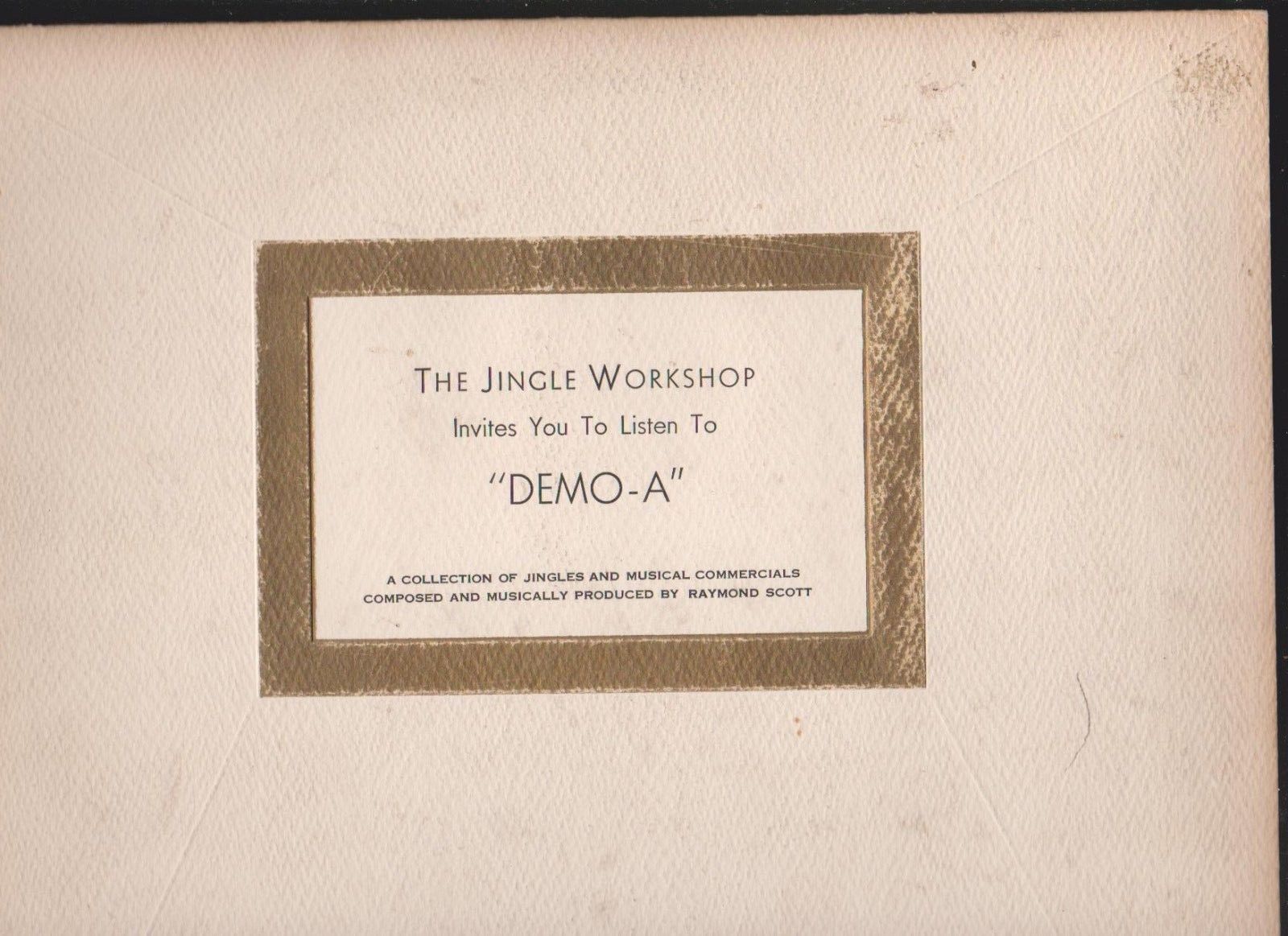
RARE Raymond Scott Jingle Workshop DEMO-A Commercials Chevrolet/Phillips 66 etc
$
360


Favourite Auctions
To save auctions to your favourites, please login
If you don't have an account, please register
Description
ULTRA-RARE RAYMOND SCOTT JINGLE WORKSHOP LP VINYL RECORD ALBUM WINNER PAYS ONLY $4.50 SHIPPING AND HANDLING ~ INSURANCE OPTIONAL AT WINNERS REQUEST ~ (FOREIGN PAYS EXACT FIRST CLASS INTERNATIONAL AIRMAIL POSTAGE PLUS HANDLING)
THE JINGLE WORKSHOP INVITES YOU TO LISTEN TO "DEMO-A" A COLLECTION OF JINGLES AND MUSICAL COMMERCIALS COMPOSED AND MUSICALLY PRODUCED BY RAYMOND SCOTT" *Embossed Textured Front Cover, Solid, Wear Front Cover/Back Cover is a Beauty (What a set-up!) Vinyl is NM/Beautiful - Labels We're Typed On Marc Brown Labels Murray Hill 8-2847-8 LABELS: MARC BROWN ASSOCIATES, INC / Dated 10/29/62 SIDE 1: Cut 1. Lincoln-Mercury Cut 2. Chevrolet Cut 3. Phillips 66 Cut 4. Chevrolet Side 2: Cut 1. Chevrolet Cut 2. Tareyton (Arrangement) Cut 3. Coca-Cola (Arrangement) Cut 4. Chevrolet - Radio Cut 5. Delco
more... Raymond Scott (born Harry Warnow, September 10, 1908 – February 8, 1994) was an American composer, band leader, pianist, engineer, recording studio maverick, and electronic instrument inventor.
Scott never scored cartoon soundtracks, but his music is familiar to millions because Carl Stalling adapted it in over 120 classic Bugs Bunny, Porky Pig, Daffy Duck, and other Warner Bros. Looney Tunes and Merrie Melodies animated shorts.
Scott's melodies may also be heard in contemporary shows like The Ren and Stimpy Show (which use the original Scott recordings in twelve episodes), The Simpsons, Duckman, Animaniacs, The Oblongs, and Batfink.
The only music Scott actually composed to accompany animation were three 20-second electronic commercial jingles for County Fair Bread in 1962.
Electronics and research Scott, who attended Brooklyn Technical High School, was an early electronic music pioneer and adventurous sound engineer. During the 1930s and 1940s, many of his band's recording sessions found the bandleader in the control room, monitoring and adjusting the acoustics, often by revolutionary means. As Gert-Jan Blom & Jeff Winner wrote, "Scott sought to master all aspects of sound capture and manipulation. His special interest in the technical aspects of recording, combined with the state-of-the-art facilities at his disposal, provided him with enormous hands-on experience as an engineer."
In 1946, Scott established Manhattan Research, a division of Raymond Scott Enterprises, Incorporated, which he announced would "design and manufacture electronic music devices and systems." As well as designing audio devices for his own personal use, Manhattan Research Inc. provided customers with sales & service for a variety of devices "for the creation of electronic music and musique concrete" including components such as ring modulators, wave, tone and envelope shapers, modulators and filters. Of unique interest were instruments like the "Keyboard theremin," "Chromatic electronic drum generators," and "Circle generators." Scott often described Manhattan Research Inc. as "More than a think factory - a dream center where the excitement of tomorrow is made available today." Bob Moog, developer of the Moog Synthesizer, met Scott in the 1950s, designed circuits for him in the 1960s, and acknowledged him as an important influence.
Relying on several instruments of his own invention, such as the Clavivox and Electronium, Scott recorded futuristic electronic compositions for use in television and radio commercials as well as records of entirely electronic music. A series of three albums designed to lull infants to sleep, Scott's groundbreaking work Soothing Sounds for Baby was released in 1964 in collaboration with the Gesell Institute of Child Development. The music did not find much favor with the record-buying public of the day. Still, Manhattan Research, Inc. had considerable success in providing striking, ear-catching sonic textures for broadcast commercials.
Scott developed some of the first devices capable of producing a series of electronic tones automatically in sequence. He later credited himself as being the inventor of the polyphonic sequencer. (It should be noted that his electromechanical devices, some with motors moving photocells past lights, bore little resemblance to the all-electronic sequencers of the late sixties.) He began working on a machine he said composed using artificial intelligence. The Electronium, as Scott called it, with its vast array of knobs, buttons and patch panels is considered the first self-composing synthesizer. Some of Raymond Scott's projects were less complex, but still ambitious. During the 1950s and 1960s, he developed and patented a large number of consumer products that brought electronically produced sounds into the homes and lives of Americans. Among these were electronic telephone ringers, alarms, chimes, and sirens, vending machines and ashtrays with accompanying electronic music scores, an electronic musical baby rattle and an adult toy that produced varying sounds dependent on how two people touched one another. It was Scott's belief that these devices would "electronically update the many sounds around us - the functional sounds."
Scott and Dorothy Collins divorced in 1964, and in 1967, he married Mitzi Curtis (1918–2012). During the second half of the 1960s, as his work progressed, Scott became increasingly isolated and secretive about his inventions and concepts; he gave few interviews, made no public presentations, and released no records. In 1966-67, Scott (under the screen credit "Ramond Scott") composed and recorded electronic music soundtracks for some early experimental films by Muppets impresario Jim Henson.
During his jazz/big band period, Scott had often endured tense relationships with musicians he employed (quote: "No one worked with Scott; everyone worked under Scott"). However, when his career became immersed in electronic gadgetry, he made friends with and seemed to prefer the company of technicians, including Bob Moog, Herb Deutsch, Thomas Rhea, and Alan Entenmann. From time to time Scott welcomed curious visitors to his lab, among them the renowned French electronic music pioneer Jean-Jacques Perrey, in March 1960.
In 1969, Motown Records impresario Berry Gordy, tipped off about a mad musical scientist engaged in mysterious works, visited Scott at his Long Island labs to witness the Electronium in action. Impressed by the infinite possibilities, Gordy hired Scott in 1971 to serve as director of Motown's electronic music and research department in Los Angeles, a position Scott held until 1977. No Motown recordings using Scott's electronic inventions have yet been publicly identified.
Guy Costa, Head of Operations and Chief Engineer at Motown from 1969 to 1987, said about Scott's hiring:
"He started originally working [on the Electronium] out of Berry’s house. They set up a room over the garages, and he worked there putting stuff together so Berry could get involved and see the progress. At one point Scott worked out of a studio. The unit never really got finalized—Ray had a real problem letting go. It was always being developed. That was a problem for Berry. He wanted instant gratification. Eventually his interest started to wane after a period of probably two or three years. Finally Ray took the thing down to his house and kept working on it. Berry kind of lost interest. He was off doing Diana Ross movies." Scott later said he "spent 11 years and close to a million dollars developing the Electronium." Scott was, thereafter, largely unemployed, though hardly inactive. He continued to modify his inventions, eventually adapting computers and primitive MIDI devices to his systems. He suffered a series of heart attacks, ran low on cash, and eventually became a mere "Where Are They Now?" subject.
Largely forgotten by the public by the 1980s, Scott suffered a major stroke in 1987 that left him unable to work or engage in conversation.[14] His recordings were largely out of print, his electronic instruments were cobweb-collecting relics, and his once-abundant royalty stream had slowed to a trickle.
Secret Seven In 1959, Scott organized a band of top-tier jazz session musicians and recorded an album entitled The Unexpected, credited to The Secret Seven, and released on the Top Rank label.[15] The secrecy extended to withholding the identity of the musicians in the album's liner notes. The players were later identified[citation needed] as Elvin Jones, Milt Hinton, Kenny Burrell, Eddie Costa, Sam "The Man" Taylor, Harry "Sweets" Edison, Wild Bill Davis and Toots Thielemans.
The cartoon connection In 1943 Scott sold his music publishing to Warner Bros., who allowed Carl Stalling, music director for Looney Tunes and Merrie Melodies, to adapt anything in the Warner music catalog.
Stalling immediately began peppering his cartoon scores with Scott quotes, such as in The Great Piggy Bank Robbery. Besides being used in Looney Tunes and Merrie Melodies, Scott's tunes have been licensed to propel the hijinks of The Simpsons, The Ren and Stimpy Show, Animaniacs, The Oblongs, Batfink, and Duckman cartoons. "Powerhouse" was quoted ten times in the Warner Brothers feature Looney Tunes: Back in Action (2003).
Obscurity and rediscovery His legacy underwent a revival in the early 1990s after Irwin Chusid met Raymond and his wife Mitzi at their home in California and discovered a vast collection of unreleased recordings of rehearsals and studio sessions. In 1992, the release of Reckless Nights and Turkish Twilights on Columbia produced by Irwin Chusid (with Hal Willner as executive producer) was the first major-label CD compilation of his groundbreaking 1937–39 six-man quintet. A year earlier, Irwin Chusid and Will Friedwald produced a CD of live Scott quintet broadcasts titled The Man Who Made Cartoons Swing for the Stash label. Around this time, the director of The Ren & Stimpy Show, John Kricfalusi, began hot-wiring his cartoon episodes with original Scott quintet recordings. In the late-1990s, The Beau Hunks (a Dutch ensemble originally formed to perform music created by Leroy Shield for the Laurel and Hardy movies) released two albums of Scott's sextet (a.k.a. "Quintette") repertoire, Celebration on the Planet Mars and Manhattan Minuet (both released on Basta Audio-Visuals). Various members of the Beau Hunks (reconfigured as a "Saxtet", then a "Soctette") also performed and recorded various Scott works, sometimes in collaboration with the Metropole Orchestra.
"Powerhouse" has been used as a promotional bumper for the Cartoon Network, as well has having been interpreted by the rock band Rush in their 1978 song "La Villa Strangiato" on their Hemispheres album. The same tune was reinterpreted as the song "Bus to Beelzebub" by the New York band Soul Coughing, who have used Scott samples in other compositions, such as Scott's "The Penguin" in their song "Disseminated." They Might Be Giants have also incorporated "Powerhouse" into their music, briefly including it in their song "Rhythm Section Want Ad" from their self-titled 1986 debut album. In 1993, Warner Bros. music director Richard Stone scored an entire installment of Steven Spielberg Presents Animaniacs around "Powerhouse" (the episode, entitled "Toy Shop Terror," notably had no dialogue except in the closing seconds, thus allowing Stone's Stalling-meets-Spike Jones arrangement to dominate the soundtrack). In late 2006, "Powerhouse" began airing regularly as the soundtrack for a Visa check card TV commercial. It has also often been used as a bumper on "Wait Wait... Don't Tell Me!," NPR's weekly quiz show. It also appeared in The Simpsons, played over the ludicrous and allegedly true method by which bowling alleys assemble new pins.
Clarinetist Don Byron has recorded and performed Scott's music, as have the Kronos Quartet, Steroid Maximus (J. G. Thirlwell), Jon Rauhouse, The Tiptons (with Amy Denio), Jeremy Cohen's Quartet San Francisco, Skip Heller, Phillip Johnston, and others. Robert Wendel arranged six Scott works and one medley for full symphony orchestra in the mid-1990s. The New York–based septet The Raymond Scott Orchestrette recorded an album (produced by Chusid) of radically modernistic interpretations of Scott compositions (Evolver Records, 2002) and stages sporadic performances. Classical pianist Jenny Lin covered Scott's "The Sleepwalker" on her album InsomniMania (Koch Classics, 2008), and has performed Scott's "Powerhouse" in concert.
The posthumously released 2-CD set, Manhattan Research Inc. (Basta, 2000, co-produced by Gert-Jan Blom and Jeff Winner) showcases Scott's pioneering electronic works from the 1950s and 1960s on two CDs (the package includes a 144-page hardcover book). Microphone Music (Basta, 2002, produced by Irwin Chusid with Blom and Winner as project advisors), explores the original Scott Quintette's work. The 2008 CD release Ectoplasm (Basta) chronicles a second (1948–49) incarnation of the six-man "quintet" format, with Scott's future wife Dorothy Collins singing on several tracks. On June 30 of 2017, Basta issued a 3-LP/2-CD set entitled Three Willow Park: Electronic Music from Inner Space, featuring 61 unreleased electronic recordings made by Scott between 1961 and 1971 (Basta, 2017, produced by Gert-Jan Blom, Irwin Chusid, and Jeff Winner).
In 2008, members of the West Point Concert Band and the band’s Field Music Group, The Hellcats, formed the Quintette 7 to perform Raymond Scott sextet repertoire. In 2010 they recorded the album Quintette 7 Plays the Music of Raymond Scott, which featured 21 Scott titles.
Devo founding member Mark Mothersbaugh, through his company Mutato Muzika, purchased Scott's only (non-functioning) Electronium in 1996, with the intention of restoring it to working order. In November 2012, the restoration team was able to get the Electronium running and producing basic sounds.
Quotations "Perhaps within the next hundred years, science will perfect a process of thought transference from composer to listener. The composer will sit alone on the concert stage and merely 'think' his idealized conception of his music. Instead of recordings of actual music sound, recordings will carry the brainwaves of the composer directly to the mind of the listener." —Raymond Scott, 1949 "The composer must bear in mind that the radio listener does not hear music directly. He hears it only after the sound has passed through a microphone, amplifiers, transmission lines, radio transmitter, receiving set, and, finally, the loud speaker apparatus itself." —Raymond Scott, 1938 "Being introduced to the music of Raymond Scott was like being given the name of a composer I feel I have heard my whole life, who until now was nameless. Clearly he is a major American composer."—David Harrington, Kronos Quartet "It's those front-line types that go into uncharted areas, and pave the way for others. Life is short. Always go to the source, sources like Raymond Scott."—Henry Rollins "I had a big thing for Raymond Scott loops -- 'Bus to Beelzebub' is also Raymond Scott -- hell, if Soul Coughing ended tomorrow I'd probably eke out a living producing hiphop records, using nothing but breakbeats, Raymond Scott, and Carl Stalling's Warner Bros. orchestra playing Raymond Scott compositions."—Mike Doughty of Soul Coughing "Quirky, memorable [Scott] themes like 'Powerhouse' in Warner Bros. cartoons arguably helped shape the postwar musical aesthetic as much as anything Elvis or the Beatles did."—John Corbett, Chicago Reader “Raymond Scott was definitely in the forefront of developing electronic music technology, and in the forefront of using it commercially as a musician.”—Bob Moog
Raymond Scott Real Name: Harry Warnow Profile: Born: 09/10/1908 in Brooklyn, NY Died: 02/08/1994 in North Hills, CA
Composer, bandleader and inventor Raymond Scott was among the unheralded pioneers of contemporary experimental music.
Of all of Scott's accomplishments of 1949, however, none was more important than the Electronium, one of the first synthesizers ever created. An "instantaneous composing machine," the Electronium generated original music via random sequences of tones, rhythms, and timbres; Scott himself denied it was a prototype synthesizer — it had no keyboard — but as one of the first machines to create music by means of artificial intelligence, its importance in pointing the way towards the electonic compositions of the future is undeniable. His other inventions included the "Karloff," an early sampler capable of recreating sounds ranging from sizzling steaks to jungle drums; the Clavinox, a keyboard Theremin complete with an electronic sub-assembly designed by a then 23-year-old Robert Moog; and the Videola, which fused together a keyboard and a TV screen to aid in composing music for films and other moving images.
By the middle of the 1960s, Scott began turning increasingly away from recording and performing to focus on writing and inventing; a 1969 musical celebrating the centennial of Kentucky Bourbon was his last orchestral work, with his remaining years spent solely on electronic composition. Among his latter-day innovations was an early programmable polyphonic sequencer, which along with the Electronium later caught the attention of Motown chief Berry Gordy Jr., who in 1971 tapped Scott to head the label's electronic music research and development team. After retiring six years later, he continued writing — his last known piece, 1986's "Beautiful Little Butterfly," was created on MIDI technology.