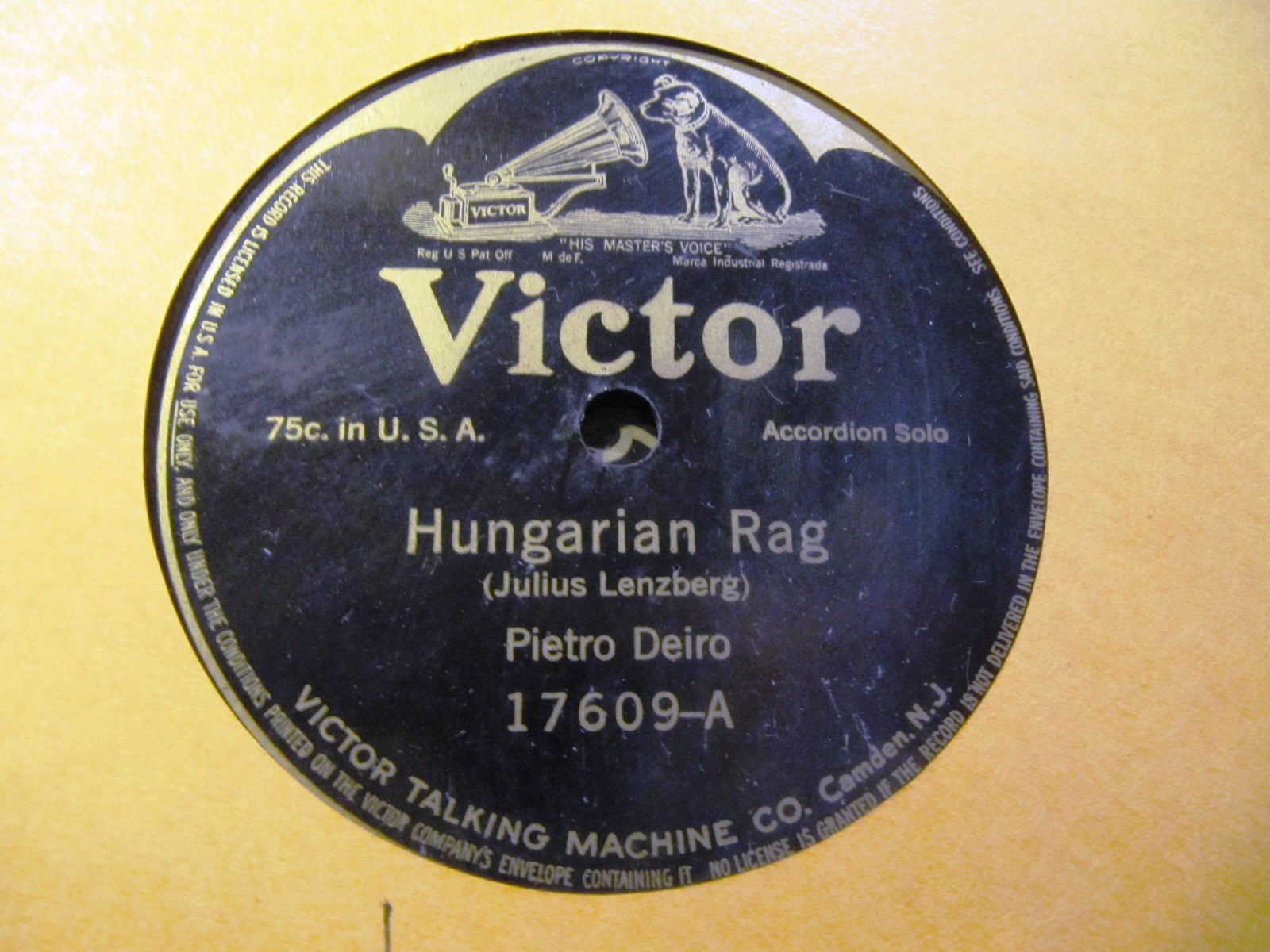
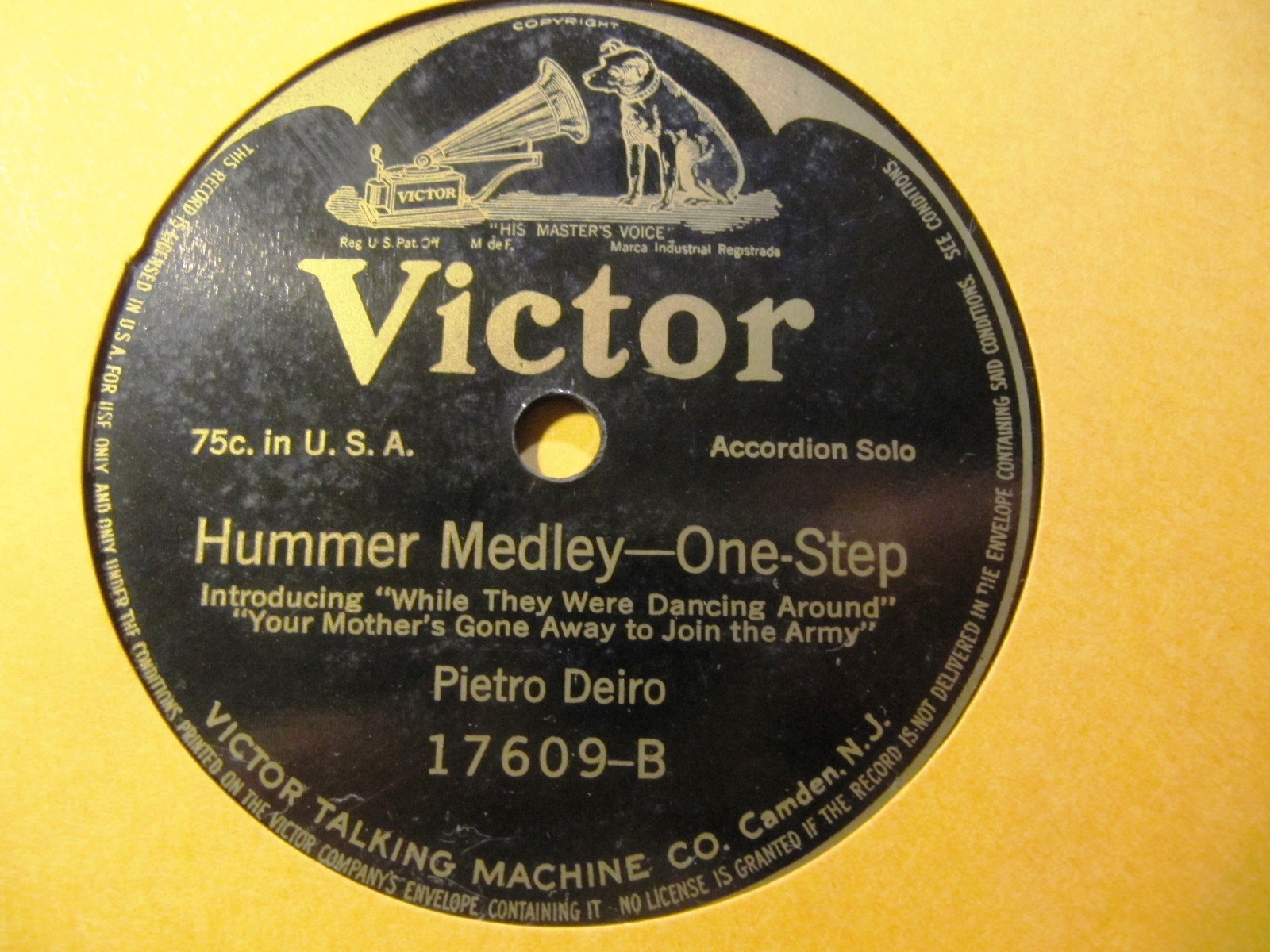
RAGTIME 1914 HUNGARIAN RAG Hummer-Medley One Step Italian ACCORDION PIETRO DEIRO
$
35

Favourite Auctions
To save auctions to your favourites, please login
If you don't have an account, please register
Description
A series of great JAZZ, Ragtime and Swing Records from early Ragtime to Beb-Bop on 78 rpm Victrola Records
Click this link for more great Jazz and Vocal Records in my other listings!
Click this link for more Italian Records in my other listings!
The Italian born Deiro Brothers are considered the Fathers of American Accordion playing. These records always have stunning acoustics and great musicality, on early acoustic
Here in a hot Uptempo Ragtime on the Accordion
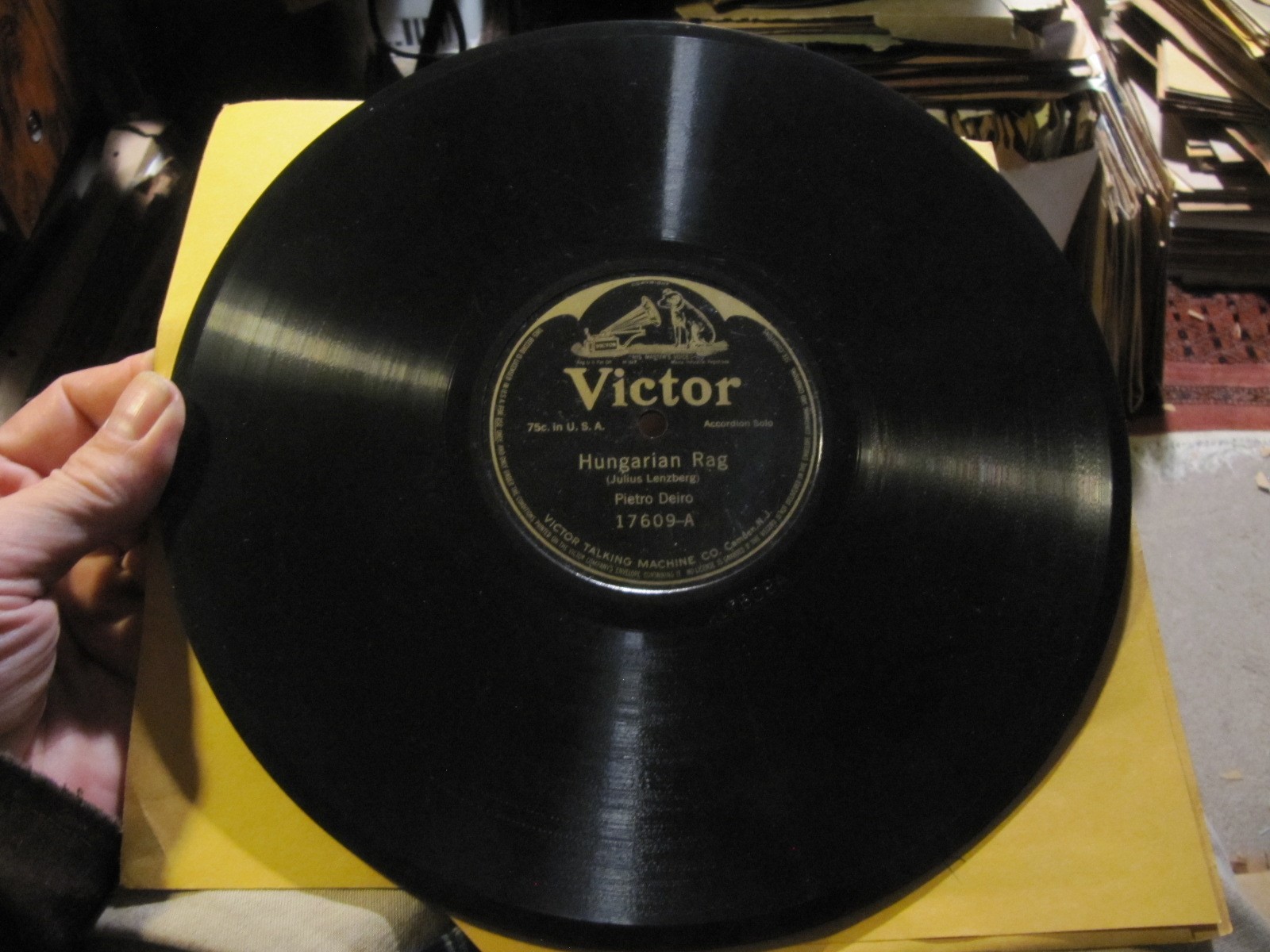
Pietro Deiro – Hungarian Rag / Hummer Medley
Label: Victor – 17609
Format:
Shellac, 10", 78 RPM
Country: US
Released: Oct 1914
Genre: Jazz, Folk, World, & Country
Style: Polka, Ragtime
A Hungarian Rag
Written-By – Julius Lenzberg
3/27/1914
B Hummer medley
While they were dancing around ; Your mother's gone away to join the army (Medley contents)
Pietro Deiro (arranger)
Pietro Deiro (instrumentalist : accordion)
4/11/1914 Camden, New Jersey
Accordion solo
B: One-step
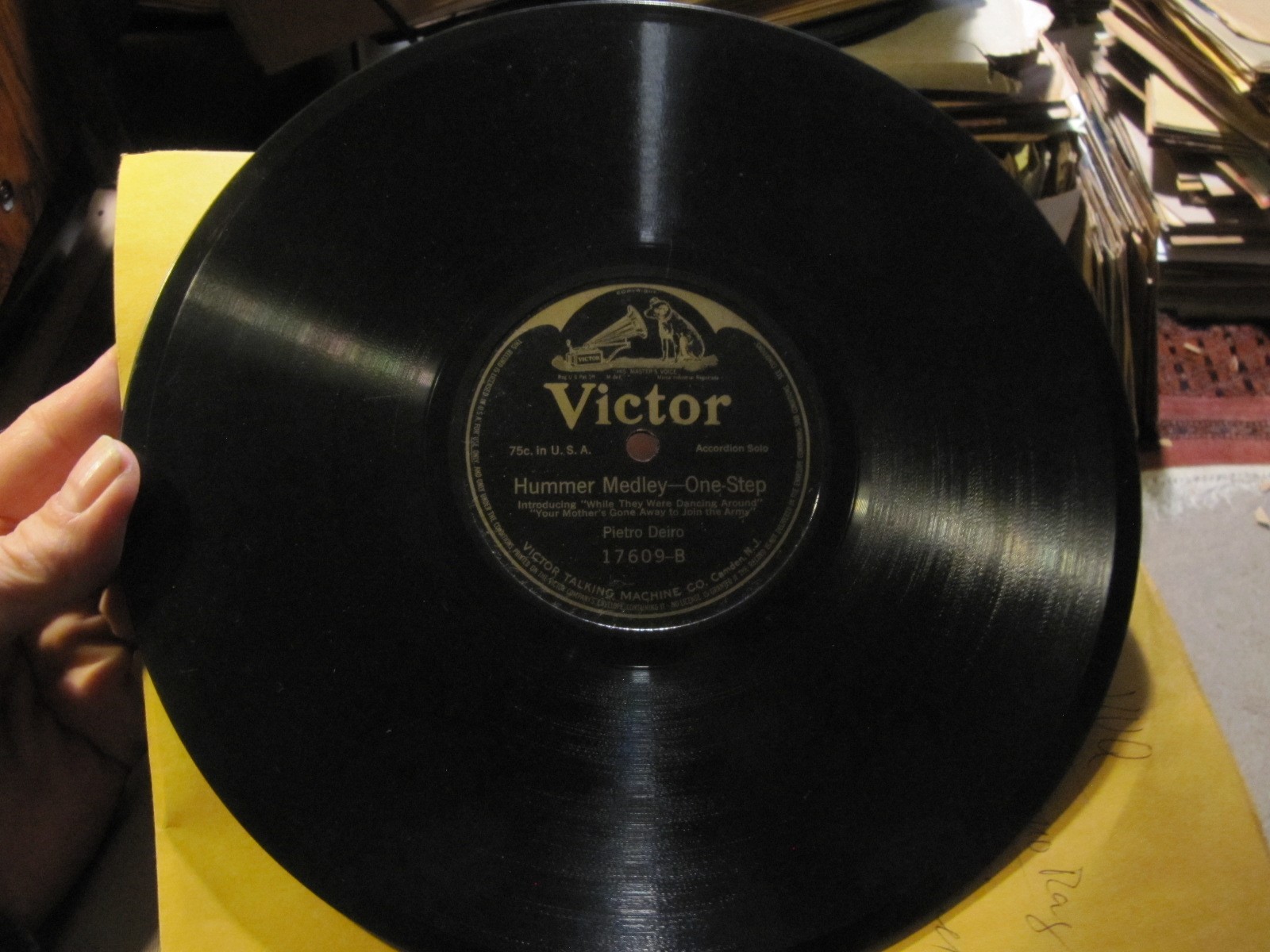
Orig issue Victor Batwing 10" 78 rpm record
LOUD AND PRESENT
Condition: Better than EXCELLENT PRISTINE plays E+ NOISELESS
A CHOICE COPY
The Deiro Brothers
The brothers Guido and Pietro Deiro were undoubtedly the two most important piano accordionists in America during the first decades of the twentieth century. Guido (1886-1950) was the eldest of the two, and the first to enter into a career in music.
Guido Deiro's Royal Method for the Piano Accordion (Nicomede Music, Altoona, Pennsylvania, 1936) provided a short biographical sketch of the first star of the piano-accordion:
This master of the Piano Accordion was born in Salto Canavese near Turin in Piedmont, Italy, and started to play the accordion when nine years old, being the first of his family to play this instrument. This was against the wishes of his father who wanted to make a grocer out of the small Guido. But in his own words, "with music singing in my heart there was no inspiration in potatoes and beans," and by the time Guido was 14 he was in Switzerland, playing professionally on the accordion and was already making a name for himself as a virtuoso of this instrument.
His work took him to Germany and it was there he first became acquainted with what is now known as the piano accordion and resolved to possess one as soon as possible. Returning to Italy in 1906 to serve in the army, he was assigned to the band of the 29th infantry, playing several wind instruments but featuring the bass. The attractiveness of the new instrument heard in Germany was not forgotten and one was built to order for his use. Additional fame came with the skillful use of this resourceful instrument, and in 1908 the innate ambition and restlessness of the true musician asserted itself and Deiro came to America, landing in Seattle. The success which had attended the use of this new instrument, his own confidence in its musical worth, and the skill which he had acquired in its use led Deiro to put to the test an idea of his own that had long been forming, the idea that this instrument was good enough to hold its own in any company and with any kind of music -- elevating it to a concert instrument of the first rank. Previous to this time it had not had this distinction, being considered an instrument for street playing and similar uses only.
In 1910, Deiro was booked on the bill at the American Theatre in San Francisco, as the Premier Piano Accordionist -- a designation that could not be more correct, for up to this time the instrument had not been used on the stage. Deiro, at this time, also furnished the name by which the instrument is since known, -- translating its Italian name of "Armonica Sistema Piano" to "Piano Accordion." As the crucial moment approached when his confidence was to be put to the test, we can well imagine the anxiety of this Italian musician. Would he be a flop, and the new Piano Accordion prove unable to hold its own? Financially and artistically, it was a critical time for Deiro. In his own words, as he told it to us: "I stepped into the spot-light, I and my piano accordion, right into the glare of it. There was the time and the place to show what could be done with this instrument. It's now or never, I told myself, and began to play. I forgot about my fingers and the keys of wood and celluloid. I only remembered that my heart was full of melody and I wanted to show the people in the theatre how beautiful that melody was."
Guido's younger brother, Pietro (1888-1954), first made his living as a miner before he pursued a career as a professional musician. First Pietro worked in the iron mines near Metz, Germany, while Guido performed at a local Metz tavern. In 1907 Pietro immigrated to the United States to live with his uncle and work in the coal mines near Cle Elem, Washington. After some time, he decided to follow in his older brotherÆs footsteps, perhaps inspired by Guido's success. Pietro explained, "When we were children together I was always inspired by his playing before I began to play the accordion. The thought uppermost in my mind in those days was if I could only become as good a player as Guido." (Typewritten undated article by Pietro Deiro found in the Deiro Archive, Center for the Study of Free-Reed Instruments, Graduate Center, City University of New York)
During the summer of 1908, Pietro got a job at the Idaho Saloon in Seattle. He played a three-row sixty-bass diatonic button accordion with a pianist, and made $18 per week. Apparently Pietro did not know how to play the left hand bass and chord buttons, and therefore he was dependent on the pianist to provide accompaniment.
Two months later during the autumn of 1908, Guido arrived in Seattle and got a job playing his piano-accordion as a soloist at another Seattle tavern, the Jackson Saloon, also for $18 per week. Pietro recognized the advantages of his brotherÆs piano-accordion (audiences were fascinated by its novel appearance and sound, and after he learned how to play the left hand, he could make twice as much money as he wouldnÆt have to share his salary with an accompanist), and asked his brother to teach him how to play the instrument.
In 1910, Guido was discovered by a talent scout and began playing professionally on the Orpheum vaudeville circuit as a solo piano-accordionist: "America's Premiere Piano Accordionist." After some time, Pietro also joined the vaudeville circuit and signed with a competing agency. Both brothers began making records, Guido for Edison and Columbia, and Pietro for Victor and Decca.
One modern scholar described the importance of the Deiro brothers, "Put simply, they were the pioneers of the piano accordion in America. Having emigrated from their native Italy around 1908, they had, within a few years, successfully established their solo acts as major attractions both in vaudeville and on record; and for nearly two decades thereafter - until roughly the time of the Depression - they were the leading popularizers of the instrument in this country. . . . The records of both brothers were enormously popular in their day, and, along with their vaudeville stardom, helped to propel them to the status of minor celebrities in American pop culture by the late teens." (Peter Muir, "The Deiro Recordings," The Free-Reed Journal, vol. 4 [Center for the Study of Free-Reed Instruments: Fall 2002])
Pietro Deiro (1888-1954) is considered one of the greatest and most influential accordionists of the first half of the twentieth century. Born in Salto, Italy, he immigrated to the United States in 1907, and in 1908 began to play the diatonic button-accordion professionally at a saloon in Seattle, Washington.
That same year Pietro's older brother Guido (already an accomplished piano-accordionist in Europe) also immigrated to the United States, and there in Seattle he taught Pietro how to play the piano-accordion. Guido was a sensation and became a vaudeville star in 1910. Pietro, recognizing a good thing, followed in his brother's footsteps, and also became a celebrity on the vaudeville circuit at least by 1912. He earned up to $500 per week: a phenomenal income in those days.
One contemporary 1921 newspaper reviewer praised Pietro's musicianship: "What Paderewski is to the piano, Spalding to the violin, and Hans Kronol to the cello, Pietro is to the piano-accordeon. This man takes this instrument, which recently has attained a dignified standing among musicians, and gives it a human voice, a voice that is alive with joy, and dragged down to the depths of sorrow."
Pietro recorded 78 RPM records for Victor and Decca: a total of 147 sides during his career, beginning in 1912. Amazingly, Pietro enjoyed a flourishing recording career even during the Great Depressionùa remarkable achievement, considering the doldrums the record industry was in at the time. Pietro dominated the solo accordion category in Victor's 1930 Italian catalog with a full eighteen sides (Pietro Frosini could only muster ten sides).
When the vaudeville industry began to decline, Pietroùa successful businessmanùestablished a music studio in 1928 in Greenwich Village, New York, which attracted so many students that he had to hire a staff of professional teachers. Eventually he established a chain of accordion studios on the East coast.
Recognizing early on that his students needed sheet music, Pietro established the music publishing firm Accordion Music Publishing Company (AMPCO), later known simply as Pietro Deiro Publications. Pietro composed over 200 original works for the accordion and arranged countless other pieces.
Pietro was popular and influential. He appeared as a regular columnist for general music publications such as The Etude and Metronome magazines, and he participated prominently in the main accordion journals of the 1930s and 1940s such as Accordion World and Accordion News. He published his own newsletter called The Pietro Musicordion, he produced his own radio show, and he established a record company devoted to the accordion: AMPCO Records.
In 1936 Italian accordion manufacturers presented him with a parchment scroll and gold plaque for his contributions toward the advancement of the instrument. Pietro was one of the founding members of the American Accordionists' Association (created on March 9, 1938), and was elected the association's first president by the board.
One modern scholar, Peter Muir, explained: "He [Pietro] effectively became the premiere accordionist in America, a sort of legendary father-figure whose status was embodied by his nickname 'The Daddy of the Accordion,' which he carefully cultivated from early in the decade [beginning in 1930]."
price rating