QUIET RIOT II rarest '78 JAPAN LP w/ obi - RANDY RHOADS
$
50


Favourite Auctions
To save auctions to your favourites, please login
If you don't have an account, please register
Description
Check out my other items! / Be sure to add me to your favorites list!
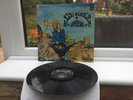
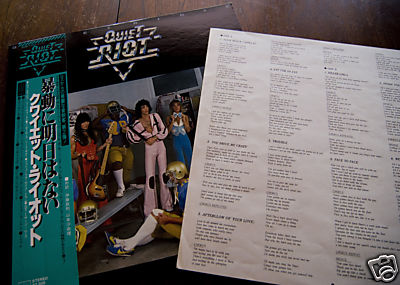
Rarest of Rare Original Pressing Japan Import LP
Quiet Riot
Quiet Riot II
1978 Original Pressing
Japan Only Import
with OBI and Lyric Sheet Insert
Condition
Vinyl: NM
Cover: NM
------------------------------------------------
Payment:
PayPal Preferred, but check ok as long as you are cool with me waiting until the check clears prior to shipping your item.
Shipping:
- Shipping is $4.00 for US Media Mail within the USA.
- I can discount shipping for combined multiple auction wins within the same week.
Good luck with the bidding!
-------------------------------------
Quiet Riot Bio
For a very brief moment, Quiet Riot was a rock & roll phenomenon. Famously described as the first heavy metal band to top the pop chart (a claim that greatly depends on one's exact definition of heavy metal), the Los Angeles quartet became an overnight sensation thanks to their monster 1983 smash album Metal Health. But Quiet Riot's road to success had in fact been long and arduous, and when their star power subsequently began to fade, their fall from grace was ironically accelerated by the man who was most responsible for taking them to the top: singer Kevin DuBrow. Unable to suppress his infamous motor mouth from assaulting many of Quiet Riot's peers, DuBrow gradually alienated his fans and fellow musicians, and in the face of plummeting record sales, faced the iniquity of being fired from his own band. The dust eventually settled and DuBrow was able to resurrect Quiet Riot in the 1990s, but despite their best efforts, the once chart-topping band would remain forever exiled to the fringes of pop conscience, and what might once have been a full chapter in rock history has instead become little more than a footnote.
The story of Quiet Riot begins with vocalist Kevin DuBrow and guitarist Randy Rhoads, who started the band in 1975 after disbanding an earlier project named Violet Fox, and completed their first lineup with bassist Kelli Garni and drummer Drew Forsyth. Along with local scene contemporaries like Van Halen, Xciter, and London, the band thrilled audiences packing the L.A. nightclubs, but found it difficult to land a record deal during the disco-dominated late '70s. Eventually securing a contract with Columbia Records in Japan, they recorded two moderately successful albums — a 1978 eponymous debut and 1979's Quiet Riot II, featuring new bassist Rudy Sarzo — before losing Rhoads (and later Sarzo) to Ozzy Osbourne's band (and later a tragic plane accident, rock & roll martyrdom, immortality, etc.). Quiet Riot disbanded and DuBrow formed a new band under his own name, working with several musicians over the next few years before signing with independent Pasha Records, reverting to the Quiet Riot moniker, and entering the studio with new guitarist Carlos Cavazo and bassist Chuck Wright to start work on a new album. The year was 1982 and, following Randy Rhoads' well-documented demise, former henchman Sarzo quit Ozzy, pushed Wright out of the way, and brought friend and drummer Frankie Banali into the fold to complete the lineup and sessions for what would become 1983's Metal Health. Driven by the irresistible double whammy of the title track's muscular bassline (reputedly played by Wright before his dismissal) and a raucous rendition of the old Slade chestnut "Cum on Feel the Noize," the album stormed up the U.S. charts, duly reaching the number one spot and going platinum five times over in the process. Their unexpected success shocked everyone, not least of which the bandmembers, who found it pretty hard to cope with sudden stardom and the pitfalls that came with it.
Pressured to capitalize on their hot streak, Quiet Riot was rushed back into the studio to whip together 1984's Condition Critical, but unsurprisingly, the album was little more than a weak carbon copy of Metal Health — even sinking so low as to include another chart-ready Slade cover in "Mama Weer All Crazee Now." Fans were unimpressed, and panic set in as the band watched the record quickly sliding off the charts to make way for fresher, up-and-coming L.A. glam metal contenders like Mötley Crüe and Ratt. An incensed DuBrow went on a rampage, incessantly slagging fellow metal bands, members of the press, and his own record company, in the process quite literally burning most every bridge he'd worked so hard to build. The abusive behavior also began wearing on his band mates, and by the time they re-grouped to launch a comeback with 1986's QR III, Sarzo was long gone (later joining Whitesnake) and had been replaced by former bassist Chuck Wright, most recently working with Giuffria. A failed experiment in ultra-glossy '80s metal, QR III was a third-rate Hysteria possessing none of its predecessor's blue-collar grit and became an even bigger flop, sending Quiet Riot into an irreversible tailspin. Mounting tension resulted in an all-out band mutiny at tour's end, with DuBrow finding himself abandoned at the hotel in Hawaii, while the remaining musicians and crew left on an earlier flight back to L.A. Furious, he watched in disbelief from the sidelines as Rough Cutt vocalist Paul Shortino stepped into his shoes and recorded 1988's simply named Quiet Riot with Cavazo, Banali, and new bassist Sean McNabb. The album's absolutely abysmal sales offered little consolation, and DuBrow finally gave up on diplomacy and filed an injunction against his former colleagues (apparently he still owned rights to the name), successfully bringing Quiet Riot to a stuttering halt. Frankie Banali said "good riddance" and jumped ship to join L.A. shock-metal kings W.A.S.P., while the remaining bandmembers went to ground.
Then, come 1991, DuBrow and Cavazo began working together once again in a band called Heat. In time, they began using the Quiet Riot name once again, eventually recording 1993's Terrified with bassist Kenny Hillery and a returning Banali. Down to the Bone followed two years later, and in 1997, a one-off performance at a party hosted by industrial shock rocker Marilyn Manson lured bassist Rudy Sarzo back to the fold. With their classic lineup intact once again, a re-energized Quiet Riot hit the road playing clubs across America. Public response was less than enthusiastic, however, and the band usually couldn't get arrested — except for DuBrow, who spent a night in jail after a tour stop in Charlotte, NC, where an irate fan had sued him for injuries sustained at a previous show. This and other roadside misadventures were captured on 1999's optimistically named Alive and Well live album, and 2001 saw the release of Guilty Pleasures, the first recording by the band's classic lineup in 17 years. Unfortunately, but unsurprisingly, said album wasn't able to capture lightning in a bottle for a second time, and Quiet Riot quietly broke up shortly thereafter. Unwilling to put the band to rest, DuBrow and Banali recruited guitarist Neil Citron and bassist Tony Franklin for the recording of Rehab in 2006. Sadly, at age 52, DuBrow's singing career was cut short. His body was found in his Las Vegas apartment on Sunday, November 25, 2007.
---------------------------------------------
Randy Rhoads Bio
While the most dominating and influential heavy metal guitarist of the '80s would have to be Eddie Van Halen, Ozzy Osbourne's original guitarist, Randy Rhoads, was one of the few guitarists of the era to create his own signature style. While just about every other guitarist was merely copying Van Halen's unorthodox two-hand tapping technique, Rhoads was one of the first heavy metal guitarists to incorporate classical music into his playing (later picked up by such six-string shredders as Yngwie Malmsteen). Although he only issued a pair of major-label albums during his lifetime, he immediately reached legendary status upon his tragic death in early 1982. Rhoads was born on December 6, 1956, in Santa Monica, CA. Rhoads came from a musical family (his mother was a school music teacher) and began playing guitar before he even reached the age of ten. By his teenage years, Rhoads had become interested in the hard rock sounds of Mountain, Led Zeppelin, and Alice Cooper and as his musical taste changed, so had his guitar style. After playing in several school bands, Rhoads hooked up with singer Kevin DuBrow and formed Quiet Riot. Along with Van Halen, Quiet Riot became a major draw on the L.A. club circuit even though new wave and punk were the most dominating musical styles on the Sunset Strip. While the band wasn't able to secure a U.S. record deal, they released two albums in Japan: 1977's Quiet Riot and 1978's Quiet Riot II. Frustrated that the band wasn't getting anywhere in their homeland, Rhoads tried out for the guitar position in ex-Black Sabbath singer Ozzy Osbourne's solo band. Rumor has it that Rhoads was hired before he even played a note because he "looked the part." Osbourne's first solo release, 1980's Blizzard of Ozz, has become one of hard rock/heavy metal's greatest releases of all-time, largely due in part to Rhoads' fiery playing. Such tracks as "I Don't Know," "Crazy Train," "Suicide Solution," and "Mr. Crowley" have become metal standards and all showcased Rhoads' talents (also of note was a brief classical acoustic guitar piece he penned for his mother, "Dee"). The album was a surprise hit as the new band toured, resulting in another album a year later, Diary of a Madman. Although Rhoads voiced dissatisfaction with his playing on the album in interviews at the time (they were rushed to meet a deadline), his six-string work was astounding, especially on such tracks as "Over the Mountain," "Flying High Again," "Little Dolls," and the title track. Rhoads was finally getting his due as a guitarist (he just won the Best New Guitarist award from Guitar Player magazine), when he was killed in a freak airplane accident while on tour in Florida on the morning of March 19, 1982. As with other talented musicians who died far too early, Rhoads' stature in the hard rock world reached mythic proportions. A Rhoads/Osbourne live album (Tribute) that was originally to be issued in 1982 was shelved until 1987. The album was an automatic Top Ten hit, as it proved once and for all the incredible skill and endless potential that the young guitar player possessed. Jackson Guitars also started issuing a line of Randy Rhoads-model guitars, based on a prototype that was finished just prior to his death. And 11 years after his passing, a Rhoads-era compilation was issued by his former band, Quiet Riot, entitled The Randy Rhoads Years. Rhoads' death remains one of rock's all-time greatest tragedies.
---------------------------------------------
New Items Listed Weekly So Check Back Often!
--------------------------------------------
Check out my other items! / Be sure to add me to your favorites list!
price rating




![Peter Murphy Deep [Vinyl]](https://www.popsike.com/php/thumbnail.php?url=https://www.popsike.pics/pix/20240904/256627546927.jpg)