QUEEN - ACETATE - Seven Seas Of Rhye (alternate version)
£
1,020
$
1,352


Favourite Auctions
To save auctions to your favourites, please login
If you don't have an account, please register
Description
QUEEN
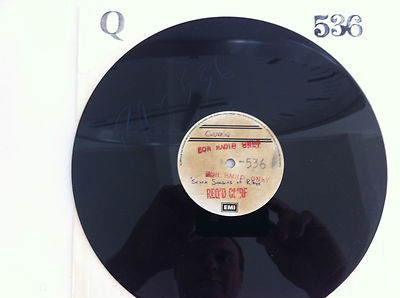
ULTRA RARE ACETATE 10"
With the alternate version of SEVEN SEAS OF RHYE
1 track acetate - 1 side
Label : EMI
cat. nr. : Q 536 / PR-536
Condition : VG
This version of SEVEN SEAS OF RHYE uses the WRONG BACKING TRACK , This version is about 1 minute longer as the ORIGINAL VERSION.
So a UNIQUE and very different version of Queens second single release Seven Seas Of Rhye (1974).
I am selling this because I need room for new Queen stuff.
Private auction. No returns accepted.
TAKE A LOOK AT MY TOHER QUEEN AUCTIONS !!!
A ACETATE IS :
Acetate disc
From Wikipedia, the free encyclopedia Jump to: navigation, searchAn acetate disc, also known as a test acetate, dubplate (a term from Jamaican reggae culture, now also applied to individually recorded discs of solid plastic), lacquer (a technically correct term preferred by engineers in the recording industry), transcription disc (a special recording intended for, or made from, a radio broadcast) or instantaneous disc (because it can be played immediately after recording without any further processing), is a type of gramophone record, a mechanical sound storage medium, widely used from the 1930s to the late 1950s for recording and broadcast purposes and still in limited use today.
Unlike ordinary vinyl records, which are quickly formed from lumps of plastic by a mass-production molding process, a so-called acetate disc is created by using a recording lathe to cut a sound-modulated groove into the surface of a special lacquer-coated blank disc, a real-time operation requiring expensive, delicate equipment and expert skill for good results. They are made for special purposes, almost never for sale to the general public. They can be played on any normal phonograph but will be degraded by wear much more quickly than vinyl. Some acetates are highly prized for their rarity, especially when they contain unpublished material.
Acetates are typically produced by dubbing from a master tape recording. By electroplating the acetate master, stampers (special moulds) can be created, which in turn are used to press large quantities of regular vinyl records. Acetates are also used for testing the quality of the tape-to-disc transfer. Historically, they were also a favored medium for use in comparing different takes or mixes, and for getting preview copies of impending new releases into the hands of important disc jockeys.
Material and packaging
Despite their name, most acetate discs do not contain any acetate. Instead, most are an aluminum disc with a coating of nitrocellulose lacquer. (Glass was also used for the substrate during World War II, when aluminum was in short supply.[1][3]) This production process results in a disc that is different in many ways from the vinyl records sold to customers at retail. Whereas vinyl records are light and semi-flexible, acetates are rigid and somewhat heavier. More significantly, the thin coating of lacquer on an acetate is much more susceptible to wear; the playback head of a stylus quickly damages the grooves of the record such that after only a relatively few number of plays the audio quality is noticeably degraded.[2] This is not necessarily a problem, however, since acetates are meant primarily for test recordings. Collectors, of course, may find themselves wishing for greater durability.
Acetates typically come in two sizes: 10" discs for singles and 12" discs for albums. The record's sleeve is typically nothing more than a generic cover from the manufacturing company and the disc's label is similarly plain, containing only basic information about the content (title, artist, playing time, etc.), which is usually typed but is often just hand-written.[2]
[edit] Value
Due to their rarity, some acetates can command high prices at auction. Brian Epstein's collection of Beatles acetates fetched between $1,000 and $10,000 per disc.[4][5] An acetate from The Velvet Underground, containing music that would later appear on their first album, The Velvet Underground & Nico, sold on eBay in 2006 for $25,200.[6] An acetate of Elvis Presleys' That All Right recently sold for $82,393.60.[7]
On 23-Apr-13 at 11:44:20 BST, seller added the following information:
Update 04.23.13 : due to questions :
* I will NOT accept payments in instalments !! (so if you are planning to buy this with monthly instalments do not take part on this auction !)
* I wont sent anyone samples of the music simply I haven't got a sample , and out of respect to the next owner. 'But I can guarantee anyone this is a unrelased version of the song ! The reason it was disapproved is because of the backing track. This is slightly different and isn't put well under the vocals. THE EXCITING THING IS THE EXTENDED VERSION , a truley unheared and unreleased version of Seven Seas Of Rhye ! Only a handfull of these were made , and most of them were destroyed. Perhaps this could be the ONE AND ONLY acetate left of this disaproved version.
* Why is it a RADIO ACETATE ? : answer : acetates were made for , the band to check their music on the record, inhouse use of the recordcompany and PROMOTIONAL PURPOSES , it is likely that this acetate was sent for promotion to a radio station and the band later decided not use this one. This doesn't mean this was ment for airplay, it could be used for a review by the DJ in advance of the upcomming single release.
* The item is what it is, probably the rarest Queen acetate ever for sale on ebay !!
On 24-Apr-13 at 12:03:50 BST, seller added the following information:
Update : April 24th 2013 !
After doing some research I can confirm this version has a playing time of 4.15 mins. The album version clocks at 2.48!!!!!!
price rating
- Popular in following searches:
- queen acetate
- queen seven
- queen seven seas
- queen seven seas of rhye