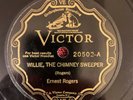
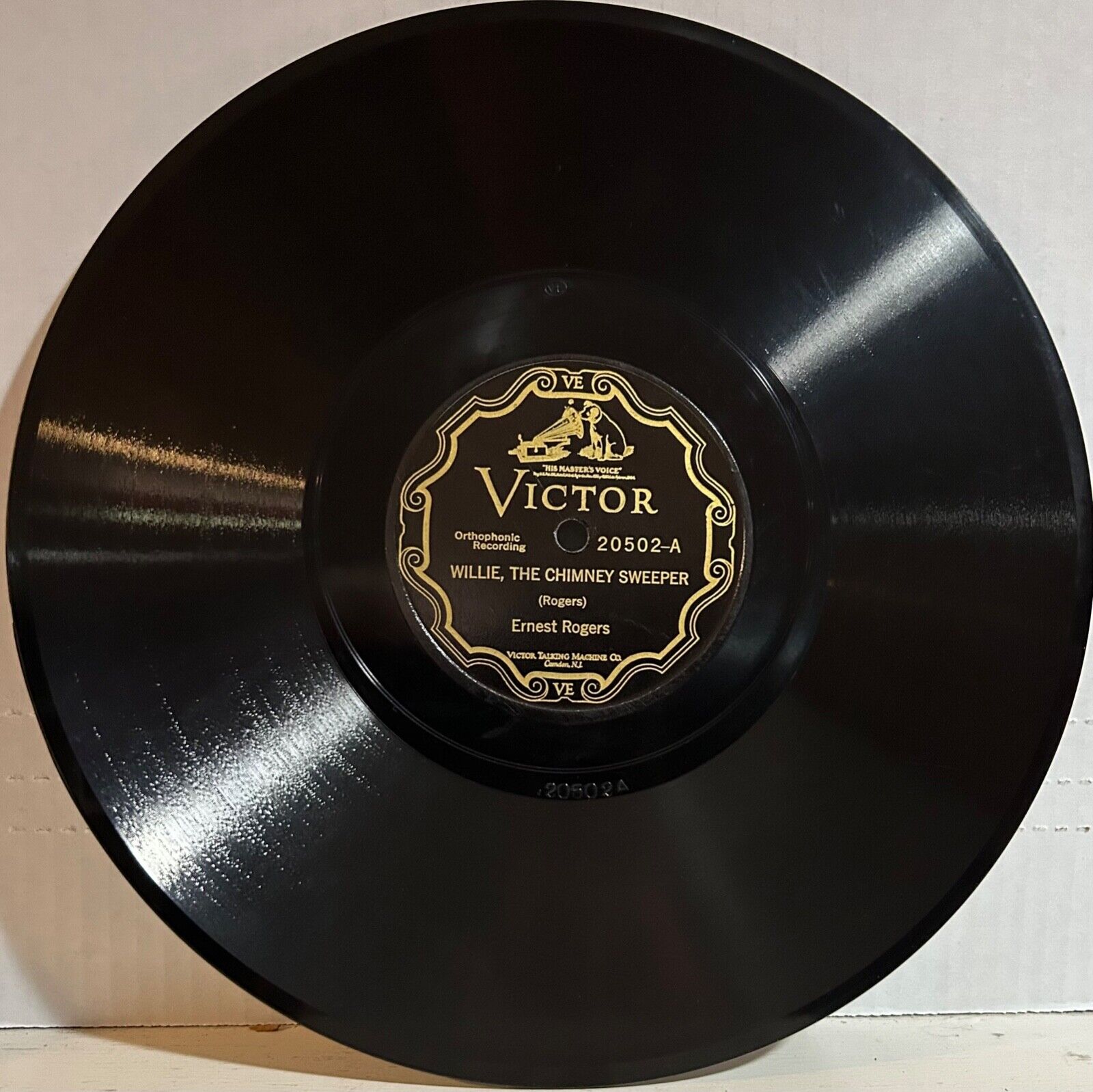
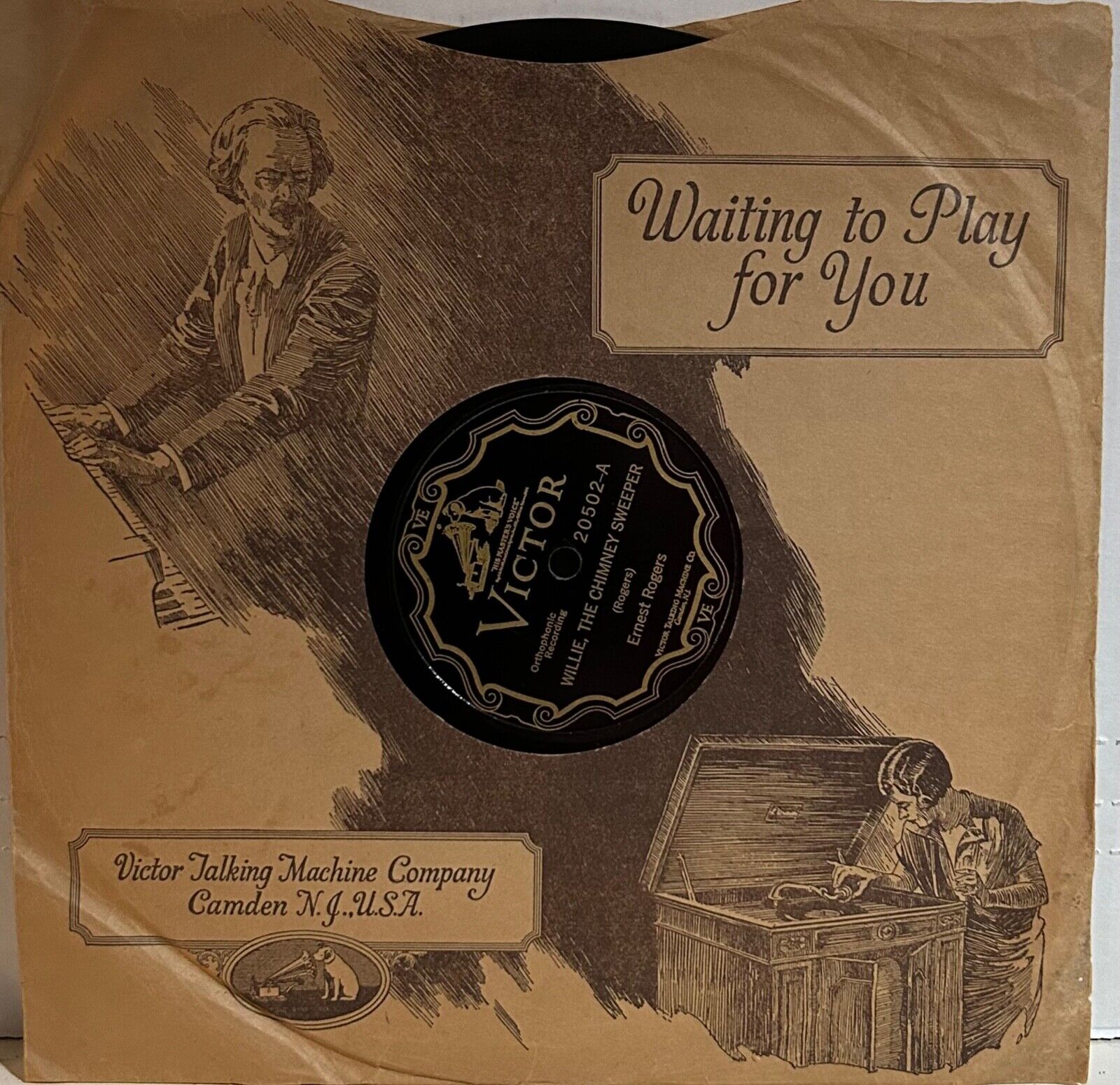
PREWAR HILLBILLY ERNEST ROGERS VICTOR 20502 Willie, The Chimney Sweeper E+ DOPE
$
50

Favourite Auctions
To save auctions to your favourites, please login
If you don't have an account, please register
Description
William Ernest Rogers was born on October 27, 1897 in Atlanta, Georgia. He was crippled by infantile paralysis at the age of two, but that evidently didn’t slow him down. He attended Emory University—where he was the champion debater, a member of the glee club, mandolin club, and literary society, and founder of the campus newspaper, the Emory Wheel—and graduated with a Bachelor of Science in 1920. After college, Rogers found work as an editor, reporter, arts critic, and features writer for the Atlanta Journal, with whom he remained until 1962. He married Bertha Turnipseed and they had one child, Wallace. On the side, Ernest sang and played the guitar, and served as a performer and announcer on the Atlanta radio station WSB. His repertoire consisted primarily of vaudevillian material, including such songs as “Steamboat Bill”, “Waitin’ for the ‘Robert E. Lee'”, and “Willie the Weeper”, as well as a few compositions of his own, like “My Red-Haired Lady” and “Let Me Be Your Man in the Moon”. He made his first record for the Columbia Phonograph Company in January of 1925, during their second field trip to Atlanta, cutting two sides which were both issued. Two years later, the Victor Talking Machine company brought their recording equipment to Atlanta, and Rogers cut another two sides. Victor must’ve liked him, because he had two more sessions with them in May of ’27 and February of ’28, producing a further eight sides. Of the twelve sides he recorded, all but two were released. Following the culmination of his recording career, Ernest Rogers continued to have success in the literary world, publishing relatively successful books: The Old Hokum Bucket in 1949, and Peachtree Parade in 1956, both compilations of his newspaper columns. Ernest Rogers died on October 9, 1967 in Atlanta.
The above is taken from http://oldtimeblues.net/2017/10/27/victor-20502-ernest-rogersvernon-dalhart-19271925/
The tune, a tale of drug addiction, was appropriated by Cab Calloway a few years later, retitled as 'Minnie The Moocher'
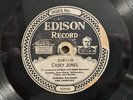
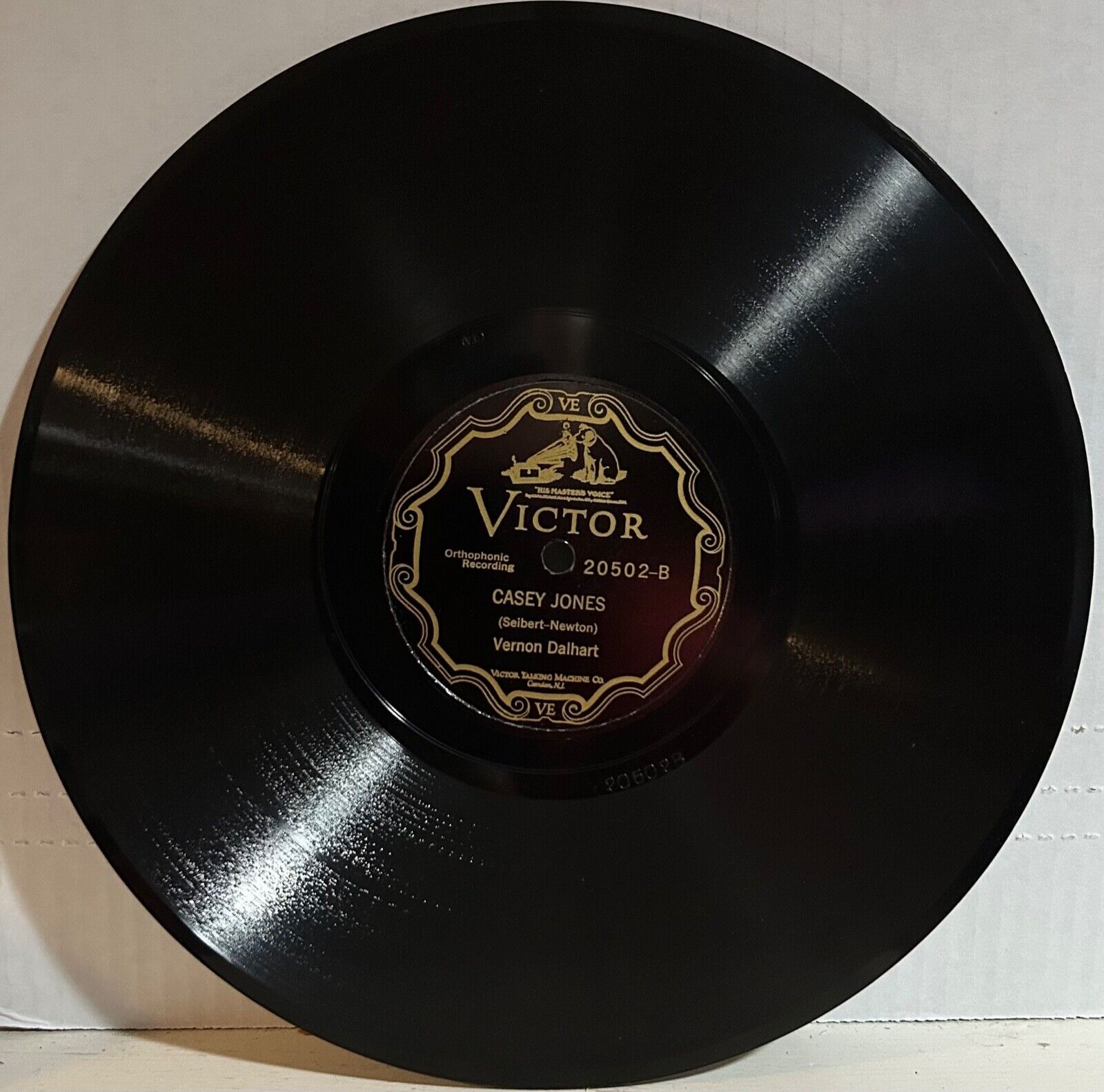
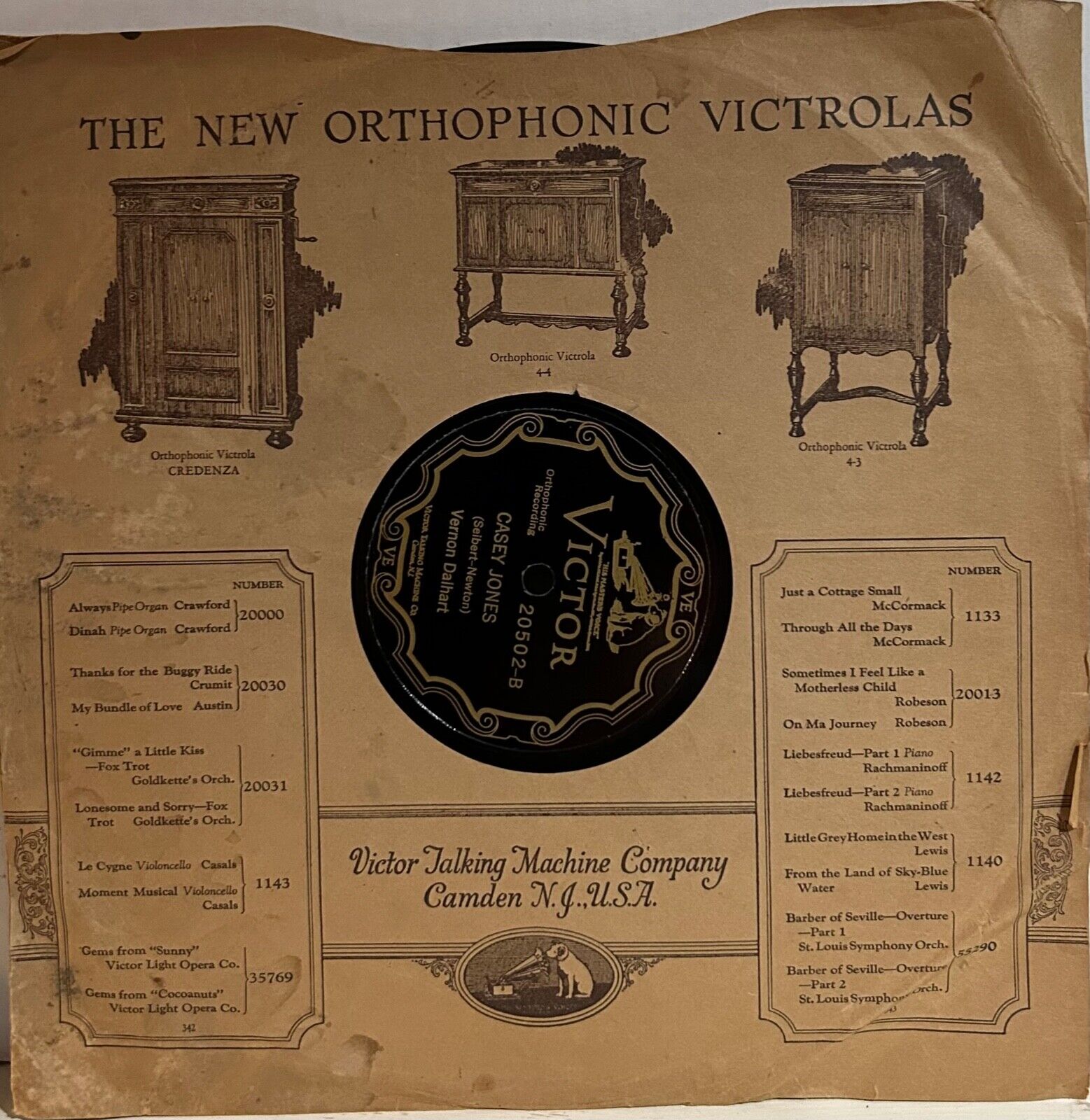
The other side, 'Casey Jones', by Vernon Dalhart is, im my opinion, one of the better sides Dalhart cut in his long career, and has his long time side-kick Carson Robison in attendance.
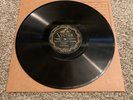
This a historic records, and this particular copy has happily lasted nearly a century without getting scratched or cracked.
We Use The VJM Record Grading System
NB 45s use the LP system as below.
N (78) M (LP). As new and unplayed (there are virtually no 78s that can categorically be claimed to be unplayed).
N- (78) M- (LP). Nearly Mint, but has been played. No visible signs of wear or damage.
E+ (78) VG+ (LP). Plays like new, with very, very few signs of handling, such as tiny scuffs from being slipped in and out of jackets.
E (78) VG (LP). Still very shiny, near new looking, with no visible signs of wear, but a few inaudible scuffs and scratches.
E- (78) VG- (LP). Still shiny but without the lustre of a new record, few light scratches. LP: Some wear, scratches and scuffs, but no skipped or repeat grooves.
V+ (78) G+ (LP) V+ is an average condition 78 in which scuffs and general use has dulled the finish somewhat. Wear is moderate but playing is generally free from distortion. Surface noise not overly pronounced. LP: Below average with scuffs and scratches on fewer than half the tracks. No skips or repeat grooves.
V (78) G (LP). Moderate, even wear throughout, but still very playable. Surface noise and scratches audible but not intrusive.
V- (78) G- (LP). Quite playable still, but distortion and heavy greying in loud passages. Music remains loud in most passages. Surface noise and scratches well below music level. LP: Lowest Grade. Audible scratches, etc. on more than half the tracks. Listening uncomfortable.
G+ (78). Grey throughout but still serviceable. Music begins to sound muffled. Heavy scratches.
G (78). Quite seriously worn and scratched, but music level is still higher than surface noise.
G- (78). Music still prominent, but wear and scratch damage extensive.
F (78). Most of music remains audible over surface noise, but listening now uncomfortable.
P (78). Unplayable.
NB: Damage to labels and jackets (LP) should be noted whenever present.
Abbreviations: sfc = surface; lbl = label; nap = not affecting play; scr/scrs = scratch/scratches; lc = lamination crack; cr = crack; hlc/hc = hairline crack; wol = writing on label; sol = sticker on label; fade = faded label; gr/grs = groove/grooves; eb = edge bite; ec = edge chip; ef = edge flake; rc = rim chip.
I have a lot of Rock and Roll, R & B, Jazz and Country LPs, 45s and 78s for sale, many at low prices. I do combine shipping so take a look! If you are bidding on more than one item, let me know you want to combine shipping, and DON'T pay the first invoice that eBay sends you. And then let me know WHEN YOU HAVE FINISHED, and I will send you an invoice for everything. It saves you money, and saves me time! 50 cents extra for each additional LP. I ship USPS Media Mail, but do charge an additional $1.50 for packaging for LPs and 45s. Because of the fragility of 78s, the packaging charge is increased to $5.00, and then an extra 50 cents per record. We?ve all been spoiled with free delivery from various retailers over the past few years, and I wish I could offer free shipping! But I can't. Even Media Mail is becoming expensive. The mailers and bubble wrap I use come out at close to a buck for each shipment for LPs and for 78s the cost is even higher. Two bucks for the box, and 50 cents for each corrugated pad. I use 4 pads per shipment, plus bio-degradable peanuts and bubblewrap. It all mounts up, and then there is the schlepping to the Post Office. I ain't getting rich!
I do pack carefully, but cannot be responsible for damage incurred during shipping. It is the buyers' responsibility to ask for insurance. If it is a valuable record, I suggest you ask for insurance. Issues such as this can be discussed between buyer and seller before paying the invoice. Don't hesitate to contact me!
I am starting to list a lot of 78s and prices are fairly low. Why not minimize your shipping costs by buying several at once?
A note about 78s and vinyl dating from 1948 through early 60s. Tracking weights in the teens and twenties on old wind up phonographs were around 150 - 200 grams. Yes, you read that right! The weight reduced as the years went by, and by the 40s and 50s was down to 8-12 grams. Playing an old record on modern equipment with a tracking weight of around 2-3 grams will often result in a lot of surface noise. The best rule of thumb is to play records on machines of similar vintage, although I do take the point that playing a 78 with tracking weight of 8 grams IS better than 150 grams! Back in the early years of the twentieth century, 78s had an abrasive mixture added to the shellac. It was added with the express purpose of wearing the needle BEFORE the needle wore the record. That is why one should change the steel needle in a wind up phono after each side of a record. Needles were MUCH cheaper than records! All of this is by way of saying, 'You gotta get in the groove'!
price rating