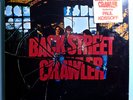
PAUL KOSSOFF's BACK STREET CRAWLER 1975 UK Prog EX RARE
£
77
$
102


Favourite Auctions
To save auctions to your favourites, please login
If you don't have an account, please register
Description
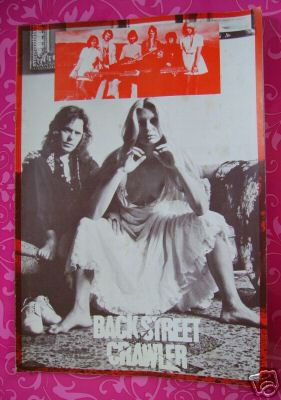
RARE BACK STREET CRAWLER TOUR PROGRAMME 1975, (Tour of Only 4 UK Dates), making this Mega-Rare
(also includes an A4 Flier for the group OUT TO LUNCH which I think was the band's support act)
This is an 8-sided Official Tour Programme. It measures A4 and is in Excellent condition without creasing or writing & is still fully intact. There is just a tiny bit of foxing due to its age but it is very clean and strong with clean (un-rusted) staples.
The Programme gives Photos and Text with background & Biographical Info. It is Copyright Theatregraphics, October ‘75.
I was lucky enough to see the band at the Liverpool Empire gig on 23rd November in 1975, (see below). However, in many ways it was a memorably sad and tragic performance. It was also a very emotional one. Paul Kossoff was so ill and weak he continued to play fantastically even though the Roadies kept coming to his assistance: propping him up & leaning him against equipment and all the time he played on, wringing every last drop out of each note as if it was his last, and sadly it so nearly was. What a tragic end to a fantastic talent & career & a great loss to the Rock music industry.
I’ve always treasured this Rare Programme but think it’s now time for someone else to own it.
History
Back Street Crawler was the rock band formed by guitarist Paul Kossoff. He only had months to live when the band, named after the title of his first solo album (released 1973), was formed in early 1975 and the albums they produced are his last recorded work.
Signed to Atlantic Records by Ahmet Ertegun on a $250,000 worldwide deal, the Anglo-American line-up comprised: Paul Kossoff (guitar), Mike Montgomery (keyboards), Tony Braunagel (drums), Terry Wilson (bass) & Terry Slesser (vocals). The band completed a nine-date UK tour in May and June 1975, then finished their debut album, The Band Plays On, which was released 1 September 1975, on the back of a massive publicity campaign. An extensive tour was announced to coincide with this release, but Kossoff was taken ill with a stomach ulcer and the tour was cancelled. Whilst at the clinic, Kossoff's condition worsened and he was taken to a hospital where he went into cardiac arrest and actually 'died' for 35 minutes.
After a month of recovery, Kossoff made an appearance on the UK TV Show Old Grey Whistle Test (October 1975) and four new dates - Liverpool, Glasgow, Newcastle and London - were arranged for November. These showed the band under-rehearsed and Kossoff struggling, though. Prior to a U.S. tour at the start of 1976, Montgomery was replaced by ex-Free keyboard player John 'Rabbit' Bundrick. However, once again, Kossoff's ill health meant too many shows were cancelled or postponed. Recording of the follow-up album 2nd Street took place whilst the band were in Los Angeles, but much of the guitar playing was the work of 'Snuffy' Walden. A few gigs in February 1976 also featured Walden, with Kossoff standing in as the MC.
With Kossoff in better health again and the band headlining four nights at the Starwood Club, Los Angeles, Kossoff was delighted that ex-Free colleagues, Paul Rodgers and Simon Kirke (headlining with Bad Company at the Forum), joined him on stage for two nights. A British tour was set to begin on 25 April 1976, coinciding with the launch of the second album, but Kossoff died of a heart attack on an overnight flight from Los Angeles to New York on 19 March 1976. Recordings from one of the UK concerts in 1975 were later released under the title Live at Croydon Fairfield Halls 15/6/75.
Back Street Crawler continued, under the name Crawler, with Geoff Whitehorn on guitar, but they were dropped by Atlantic after failing to replace Kossoff with a big name.
Throughout the years, rock music has been littered with talented musicians whose lives were cut short due to drug-related deaths. Free/Back Street Crawler guitarist Paul Kossoff was one such casualty. Kossoff was born in London, England, on September 14, 1950, and early on studied classical guitar (before giving up on the instrument by his teenaged years). But upon discovering the British blues-rock movement of the '60s, Kossoff's interest in guitar perked up once again, especially after catching a John Mayall's Bluesbreakers live show with Eric Clapton. Kossoff soon purchased an electric guitar (a vintage Gibson Les Paul, which eventually become his trademark guitar) and began playing in local bands. Through one such band, Black Cat Bones, Kossoff became good friends with their drummer, Simon Kirke, who would serve a prominent part in Kossoff's musical future. Eventually feeling that the band had reached its zenith, the band broke up after the Black Cat Bones backed bluesman Champion Jack Dupree on a song called "When You Feel the Feeling."
Kossoff and Kirke set out to form another group, hooking up with vocalist Paul Rodgers and bassist Andy Fraser, the quartet decided to go by the name Free (which was supposedly christened by British blues icon Alexis Korner). Just as the new band signed a deal with Island/A&M Records, Kossoff had fully blossomed into an outstanding guitarist, renowned for his fluid, slow, and melodic leads and bluesy riffs. Free issued a pair of albums in the late '60s that went largely unnoticed -- 1968's Tons of Sobs and 1969's self-titled release -- as Kossoff grew slightly disillusioned by the group's lack of commercial progress and tried out for guitar openings in such groups as the Rolling Stones and Jethro Tull. But big-time success would prove to be just around the corner for Free as their 1970 release Fire and Water spawned the massive hit single (and eventual classic rock standard) "All Right Now" and helped secure the group a spot at the esteemed 1970 Isle of Wight Festival (which also included performances by the Who and Sly & the Family Stone, as well as one of the final performances ever by both Jimi Hendrix and the Doors).
But, this would prove to be Free's commercial apex as after one more release, 1971's underappreciated Highway, the group brokeup. In the wake of their split, Free's record label issued the concert set Free Live, while its members indulged in other projects. Both Kirke and Kossoff decided to stay together, forming the short-lived Kossoff, Kirke, Tetsu & Rabbit, along with bassist Tetsu Yamauchi and keyboardist John "Rabbit" Bundrick, issuing a lone self-titled release the same year. To the delight of fans, Free's split was short-lived as the quartet reunited in 1972, offering a strong "comeback" album, Free at Last. But behind the scenes, things were in disarray: Kossoff, by this time, had developed a dangerous drug dependency, which led to Fraser's exit from the band. With Yamauchi taking Fraser's place in the lineup (and Bundrick on board for good measure), the new lineup of Free attempted to record a sixth studio album, but due to his problems, Kossoff's input was minimal (with Rodgers and another guitarist subbing in for Kossoff). When Free supported the resulting album, 1973's Heartbreaker, with a tour, Kossoff was replaced with Wendell Richardson and upon the tour's completion, Free split up once more, but this time for good (as both Rodgers and Kirke would go on to form Bad Company).
The same year as Free's swan song, Kossoff was able to pull himself together long enough to record a solo album, Back Street Crawler, which surprisingly featured contributions from his former Free bandmates (as well as Yes drummer Alan White). Happy with the results, Kossoff decided to form a full-time solo outfit, named after the title of his solo debut. In addition to Kossoff, Back Street Crawler featured singer Terry Wilson-Slesser, keyboard player Mike Montgomery, bassist Terry Wilson, and drummer Tony Braunagel and the lineup signed on with Atlantic Records to issue a total of two releases -- 1975's The Band Plays On and 1976's Second Street. But Kossoff's health kept worsening; while in a London drug rehab in 1975, Kossoff narrowly escaped death when his heart stopped beating and he had to be revived. Undeterred, Kossoff continued on his destructive path and on March 19, 1976, Kossoff died from a drug-induced heart attack while on a plane flight from Los Angeles to New York at the age of 25.
In the wake of his tragic death, a 16-track career retrospective of Kossoff's, titled Koss (after his nickname), was issued in 1977. Subsequently, several British Kossoff releases were issued in the '80s on the Street Tunes label: 1981's The Hunter, 1982's Leaves in the Wind, 1983's Mr. Big, and 1984's Croydon June 15th, 1975. The late '90s saw a renewed interest in Kossoff and another career retrospective was issued, 1997's 14-track Blue Blue Soul, as well as five-disc Free box set Songs of Yesterday, and a Free biography entitled Heavy Load -- The Story of Free. ~ Greg Prato, All Music Guide