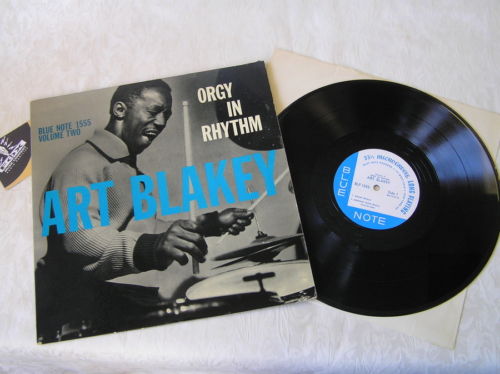
Orig ART BLAKEY Orgy In Rhythm Vol 2 BLUE NOTE Vinyl Record RVG Deep Groove two
$
66



Favourite Auctions
To save auctions to your favourites, please login
If you don't have an account, please register
Description
Fox Music Brings You This,
Original Vintage 1957 Deep Groove Vinyl 33 1/3 LP Record Album
by Art Blakey "Orgy In Rhythm Volume Two (2)"
on Blue Note Records BLP 1555
Address W63 NY 23 - No Inc
Complete with "Ear" (P) Stamped In Lead Out Groove
Along with "RVG" Engineered by Rudy Van Gelder
GRADES
Record: VG+ High gloss, few light sleeve scuffs
Label: VG+ Crisp & clean, shows very minor spindle marks
Cover: VG Laminated cover shows slight rounding at corners, upper right corner
front has a small piece of laminate missing, top and bottom seems both have an aprox.
two (2) inch split at the gate, shows a slight waffle at gate, showing very slight slight signs of ring ware, overall cover presents well - please view the many large photos within the listings
Track List - Side A
Amuck 6:49 -- Elephant Walk 6:56
Track List - Side B
Come Out And Meet Me Tonight 5:43 -- Abdallah's Delight 9:46
Personnel -- Recorded at the Manhattan Towers, NYC, March 7, 1957
Herbie Mann (fl -1,3,4) Ray Bryant (p -1,3,4) Wendell Marshall (b -1,3,4) Jo Jones, Art Taylor (d) Charles "Specs" Wright (d -1,3,4) Art Blakey (d, vo -1,3,4, d -2) Carlos "Patato" Valdes, Jose Valiente (conga -1,3,4) "Sabu" Martinez (bongo, timbales, vo -1,3,4) Ubaldo Nieto (timbales -1,3,4) Evilio Quntero (concerro, maracas, tee log -1,3,4)
Orig ART BLAKEY Orgy In Rhythm Two BLUE NOTE Vinyl Record Album RVG Deep Groove
Complete with "Ear" (P) Stamped In Lead Out Groove Along with "RVG" Engineered by Rudy Van Gelder
Address W63 NY 23 - No Inc after Blue Note
Track List - Side A Amuck 6:49 -- Elephant Walk 6:56
Track List - Side B Come Out And Meet Me Tonight 5:43 -- Abdallah`s Delight 9:46
Fox Music Brings You This,
Original Vintage 1957 Deep Groove Vinyl 33 1/3 LP Record Album
by Art Blakey "Orgy In Rhythm Volume Two (2)"
on Blue Note Records BLP 1555
Complete with "Ear" (P) Stamped In Lead Out Groove
Along with "RVG" Engineered by Rudy Van Gelder
GRADES
Record: VG+ High gloss, few light sleeve scuffs
Label: VG+ Crisp & clean, shows very minor spindle marks
Cover: VG Laminated cover shows slight rounding at corners, upper right corner
front has a small piece of laminate missing, top and bottom seems both have an aprox.
two (2) inch split at the gate, shows a slight waffle at gate, showing very slight slight signs of ring ware, overall cover presents well - please view the many large photos within the listings
Track List - Side A
Amuck 6:49 -- Elephant Walk 6:56
Track List - Side B
Come Out And Meet Me Tonight 5:43 -- Abdallah's Delight 9:46
Personnel
Recorded at the Manhattan Towers, NYC, March 7, 1957
Herbie Mann (fl -1,3,4) Ray Bryant (p -1,3,4) Wendell Marshall (b -1,3,4) Jo Jones, Art Taylor (d) Charles "Specs" Wright (d -1,3,4) Art Blakey (d, vo -1,3,4, d -2) Carlos "Patato" Valdes, Jose Valiente (conga -1,3,4) "Sabu" Martinez (bongo, timbales, vo -1,3,4) Ubaldo Nieto (timbales -1,3,4) Evilio Quntero (concerro, maracas, tee log -1,3,4)
In the '60s, when John Coltrane and Ornette Coleman were defining the concept of a jazz avant-garde, few knowledgeable observers would have guessed that in another 30 years the music's mainstream would virtually bypass their innovations, in favor of the hard bop style that free jazz had apparently supplanted. As it turned out, many listeners who had come to love jazz as a sophisticated manifestation of popular music were unable to accept the extreme esotericism of the avant-garde; their tastes were rooted in the core elements of "swing" and "blues," characteristics found in abundance in the music of the Jazz Messengers, the quintessential hard bop ensemble led by drummer Art Blakey. In the '60s, '70s, and '80s, when artists on the cutting edge were attempting to transform the music, Blakey continued to play in more or less the same bag he had since the '40s, when his cohorts included the likes of Charlie Parker, Miles Davis, and Fats Navarro. By the '80s, the evolving mainstream consensus had reached a point of overwhelming approval in regard to hard bop: this is what jazz is, and Art Blakey -- as its longest-lived and most eloquent exponent -- was its master.
the Jazz Messengers had always been an incubator for young talent. A list of the band's alumni is a who's who of straight-ahead jazz from the '50s on -- Lee Morgan, Wayne Shorter, Freddie Hubbard, Johnny Griffin, Jackie McLean, Donald Byrd, Bobby Timmons, Cedar Walton, Benny Golson, Joanne Brackeen, Billy Harper, Valery Ponomarev, Bill Pierce, Branford Marsalis, James Williams, Keith Jarrett, and Chuck Mangione, to name several of the most well-known. In the '80s, precocious graduates of Blakey's School for Swing would continue to number among jazz's movers and shakers, foremost among them being trumpeter Wynton Marsalis. Marsalis became the most visible symbol of the '80s jazz mainstream; through him, Blakey's conservative ideals came to dominate the public's perception of the music. At the time of his death in 1990, the Messenger aesthetic dominated jazz, and Blakey himself had arguably become the most influential jazz musician of the past 20 years. Blakey's first musical education came in the form of piano lessons; he was playing professionally as a seventh grader, leading his own commercial band. He switched to drums shortly thereafter, learning to play in the hard-swinging style of Chick Webb and Sid Catlett. In 1942, he played with pianist Mary Lou Williams in New York. He toured the South with Fletcher Henderson's band in 1943-1944. From there, he briefly led a Boston-based big band before joining Billy Eckstine's new group, with which he would remain from 1944-1947. Eckstine's big band was the famous "cradle of modern jazz," and included (at different times) such major figures of the forthcoming bebop revolution as Dizzy Gillespie, Miles Davis, and Charlie Parker. When Eckstine's group disbanded, Blakey started a rehearsal ensemble called the Seventeen Messengers. He also recorded with an octet, the first of his bands to be called the Jazz Messengers. In the early '50s, Blakey began an association with Horace Silver, a particularly likeminded pianist with whom he recorded several times. In 1955, they formed a group with Hank Mobley and Kenny Dorham, calling themselves "Horace Silver and the Jazz Messengers." The Messengers typified the growing hard bop movement -- hard, funky, and bluesy, the band emphasized the music's primal rhythmic and harmonic essence. A year later, Silver left the band, and Blakey became its leader. From that point, The Messengers were Blakey's primary vehicle, though he would continue to freelance in various contexts. Notable was A Jazz Message, a 1963 Impulse record date with McCoy Tyner, Sonny Stitt, and Art Davis; a 1971-1972 world tour with "the Giants of Jazz," an all-star venture with Thelonious Monk, Dizzy Gillespie, Sonny Stitt, and Al McKibbon; and an epochal drum battle with Max Roach, Elvin Jones, and Buddy Rich at the 1964 Newport Jazz Festival. Blakey also frequently recorded as a sideman under the leadership of ex-Messengers.
Blakey's influence as a bandleader could not have been nearly so great had he not been such a skilled instrumentalist. No drummer ever drove a band harder; none could generate more sheer momentum in the course of a tune; and probably no drummer had a lower boiling point -- Blakey started every performance full-bore and went from there. His accompaniment style was relentless, and woe to the young saxophonist who couldn't keep up, for Blakey would run him over like a fullback. Blakey differed from other bop drummers in that his style was almost wholly about the music's physical attributes. Where his contemporary Max Roach dealt extensively with the drummer's relationship to melody and timbre, for example, Blakey showed little interest in such matters. To him, jazz percussion wasn't about tone color; it was about rhythm -- first, last, and in between. Blakey's drum set was the engine that propelled the music. To the extent that he exhibited little conceptual development over the course of his long career, either as a player or as a bandleader, Blakey was limited. He was no visionary by any means. But Blakey did one thing exceedingly well, and he did it with genius, spirit, and generosity until the very end of his life.
Vinyl Record Care & Maintenance
Cleanliness is absolutely mandatory if the optimum sound capability of your vinyl record is to be realized. Clean records will not only sound better, but last longer. It has been shown that repeated playing of dirty records can cause permanent damage to the vinyl. Preservation of valuable or irreplaceable records requires careful cleaning. Further more, stylus wear is greatly accelerated by playing dirty records, and with cartridges costing what they do these days, playing soiled records can lead to significant and unneeded expense. For more info about
Vinyl Record Care and Maintenance
What is a Vinyl Record ??
Vinyl records were introduced and marketed as the unbreakable record, unlike its shellac counterpart of days gone by, that would break at the drop of a hat and becomes more brittle over time. Vinyl records are made from polyvinyl chloride (PVC) which has been proven to be a most stable material for sound recording. As a practical matter, vinyl records provide excellent sound quality when treated with care.Vinyl Records were the music source of choice for radio stations for decades, and the switch to digital music libraries by radio stations has not produced a noticeable improvement in sound quality..., as a note most radio stations severely reduce the dynamic range of their broadcasts and the allowed frequency bandwidth for a radio station is less than the bandwidth on a well-made record. Casual ears cannot detect a difference in quality between a CD and a clean new LP. Read More about Vinyl Records
Great Videos About "How Vinyl Records Are Made"
Did You Know That Cleaning Your Vinyl Records Will Not Only Increase the Records Longevity
but Will Also Show Sonic Improvements Such as
- - Increased Dynamic Contrasts.
- - Improved Bass Response.
- - A Vast Improvement in Overall Sound-stage Clarity.
- - Increased Stage Depth and Sense of Musical Ease.
- - A Substantial Reduction in LP Noise Resulting in Improved Clarity.
- - Increased Instrumental Definition.
Cleanliness is an absolute to achieve the best sound quality of your vinyl records. A clean vinyl record will not only sound better, but last longer. It has long been proven that the playing of dirty records will result in a rapid deterioration of quality and degradation of the original recorded sound, or simply can cause permanent damage to your vinyl records. The preservation of your valuable or irreplaceable vinyl records requires special care and cleaning. Not to mention that, stylus wear is greatly accelerated by playing dirty records, and as you know with the cost of new cartridges these days, playing dirty records can lead to a significant and unneeded expense.
So then everyone who owns, previously owned or is interested in purchasing vinyl records should know they need to be maintained in a clean condition in order to sound their best and to preserve the quality of their fragile surfaces. Record cleaning devises operate on a number of different theories and principles, but they all have one thing in common -- they do not totally clean all pollutants from record grooves. They leave film, grease, residue, micro dust, static electricity, carbon fiber hair, and mold release compounds behind. These remaining pollutants prevent the record owner from hearing all the music on the record, regardless of the quality of the playback system and they cause premature wear of the record and stylus. Until now, no available record cleaning system was accepted by professionals and enthusiasts alike as producing the desired result -- clean records. No single system was able to rid a record's surface of film, grease, residue, and dust while it eliminated static electricity and left a purified vinyl disc.
Nitty Gritty offers such a system. Records cleaned on a Nitty Gritty system reproduce all the music stored in their grooves without the interference and masking of record pollutants. The Improvement in sound that a Nitty Gritty cleaning makes is so dramatic that the benefit of upgrading one component of a hi-fi system is less significant in comparison. the Nitty Gritty record cleaning system has established itself as an essential component in every hi-fi system
The proper care and maintenance of records is really a common sense procedure. once we understand and appreciate those conditions or circumstances which contribute to record wear and deterioration, we are in much better position to do something about it.
The Nitty Gritty Two Step Record Cleaning System
Vinyl Record Cleaning Perfected
The first step of the Nitty Gritty record cleaning process is to scrub the record with a special fluid wash. Nitty Gritty offers two record cleaning washes. Purifier 2 is the stronger cleaner, capable of overpowering the most stubborn residue or grease. It contains a de-greaser, a static neutralizer, a mild detergent and surfactant. Purifier 2 has a remarkable low 6 parts solid per million dissolved solids, making it residue free. Purifier 1 is recommended for 78 rpm records as it contains no alcohol. Both purifiers are formulated from chemicals that are totally biodegradable. The Nitty Gritty vac-sweep brush has thousands of microscopic fibers that gently scrub the record's grooves. Its short bristles make the most efficient use of Nitty Gritty's special cleaning fluids, and its softness protects a record from abrasion
The second step of the Nitty Gritty record cleaning process is to vacuum the scrubbed record. Possibly the most unique part of the Nitty Gritty system is the "hemicylindrical lip interface". Through these fiber covered lips, the vacuum motor suctions a dry path across the entire grooved surface of the record. The shape of the lips serves to minimize contact with the record as well as maximize the velocity of air. The vac-sweep fibrous cloth liner provides additional scrubbing while it cushions contact with the record, protecting the fragile grooves. The record is supported on the rotating platform which is designed to eliminate any contact with the record grooves. This removes the possibility of re-contaminating the first side cleaned, while cleaning the second. The vacuum motor is directly coupled to the lips, providing the most powerful, effective design possible. The motor is an industrial grade, flow-through type, providing the user with trouble free cleaning.
CLEANING SYSTEMS CLEANING FLUIDS DUST COVERS
Nitty Gritty Vinyl Record Cleaning Demonstration
Nitty Gritty Record Cleaning Systems
Nitty Gritty 1.0 & 2.0
The Nitty Gritty 1.0 & 2.0 are basic model Nitty Gritty with manual operations
but cleans just as well as the more expensive models. Manual fluid application
and scrubbing, manual rotation during vacuum cycles.
Nitty Gritty Record Master
Just like the Model 1.0 the Nitty Gritty Record Master is a manual operation system
but cleans just as well as the more expensive automated models, the Record Master
includes a built in adapter to allow rapid cleaning of all sizes of records.
Nitty Gritty 1.5 & 2.5
The 1.5 & 2.5 models are a semi manual record cleaning system which automatically rotates
the record for you in both scrub and dry cycles with manual fluid application.
Nitty Gritty Fi Models
The 1.5 & 2.5fi models automatically rotates the record for you while it simultaneously applies
the cleaning fluid starting the scrub process. Automatic fluid application, automatic
rotation during scrub and vacuum cycles.
Nitty Gritty 2.5Fi-XP
The versatile, Dual-Pump RCM breakthrough! Dispenses (2) separate fluids interchangeably,
as the record automatically rotates during the scrub and vacuum cycles.
Nitty Gritty Mini-Pro
The Ultimate 2-Sided LP Cleaner Automatically wets, rotates, scrubs and vacuums
both sides simultaneously
Nitty Gritty Record Cleaning Fluids
Nitty Gritty PUREnzyme+ Vinyl Record Cleaner
A 2nd-generation enhanced enzyme cleaning fluid developed by Nitty Gritty. This power cleaner, formulated to deep-clean even the nastiest of used records, diminishes surface noise and unleashes the dynamics and subtle detail in your records.
Nitty Gritty Vinyl FIRSTrv Pre-Cleaner
Vinyl & lacquer record pre-cleaner designed to remove mold-release compounds and fingerprints from the records surface, as well as reduce stylus friction and/or poor tracking. FIRSTrv must be applied with a separate applicator --- FIRSTrv should not be put in the fluid pump!
Nitty Gritty PURE 2 All Vinyl Cleaner
Specially formulated cleaning fluid for all vinyl which prevents contaminants from reattaching to the grooves during cleaning.The all vinyl cleaner is the stronger cleaner, capable of overpowering the most stubborn residue or grease. It contains a degreaser, a static neutralizer, a mild detergent, and surfactant, the fluid does contain a small amount of pure alcohol. Will not leave any residues.
Nitty Gritty PURE 1 78's-Only Cleaner
For all lacquer records. Specially formulated cleaning fluid for all lacquer records which prevents contaminants from reattaching to the grooves during cleaning. The 78's cleaner has a remarkably low 6 parts solid per million dissolved solids, making it residue free. The 78's cleaner is recommended for 78 RPM records as it contains no alcohol.
Protective Dust Covers
Nitty Gritty DC-1
Soft Vinyl Dust Cover for use with the following Nitty Gritty Record Cleaning Machines
Models 1.0, 1.5, 2.0, 2.5, Record Master (15" Inch Cabinet).
Nitty Gritty DC-1L
Soft Vinyl Dust Cover for use with the following Nitty Gritty Record Cleaning Machines
Models 1.5 Fi, 2.5 Fi, Mini-Pro1 and Mini-Pro2 (17.5" Inch Cabinet).
Nitty Gritty DC-1XP
Soft Vinyl Dust Cover for use with Nitty Gritty Model 2.5Fi-XP Record Cleaning Machines Only.
The versatile, Dual-Pump Record Cleaning Machine.
Nitty Gritty DC-2
Hard smoked acrylic dust cover for use with the following Nitty Gritty Record Cleaning Machines
Models 1.0, 1.5, 2.0, 2.5, and Record Master. Covers entire unit. (15" Inch Cabinet).
Nitty Gritty DC-2L
Hard smoked acrylic dust cover for use with the following Nitty Gritty Record Cleaning Machines
Models 1.5 Fi, 2.5 Fi, MiniPro1, and MiniPro2. (17.5" Inch Cabinet).
Nitty Gritty DC-2XP
Hard smoked acrylic dust cover is made for use with the Nitty Gritty Model 2.5Fi-XP
Record Cleaning Machines Only. The versatile, Dual-Pump Record Cleaning Machine.
Fox Music Company Bricks & Mortar Store
Fox Music Company is a Indie Record Store Nestled in the Heart of Watertown Wisconsin. Fox Music has a Large Inventory of Records & CD's, New & Used and is located in the Historic Merchants National Bank Building on the corner of First Street and Main Street. Our entrance is on First Street at the top of the wheel chair ramp. The City of Watertown is located in the South Eastern portion of
Wisconsin and is centered where the counties of Dodge and Jefferson meet.
The North side of Watertown sits in Dodge County, the South side in Jefferson County. In the East-West direction we are midway between Madison and Milwaukee.
Other Items Feedback eBay Store
txzj pxzj1036 txzj67
price rating