ORQUESTA AMERICA: RARE 10" LP RCA-VICTOR (1955) HEAR
$
38


Favourite Auctions
To save auctions to your favourites, please login
If you don't have an account, please register
Description
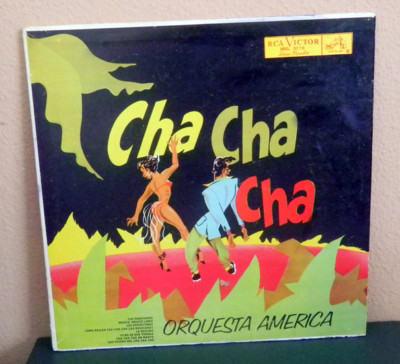
TITLE : CHA CHA CHA
ARTIST : ORQUESTA AMERICA
LABEL & RECORD #: Rca-Victor #MKL 3078 (1955) Later that year the 12" LP replaced the 10" one!
VINYL CONDITION: HEAR SOUND CLIPS: GLOSSY BUT WITH SOME NOISE (55 Years Old...) NO SKIPS!
LABELS CONDITIONS: SEE SCAN : NM
COVER CONDITION: SEE SCAN : GREAT COVER ART!!!....VG+++, NO Splits, Light Edge Stain/Wear!
REMARKS: THIS COLLECTOR ITEM DESERVES HISTORIC REMARKS COMPILED BY THE GREATEST CUBAN (& PUERTO RICO WHERE HE STILL LIVES) DON CRISTOBAL DIAZ AYALA!!!....LA ORQUESTA AMERICA Y EL CHA CHA CHA ("The Mambo's Cousin")
"Trataremos de resumir la historia de esta orquesta y sus dos figuras protagonistas, alrededor de los cuales se desarrolló y sigue vigente una de las grandes polémicas de la música cubana.
Anacario Crispiniano Mondéjar y Soto nació en Calimete, Matanzas el 25 de septiembre de 1914, de familia humilde. Se le apodó de niño Ninón, y así quedaría. Le gustaba cantar pero trabajó en varias actividades para abrirse paso. En 1942 había logrado establecerse como panadero en la población de Marianao, aledaña a La Habana, era miembro del Partido Socialista Popular (comunista) y organizó y dirigió una charanga a la que llamó América, que se desenvolvió discretamente en esta época que no fué la mejor para la música danzonera.
Al parecer al final de los 40 grabaron los cuatro danzones en el sello SMC que aquí aparecen y según información (no lo hemos oído) eran cantados por Raúl Simons.
Mientras Calimete queda al este de la Habana, el poblado de Candelaria queda al oeste. Allí nace el 25 de diciembre de 1926 Enrique Jorrín, quien también deriva hacia el imán, hacia la Habana, donde cursa studios de música en el Conservatorio Municipal. En 1941 ingresa en la orquesta de los Hermanos Contreras, pasa por otras hasta llegar a la más importante, a las Maravillas de Arcaño, en 1945. Hay danzones de su autoría grabados por Arcaño en 1946 y 1948, como: Que pollos, Doña Olga y Varón, lo que sea. Según sus
manifestaciones, en el año 1946 empezó a dirigir la orquesta América, en la que está hasta el año 1954. Pero en 1953 sucede algo muy importante: la orquesta América graba y el sello Panart lanza un disco que tiene por una cara un número llamado Silver Star, que según la etiqueta, original era un danzón y la otra cara La Engañadora, denominado en la etiqueta mambo-rumba. Pero en el estribillo de Silver Star se dice,
“Chachacha, chachacha, es un baile sin igual…” Y el público rebautiza así este nuevo ritmo, este Nuevo género musical.
En realidad, su gestación comienza con el danzón de nuevo ritmo de la orquesta de Arcaño, con más libertad para el bailador; con las innovaciones que varios compositores habían introducido en el danzón, en que en alguna de sus secciones un pequeño coro de la orquesta repetía un estribillo; término medio entre el rancio danzón instrumental clásico, y el danzón cantado, pasado de moda; pero estos dos números de Jorrín tenían unos pasos bien marcados, que acomodaban con el escobilleo de los bailadores arrastrando los pies, y era sobre todo más cómodo de bailar que el mambo, más rápido y de pasos más complicados.
El chachachá arrasó rápidamente. Se puso de moda en un santiamén. Pero empezó la pugna entre Ninón y Jorrín, primero sorda, y después abiertamente ventilada en los diarios y revistas de Cuba. Jorrín sale de la orquesta, porque Ninón tiene inscrito el nombre. Además, de 1955 en adelante empieza a denominar la orquesta “América del 55”, u orquesta “América de Ninón Mondéjar”. Comienza la guerra, para provecho de compositores de chachachá, de las charangas que rápidamente montan el nuevo ritmo, y ven de pronto sus calendarios de bailes llenos; de las casas disqueras, que rápidamente graban el nuevo ritmo. Los menos beneficiados, irónicamente, son Jorrín y Mondéjar. Pensando que Pérez Prado había popularizado el mambo en México, no en Cuba, ambos tienen la misma idea; llevar el mambo a México, Ninón con la América a fines de 1954 y Jorrín con la nueva orquesta que hace, con su nombre, y empieza a grabar con la Victor. Pero han dejado la plaza de Cuba libre, y la música aborrece el vacío, que llenan unos avispados chicos de Cienfuegos, la orquesta Aragón, que se convierten en los reyes del chachachá, empezando con orquestaciones que el propio Jorrín generosamente les brinda. Mientras tanto, allá en México, y para adaptarse al gusto mexicano, ambos le agregan trompetas a sus charangas.
Según Jordi Pujol a las notas de los TCD-100 y 103, al momento de producirse la ruptura con Jorrín, la orquesta se componía de Ninón Mondéjar, director y cantante, Jorrín y Antonio Sánchez “Musiquita” violines, Juanito Ramos, flauta; Alex Sosa, piano; Manuel Montejo “Camagüey”, bajo; Julio Salas, tumbadora; Augusto Barcía, timbal y Gustavo Tamayo, güiro. Jorrín fue sustituído por Ignacio Berroa y agregándose Félix Reina
que pasó a segundo violín. Al mes de estar en México, un grupo de los músicos de Ninón, Ramos, Sánchez, Montejo, Tamayo, Berroa y Salas decidieron regresar a Cuba y completar e inscribir una nueva orquesta a la que llamaron Orquesta América del 55, sustituyendo los que quedaron por el pianista Rubén González, el timbalero Pascualito Hernández y los cantantes Tony Raimat y Cheo Junco. Claro que las grabaciones que hace la América en la Habana hasta el 1955, siguieron gozando del favor del público, pero pronto Aragón fue ganando la primacía. Al cabo de los años, ambas orquestas regresaron a Cuba. Aunque se mantuvo y aún existe la orquesta América, tuvo que ceder su lugar cimero no tan sólo a la
Aragón, sino a otras charangas. Igual sucedió con Jorrín, que mantuvo la suya hasta su retiro, muriendo en la Habana, el 12 de diciembre de 1988. Mondéjar murió en La Habana el 27 de enero de 2006
Esta Es La America De Nino Mondejar....Mexico...1955
As It Happens With A New Dance Craze There Will Be Always A Question Without A Final Answer....Who Was The Creator Of That New Rhythm?? (It Still Happens With ...Who??? Salsa?, Mambo?, Cha Cha Cha? Rock'n Roll?....Different Opinions Even Within The Music Historians)...Here is one...The Cha Cha Cha(Supposedly Created So The Mambo Dancers Could Did it At A Slower "Speed":)
TRACKS SIDE A:
1- LOS MARCIANOS
2- MEXICO, MEXICO LINDO
3- LOS ESPIRITUNES
4- COMO BAILAN CHA CHA CHA LAS MEXICANAS
TRACKS SIDE B:
1- LA BASURA
2- YO NO SE QUE TENDRA
3-CHA-CHA-CHA EN MARTE
4- LAS VIUDAS DEL CHA-CHA-CHA
WEB REMARKS: I WILL BE PLACING ANOTHER 10" Rarity (Yayo y Cané) and 2 other Cuban Rarities in 12" LPs...Watch Out! EXTREMELY HARD TO FIND...THAT IS WHY I PLACED A "BUY ME NOW" OPTION...NO TE LO PIERDAS
SHIPPING CHARGES........FOR GATEFOLDS With 2 Lps ADD S&H FOR 2
POSTAL RATES & WEIGHTS - LPs
LBS.
0.82
1.4
1.9
2.6
3
# of LPs
1
2
3
4
5
USA MEDIA $4.00 $4.00 $4.00 $4.25 $4.50 USA PRIORITY $6.50 $9.50 $9.50 $11.50 $11.50 EUROPE $13.25 $15.50 $19.00 $24.00 $26.00 ASIA $13.25 $15.50 $19.00 $24.00 $26.00 SOUTH AMERICA $11.50 $15.00 $18.50 $23.50 $27.00 CENTRAL AMERICA $11.50 $15.00 $18.50 $23.50 $27.00 CARIBBEAN $11.50 $15.00 $18.50 $23.50 $27.00 MEXICO $10.00 $13.50 $16.00 $20.75 $22.00 CANADA $6.25 $8.25 $10.25 $13.00 $14.00
* We offer a money back + shipping costs guarantee on our records (unless otherwise noted) if you feel the LP was not graded properly We Must Be Notified Of Any Discrepancy in 2 Days after received. . We will issue a full refund upon its return, once our mistake has been verified. Record Must Be Returned in 3 Days…Foreign in 7 Days….We have available the insurance option…
WE USE STURDY CARDBOARD MADE BY BAGS UNLIMITED IN ORDER TO TO PROTECT YOUR RECORDS FOR ANY MISHANDLING/DAMAGE WHILE IN-TRANSIT
Record Grading: Standard guidelines for grading records comes down to a subjective judgment that may vary from person to person. We grade records and LP covers visually AND (when possible) play-tested. We make every effort to give full disclosure (remember that the LP has at least 12 tracks and the grading may vary between each other) and your satisfaction is guaranteed. Don't assume that our vinyl determination of "Very Good+" is the same as yours!
MM RECORDS: are shiny, with no visible defects. They might have some minor superficial (“Paper”) scuff but they should play without any noise. Writing, stickers or other markings cannot appear on the label, nor can any “spindle marks” from someone trying to blindly put the record on the turntable. Major factory defects also must not be present; a record and label obviously pressed off center is not Near Mint. If played, it will do so with no surface noise. (NM records don’t have to be “never played”; a record used on an excellent turntable can remain NM after many plays if the disc is properly cared for.)
NM COVERS: have no creases, ring wear or seam splits of any kind.
NM PICTURES SLEEVES: should look as if they never housed a record. This is a great reason to remove your 45s from their picture sleeves and keep them separate. Just keeping the 45 inside the sleeve will cause damage than can reduce the grade of the sleeve.
VG++ (Excellent) RECORDS: Barely noticeable play wear and background noise. May have surface scuffs and/or superficial marks, which will be inaudible or indiscernible from the background, no scratches. Very nice, no flaws noted.
VG++ COVERS: Artwork is still as close to perfect as can be. Some impression to the cover (minor outer ring wear) but no ink wear! Some slight creases to the corners, but not wrinkled and obtrusive to the eye. The corners can show white (where the artwork pasted slick was) meaning, slight wear. No seam splits or writing on the cover or taped repairs can make this grade.
VG+ RECORDS: may show some slight signs of wear, including light scuffs or very light scratches that do not affect the listening experience. Slight warps that do not affect the sound are OK. Minor signs of handling are OK, too, such as telltale marks around the center hole, but repeated playing has not misshapen the hole. There may be some very light ring wear or discoloration, but it should be barely noticeable
.VG+ COVERS: should have only minor wear. A VG+ cover might have some very minor seam wear or a split (less than one inch long) at the bottom, the most vulnerable location. Also, a VG+ cover may have some defacing, such as a cut-out marking. Covers with cut-out markings can never be considered Near Mint Unless Tiny/Small (EG: Tiny DH).
VG+ PICTURE SLEEVES: might show some very light creasing where it is obvious that a record once resided (or still does reside). A VG+ picture sleeve might have some very minor seam wear or a split (less than one inch long) at the bottom, the sleeve’s most vulnerable location.
VG RECORDS: have more obvious flaws than their counterparts in better shape. They lack most of the original gloss found on factory-fresh records. Groove wear is evident on sight, as are light scratches deep enough to feel with a fingernail. When played, a VG record has surface noise, and some scratches may be audible, especially in soft passages and during a song’s intro and ending. But the noise will not overpower the music otherwise. Minor writing, tape, or a sticker can detract from the label. Many collectors who have jukeboxes will use VG records in them and not think twice. They remain a fine listening experience, just not the same as if it were in better shape.
VG COVERS and PICTURE SLEEVES: will have many signs of human handling. Ring wear in the middle or along the edges of the cover where the edge of a record would reside, is obvious, though not overwhelming. Some more creases might be visible. Seam splitting will be more obvious; it may appear on all three sides, though it won’t be obvious upon looking. Someone might have written or stamped a price tag on it, too.
RECORDS GRADED VG OR BELOW WILL BE "SOLD AS IS"
(We Will Try To Grade Them As Accurately As Possible!)
TERMS & CONDITIONS
- You bid to win
- I am Honest & Fair and expect you to act in the same manner
- If you change your mind after the auction - I will still be charged by ebay for re-listing the item & for the final auction fee - so will need to file an unpaid item dispute to ensure that I am reimbursed by Ebay - I do not do it as some kind of revenge! so please understand my predicament
- Please ask any questions PRIOR to placing a bid
- Payment within 5 days
- my postage & packaging rates are fair & dispatch will be prompt
- Please leave feedback when your item arrives - then I know that you have received it and I can leave feedback for you
- If you are unhappy in any way please contact me first! Prior to using Negative feedback as we may have been able to reach a resolution that makes both of us happy!
- NEGATIVE FEEDBACK will always be left for timewasters
- Items are listed as accuretly as possible & any faults observed will be brought to your attention in the listing
- Lets make Ebaying a fair & honest way of buying & selling Reasonably products online!
price rating
![LP:Manfred Mann Chapter Three,Manfred Mann Chapter III Volume 1[NM] (Bronze Rec)](https://www.popsike.com/php/thumbnail.php?url=https://www.popsike.pics/pix/20120819/380463658046.jpg)


![Trainspotting [Vinyl LP]](https://www.popsike.com/php/thumbnail.php?url=https://www.popsike.pics/pix/20170612/272713508838.jpg)











![LP-BOX:Pop History Box Set,Die Geschichte der Popmusik(30 LP BOX SET)[NM]](https://www.popsike.com/php/thumbnail.php?url=https://www.popsike.pics/pix/20160505/182119924080.jpg)