New Sealed RARE 1953-4 WHAT'S MY LINE? TV OC LP ROSALIND RUSSELL JUDY HOLLIDAY +
$
100


Favourite Auctions
To save auctions to your favourites, please login
If you don't have an account, please register
Description
WHAT'S MY LINE?
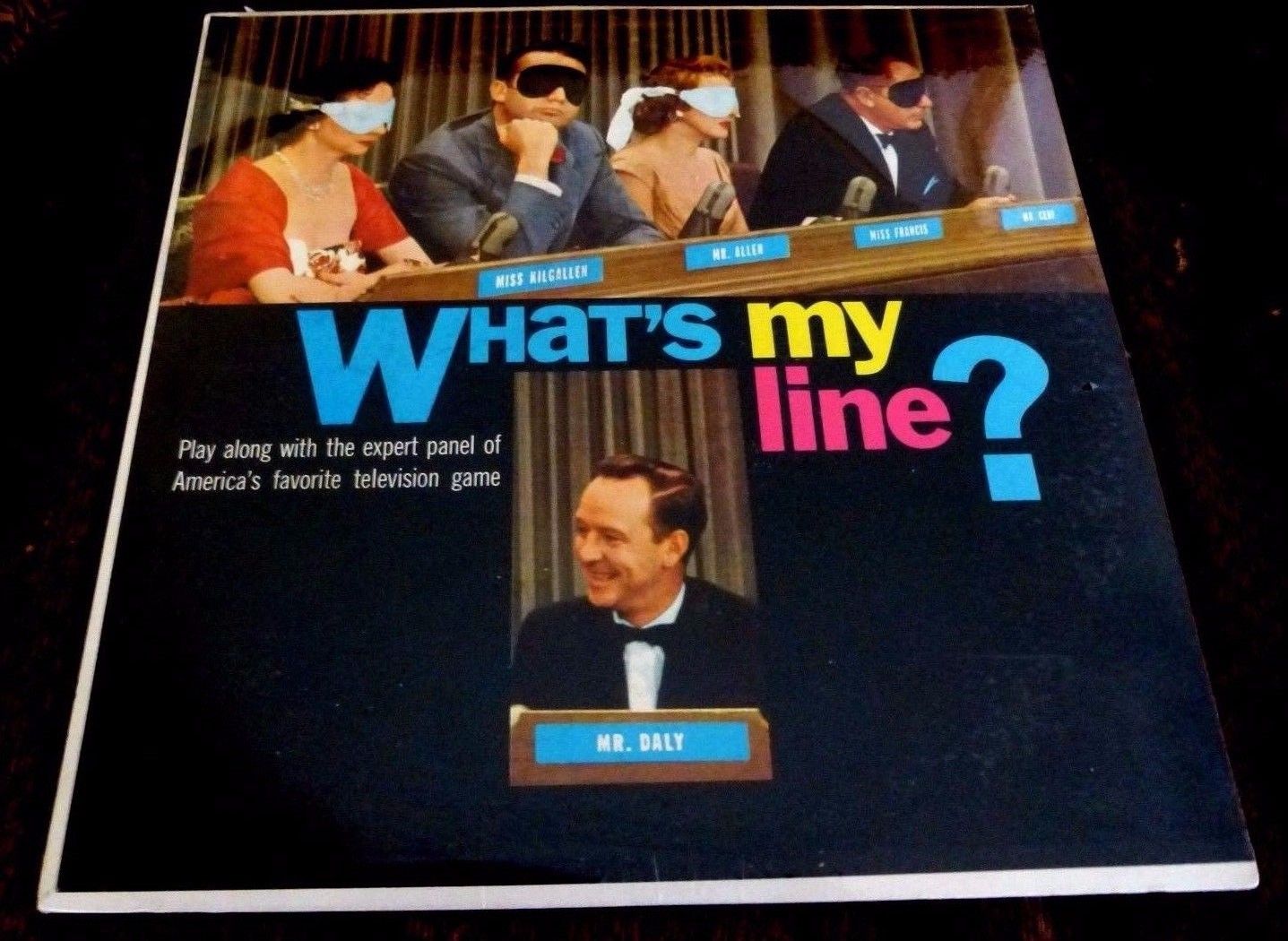
PICTURED: JOHN DALY with MASKED PANELISTS: DOROTHY KILGALLEN, STEVE ALLEN, ARLENE FRANCIS & BENNETT CERF
MYSTERY GUESTS ARE: ROSALIND RUSSELL, MARILYN MAXWELL, FRED ALLEN, PETER LAWFORD, DAVE GARROWAY, JUDY HOLLIDAY, JAYNE MEADOWS & WILLIAM BENDIX.
FROM THE 1953-4 SEASON.
"ARE YOU IN SHOW BUSINESS?"
FACTORY SEALED ORIGINAL CAST VINYL LP
Label: Dot Records ?– DLP 3153
Format: Vinyl, LP, Album
Country: US
Released: 1958
Genre: Non-Music, Stage & Screen
Style: Public Broadcast
Tracklist
A1 Mystery Guest 1 ROSALIND RUSSELL
A2 Mystery Guest 2 MARILYN MAXWELL
A3 Mystery Guest 3 FRED ALLEN
A4 Mystery Guest 4 PETER LAWFORD
B1 Mystery Guest 5 DAVE GARROWAY
B2 Mystery Guest 6 JUDY HOLLIDAY
B3 Mystery Guest 7 JAYNE MEADOWS
B4 Mystery Guest 8 WILLIAM BENDIX
VINYL = FACTORY SEALED
COVER = FRONT COVER IS MISSING SMALL PIECE OF SHRINKWRAP ON THE UPPER LEFT CORNER. CORNER TIPS ARE SLIGHTLY WORN FROM TIGHT SHRINKWRAP. BACK SIDE HAS ONLY A HINT OF RINGMARK UNDER THE SHRINKWRAP.
What's My Line? is a panel game show which originally ran in the United States on the CBS Television Network from 1950 to 1967, with several international versions and subsequent U.S. revivals. The game tasks celebrity panelists with questioning a contestant in order to determine his or her occupation, i.e., "line [of work]," with panelists occasionally being called on to identify a celebrity "mystery guest" with specificity. It is the longest-running U.S. primetime network television game-show. Moderated by John Daly and with panelists Dorothy Kilgallen, Arlene Francis, and Bennett Cerf, What's My Line? won three Emmy Awards for "Best Quiz or Audience Participation Show" in 1952, 1953, and 1958 and the Golden Globe for Best TV Show in 1962.[1][2]
After its cancellation by CBS in 1967, it returned in syndication as a daily production, moderated originally by Wally Bruner and later by Larry Blyden, which ran from 1968 to 1975. There have been several international versions, radio versions, and a live stage version.
In 2013, TV Guide ranked it #9 in its list of the 60 greatest game shows ever.[3]
The original CBS series, 1950 to 1967
Produced by Mark Goodson and Bill Todman for CBS Television, the show was initially called Occupation Unknown before deciding on the name What's My Line?[4] The original series, which was usually broadcast live, debuted on Thursday, February 2, 1950, at 8:00 p.m. ET. After airing alternate Wednesdays, then alternate Thursdays, finally on October 1, 1950, it had settled into its weekly Sunday 10:30 p.m. ET slot where it would remain until the end of its network run on September 3, 1967.
Starting in July 1959 and continuing for 8 straight years, until July 1967, when John Daly was due to appear in Moscow, the show would occasionally record episodes onto Quadruplex videotape for playback at a future date. This was then state-of-the-art technology, and Daly praised it upon his return from Moscow.[5] In such instances, there would often be two shows a day; the "taped" one, followed immediately by the "live" one.[6] The cast and crew began taking "Summer breaks" from the show in July 1961, through July 1967.
Hosts and panelists
The host, then called the moderator, was veteran radio and television newsman John Charles Daly. Clifton Fadiman,[7][8] Eamonn Andrews, and Random House co-founding publisher and panelist Bennett Cerf[9] substituted on the four occasions when Daly was unavailable.
The show featured a panel of four celebrities who questioned the contestants. On the initial program of February 2, 1950, the panel was former New Jersey governor Harold Hoffman, columnist Dorothy Kilgallen, poet Louis Untermeyer, and psychiatrist Richard Hoffmann. For the majority of the show's network run the panel consisted of Kilgallen, Cerf, actress Arlene Francis and a fourth guest panelist. During the show's earliest period the panel generally consisted of Kilgallen, Francis, Untermeyer and comedy writer Hal Block with Cerf replacing Untermeyer in 1951 and comedian Steve Allen replacing Block in 1953. Allen left in 1954 to launch The Tonight Show, and he was replaced by comedian Fred Allen, who remained on the panel until his death in 1956. After Kilgallen's death in 1965, the two remaining seats on the panel were never filled regularly again. The most frequent guest panelist was Arlene Francis's husband Martin Gabel, who appeared 112 times.
Regular announcers included Lee Vines, who so served from 1950 to 1955, Hal Simms, who served from 1955 to 1961, Ralph Paul, whose tenure was confined to 1961, and Johnny Olson, perhaps the best known of Goodson-Todman's television announcers, whose tenure began in 1961 and ran till 1967.
The game-play
What's My Line? was a guessing game in which the four panelists attempted to determine the occupation (i.e., "line [of work]") of a guest. In the case of the famous mystery guest each week, the panel sought to determine the identity of the contestant. Panelists were required to probe by asking only yes-no questions. A typical episode featured two standard rounds (sometimes a third, and very rarely a fourth) plus one mystery guest round. On the occasions on which there were two mystery guests, the first would usually appear as the first contestant.
Standard rounds
For the first few seasons, the contestant would first meet the panel up close, for a casual inspection, and the panel was allowed one initial guess. Beginning in 1955 Daly simply greeted and seated the contestant, who then met the panel at the end of the game. Additionally, starting April 17, 1955, the panel stopped taking initial guesses.[10] The contestant's line was then revealed to the studio and home audiences, and Daly would tell the panel whether the contestant was salaried or self-employed, and from 1960 on, dealt in a product or a service.
A panelist chosen by Daly would begin the game. If his question elicited a yes answer, he continued questioning. When a question was answered no, questioning passed to the next panelist and $5 was added to the prize. The amount of the prize was tallied by Daly who flipped one of 10 cards on his desk. A contestant won the top prize of $50 by giving ten no answers, or if time ran out, with Daly flipping all the cards. As Daly occasionally noted, "Ten flips and they (the panel) are a flop!" Daly later explained, after the show had finished its run on CBS, the maximum payout of $50 was to ensure the game was played only for enjoyment, and that there could never be even the appearance of impropriety.[citation needed] Later in the series, Daly would throw all the cards over with increasing frequency and arbitrariness (frequently to give a particularly interesting or worthy panelist the maximum available prize money), evidence the prize was secondary to game play.
Panelists had the option of passing to the next panelist—or even disqualifying themselves entirely if they somehow knew the contestant's occupation before the round. They could also request a conference, in which they had a short time for open discussion of ideas about occupations or lines of questioning.
Panelists adopted some basic binary search strategies, beginning with broad questions, such as whether the contestant worked for a profit-making or non-profit organization or whether the product was alive, worn, or ingested. To increase the probability of affirmative answers, panelists would often phrase questions in the negative starting with "Is it something other than..." or "Can I rule out..."
The show popularized the phrase, "Is it bigger than a breadbox?" Steve Allen first posed this on January 18, 1953, and it was then refined over subsequent episodes. Soon, other panelists were asking this question as well.[11][12] On one occasion the guest was a man who made breadboxes. Allen correctly guessed the guest's occupation after Kilgallen asked, "Is it bigger than a breadbox?" Daly could not restrain his laughter in response to the question.[13][14]
The mystery guest round
Blindfolds on for a mystery guest
The final round of an episode involved blindfolding the panel for a celebrity "mystery guest" (originally called "mystery challengers" by Daly) whom the panel had to identify by name, rather than occupation. (In the first edition, the mystery guest was New York Yankees shortstop Phil Rizzuto.)[15] In the early years of the show, the questioning was the same as it was for regular contestants, but starting with the April 17, 1955 edition, panelists were only allowed one question at a time.[10] Mystery guests usually came from the entertainment world, either stage, screen, television or sports. When mystery guests came from other walks of life, or non-famous contestants whom the panel but not the studio audience might know, they were usually played as standard rounds. However, the panel might be blindfolded, or the contestant might sign in simply as "X," depending on whether he would be known by name or sight.
Mystery guests would usually attempt to conceal their identities with disguised voices, much to the amusement of the studio audience. According to Cerf, the panel could often determine the identities of the mystery guests early, as they knew which celebrities were in town, or which major movies or plays were about to open. On those occasions, to provide the audience an opportunity to see the guest play the game, the cast would typically allow questioning to pass around at least once before coming up with the correct guess.[16]
Sometimes, two mystery guest rounds were played in an episode, with the additional round usually as the first round of the episode.
Style
What's My Line? is known for its attention to manners and class.[17][18] In its early years, business suits and street dresses were worn by the host and panelists, but by 1953, the men normally wore black suits with bow ties (a few guests in fact wore tuxedos) while female panelists donned formal gowns and often gloves. Exceptions to this dress code were on the broadcasts immediately following the deaths of Fred Allen[19] and Dorothy Kilgallen,[20] in which the male cast members wore straight neckties and the women wore simpler dresses.
The game followed a line of formality and adherence to rules. Although using first names at other points, Daly usually addressed using surnames when passing the questioning to a particular panelist. He would also amiably chide the panel[21] if they began a conference without first asking him.
However, even with such formality, Daly was not above trading bon mots with the panelists during the game, and Cerf would often attempt to make a pun of his name. Occasionally Daly would amiably one-up Cerf if he felt the pun was of lesser quality. Cerf also played a myriad of games with Daly's full name, John Charles Patrick Croghan Daly, reciting it correctly only a handful of times over the course of the series.[22]
Often Daly would need to clarify a potentially confusing question, but he had a penchant for wordy, almost long-winded replies that often left panelists more confused than before, which Danny Kaye once parodied as a panelist.[23] On more than one occasion, Daly "led the panel down the garden path" – a favorite phrase used when an answer had proven misleading to the panelists.
Broadcast format
From 1950 to 1966, the game show was broadcast in black-and-white, as was typical of most game shows at the time. But by 1966, all three networks were broadcasting their prime-time schedules entirely in color, including What's My Line? After the show ended in 1967, CBS replaced the color videotapes with the kinescope versions instead for syndication. As a result of this change, the 1966–1967 episodes of What's My Line? were only shown in black-and-white after the show ended.[24]
Radio[edit]
In addition to the television version, What's My Line was also broadcast on network radio for a short time. From May 20, 1952 to August 27, an NBC Radio version was produced on Tuesday nights with the same cast as the TV version. After August 27, the program was then broadcast live on CBS Radio on Wednesday nights at 8:00 PM for 10 months concluding July 1, 1953.[25][26] The radio version is notable for the only appearances of Marlene Dietrich, Constance Bennett, Paulette Goddard, and Marlon Brando.
1953 Community Chest Special
A Community Chest Special, completely separate from the regular production of episodes, was broadcast live on all the major networks (CBS, ABC, NBC, and DuMont) on the afternoon of Sunday September 27, 1953.[27]
Production practices
On-camera
The program began with Daly and panel entering from off-stage as they were introduced. Prior to 1954, both panelists and host began the program in their seats, but this was changed, responding to letters asking what panelists looked like away from their seats.[citation needed] The first panelist would be introduced by the announcer following the show's introduction, and each panelist would introduce the next in turn, with the last introducing Daly. During his tenure, Hal Block sat in the final seat and began the practice of introducing Daly with a pun. Upon his departure, Bennett Cerf took over this position and expanded these introductions, often telling long jokes which he tied to Daly in some way.[28]
To begin a round, Daly would invite the contestant to "come in and sign in, please," which, by 1960, had evolved to the more familiar "enter and sign in, please." The contestant entered by writing his or her name on a small sign-in board. Daly would then usually ask where the guest lived and, with a woman, if she should be addressed as "Miss" or "Mrs." Early in the show's run, the panel was allowed to inspect contestants, studying their hands, or label on their suit or asking them to make a muscle.
While ostensibly a game show, if there was time, it also was an opportunity to conduct interviews. Line's sister show, I've Got a Secret, and later, the syndicated version of WML engaged in the practice of contestants demonstrating their talents. However, despite frequent requests by the panel, particularly Arlene Francis, such demonstrations rarely occurred as according to executive producer Gil Fates, Daly was not fond of this practice.[28]
Sponsors
After the first four episodes, the show gained its initial sponsor when Dr. Jules Montenier paid to have his product, Stopette spray deodorant, featured in advertising on the program. This involved featuring the product in the show's opening, on the front of the panel's desk, above the sign-in board, and on Daly's scorecards. In his last years, Cerf explained to interviewer Robbin Hawkins that Dr. Montenier was ultimately ruined by his refusal to abandon or share sponsorship as the show entered new markets and became too expensive.[29][30] After Dr. Montenier sold Stopette to Helene Curtis,[31] the series was sponsored by a variety of companies which were either regular or rotating. Sponsors were accorded the same exposure on the set as Stopette. One of the first rotating sponsors, which actually came before Montenier's sale of Stopette to Helene Curtis (who continued to sponsor the program after the purchase and still promoted Stopette in their advertising), was the Remington Rand Corporation, who used their time to promote their line of electric shavers and business machines such as the UNIVAC.
Near the end of its run, sponsors would be introduced in the opening title and given commercials during the show, but would not be displayed on the set. Frequent sponsors in the 1960s were Kellogg's cereals, Allstate Insurance, and Geritol.
Behind the scenes
Unknown to the public, mystery guests were paid $500 as an appearance fee, whether they won or lost the game. This was in addition to the maximum $50 game winnings, which guests sometimes donated to charity. Guest panelists were paid $750 as an appearance fee. The regular panelists were under contract and were paid "much more," according to Fates.[32] Bennett Cerf explained that when he became a permanent member of the program, he was paid $300 per week, and he told Robbin Hawkins in their interview that by the end of the series, the panelists were being paid "scandalous amounts of money."[33][34]
Studio locations[edit]
The first four episodes (#001 – #004; February – March 16, 1950) were broadcast live from a converted loft at the former CBS Studio 41 Grand Central Studios at Grand Central Terminal (15 Vanderbilt Ave., NY).[35]
Beginning with the first Wednesday episode (#005; April 12, 1950, and continuing until around 1951), the show was broadcast from the now demolished CBS Studio 51 (Maxine Elliott's Theatre, aka Maxine Elliott Theatre, 109 W. 39th St., NY).[35]
At least by episode #034 (January 21, 1951),[36] the show moved to CBS Studio 59 (Mansfield Theatre, later renamed the Brooks Atkinson Theatre in 1960, 256 W. 47th St., NY), and stayed there until Episode #516, June 5, 1960.[35][37] Meanwhile, the concurrent 1952–1953 Radio edition, at least during the CBS run, was heard live from CBS Studio Building 22 (49 E. 52nd St., NY).[38]
In Episode #225 (September 19, 1954) a color edition of the show was broadcast live from CBS Studio 72 (On Manhattan's Upper West Side, Broadway at 81st St., NY). This predated the shows's eventual move to color by 12 years.[35][39]
In Episode #323 (August 12, 1956), in conjunction with the 1956 Democratic Party Convention, a special Chicago episode was broadcast from the studios of the CBS Chicago affiliate of WBBM-TV (630 N. McClurg Ct., Chicago, IL).[35]
In Episode #397 (January 12, 1958), a special Hollywood episode was broadcast from CBS Television City (7800 Beverly Blvd, Los Angeles, CA). The moderator's and panel's desks were not brought over, as they had been for the Chicago special.[40]
Beginning with episode #517, through episode #829 (June 12, 1960 – September 4, 1966), the show used CBS Studio 52 (254 W. 54th St., NY; the future Studio 54).[35] The last episode aired in black & white was taped on July 17, 1966, and the last episode to be produced there in black & white aired live on July 24.
For the final season, from episode #830 to episode #876 (September 11, 1966 – September 3, 1967), in conjunction with the program's permanent move to color, the show used CBS Studio 50 (Later renamed the Ed Sullivan Theatre, 1697 Broadway at 53rd St., NY).[35]
The final CBS network show[edit]
CBS announced in early 1967 that a number of game shows, including What's My Line?, were to be canceled at the end of the season. Bennett Cerf wrote that the network had decided that game shows were no longer suitable for prime time, and that the news was broken by the New York Times on February 14[41][42] before anyone involved with the show was notified.[43]
The 876th and final CBS telecast of What's My Line? aired on September 3, 1967; it was highlighted by clips from past telecasts, a visit by the show's first contestants, and the final mystery guest, who was John Daly himself. Daly had always been the emergency mystery guest in case the scheduled guest was unable to appear on the live broadcast, but this had never occurred. Mark Goodson, Bill Todman and Johnny Olson appeared on-camera as well.[44][45][46]
Broadcast history and Nielsen ratings[edit]
Season Time slot Rank Rating
1 1950–1951 Sunday nights at 10:30 PM Not in the Top 30
2 1951–1952
3 1952–1953 #20 35.3 (tie)
4 1953–1954 #28 29.6
5 1954–1955 Not in the Top 30
6 1955–1956
7 1956–1957 #26 28.9 (tie)
8 1957–1958 Not in the Top 30
9 1958–1959
10 1959–1960 #27 23.9
11 1960–1961 #22 23.1
12 1961–1962 Not in the Top 30
13 1962–1963 #13 25.6
14 1963–1964 #24 22.6
15 1964–1965 Not in the Top 30
16 1965–1966
17 1966–1967
The syndicated revival, 1968 to 1975
The revival premieres
Once the original What's My Line? had ended, Goodson-Todman struck a deal with CBS's syndication arm, which in time became the present-day Viacom, to syndicate a new weekday videotaped edition. This version became a staple of local stations's afternoon and early evening schedules, especially from the 1971-72 season onward, when the FCC forced networks to cede one half-hour to their affiliates. The Prime Time Access Rule was intended to permit local stations to produce news and public affairs programming, but instead many of them turned to programs like WML, as practically all stations outside the largest markets found it unprofitable to produce their own shows locally. The first three seasons (1968–1971) originated from Studio 50, the home of the original series.[47] In 1971, production of What's My Line? moved from the Broadway studio to Studio 6-A at NBC in Rockefeller Center,[48] and the series remained there for the rest of its run. As it had with the original series, Goodson-Todman went to ABC News to seek out a host, whose title had ceased to be that of "moderator," and hired Wally Bruner to take over for John Charles Daly. Bruner left the series at the conclusion of its fourth season, the 1971-1972 season, and actor Larry Blyden stepped in at the beginning of the 1972-1973 season to host the remaining three seasons.
The panelists for the revival
The syndicated edition had two regular panelists for its entire run, with Soupy Sales joining the returning Arlene Francis. Bennett Cerf appeared as a guest on an irregular basis till he died during production of the fourth season in 1971. Other panelists included Alan Alda, his father Robert Alda, Joanna Barnes, Joyce Brothers, Jack Cassidy, Bert Convy, Joel Grey, Elaine Joyce, Ruta Lee, Meredith MacRae, Henry Morgan, Gene Rayburn, Nipsey Russell, Gene Shalit and Dana Valery.
The look and the style
Unlike its predecessor, the syndicated What's My Line? did not emphasize formality as the panelists dressed in normal attire. In addition, the panelists were simply referred to by name and only their first names were displayed in front of them. The show did manage to keep some elements of the original series intact, as the intro used during the final two seasons on CBS was reused.[49] The panelists also entered in the same manner as they had before with Soupy Sales (or the panelist occupying the seat furthest left when he was absent) coming out first and introducing the person sitting next to him, and continuing down the line to Arlene Francis (or whoever occupied her seat while she was absent), who would then introduce the host.
The producers considered the revival a merger of What's My Line? and its 1950s spinoff, I've Got a Secret, which resulted in noticeable changes from the original. As with Secret, contestants frequently demonstrated their skill or product after the game. (Bruner, and later Blyden, would preface the demonstrations by asking Lloyd Gross, who directed most of the editions, "Lloyd, would you open the curtains, please?") Dollar signs for "no" answers were replaced by sequential numbers. Mystery guest rounds were no longer scored and simply ended with a correct guess or when time ran out. A new game was added, called "Who's Who?" In it, four audience members, selected before the show, stood on stage with four occupations indicated on cards and panelists would attempt to place the correct occupations with the contestants.
The set, designed by veteran Goodson-Todman art director Theodore Cooper, was predominantly blue and featured walls behind panel and host areas tiled with illustrations representing various occupations. This set debuted when the show premiered, made the move from Broadway to Rockefeller Center in 1972, and was used until the end of the 1973-74 season.
The later introductions
For the 1974-75 season, the show's set and introduction were changed. The tiles were done away with in favor of having blue walls with question marks painted on them, and the rest of the set adopted a red and yellow color palette. The animated intro was done away with in favor of the show's announcer offering a preview of one of the contestants's games, and the panelists simply entered the stage one at a time as they were introduced. The panel was still introduced from left to right, as they had been before, and Blyden was introduced last.
A bright, contemporary music package was composed by Charles Fox. According to Fox's book, Killing Me Softly: My Life in Music, Robert Israel of Score Productions paid him a buyout fee of $1,000 for the work. The music was performed and recorded at CTS Studios in Wembley, England, with Fox, Israel and producer Mark Goodson in attendance.
The announcers
Johnny Olson continued as announcer until 1972 when he parted for California, after which a succession of guest announcers were used including Wayne Howell, Dennis Wholey, Bob Williams, Jack Haskell, and Chet Gould,[50] with Gould eventually taking over full-time in early 1973.
After the death of Bennett Cerf[edit]
After Bennett Cerf's death, stations continued to air shows where he was a panelist resulting in confusion among some fans, who were seeing "new" episodes with Cerf long after hearing about his death. At the time, syndication involved tape sharing between stations airing series, a practice referred to as "bicycling." As such, while What's My Line? aired daily, each station airing the show did not air the same episode on a particular day. This prompted producer Gil Fates, who recalled the situation in his book, What's My Line?: TV's Most Famous Panel Show, to send a form letter response to fans who had written complaining about the late Bennett Cerf's failure to disappear, some saying the television stations were using poor taste. Fates explained that Cerf indeed had died, but television was practicing a time-honored tradition of celebrating one's work long after their death. As he wrote in his book, Fates knew, but did not tell viewers, about the production costs that would have gone to waste had his company acceded to the demands, some coming from station managers, to scrap the Cerf tapes.[51]
The revival's end and Blyden's death
The syndicated series ran for 1,320 episodes over seven seasons. An attempt at an eighth season did not get off the ground as not enough stations were willing to pick up the series for an additional year. With this in mind, Goodson-Todman offered host Blyden the hosting position on Showoffs, a charades-based game show that the company was developing for ABC's daytime lineup. He accepted and shot a pilot shortly after What's My Line? ended production. However, Blyden never got to host the series as he was killed in an automobile accident while traveling in Morocco just before taping was to begin. At the time of Blyden's death, a handful new episodes of What's My Line? had yet to air in certain markets; by the fall of 1975, the last of these episodes had aired across the United States.
Later revival attempts[edit]
New versions of WML were planned as early as 1981, then in 1996, the show was going to be revived by a joint venture between All-American Television and Miramax Films (which also would have been Miramax's first foray into television game shows) as it was being described as "a new model" that would have blended the original features such as having a celebrity panel question contestants in an effort to guess their occupation and also having the panel "Blindfolded" to guess the identity of a famous person, with contemporary "special effects" and "interactive twists." CBS reportedly committed to air six episodes for its fall 1999 schedule. However, according to the president of Miramax TV Billy Campbell, the deal crumbled because the network decided the show was too costly and ambitious. In 2000, a pilot was shot with host Harry Anderson (of Night Court fame) for CBS, but was later turned down in favor of the reality show Survivor. In 2008, another revival of the show with actor David Hasselhoff was planned in cooperation with FremantleMedia, which had taken over ownership of all Goodson-Todman and Mark Goodson Productions programming, that never got off the ground. None of these revivals, however, ever made it to air. In 2014, another pilot for a revival was shot to offer to stations in 2015.
The Woody Allen parody[edit]
It was during the run of the syndicated version that Woody Allen parodied What's My Line? in his 1972 film Everything You Always Wanted to Know About Sex, with the segment "What Are Sex Perverts?" featuring a game show called What's My Perversion? Appearing as panelists were Robert Q. Lewis, who had been a panelist on the original What's My Line?, and Pamela Mason, who had been a mystery guest. Jack Barry, partner of Dan Enright, both of whom had taken falls in the quiz-show scandals of the 1950s, hosted the What's My Perversion? game show, years before both would finally return to television in triumph with The Joker's Wild.
After What's My Line?
25th anniversary special[edit]
In early 1975, with production of the syndicated version of the series on break, the show's staff went through the annual process of selling the syndication rights to TV stations across North America. That year, there were not enough takers to justify further production.[52] Just days after disbanding their technical crew, Goodson and Todman pitched the idea of a retrospective network special to celebrate the 25th anniversary of the program's CBS debut, called What's My Line at 25. The programming department at CBS turned down the idea[53] but ABC bought it. The special was broadcast by ABC on May 28, 1975 as a late-night Wide World Special, and is currently available for viewing at The Paley Center for Media. It made a return to television as a one-time rerun on Game Show Network on December 25, 2014 at 1:00 A.M. EST.
In producing the special, the only existing master 16mm prints of the original series kinescope films were removed from storage and brought to a Manhattan editing facility that Goodson-Todman Productions rented. There, company employees Gil Fates, Bob Bach, Pamela Usdan and Bill Egan[53] worked round-the-clock for three days to compile the 90-minute special under deadline pressure from ABC network official Bob Shanks.[54] In the process of viewing and editing the films for the special, they accidentally damaged or destroyed several kinescope films which spanned the entire run of the original series, including a few that did not make the final cut of the retrospective.[28] In addition, some unspooled film remained on the floor after the group's rented time at the facility ran out.[28] An April 1967 episode featuring Candice Bergen as the mystery guest was lost in its entirety, as was a June 1967 episode featuring both Betty Grable and F. Lee Bailey. Other episodes sustained only partial damage, such as a 1965 episode that is mainly damaged during the mystery guest appearance of Marian Anderson.
COMBINE RECORD SHIPMENTS AND SAVE MONEY ON SHIPPING!!! Visual Grading Is as Follows:MINT .. Literally Perfect Record, Shiny Gloss, No Marks, Beautiful Condition.
MINT- .. Very Clean, Light Paper Marks... A Great Record for Most Any Collector.
VG++ (EX) ... Very Clean, Light Paper Marks... Plays Well with Seldom, but Occasional and Minimal Surface Noise
VG+ .. Light Scratches Only, Should Play Well with Only Occasional and Minimal Surface Noise at Times.
VG .. A Nice Record, Looks Used with Some Scratches. Plays with Some Surface Noise.
VG- .. Rough with Scratches and has Some Surface Noise , but Will Play without skips.
G .. Plays Quite Rough, Has Multiple Scratches, Very Noisy.
P .. Poor Condition. Good only for those who will accept any copy to fill in their collection.
COMBINE RECORD SHIPMENTS AND SAVE MONEY ON SHIPPING!!!
USA: ADD $1.00 FOR EACH ADDITIONAL LP (2 LP SETS COUNT AS 2, ETC.)INTERNATIONAL COMBINING: PLEASE CONTACT DUE TO HIGH RATES AND WEIGHT RESTRICTIONS
If You Are Interested in SIMILAR ITEMS, Please:
VISIT MY EBAY STORE
Just Click Below to Visit Seller's Store:
Baby Jane's Looney Bin
price rating