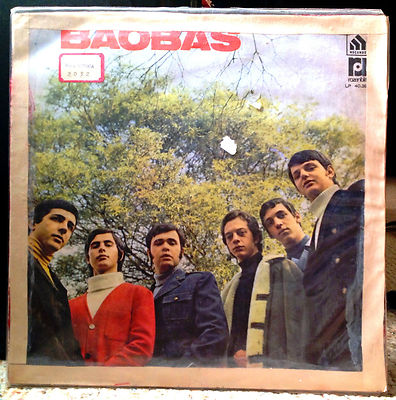
NM/VG+ (R/S) 1968 OS BAOBAS Baobás Orig. 1st Vinyl Debut LP Brazil Psych Fuzz
$
43


Favourite Auctions
To save auctions to your favourites, please login
If you don't have an account, please register
Description
Be sure to add me to your favorites list! Check out my other items!;Check me out on YouTube
Kevin's Live Music Video Vault!
Combined payment/shipping discount: Pay standard USPS Media Mail rate for first item, and then pay only $1.00 for each additional LP/CD within 3 days.
J
The Psychedelic Artwork
is not for sale!! Just for fun!!J
(Stock Photo)
Baobás ?– Baobás
Label:
Mocambo / Rozenblit (Rio, Brazil) - LP 40.388
Format:
Vinyl, LP, Album
Country:
Brazil
Released:
1968
Genre:
Rock
Style:
Garage Rock
TracklistHide Credits?
A1
Nights In White Satin
Written-By – Hayward*
3:52
A2
Hello I Love You
Written-By – Doors, The
2:16
A3
Undecided Man
Written-By – Lindsay
1:45
A4
Sunny Afternoon
Written-By – Davis*
2:58
A5
Tonite
Written-By – Googha
3:15
A6
I Love You
Written-By – White
5:11
B1
Orange Skies
Written-By – Maclean*
3:14
B2
Baby Come Back
Written-By – E. Grant*
2:43
B3
Hey Joe
Written-By – Hendrix*
3:21
B4
Well Respected Man
Written-By – Davis*
2:37
B5
Got To Say Goodbye
Written-By – Tuca
3:00
B6
The Dock Of The Bay
Written-By – O. Redding*, Cropper*
2:43
Here it is, "the most important band of garage '60s in Brazil, Os Baobas. This original LP, together with The Beat Boys LP, is today one of the most wanted records for garage collectors. Os Baobas were one of the most important bands in Sao Paulo's garage rock scene of the sixties, but they have remained in obscurity in the USA. The band is best remembered for having included Liminha (later on a Mutantes member and producer) in its line-up and having played with Caetano Veloso, replacing the Beat Boys.
'Os Baobas was a good garage band from Brazil with psychedelic tinges, their career lasted from 1965 to 1968. They initially called themselves Rubber Souls, but change to Baobas after "Baobab", a big African tree on the suggestion of singer Ronnie Von (taken from Saint-xupery's The Little Prince).
They also backed Caetano Veloso on some T.V. appearances, deputising for The Beat Boys, and even recording a single with Ronnie Von, Menina Azul (which was co-written by Ricardo Contins and Ronnie Von).
Like many of their contemporaries, Os Baobas drew their repertoire from U.K. and U.S. records unissued (at least at the time) in Brazil, like the Doors (their Light My Fire came out before the original was issued there), Love (Orange Skies), the Kinks (A Well-Respected Man and Sunny Afternoon). Other covers of note were the Turtles' Happy Together and their version of the Stones' Paint It Black (Pintada De Preto), but there were original compositions by Ricard Contins (Down, Down).' - Dreams, Fantasies And Nightmares
Liminha
From Wikipedia, the free encyclopediaLiminha (born Arnolpho Lima Filho in 1951 in São Paulo) is a Brazilian musician and producer. He started his career as the bassist of "Os Baobás", and was called in 1970 to tour with Os Mutantes, becoming an official member later. In 1974, he left the group to start his producing career.
He produced albums of artists such as Ritchie, Gilberto Gil (he produced his Grammy Award winner album Eletroacústico,[1] Os Paralamas do Sucesso, Kid Abelha, Elis Regina, Barão Vermelho, Titãs, Raul Seixas,Guilherme Arantes, Gabriel, O Pensador, Belchior, Daniela Mercury, Ed Motta, João Gilberto, Luis Melodia, Chico Science & Nação Zumbi, Fernanda Abreu, Lulu Santos, Oswaldo Montenegro, As Frenéticas, O Rappa,Jorge Ben Jor and Forfun. He co-wrote the song "Vamos Fugir" with Gilberto Gil, which was later covered by Skank.
Brazilian rock
From Wikipedia, the free encyclopediaIn São Paulo there were Os Baobás, who recorded cover versions of the Kinks, Love, Turtles and the Rolling Stones, during the beginning of their activities. From the 1960s is also Os Primitivos, from Brasília, mixing traditional folk rock (in the vein of the Byrds) with Brazilian Northeastern folk music (i.e. baião).
In the legendary show named Opinião, in 1964, the first Brazilian genuine musical, Zé Kéti represented the black people, João do Vale, the people from the Northeastern region, and Nara Leão (then substituted by Maria Bethânia) represented the woman from the Brazilian high society. The inovattive proposal of this show changed the Brazilian music forever from the post-Bossa Nova period, because it introduced other Brazilian genres to popular music. Sometimes with the protest characteristic the MPB base was formed:Chico Buarque, Edu Lobo, Geraldo Vandré, Sérgio Ricardo, João Donato, Eumir Deodato, Roberto Menescal, MPB4, Quarteto em Cy, Francis Hime, and Joyce, arising fromBossa Nova, in spite of the music is not rock, their collaboration is important on almost all popular urban genres, including the rock. In 1969, Marcos Valle, that belonged to the second generation of the Bossa Nova, change his style to a Psychedelic rock and Soul music Brazilian concept, and his brother Paulo Sérgio Valle went in a similar way.Sidney Miller is a very important musician for the MPB transformation process because he included the rock and the 60s and 70s international pop in his music. From this post-bossa nova time, Tuca, a female singer/songwriter, traveled to Europe in 1969, settling in Paris for six years (she has performed for several countries including Spain, Italy and Holland) when in 1971 Françoise Hardy released the album "La question", the result of close partnership between both and thereafter, her performance turned more rocker.
The Tropicália movement turned the psychedelic rock and the use of electric instruments more popular in the Brazilian music. Some tropicalistas were: Caetano Veloso, Gilberto Gil, Tom Zé, Gal Costa, Rogério Duprat,Torquato Neto, Nara Leão, etc... The seminal "tropicalista" Os Mutantes influenced and tended for the psychedelic rock'n'roll and is one reference for several relevant bands and musicians in the world.
Clube da Esquina, a group of friends from Minas Gerais, one of the most culturally prolific regions from Brazil, was joined with the Tropicália responsible for the diffusion on bigger scale by the electrification of the pop and rock music, with a universal, but Brazilian proposal. Some musicians from this group are: Milton Nascimento, Lô Borges, Toninho Horta, Beto Guedes, Novelli, Nelson Angelo, Tavinho Moura and the band Som Imaginário.
Billboard Albums
Year Album Chart Peak noneBillboard Singles
Year Single Chart Peak none I try to rate my records down one level than I feel they should be, due to opinion differences. Please note that I can not possibly play test every LP. If there are any problems, please let me know, as my return policy is fair. CDs are rated NM if opened but played no more than once.J
J
Orange Skies by Baobas on Vimeo ? 3:16? 3:16 vimeo.com/39530104Share Mar 31, 2012 The Baobas recorded Orange Skies in 1968, Sao Paulo, Brazil.os baobas - night in white satin
All The Videos From The Psychadilsnik Page Will Be Back up Soo
Os Baobas Tonite 1
- HD
J
JJ
The Disc (Vinyl) and the Album Cover are graded separately.
DISC (VINYL) GRADES SS(STILL SEALED) Sealed at factory and never opened. Disc is assumed to be undamaged and mint, but this cannot be proven until the album is actually opened and the disc examined. M
(MINT) Perfection, no flaws, defects, marks or otherwise indications of being handled or played. Any scuffs, hairline scratches or other marks disqualify discs from this category. I do not use this grade, as even the act of inserting the disc or removing it from the paper sleeve may cause scuff marks on the vinyl. NM or M-
(NEAR MINT or MINT MINUS) This is highest grade that I will assign to opened, handled records. The vinyl is virtually flawless, bright and shiny. A very minor, barely visible scuff or two may be permitted, but no scratches. The disc should play with no audible noise. The label is bright, clean and unmarked. E or VG++
(EXCELLENT or VERY GOOD ++) Disc plays near perfectly, but may have minor paper scuffs that do not interfere with the sound quality. There can possibly be a hairline scratch or two but nothing that is obvious or affects play. Vinyl is bright and shiny; label is clean and unmarked. VG+
(VERY GOOD PLUS) Some visible surface wear, very minor scratches and scuffs, but minimal impact on the sound quality. Vinyl will still have good luster; labels may have minor imperfections (small labels or initials, etc.) but otherwise clean. VG
(VERY GOOD) Vinyl will have noticeable scratches or scuffs that cause minor surface noise, but do not overpower the music. There will be no skips. Vinyl may appear somewhat dull and grayish. Labels may have small tears, tape marks, larger writing, etc. but still easily legible. There may be wear or deformation of the spindle hole. G
(GOOD) Well-played, dull, grayish vinyl with deeper scratches and wear causing distracting surface noise (hisses, pops, cracks and other nasties). The record will still play through without any skips. Labels may be significantly defaced or damaged. F
(FAIR)
P
(POOR) Unless the record is particularly rare, I would not try to sell a record in this condition. There will be major noise, surface damage, deep scratches, and skips. Attempting to listen to these discs will be painful. These discs are basically trash unless a collector desires one to fill a space in a collection until a better one comes along. ALBUM COVER GRADES SS
(STILL SEALED) Album is still in the factory-applied shrink-wrapping. M
(MINT) Absolutely perfect; no corner dings, marks, tears, dents, impressions from the disc, or other flaws. Cover should appear as if a record has never been inside. NM or M-
(NEAR MINT or MINT MINUS) Very minor signs of wear or cover impressions. Artwork is as close to perfection as possible. E or VG++
(EXCELLENT or VERY GOOD ++) Minor disc impression or slight corner creases, no wrinkles, puckers, seam splits or writing on the cover. Artwork is clean and unworn and there is no ink wear. VG+
(VERY GOOD PLUS) Cover is clean but may have minor writing or marks and may show slight wear. There may be just the start of ring wear, where the disc has created a raised area on the cover that resulted in the ink wearing off the paper. There may be slight discoloration or staining, minor seam wear, but no splits or tears. Corners may have small creases or fraying. VG
(VERY GOOD) Covers are worn and used. Seams may be starting to split or may have been unobtrusively repaired with clear tape. There is moderate ringwear, but the artwork is still attractive. There may be yellowing or discoloration and there may be larger writing, labels, or marks. Corners may have damage or creases and there may be scratches or gouges that otherwise damage the artwork. G
(GOOD) Several (but not all of the following flaws will apply: Seam splits, large marker writing, major seam splits, significant ring wear, damaged corners, tears, cuts, gouges, masking or duct tape seam repairs, or other flaws and damage. Again, probably only useful to fill a collection niche until something better can be found. F
(FAIR)
P
(POOR) Trash, useable only to keep the record off the floor.
My YouTube Feature - Kevin's Live Music Video Vault http://www.youtube.com/playlist?list=PL9CE07D64936CE306 My kids newspaper project on Facebook http://www.facebook.com/pages/The-Wiki-Weekly/266866373375558?ref=hl My ebay items for sale http://www.ebay.com/sch/m.html?_sop=1&_from=&_nkw=&_dmd=2&_armrs=1&_ssn=psychedelic-kevin&_ipg=96&rt=nc
price rating