MUSICA FUTURISTA LUIGI RUSSOLO-MARINETTI 2-LP AVANT-NWW
$
52


Favourite Auctions
To save auctions to your favourites, please login
If you don't have an account, please register
Description
FILIPPO TOMMASO MARINETTI / ALFREDO CASELLA / LUIGI RUSSOLO / DANIELE NAPOLETANO / SILVIO MIX / FRANCESCO BALILLA PRATELLA / ETC.
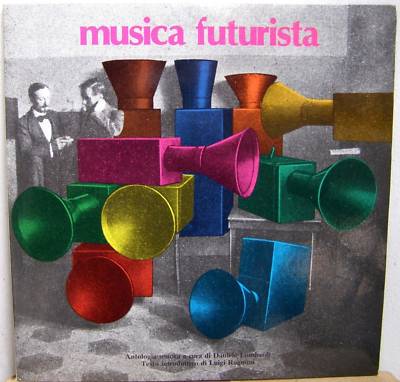
MUSICA FUTURISTA 2-LP
Fonit Cetra
Gatefold Cover
Must have historic sound document of the ground-breaking "musics" & documentary recordings of the futurist movement. Italian press on Fonit Cetra.
Some info on the release: See Broken Music book. Musica Futurista is a collection of music and spoken word from the Italian Futurist movement 1909-1935, including original recordings by Marinetti, Russolo and Balilla Pratella. Daniele Lombardi, both performer and scholar of avantgarde music, was also the editor of the first LP release of this collection. As well as period recordings, including free-verse readings by Marinetti and Russolo's intonarumori, the record includes contemporary performances by Daniele Lombardi of other key Futurist piano works. Russolo's public performances scandalized Europe in 1914 yet still resonate today. Although his extraordinary ideas met with fierce resistance, it is now clear he exerted a powerful influence on a number of leading avant-garde and experimental composers, initially Igor Stravinsky, George Antheil and Arthur Honegger, and later John Cage, Edgard Varese, Karlheinz Stockhausen and Harry Partch, as well as non-classical electronica and avant-rock.
Filippo Tommaso Marinetti initiated the movement in his Manifesto of Futurism, published in February 1909. Futurist music rejected tradition and introduced experimental sounds inspired by machinery. It influenced several 20th century composers. The musician Francesco Balilla Pratella joined the movement in 1910 and wrote the Manifesto of Futurist Musicians (1910), the Technical Manifesto of Futurist Music (1911) and the The Destruction of Quadrature (Distruzione della quadratura), (1912). In The Manifesto of Futurist Musicians, Pratella appealed to the young, as had Marinetti, because only they could understand what he had to say. He boasted of the prize that he had won for his musical Futurist work, La Sina d’Vargöun, and the success of its first performance at the Teatro Communale at Bologna in December 1909, which placed him in a position to judge the musical scene. According to Pratella, Italian music was inferior to music abroad. He praised the "sublime genius" of Wagner and saw some value in the work of Richard Strauss, Debussy, Elgar, Mussorgsky, Glazunov and Sibelius. By contrast, the Italian symphony was dominated by opera in an "absurd and anti-musical form". The conservatories encouraged backwardness and mediocrity. The publishers perpetuated mediocrity and the domination of music by the "rickety and vulgar" operas of Puccini and Umberto Giordano. The only Italian Pratella could praise was his teacher Pietro Mascagni, because he had rebelled against the publishers and attempted innovation in opera, but even Mascagni was too traditional for Pratella's tastes. In the face of this mediocrity and conservatism, Pratella unfurled "the red flag of Futurism, calling to its flaming symbol such young composers as have hearts to love and fight, minds to conceive, and brows free of cowardice".
Luigi Russolo (1885-1947) was an Italian painter and self-taught musician. In 1913 he wrote The Art of Noises, which is considered to be one of the most important and influential texts in 20th century musical aesthetics. Russolo and his brother Antonio used instruments they called "intonarumori", which were acoustic noise generators that permitted the performer to create and control the dynamics and pitch of several different types of noises. The Art of Noises classified "noise-sound" into six groups:
- Roars, Thunderings, Explosions, Hissing roars, Bangs, Booms
- Whistling, Hissing, Puffing
- Whispers, Murmurs, Mumbling, Muttering, Gurgling
- Screeching, Creaking, Rustling, Humming, Crackling, Rubbing
- Noises obtained by beating on metals, woods, skins, stones, pottery, etc.
- Voices of animals and people, Shouts, Screams, Shrieks, Wails, Hoots, Howls, Death rattles, Sobs
Futurism was one of several 20th century movements in art music that paid homage to, included or imitated machines. Feruccio Busoni has been seen as anticipating some Futurist ideas, though he remained wedded to tradition. Russolo's intonarumori influenced Stravinsky, Honegger, Antheil, and Edgar Varèse. In Pacific 231, Honegger imitated the sound of a steam locomotive. There are also Futurist elements in Prokofiev's The Steel Step.
Most notable in this respect, however, is George Antheil. Embraced by Dadaists, Futurists and modernists, Antheil expressed in music the artistic radicalism of the 1920s. His fascination with machinery is evident in his Airplane Sonata, Death of the Machines, and the 30-minute Ballet mécanique. The Ballet mécanique was originally intended to accompany an experimental film by Fernand Léger, but the musical score is twice the length of the film and now stands alone. The score calls for a percussion ensemble consisting of three xylophones, four bass drums, a tam-tam, three airplane propellers, seven electric bells, a siren, two "live pianists", and sixteen synchronized player pianos. Antheil's piece was the first to synchronize machines with human players and to exploit the difference between what machines and humans can play. Russian Futurist composers included Mikhail Gnesin, Alexander Goedicke, Geog Kirkor (1910-1980), Julian Krein (1913- 1996), and Alexander Mosolov.
Condition: Vinyls lie in excellent condition, look clear with some storage wear and play nice and clean with some occasional crackle, while cover lies in mint- condition with very light storage wear.
Tracklist
A1 Francesco Balilla Pratella - La Guerra - Tre Danze Per Orchestra Op 32 1. L'aspettazione 2:21 A2 Francesco Balilla Pratella - 2. La Battaglia 2:51 A3 Francesco Balilla Pratella - 3. La Vittoria 3:16 A4 Francesco Balilla Pratella - Giorno Di Festa 3:13 A5 Silvio Mix - Due Preludi Dagli Stati D'Animo - Assai Calmo Molto Largo E Drammatico 2:43 A6 Silvio Mix - Profilo Sintetico Musicale Di Marinetti 1:12 A7 Franco Casavola - Prelude To 'Prigionieri' 2:47 A8 Franco Casavola - Danza Della Scimmie 2:29 B1 Filippo Tommaso Marinetti - Cinque Sintesi Radiofoniche 13:07 B2 Daniele Napoletano - Estratti Musicali 6:53 C1 Luigi Russolo - Risvegli Di Una Città 0:25 C2 Luigi Russolo - Esempi Sonori Di: A) Crepitatore B) Ululatore C) Gracidatore D) Gorgogliatore E) Ronzatore F) Arco Enarmonico 2:53 C3 Antonio Russolo - A) Corale B) Serenata 4:31 C4 Virgilio Mortari - Fox Trot Del Teattro Della Sorpresa 5:05 C5 Luigi Grandi - I) Aeroduello II) Cavalli + Acciaio 5:41 D1 Filippo Tommaso Marinetti & Aldo Giuntini - Sintesi Musicali Futuristiche 6:56 D2 Aldo Giuntini - The Indian Rubber Man (Foxtrot) 2:00 D3 Alfredo Casella - Pupazzetti 6:10 D4 Filippo Tommaso Marinetti - La Battaglia Di Adrianopoli 3:05 D5 Filippo Tommaso Marinetti - La Definizione Di Futurismo 3:08SHIPPING & PAYMENT
Shipping: Shipping for this double LP is 9$ airmail in Europe / 12$ for the rest of the world
Registered mail: +5$
Insurance: optional
Combined shipping: BIG discounts
Payment: Paypal
Packaging: I am a collector too and i know
price rating