MFSL UHQR Alan Parsons I Robot | No Reserve
$
88


Favourite Auctions
To save auctions to your favourites, please login
If you don't have an account, please register
Description
RARE - Ultra High Quality Recording (UHQR), by Mobile Fidelity Labs
Brief History of Mobile Fidelity Labs via Wikipedia:
http://en.wikipedia.org/wiki/Mobile_Fidelity_Sound_Lab
Mobile Fidelity Sound Lab (MFSL or MoFi) is a company known as an innovator in the production of audiophile-quality sound recordings. All releases are advertised as being produced from the first-generation analog master recordings, and using proprietary technology, which MFSL claims allows for improved sound quality. MFSL has produced LP,[1] CD, DVD and cassette tape releases. Each title is licensed from the original record company as a limited edition item. It is manufactured and sold only within a specific period of time.
The emphasis on quality at MFSL has been praised by critics and music fans. The success of MFSL proved that there was a significant market for premium product and encouraged other labels to emphasize quality also. Many other "audiophile" labels soon sprouted up to compete with MFSL, some of these begun by the major record labels themselves.
Half-Speed LP Mastering
MFSL initially became known to the public for the Half-Speed Mastering technique, which has since been employed by many other record companies. It was the first label to use this as standard on all of its LP releases. The use of this technique was pioneered by engineer Stan Ricker, who mastered all of the early MFSL releases. Ricker's work can be recognized by the signature "SR/2" carved between the run out grooves.
With some notable exceptions, MFSL uses the original master tape as its source. This tape was then played back at half its original speed (if the master tape were recorded at 30 inches per second, it would be played back at 15 ips.) Simultaneously the record cutting lathe runs at 16?? revolutions per minute (half of its regular speed of 33?? RPM.)
The Half-Speed Mastering technology allows for cleaner reproduction of high frequencies (by cutting the actual transfer frequency in half) and allows twice as much time to carve a groove that accurately represents the sound on the master tape. It also permits extended high frequency response, extending into the ultrasonic region.
Jack Hunt ("JH/2") mastered many of MFSL's releases in the 1970s and 1980s. Some later titles were mastered by John LeMay and Paul Stubblebine, with a few uncredited releases. Currently, Shawn R. Britton and Rob LoVerde are mastering most LPs for MFSL. CD, SACD, and audio cassette mastering has been done by a variety of engineers, most recently by Britton. The company has only had a handful of engineers in its history.
Supervinyl
Early MFSL titles were pressed by JVC in Japan on virgin 180 gram "SuperVinyl" LP discs. JVC originally developed this proprietary plastic compound in the early 1970s to reduce record wear on discreet 4-channel quadraphonic LP records. Supervinyl is a harder and more durable plastic than is normally used for LP records. The pressings exhibit a very low amount of surface noise, pops, clicks or other defects. Supervinyl remains a proprietary JVC technology and in the late 1980s JVC stopped production of the product. JVC has declined to license the use of Supervinyl to any other manufacturer, including MFSL.
Early History and the LP Era – 1971 to 1984
Recording engineer Brad Miller (1939–1998) created the first recordings on the Mobile Fidelity label during the late 1950s and 1960s. These were highly realistic recordings of environmental and locomotive sounds which drew interest from audiophiles but gained little attention from the public. In 1971, while located in Burbank California, the company released a 7" 45rpm single, MFP-1 "Saunders Ferry Lane"/"Early Morning" by Clare (Torry) which was produced by Brad Miller. (The promotional version used stereo and mono versions of the A-side.) The record was re-issued as A&M Records 1299-S through the Mendes/Graham Association.
MFSL gained a reputation for emphasizing quality at all points in the sound duplication and manufacturing process. At this time MFSL was very unusual in the record industry by offering a premium quality product at prices significantly higher than the major record companies. Simultaneously, most large record labels were forced to lower costs and reduce quality standards. The decline in quality at the major labels was brought on by uncertain economic conditions and high inflation, declining record sales and increasing vinyl costs. In 1977 most major labels were using relatively poor quality disc mastering and duplication methods and had begun pressing their product on thin and often recycled vinyl. These low cost methods led to an unnecessary increase in surface noise and other audio distortions.
By 1977 Miller and entrepreneur Gary Giorgi established Mobile Fidelity Sound Lab as a record company originally based in the suburb of Veradale, Washington, near Spokane. MFSL's first four LPs in this series were pop-orchestral titles performed by the Mystic Moods Orchestra. These albums also made extensive use of natural sound effects. Following this MFSL shifted course, offering mostly well known Rock, Pop, and Jazz titles licensed from major record companies. The first of these was Crime of the Century by Supertramp, originally released by A&M Records in 1974. Another early success was Katy Lied by Steely Dan, licensed from ABC Records.
MFSL moved to the Chatsworth neighborhood of Los Angeles California in 1978. In 1979 Herbert A. Belkin, a music industry attorney and executive who had previously worked at ABC Records and Capitol Records, bought the company from Miller. MFSL reached greater recognition and acclaim with their release of titles such as George Benson's Breezin', Fleetwood Mac's second eponymous album. Pink Floyd's The Dark Side of the Moon was the label's biggest success in this period when it was re-issued on LP in the Original Master Recording series in 1979.
MFSL's releases received increased publicity in 1981 when they released a box set of Beatles recordings. This comprised all 13 original British versions of their albums, mastered from the original Abbey Road Studio master tapes with the exception of Magical Mystery Tour which was sourced from a copy of the original US Capitol tapes. An album-sized booklet displaying the original album covers was also included. This project was the first and only time the Beatles master tapes ever left Abbey Road studios.
The box set was followed up with similar box sets of Frank Sinatra and The Rolling Stones. In addition to the regular-weight LP releases and box sets, MFSL also released eight UHQR (Ultra High Quality Record) title on LP. Each was a single-record box set limited to 5000 copies and individually numbered. UHQRs were pressed on heavy-weight (200 gram) "virgin" vinyl and pressed on the master stamper, also at JVC in Japan.
Super Vinyl: Super Vinyl was used to press the finished records. This Super Vinyl was only available in Japan from JVC where it was originally developed for CD-4 discs, and had anti-static properties, longer wear, quieter surfaces, and rigid groove walls. It also has no "memory" allowing repeated plays of a record without having to rest it in between plays.
Vinyl Weight: Early MFSL Original Master Recording vinyl albums were pressed on high quality vinyl with a standard mass of approximately 100 grams (the Dark Side of the Moon LPs have been weighed at between 100 grams and 122 grams). It wasn't until the later pressings of the UHQR series that 200 gram vinyl was used.
Album Box: The record album is housed in a 3/4 inch thick black cardboard box. On the inside of the cover of the box is a pouch that holds the Technical Specification Manual, and the UHQR Certificate of Authenticity. The record itself is housed in a separate inner album cover, sandwiched in between two 1/4 inch foam protectors. The inner album cover is black with "Original Master Recording." in a red strip at the top, and "UHQR By Mobile Fidelity Sound Lab" in the lower right corner. Inside the inner album cover, the record is in a static free inner sleeve.
Production Run: All MFSL UHQR albums were made in limited quantities of 5,000 numbered copies each.
Super Vinyl: MFSL UHQR records were made with Super Vinyl. Super Vinyl was produced using a highly-polymerized synthetic resin with high vinyl acetate content derived from a vinylchloride-vinylacetate coploymer. Its characteristics include superior elasticity, extreme durability, and an excellent signal-to-noise ratio. Its frequency response is so accurate that the specification of plus or minus 0.5dB is maintained over a frequency range of 20Hz to 20kHz.
Technical Specifications:
Distortion: Distortion was so low on MFSL UHQR records that nearly theoretical values were achieved. Low, mid, and high range distortions were improved by 12, 10 and 6 dB or more, respectively.
Frequency Response: Frequency response on MFSL UHQR records is flat. Its accuracy is within plus or minus 0.5 dB, whereas conventional records have a frequency response of plus or minus 3 dB.
Record Quality: Production of UHQR records by MFSL produced minimal individual disc quality variations.
Surface Vibration: Mid-range disc surface vibration at 700 Hz was reduced by 10 dB.
Wear Resistance: Because MFSL UHQR records are flat, thick, and free from physical shape distortion, there is relatively little wear resistance.
UHQR Characteristics: The sound quality of UHQR records is excellent. They have solid bass, more substantive imaging, a better three-dimensional field, and greater definition of inner detail than any other record. UHQR albums are perfectly flat, eliminating tracking errors, mechanical pickup vibration, and disc surface vibration due to reproduced sound pressure from the speakers. They are also thicker than conventional records, significantly reducing disc surface vibration. These records are made with Super Vinyl, producing high forming accuracy and excellent wear resistance. Each UHQR record was pressed with an ultra precision mold on a totally unique, high precision press, developed by JVC as a result of its research with the original CD-4 disc and VHD / ADH video-disc production process. Pressing irregularities, such as "orange peel," were eliminated, resulting in reduced low frequency range distortion.
Vinyl Weight: MFSL UHQR albums were pressed on 200 gram Super Vinyl.
Album Alan Parsons I Robot:
Alan Parsons (born 20 December 1948[1]) is a British audio engineer, musician, and record producer. He was involved with the production of several significant albums, including The Beatles' Abbey Road and Let It Be, as well as Pink Floyd's The Dark Side of the Moon for which Pink Floyd credit him as an important contributor. Parsons' own group, The Alan Parsons Project, as well as his subsequent solo recordings, have also been successful commercially.
I Robot is a progressive rock album recorded by The Alan Parsons Project, engineered by Alan Parsons and Eric Woolfson in 1977. It was released by Arista Records in 1977 and re-released on CD in 1984 and 2007. It was intended to be based on the I, Robot stories written by Isaac Asimov, and Woolfson actually spoke with Asimov, who was enthusiastic about the idea. As the rights already had been granted to a TV/movie company, the album's title was altered slightly by removing the comma, and the theme and lyrics were made to be more generically about robots rather than specific to the Asimov universe.[3][4]
The cover inlay read: "I ROBOT...THE STORY OF THE RISE OF THE MACHINE AND THE DECLINE OF MAN, WHICH PARADOXICALLY COINCIDED WITH HIS DISCOVERY OF THE WHEEL...AND A WARNING THAT HIS BRIEF DOMINANCE OF THIS PLANET WILL PROBABLY END, BECAUSE MAN TRIED TO CREATE ROBOT IN HIS OWN IMAGE."
The title of the final track, "Genesis Ch.1 v.32," follows this theme by implying a continuation to the story of Creation, since the first chapter of Genesis only has 31 verses.
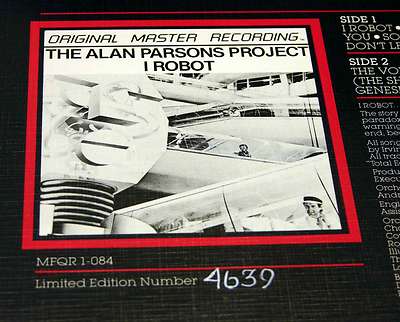
The album cover photo of the band members is of the criss-crossing escalator tubes in the circular Terminal 1 building of Charles de Gaulle airport outside Paris.
Track listing
All tracks written by Alan Parsons and Eric Woolfson; except "Total Eclipse" written by Andrew Powell
- "I Robot" (instrumental) – 6:02
- "I Wouldn't Want to Be Like You" (lead vocal: Lenny Zakatek) – 3:22
- "Some Other Time" (lead vocals: Peter Straker & Jaki Whitren) – 4:06
- "Breakdown" (lead vocal: Allan Clarke) – 3:50
- "Don't Let It Show" (lead vocal: Dave Townsend) – 4:24
- "The Voice" (lead vocal: Steve Harley) – 5:24
- "Nucleus" (instrumental) – 3:31
- "Day After Day (The Show Must Go On)" (lead vocal: Jack Harris) – 3:49
- "Total Eclipse" (instrumental) – 3:09
- "Genesis Ch.1. V.32" (instrumental) – 3:28
MFQR 1-084 Serial number 4369.
BOX is not in perfect or mint condition.
Minor Blemishes on top Normal wear. Would rate as good
Technical Specification Manual, and the UHQR Certificate of Authenticity (Serial Number 4369 matches album Cover) are included - pouch is not affixed to inside top of box as original.
ALBUM Cover: Minor wear, beginnings of a small spit on the bottom.
ALBUM:
Album would rate as near mint, several spindle marks on the label, high sheen, no scratches.
History: Was purchased off ebay as near new condition (played several times on high end audiophile equipment).
Quality: What you would expect from Brad Miller and Alan Parsons - perfection.
An opportunity for a very nice, rare, unreproducible, ANALOG - vinyl recording for your listening collection.
Will be well packed for shipping - US priority Mail.
Actual shipping costs to follow on separate paypal invoice..
No return on this item and sale is final.
price rating