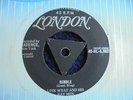
Link Wray 10 Norton Singles PLUS BONUS Rumble NEW
£
28
$
37


Favourite Auctions
To save auctions to your favourites, please login
If you don't have an account, please register
Description
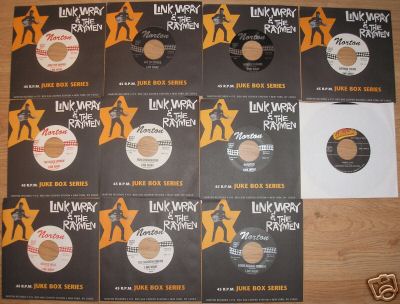
Announcing the LINK WRAY JUKEBOX SERIES, featuring Link's most sonic Swan A-sides (unavailable on 45 in 30 years!) b/w worthy obscuro flips & tucked in a knockout custom sleeve! All ten Norton seven inchers plus BONUS single Rumble/The Swag (on the Collectables label).
BRAND NEW MINT! A LOVELY SET! HIGHLY RECOOMENDED!
11 Import singles brand new MINT. As with all the Norton stuff these singles have amazing sound quality, probably the best you can get of these records. Check out the great picture labels. This set comes highly recommended and consists of the following singles:
801 JACK THE RIPPER/BO DIDDLEY
802 ACE OF SPADES/FAT BACK
803 HIDDEN CHARMS/FIVE AND TEN
804 THE BLACK WIDOW/MUSTANG
805 RUN CHICKEN RUN/SCATTER
806 BRANDED/LAW OF THE JUNGLE
807 DEUCES WILD/THE SWEEPER
808 THE SHADOW KNOWS/HANG ON
809 GOOD ROCKIN' TONIGHT/SOUL TRAIN
810 BATMAN THEME/ZIP CODE
+ BONUS RUMBLE/THE SWAG
Rock guitarist Link Wray was born on May 2nd in North Carolina. In his 1958 instrumental hit "Rumble," Wray invented the power chord, the basis of modern rock guitar-playing from thrash to heavy metal. He is the missing link in the history of rock guitar in that he is not often given credit for being the connection between early blues guitarists and the late '60s gods (Jimi Hendrix, Eric Clapton, Jimmy Page, Pete Townshend, etc.).
There are those who claim that Link Wray invented heavy metal, an accusation based on his 1958 million-seller "Rumble", an intense, moody guitar instrumental intended to capture the feel of a gang fight. This brilliantly simple track has influenced everyone from The Kinks down to PJ Harvey, and it set the essential Link Wray style - rather than a lead line, Wray favoured a slow drag across distorted strings in an elementary chord progression. Though he was capable of more dextrous playing, Wray was a visionary who understood that, in rock, simplicity was best.
North Caroline-born Link's first dive in to professional music came in the early '50s with his brothers Vern and Doug (and later bassist Shorty Horton) around the Portsmouth, Virginia, area under snazzy names like "The Lazy Pine Wranglers" and "Lucky Wray and Palomino Ranch Hands". When the family moved to Washington D.C. Vern Wray has some solo success on the Cameo label. While Vern's star shone on a string of commercial releases Link, Shorty and Doug continued to rattle the floorboards in and around D.C., although with rock & roll in full swing, the band's sound took on a much grittier edge. They also ditched their outdated hayseed moniker for a more streamlined jet-age handle - The Raymen. Under the management of Milt Grant (whose popular TV dance show made him D.C.'s answer to Dick Clark), The Raymen made a local name for themselves blastin' crude rock and roll.
"Rumble" changed all that as Link recalls. "Somebody asked for a stroll and I didn't know one som I kinda just start playin' and the kids really dug it". They recorded it the next year. The demo was presented to Archie Bleyer of the Cadence label, which was ridin' high with the Everly Brothers. Bleyer was actually nonplussed by "Rumble". It was his teenage daughter which was so nuts for the demo. The release was the biggest non-Everly rock and roll hit on the Cadence label, reaching #16 in the Billboard charts. The only problem was that this was the only instrumental hit ever which was banned as too suggestive ! Bleyer expressed no long term interest in Link Wray and gave Grant the green light to take the Raymen elsewhere.
With some new demo's they get a three year contract by Epic. The first release was "Rawhide"/"Dixie doodle" which reached #23 on the Billboard charts. Other releases failed to chart. Following the success of "Rumble", Wray milked the formula for some years - notably on "Jack The Ripper" and, "The Shadow Knows" - before the more melodic instrumental styles of Duane Eddy and The Ventures made him sound primitive and dated. He then abruptly shrank from the spotlight, publicly renouncing music in 1965 to become a farmer.
Fortunately Wray continued to record in the three-track he had built on his farm, and in 1971 he produced the glorious Link Wray. A blend of country, gospel and blues, it presented the kind of trans-American vision that critics have long claimed to be the property of The Band, but surpassed even their best work. The song titles occasionally sounded like old-time Link Wray - "Crowbar", "Black River Swamp" - but there was no other connection with his earlier incarnation. Though a lung condition had always precluded too much singing, here he let loose, revealing a hoarse, beautiful voice that creaked with authority. The effect was almost that of the land itself speaking.
A second album from the same sessions, Beans And Fatback, was released by Virgin in 1973; though, like Link Wray, it was roundly ignored by the public. A couple of early 70s albums on Polydor also failed to connect, and Wray again faded from view.
In the late 70s, Robert Gordon, erstwhile singer for New York punks The Tuff Darts, brought Wray out of retirement for his new rock'n'roll revival project. Link played on two excellent albums and even toured with Gordon a bit, keeping his back to the audience in an effort to keep the focus on Gordon. Wray has also been rediscovered by The Cramps and their fellow psychobillies, though among knowledgable musicians he has never needed any introduction.
He continued to record to this day, the latest offerings being Shadowman (Ace 1997) and a gloriously fiery live set Walking Down A Street Called Love (Visionary 1997).
Link Wray: Rockabilly Legend, 1929-2005
Fred Lincoln 'Link' Wray Jr. was a rock and roll guitar player most noted for introducing a new sound for electric guitars in his major hit, the 1958 instrumental ‘Rumble’, by Link Wray and his Ray Men. Before ‘Rumble’, electric guitars were used to produce clean sounds and jazz chords. Wray made a new sound by inventing fuzz-tone, adding feedback, distortion and noise. He also pioneered the power chord.
Wray was born in Dunn, North Carolina. It was there that Link first heard slide guitar at age 8 from a black player named "Hambone". From Hambone, Wray began to learn and play songs such as "Trouble in Mind" and "The Whale Did Swallow Jonah Down. Not having any formal musical training, he relied on his ability to pick up tunes by ear, listening to his favorite guitarists: Grady Martin, Johnny Smith, Les Paul, Hank Williams, and Chet Atkins. "If a song is easy and has simple chords," Wray explained, "I could probably hear it once or twice and then play it, if it’s a real fast lead, I’d probably have to play it two, three or four times to really get the idea of what’s going on."
Wray started playing electric guitar in 1947. "It was a Vega," he says, "with one pickup way up, sort of like jazz guitar." He purchased a Gibson Les Paul in 1953 and a Premier amplifier. It was the only amplifier at that time that had a tremolo effect and crossover heads. "It had a big fifteen-inch speaker, and two little six-inch tweeters on each side. I made my own fuzz by punching holes in the speakers."
Link and his family later moved to Norfolk, Virginia as his father got work in the Navy shipyards. His family later moved to Washington DC, and from there they moved to a farm in Accokeek, Maryland. After moving with his parents to Arizona, Wray joined the US Army and entertained the troops on the American Forces Network in Germany.
Wray was a veteran of the Korean War, where he contracted tuberculosis that ultimately cost him a lung and earned him the nickname, "One-Lung Link". Despite this, on his rare vocal numbers he displays a remarkable range which some say is equivalent to Clarence "Frogman" Henry.
After discharge from the Army, Wray and his brothers Doug and Vernon Wray formed the ‘Lucky Wray and the Palomino Ranch Gang', sometimes known as the 'Lazy Pine Wranglers'. They had been playing country music and Western swing for several years when they took a gig as the house band on Milt Grant's House Party, a Washington D.C. version of American Bandstand.
The band made their first recordings in 1956 as 'Lucky Wray and the Palomino Ranch Gang' for Starday Records. They also backed many performers, from Fats Domino to Ricky Nelson. At a live gig in Fredericksburg Virginia, attempting to work up a backing for The Diamonds' ‘The Stroll’, they came up with the stately, powerful blues instrumental "Rumble", which they originally called "Oddball". The song was an instant hit with the live audience, which demanded four repeats that night. Eventually the song came to the attention of record producer Archie Bleyer of Cadence Records, who hated it, particularly after Wray poked holes in his amplifier's speakers to make the recording sound more like the live version. However, Bleyer's daughter loved it and it was released despite her father's protest. She was the one who suggested renaming the song "Rumble", because it reminded her of West Side Story.
The menacing sound of "Rumble" (and its title) led to a ban on several radio stations, a rare feat for a song with no lyrics, on the grounds that it glorified 'juvenile delinquency'. Nevertheless it became a huge hit, not only in the United States, but also Great Britain, where it has been cited as an influence on The Who, among others. Pete Townshend stated in liner notes for a 1974 Wray album, "He is the king; if it hadn't been for Link Wray and 'Rumble,' I would have never picked up a guitar." Jeff Beck, Jimi Hendrix, Marc Bolan, Neil Young and Bob Dylan have all cited Wray as an influence.
Following his two successful single releases, Link’s life became increasingly difficult, especially since he was labeled as an instrumentalist only. As he put it, "On one session they were having me do ‘Clair de Lune’ with a sixty-two piece orchestra. I got completely lost in the whole set-up."
Finally, retaining his pride as an artist and with a belief in his overall ability as a performer, he packed his guitar and walked away from the whole mess, retiring (from the recording end of the music industry) to his family’s five-acre farm in Accokeek, Maryland where for the next eight years his only performing was done in clubs in the Baltimore-Washington area. "You know the kind of clubs – the guys are there to make broads, the broads are just sittin’ there waitin’ for the guys, and I’m up there on the bandstand makin’ with my guitar."
While Link was busy with small gigs, his father was equally busy converting the chicken coop into a recording studio. Ray, Link’s older brother, moved his three-track tape recorder into the location, and the coop was christened. "Wray’s Shack Three Track." Instead of a snare drum, they would use can of nails; in place of a bass, foot stomping; and when a couple of amps couldn’t fit inside, they were miked through window. Link described the recording set-up: "I used Telefunken mikes. I put them on my amplifier and let the sound leak through to give me that freedom of playing, because when you put a mike tight next to an amplifier you get that sharpness, and you also get amplifier noise. But when you put an amp in one spot and the microphone across the room, all you get are the overtones, no electronics – just real nitty-gritty."
Wray was named as one of the hundred greatest guitarists of all time by Rolling Stone magazine, but still has not yet been inducted into the Rock and Roll Hall of Fame. He is, however, a member of the Rockabilly Hall of Fame.
The band had several more hard-rocking instrumental hits in the late 1950s and early 1960s, including "Rawhide", "Ace of Spades", and "Jack the Ripper", the latter named after a "dirty boogie" dance popular in Baltimore at the time.
After his initial hits, Wray's career had periods of retirement followed by renewed popularity, particularly in Europe. He toured and recorded several albums with retro-rockabilly artist Robert Gordon and continued to tour up until four months before he died.
Part Shawnee Indian, Wray frequently spoke of ancestry in performances and interviews, and three of his compositions bear the names of American Indian tribes: "Shawnee," "Apache," and "Comanche." He moved to Denmark in the 1980s after meeting and marrying a Danish student, Olive, who had been studying Native American culture.
He lived his last years with Olive on a Danish island. Link Wray passed away November 5, 2005 at his home in Copenhagen. He was 76. He was buried at the Christian Church Cemetery in the eastern Copenhagen suburb of Christianshavn on November 18, 2005.
price rating








![In Concert [Vinyl Box, 3 LP] (Limited Edition) - Dead Can Dance](https://www.popsike.com/php/thumbnail.php?url=https://www.popsike.pics/pix/20160409/371596054746.jpg)