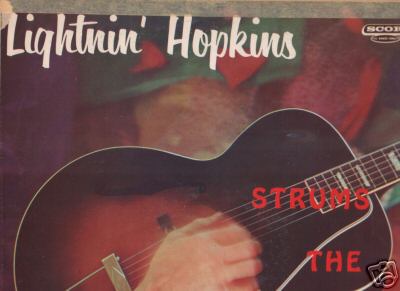
Lightnin' Hopkins - Strums The Blues LP Lightning Rare
$
226


Favourite Auctions
To save auctions to your favourites, please login
If you don't have an account, please register
Description
Record Condition: VG + (Minor light surface marks on side A. Side B is nearly flawless. No skips. Shiny lacquer. Clean labels.) This LP was play-graded on my system prior to listing with only minimal surface noise during quiet passages. All auction LP's are professionally cleaned using a VPI Record Cleaning Machine.
Cover Condition: Conservatively graded at VG due to taped seam splits along side and top - see photo. (Slight surface and edge wear. No ring wear. No writing or stickers.) Taped seam splits aside, this is a very clean record with a book value of $1200 in near mint condition.
Notes: From 1958. Score Records (#SLP 4022). Mono. U.S. pressing.
Track Listing: Katie May, My California, Honey Babe, Short Haired Woman, Little Mama Blues, Shotgun, Rollin' And Rollin', See See Rider, So Long, Mistreated
Biography by Bill Dahl (www.allmusic.com)
Sam Hopkins was a Texas country bluesman of the highest caliber whose career began in the 1920s and stretched all the way into the 1980s. Along the way, Hopkins watched the genre change remarkably, but he never appreciably altered his mournful Lone Star sound, which translated onto both acoustic and electric guitar. Hopkins' nimble dexterity made intricate boogie riffs seem easy, and his fascinating penchant for improvising lyrics to fit whatever situation might arise made him a beloved blues troubadour.
Hopkins' brothers John Henry and Joel were also talented bluesmen, but it was Sam who became a star. In 1920, he met the legendary Blind Lemon Jefferson at a social function, and even got a chance to play with him. Later, Hopkins served as Jefferson's guide. In his teens, Hopkins began working with another pre-war great, singer Texas Alexander, who was his cousin. A mid-'30s stretch in Houston's County Prison Farm for the young guitarist interrupted their partnership for a time, but when he was freed, Hopkins hooked back up with the older bluesman.
The pair was dishing out their lowdown brand of blues in Houston's Third Ward in 1946 when talent scout Lola Anne Cullum came across them. She had already engineered a pact with Los Angeles-based Aladdin Records for another of her charges, pianist Amos Milburn, and Cullum saw the same sort of opportunity within Hopkins' dusty country blues. Alexander wasn't part of the deal; instead, Cullum paired Hopkins with pianist Wilson "Thunder" Smith, sensibly re-christened the guitarist "Lightnin'," and presto! Hopkins was very soon an Aladdin recording artist.
"Katie May," cut on November 9, 1946, in L.A. with Smith lending a hand on the 88s, was Lightnin' Hopkins' first regional seller of note. He recorded prolifically for Aladdin in both L.A. and Houston into 1948, scoring a national R&B hit for the firm with his "Shotgun Blues." "Short Haired Woman," "Abilene," and "Big Mama Jump," among many Aladdin gems, were evocative Texas blues rooted in an earlier era.
A load of other labels recorded the wily Hopkins after that, both in a solo context and with a small rhythm section: Modern/RPM (his uncompromising "Tim Moore's Farm" was an R&B hit in 1949); Gold Star (where he hit with "T-Model Blues" that same year); Sittin' in With ("Give Me Central 209" and "Coffee Blues" were national chart entries in 1952) and its Jax subsidiary; the major labels Mercury and Decca; and, in 1954, a remarkable batch of sides for Herald where Hopkins played blistering electric guitar on a series of blasting rockers ("Lightnin's Boogie," "Lightnin's Special," and the amazing "Hopkins' Sky Hop") in front of drummer Ben Turner and bassist Donald Cooks (who must have had bleeding fingers, so torrid were some of the tempos).
But Hopkins' style was apparently too rustic and old-fashioned for the new generation of rock & roll enthusiasts (they should have checked out "Hopkins' Sky Hop"). He was back on the Houston scene by 1959, largely forgotten. Fortunately, folklorist Mack McCormick rediscovered the guitarist, who was dusted off and presented as a folk-blues artist; a role that Hopkins was born to play. Pioneering musicologist Sam Charters produced Hopkins in a solo context for Folkways Records that same year, cutting an entire LP in Hopkins' tiny apartment (on a borrowed guitar). The results helped introduced his music to an entirely new audience.
Lightnin' Hopkins went from gigging at back-alley gin joints to starring at collegiate coffeehouses, appearing on TV programs, and touring Europe to boot. His once-flagging recording career went right through the roof, with albums for World Pacific; Vee-Jay; Bluesville; Bobby Robinson's Fire label (where he cut his classic "Mojo Hand" in 1960); Candid; Arhoolie; Prestige; Verve; and, in 1965, the first of several LPs for Stan Lewis' Shreveport-based Jewel logo.
Hopkins generally demanded full payment before he'd deign to sit down and record, and seldom indulged a producer's desire for more than one take of any song. His singular sense of country time befuddled more than a few unseasoned musicians; from the 1960s on, his solo work is usually preferable to band-backed material.
Filmmaker Les Blank captured the Texas troubadour's informal lifestyle most vividly in his acclaimed 1967 documentary, The Blues Accordin' to Lightnin' Hopkins. As one of the last great country bluesmen, Hopkins was a fascinating figure who bridged the gap between rural and urban styles.
Buyer must include $5 for Priority shipping and handling using a sturdy cardboard LP mailer. More overseas. If you have any questions, please feel free to e-mail us.
All records are graded using the following Goldmine Price Guide criteria:
Mint: Absolutely perfect in every way. Certainly never been played, possibly even still sealed. I do not use this grade.
Near Mint: (NM or M-) A nearly perfect record. Many dealers won't give a grade higher than this implying (perhaps correctly) that no record is ever truly perfect. The record should show no obvious signs of wear. A 45 RPM or EP sleeve should have no more than the most minor defects, such as almost invisible ring wear or other signs of slight handling. An LP cover should have no creases, folds, seam splits or other noticeable similar defects. No cut-out holes, either. And of course, the same should be true of any other inserts, such as posters, lyric sleeves and the like. Basically, an LP in near mint condition looks as if you just got it home from a new record store and removed the shrink wrap.
Very Good Plus: (VG+) A Very Good Plus record will show some signs that it was played and otherwise handled by a previous owner who took good care of it. Record surfaces may show some signs of wear and may have slight scuffs or very light scratches that don't affect one's listening experiences. Slight warps that do not affect the sound are "OK". The label may have some ring wear or discoloration, but it should be barely noticeable. The center hole will not have been misshapen by repeated play. Picture sleeves and LP inner sleeves will have some slight wear, lightly turned up corners, or a slight seam split. An LP cover may have slight signs of wear also and may be marred by a cut-out hole, indentation or corner indicating it was taken out of print and sold at a discount. In general, if not for a couple things wrong with it, this would be Near Mint. All but the most mint-crazy collectors will find a Very Good Plus record highly acceptable.
Very Good: (VG) Many of the defects found in a VG+ record will be more pronounced in a VG disc. Surface noise will be evident upon playing, especially in soft passages and during a song's intro and fade, but will not overpower the music otherwise. Groove wear will start to be noticeable, as with light scratches (deep enough to feel with a fingernail) that will affect the sound. Labels may be marred by writing, or have tape or stickers (or their residue) attached. The same will be true of picture sleeves or LP covers. However, it will not have all of these problems at the same time, only two or three of them.
This item must be paid for within 14 days of the end of the auction or it will be re-posted. We gladly accept PayPal as well as money orders and checks.
Click here to see our other auctions.
Check Out Our 'About Me' Page For More Info On Our Chicagoland Stores!
price rating