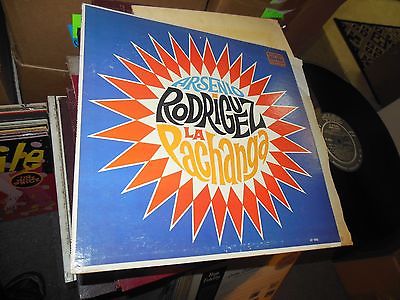
La Pachanga - Arsenio Rodriguez LP MONO
$
79


Favourite Auctions
To save auctions to your favourites, please login
If you don't have an account, please register
Description
LP NM-
Jacket NM-
Artist Biography by Nick Herman
Arsenio Rodríguez, one of the most important figures in the history of Cuban music, was a prolific composer (he penned close to 200 songs), tresero, percussionist, and bandleader whose innovations changed the face of Latin dance music and paved the way for what would eventually become known as salsa. He is considered the father of the conjunto, an instrumental format that was revolutionary for its time because it introduced the conga drum, which had previously been considered taboo because of its African origin. His compositions, many of which became standards of the Cuban and New York salsa repertoires, frequently emphasized Afro-Cuban, particularly Congolese, elements in their subject matter.
A descendent of Congolese slaves, Rodríguez was born on August 30, 1911, in Guira de Macurije in Cuba's western province, Mantanzas. At age seven Rodríguez was blinded by a horse's kick; he would later become know as "El Ciego Maravilloso" (The Marvelous Blind One). As a child, he began playing a variety of instruments, including Afro-Cuban drums and percussion, bass, and tres, a Cuban six-string guitar that would become his primary instrument. Some important early influences on tres included Nene Malfugas, Isaac Oviedo, and Eliseo Silviera. He began composing in his teens and in the early '30s formed El Sexteto Boston. In 1937 he joined trumpeter José Interain's Septeto Bellamar. 1937 also saw the first recordings of Rodríguez's compositions; Miguelito Valdés sang "Bruca Manigua," "Ven Acá Tomas," and "Fuñfuñando" with Orquesta Casino de la Playa.
During this period, the standard format for playing son was the septeto, consisting of trumpet, guitar, tres, bongos, bass, maracas, and claves, with two or more bandmembers singing. The general trend in the 1930s had been for the son to stray somewhat from its African roots, adopting a more subdued sound. This would all change around 1940 when Rodríguez added conga drum, piano, and a second (and later third) trumpet to the typical son ensemble, giving birth to the conjunto. The conjunto format revolutionized the son with the added drive provided by the conga's deep tone and the trumpet section's power. Around this time, Rodríguez introduced the son montuno, a son with a montuno section featuring improvised vocals (soneos) by the lead singer (sonero) over a repeated chorus; trumpet, tres, and piano solos also occurred frequently. Rodríguez is also credited, along with bandleaders Antonio Arcaño and Pérez Prado, with developing the mambo rhythm during this period. Another key innovation was the band's adaptation of the guaguancó to the dance band/conjunto format. The guaguancó is an Afro-Cuban style traditionally performed by voices and percussion; Rodríguez mixed some of its melodic and formal elements with those of the son. These further "Afro-Cubanizations" of the son are among Rodríguez's most important and lasting contributions. The conjunto format, son montuno, and mambo are three essential elements of what would later be called salsa.
The 1940s were a classic period in Rodríguez's career and the history of the son. Many of his most famous compositions were recorded, including "A Belen Le Toca Ahora," "La Yuca de Catalina," "Juventud Amaliana," and perhaps his most famous work, the bolero "La Vida es un Sueño," which was written after an unsuccessful attempt to restore his sight in 1947. Among his bandmembers during the '40s were several key figures in the development of the son, namely vocalists Miguelito Cuní, Marcelino Guerra, and René Scull, trumpeters Felix Chappotin and Chocolate Armenteros, and pianist Lilí Martínez. This period is represented on several reissue CDs: Montuneando con Arsenio Rodríguez y Su Conjunto (Tumbao), Legendary Sessions: Chano Pozo and Arsenio Rodríguez (Tumbao), Dundunbanza (Tumbao), A Todos los Barrios (RCA), and Oye Como Dice (Cubanacan). In 1953, Rodríguez moved to New York, leaving his conjunto in Cuba under the leadership of trumpeter Chappotin, who would become a legend in his own right. Compositions such as "La Gente del Bronx" and "Como se Goza en el Barrio" (both available on the Tumbao CD named after the latter) continued to reflect his gift for writing about his everyday surroundings. His popularity in New York, while strong, would never match what it had been in Cuba. The mid-'50s saw the release of a strong album, Sabroso y Caliente(reissued on CD on Antilla), which added flute and timbales to the conjunto setup. "El Ciego Maravilloso" would continue to experiment with different instrumentations for the rest of his career, at times adding one or more saxophones to his band. In the late '50s, Rodríguez recorded Primitivo and appeared, under the leadership of conguero Sabu Martinez, on the Blue Note release Palo Congo, which featured his brothers and conjunto sidemen Quique and Caesar Rodríguez. This album includes chants from Palo Congo, an Afro-Cuban religion of Congolese origin. In the early '60s, Rodríguez recordedQuindembo/AfroMagic (Epic), an innovative experimental album on which he wrote and sang on all the tracks. Rodríguez called this style, which blends jazz influences with son and more earthy Afro-Cuban religious elements, "Quindembo," a Congolese word meaning a mixture of many things. Around this time he also recorded two very strong albums in the conjunto style, Arsenio Rodríguez y Su Conjunto, Vol. 1 and Vol. 2. In his final years he continued to experiment, developing a style he called "swing son." The last album Rodríguez recorded was Arsenio Dice, a 1968 Tico release. On December 30, 1970, "El Ciego Maravilloso" died of pneumonia in Los Angeles. As a composer, performer, and musical experimenter, Rodríguez was one of the undoubted giants of Cuban music. In the United States, he was a decisive influence in the '60s and '70s tipico movement, and his experimentation pointed to way to some of the developments made by the more adventurous architects of salsa, such as Willie Colón. His legacy is recognized on several tribute albums, including Larry Harlow's Tribute to Arsenio Rodríguez and Tico's all-starRecordando a Arsenio.All Lps are sight graded
Note: I Do Not Grade inner sleeves, If these are Important to you then you may e-mail me)
RECORD GRADING Based On Goldmine Grading Standards:
Near Mint (NM): A nearly perfect record. There may be one or two small inaudible defects. The record should show no obvious signs of wear. A 45 RPM or EP sleeve should have no more than the most minor defects, such as almost invisible ring wear or other sights of slight handling. An LP jacket should have no creases, folds, seam splits or any other noticeable similar defect. No cut-out holes, either.
Near Mint Minus (NM-): A record that should play mint but has a few slight visible marks. The album will have as much luster as an NM, there just may be some superficial scuffs from the sleeve or very light hairlines that shouldn't be audible. An NM- album cover subjectively fits somewhere in between VG+ and NM.
Very Good Plus (VG+): A Very Good Plus record will show some signs that it was played and otherwise handled by a previous owner who took good care of it. Record surfaces may show some slight signs of wear and may have slight scuffs or very light scratches that don t significantly affect play. Slight warps that do not affect the sound are OK. The label may have some ring wear or discoloration, but it should be barely noticeable. The center hole will not have been misshapen by repeated play. 45 Picture sleeves will have some slight wear, lightly turned-up corners, or a slight seam-split. An LP jacket may have slight signs of wear also and may be marred by a cut-out hole, indentation or corner indicating it was taken out of print and sold at a discount.
Very Good (VG): Many of the defects found in a VG+ record will be more pronounced in a VG disc. Surface noise will be evident upon playing, especially in soft passages and during a song s intro and fade, but will not overpower the music otherwise. Groove wear will start to be noticeable, as will light scratches (deep enough to feel with a fingernail) that will affect the sound. Labels may be marred by writing, or have tape or stickers (or their residue) attached. The same will be true of picture sleeves or LP covers. However, it will not have all of these problems at the same time, just two or three of them.
Good (G), Good Plus (G+): Good does not mean Bad! A record in Good or Good Plus condition can be put onto a turntable and will play though without skipping. But it will have significant surface noise and scratches and visible groove wear. A jacket or sleeve will have seam splits, especially at the bottom or on the spine. Tape, writing, ring wear or other defects will start to overwhelm the subject.
Poor (P), Fair (F): Below good. imperfections will be described.
Please check out my other items for sale. (I offer shipping discounts) I'll Be adding More Daily except for Friday and Saturday.
ALLSHIPPING PRICES ARE FINAL
additional items are 1.50 per item up to 6 within USA (if you are bidding on multiple items lots I have in one listing. you pay each shipping total added together)
Priorty shipping is available e-mail for total
Please Do A One Time payment for combined shipping on all all items won. Request a Final invoice if I have not already combined them for you
NOTE: Gatefold Lps Count as 2 Lps when shipping out of the country
SHIPPING TO CANADA Multiple LP Shipping Rates In USD
1 LP 11.50
2. Lps 13.00
3 Lps 15.00
4 Lps 17.00
5 Lps 26.00
6 Lps 29.00
Multiple Shipping Rates SHIPPING TO Rest Of The World Outside USA in USD
Note: Gatefold Lps Count as 2 Lps
1 LP 17.25
2 LP 20.00
3. Lps 26.50
4 Lps 30.00
5 Lps 48.00 (price jump becuse weight usually takes it to priority mail rate)
6 Lps 51.00
7 Lps 54.00
8 LPs 58.00
9 Lps 61.00
10 Lps 64.00
11 Lps 67.00
12 Lps 70.00
The MAN has to get his cut so Texas residents must add 8.25 % Sales Tax
If you are unsure about shipping costs please do not hesitate to e-mail me.
QUESTIONS:? Please ask. That is what I am here for. (I may not get to them if you wait close to an item's ending.)
MORE PICTURES? Just ask and I'll send them to you
MEDIA MAIL: is not recommended for rare items. Priority mail is faster and safer.
I leave feedback after item arrives and it is left for me. (It's easier to keep up with that way) Please limit your feedback comments to things within the realm of my responsibility.
Thank you for reading all of this :-)
price rating


