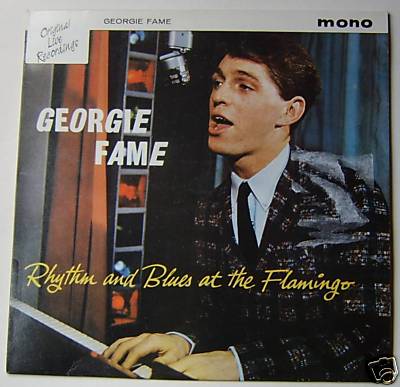
LP-GEORGIE FAME -RHYTHM & BLUES AT THE FLAMINGO (LIVE)
£
17
$
23


Favourite Auctions
To save auctions to your favourites, please login
If you don't have an account, please register
Description
CHECK OUT MY OTHER DISCS. SOME HERE ON ebay UK AND SOMETIMES ON (U.S.) ebay.com
Click Here: View seller's other items (I can usually fit two LPs in one package)
ATTENTION ALL EUROPEANS!! - THE EURO IS TEMPORARILY STRONG AGAINST THE POUND. GRAB BRITISH BARGAINS WHILST YOU STILL CAN!
BRITISH 33rpm LP RECORD ALBUM, SCARCE RE-ISSUEOF A RARE DEBUT LP FIRST ISSUED IN 1964
"The people who designed today's CD standard knew that vinyl Records offered superior sound"
GEORGIE FAME AND THE BLUE FLAMES
RHYTHM AND BLUES AT "THE FLAMINGO"
RSO - SPELP 80 - ORIGINAL COMPREHENSIVE SLEEVE NOTES BY JOHNNY GUNNELL - THE REPLICA SLEEVE STATES MONO BUT THE DISC LABEL INDICATES THAT THIS IS A STEREO RECORD SO I'M NOT 100% SURE."Blistering early work from a young Georgie Fame -- a set that definitely lives up to the Rhythm & Blues in the title! The set was recorded live at London's hip Flamingo club -- and Georgie and The Blue Flames are very much in command of the crowd -- burning with the intensity of a American small organ combo, especially the early 60s variety that often played equal parts soul jazz and R&B! Georgie's on the Hammond, and also sings with a rough-edged style that's plenty soulful, and incredibly appealing -- a mode that oozes charisma, but never sounds fake or forced. Other instrumentation includes tenor, baritone sax, bass, drums, and conga -- plus some great guitar from Big Jim Sullivan"
"...the Blue Flames became one of the most popular live bands in London. In 1963, they signed with EMI Columbia, and in early 1964 released their acclaimed debut LP, Rhythm and Blues at the Flamingo which was recorded at the club on Wednesday 25th September, 1963."
"Great live recording from 1963. The Blue Flames are:
Georgie Fame (vocals, Hammond organ), Johnny Marshall (baritone sax), Michael Eve (tenor sax), Big Jim Sullivan (guitar), Boots Slade (bass), Red Reece (drums), Tommy Thomas (congas)"
1. Night Train
2. Let The Good Times Roll
3. Do The Dog
4. Eso Beso
5. Work Song
6. Parchman Farm
7. You Can't Sit Down
8. Humpty Dumpty
9. Shop Around
10. Baby Please Don't Go
CONDITION: Note, unless stated beneath, I haven't had time to play the record
Disc: looks like it might be unplayed, I didn't notice any marks, clean, shiny and tight-grooved. I loudly test-played the first track. I didn't notice any noise except a tiny bit of crackle during the fad-in intro. Great stuff..Vocals and backing were loud and very clear, bearing in mind it is a live 1963 recording.
(As a teenager I was on a course near London and about 20 young men were treated to a day trip and let loose in Soho..I persuaded a few to go find the Flamingo Club whilst the others visited strip clubs and shady ladies, I was praying that Georgie and the Blue Flames would be playing but sadly they weren't..My sister did get a kiss from him about 10 years later though!)
Sleeve/Cover: crisp and firm, light corner wear, residue of a large sticker, needs partial re-glueing.
The Flamingo Jazz Club which operated out of a dingy basement in London's Wardour Street Soho in the late 1950s and the first half of the 1960s, has become legendary amongst cultural buffs of that city and was recently featured in the BBC2 documentary Soul Britannia, which looked at the history of Soul music in the United Kingdom. The Club is also a sweet memory of those of us who when teenagers spent our weekend's in its sweaty bowel's. Although if one reads the odd article on the Flamingo Club that appears these days, one may get the impression it was a Mod club,* which whilst half true is far from the actual story. It is true the more adventurous Mod's who inhabited London's West End back then, gradually became regulars at the club and by 1963 the music played within the Flamingo was entirely within the Mod tradition, but this is a chicken or egg conundrum as the claim could equally be made that the Flamingo was a major influence on the music that became inherent within Mod culture rather than the other way around. No, the Flamingo was much more than a club where members of the youth cult known as Mod's hanged out, it was the precursor of the ethnic melting pot London was to become and this was reflected in the sounds played within the club. Indeed ask any old Mingolian why their anti racist roots are so firm; and it is a fact few who were Mingo regulars ended up as racists, they would not reply with the names of the great men and women of the civil rights and anti racist movement, nor from having been racially abused themselves but because for a short period of time their roots lay within that grubby Wardor Street basement lovingly known to us all as, 'the Mingo'.There were two main Soho clubs in the 1960s that could be exclusively called Mod hangouts, The Scene in Ham Yard and the Discotheque in Lower Wardour Street. In both of these clubs the sounds were American R&B with a touch of Jazz and West Indian Bluebeat. Whilst today's media may go on about how UK bands like the Who, Kinks and the Small Faces provided the soundtrack for the Mod scene, I don't recall ever hearing any of the music of these bands being played within any of the West End Mod hangouts, although Millie Small, Prince Buster, James Brown, Chuck Berry, Jimmy Smith, Bo Diddley and Cannonball Adderley were regularly blasted out, bouncing off the ceiling and out into the street. However for many of us Mods, neither of these clubs were a touch on the Mingo, the Scene was elitist, look at me am I not a face, an edgy place with a certain violence lurking beneath the surface, which often erupted outside in HamYard.Whilst the Disc as it was known was more of a rough and ready joint, it had old mattresses along one wall, more welcoming that the Scene; and for me it provided a taster of what was to come, whilst the music was Black, the cliental of both the Scene and Disc were almost exclusively white.
Georgie Fame's swinging, surprisingly credible blend of jazz and American R&B earned him a substantial following in his native U.K., where he scored three number one singles during the '60s. Fame played piano and organ in addition to singing, and was influenced by the likes of Mose Allison, Booker T. & the MG's, and Louis Jordan. Early in his career, he also peppered his repertoire with Jamaican ska and bluebeat tunes, helping to popularize that genre in England; during his later years, he was one of the few jazz singers of any stripe to take an interest in the vanishing art of vocalese, and earned much general respect from jazz critics on both sides of the Atlantic.
Fame was born Clive Powell on June 26, 1943, in Leigh, Lancashire (near Manchester, England). He began playing piano at a young age, and performed with several groups around Manchester as a teenager, when he was particularly fond of Fats Domino and Jerry Lee Lewis. In 1959, his family moved to London, where the 16 year old was discovered by songwriter Lionel Bart (best known for the musical Oliver). Bart took Powell to talent manager Larry Parnes, who promoted British rockers like Billy Fury, Marty Wilde, Johnny Gentle, and Vince Eager. Powell naturally had to be renamed as well, and as Georgie Fame, he played piano behind Wilde and Eager before officially joining Fury's backing band, the Blue Flames, in the summer of 1961. (The Blue Flames also included guitarist Colin Green, saxophonist Mick Eve, bassist Tony Makins, and drummer Red Reece.) When Fury let the band go at the end of the year, Fame became their lead singer, and they hit the London club circuit playing a distinctive blend of rock, pop, R&B, jazz, and ska. Their budding reputation landed them a residency at the West End jazz club the Flamingo, and thanks to the American servicemen who frequented the club and lent Fame their records, he discovered the Hammond B-3 organ, becoming one of the very few British musicians to adopt the instrument in late 1962. From there, the Blue Flames became one of the most popular live bands in London. In 1963, they signed with EMI Columbia, and in early 1964 released their acclaimed debut LP, Rhythm and Blues at the Flamingo. It wasn't a hot seller at first, and likewise their first three singles all flopped, but word of the group was spreading.
Finally, in early 1965, Fame hit the charts with "Yeh Yeh," a swinging tune recorded by Latin jazz legend Mongo Santamaria and given lyrics by vocalese virtuoso Jon Hendricks of Lambert, Hendricks & Ross. "Yeh Yeh" went all the way to number one on the British charts, and Fame started living up to his stage name (although the song barely missed the Top 20 in America). His 1965 LP Fame at Last reached the British Top 20, and after several more minor hits, he had another British number one with "Getaway" in 1966. After one more LP with the original Blue Flames, 1966's Sweet Thing, Fame broke up the band and recorded solo; over the next few years, his backing bands included drummer Mitch Mitchell (later of the Jimi Hendrix Experience) and the young guitarist John McLaughlin (Miles Davis, Mahavishnu Orchestra).
At the outset, Fame's solo career was just as productive as before, kicking off with the Top Ten big-band LP Sound Venture (recorded with Harry South's orchestra); thanks to its success, he toured with the legendary Count Basie the following year. Several hit singles followed over the next few years, including "The Ballad of Bonnie and Clyde," which became his third British chart-topper in late 1967 and, the following year, his only Top Ten hit in America. But by 1969, his success was beginning to tail off; hoping to make inroads into the more adult-oriented cabaret circuit, Fame was moving more and more into straight-up pop and away from his roots. In 1971, he teamed up with onetime Animals organist Alan Price and recorded an album of critically reviled MOR pop, Fame & Price; the partnership produced a near-Top Ten hit in "Rosetta," but ended in 1973. Fame re-formed the Blue Flames with original guitarist Colin Green in 1974 and attempted to return to R&B, but his records for Island attracted little attention. He spent much of the '70s and '80s making ends meet by performing on TV and the cabaret circuit, as well as writing advertising jingles; he also continued to make records, to little fanfare.
In 1989, Fame played organ on Van Morrison's Avalon Sunset album, which grew into a fruitful collaboration over the course of the '90s; Fame played on all of Morrison's albums through 1997's The Healing Game, received co-billing on Morrison's 1996 jazz album How Long Has This Been Going On, and even served a stint as Morrison's musical director. Meanwhile, Fame's own solo work during the '90s received some of his best reviews since the '60s, starting with 1991's jazzy Cool Cat Blues, which featured a duet with Morrison on "Moondance." 1995's Three Line Whip featured his sons Tristan and James Powell on guitar and drums, respectively, and 1996's The Blues and Me further enhanced his growing jazz credibility. In 1998, Fame split with Morrison to record and tour with former Rolling Stones bassist Bill Wyman's new group the Rhythm Kings, contributing organ and vocals to several albums. In 2000, now signed to Ben Sidran's Go Jazz label, Fame released the acclaimed Poet in New York, which established him as an impressive student of jazz's vocalese tradition.
VIEW MY FEEDBACK - BID WITH CONFIDENCE
THE PHOTO IS OF THE ACTUAL ITEM YOU WILL RECEIVE
ANY QUESTIONS PLEASE EMAIL ME
POSTAGE & PACKING - All records are posted in a proper mailer with stiffener. Note - this item is located in The United Kingdom of Great Britain and Northern Ireland.
UK - Royal Mail Second Class £3.14
EUROPE Airmail £4.89. Europe includes Russia, Turkey, Azerbaijan, Georgia...(NOT the USA state), Kazakhstan, Kyrgystan, Spitzbergen, Turkmenistan and Uzbekistan
REST OF THE WORLD (Including USA) - Airmail £7.49. Surface Mail £4.59. NB. Surface mail travels by ship so will take several weeks to arrive, I usually invoice Airmail. If you prefer Surface mail, please ask.
Items are posted at your risk. If you require extra services please enquire before bidding. UK buyers may be able to initiate a compensation claim from Royal Mail up to a value of £32 (at the time of writing). I usually keep proof of posting and I shall be pleased to provide this if requested.
This item is described in good faith and has a low starting price to reflect the fact that it is not in brand-new condition (unless stated). I would not usually consider a refund but please do not hesitate to contact me if you have any queries or problems
PAYMENT - I accept PAYPAL from any country. I'd be grateful for payment within 3 days of invoice please.
UK - I will also accept cheques (allow time to clear) and Postal Orders. If you want to pay by any other method please contact me before bidding.
EUROPE & REST OF THE WORLD (including USA) I will also accept Bankers Drafts and International Money Orders drawn on a UK bank in GBP - Pounds Sterling. If you want to pay by any other method please contact me before bidding.
THE TRUTH ABOUT VINYL RECORDS VERSUS CDs
"The people who designed today's CD standard twenty years ago knew that
vinyl Records offered superior sound"
THE DAY THE MUSIC DIED - THE DIGITAL DISASTER
"Digitalization kills music stone dead. It is music with the heart and soul ripped out of it.
It is genetically-modified music, throwaway music for the throwaway age"
SALES OF VINYL RECORDS ARE MAKING A COMEBACK IN BRITAIN
"Industry officials say indie and rock fans are buying vinyl in droves,
British album sales are up 87.3 percent compared to the same period last year."
FANS STAY TRUE TO VINYL RECORD FORMAT
"Record fans see vinyl in a different light. Vinyl records are lasting works of art.
People who sold their old records are kicking themselves for it now."
price rating




![Ian Anderson - 8314 Boxed [New Vinyl LP] Oversize Item Spilt, Boxed Set, With Bo](https://www.popsike.com/php/thumbnail.php?url=https://www.popsike.pics/pix/20240822/135205469559.jpg)


![George Duke - Reach For It [LP] | Epic - EPC 82216 | LP NM / Near MINT](https://www.popsike.com/php/thumbnail.php?url=https://www.popsike.pics/pix/20230824/204438799318.jpg)


![Slim Harpo - Baby Scratch My Back [New Vinyl LP]](https://www.popsike.com/php/thumbnail.php?url=https://www.popsike.pics/pix/20220915/134232982916.jpg)