LP SONNY BOY WILLIAMSON-Down & Out Blues CHESS 1437 NM
$
609


Favourite Auctions
To save auctions to your favourites, please login
If you don't have an account, please register
Description
THIS VINTAGE, COLLECTIBLE ALBUM IS PART OF A LARGE & FABULOUS PRIVATE COLLECTION CONTAINING MANY RARE RECORDS IN REMARKABLY FINE CONDITION. I WILL BE OFFERING 100s AND 100s OF THESE CAREFULLY PRESERVED LP's OVER THE NEXT FEW WEEKS. PLEASE CHECK OUT MY OTHER RARE BLUES ALBUMS! THANKS FOR LOOKING.
NO RESERVE!
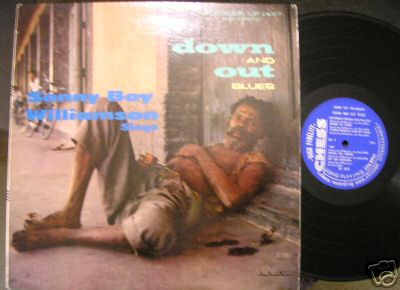
Sonny Boy Williamson-"Down and Out Blues" in mono on Chess 1437. The cover reads Checker 1437 as no Chess covers were made. As you see, this was released on the Chess numbering series but almost all records had the Checker label. Great album released in 1959, many of the songs are as much rock 'n' roll as electric blues. Fattening Frogs for Snakes is a classic. Earlier this year, a copy of lesser condition sold for $425 on eBay.
If you'd like to know if a certain song is on the album, e-mail me and I'll let you know if it is or isn't but please don't ask me for a track listing as I don't have the time to provide that. For many albums, the All Music Guide website (allmusic.com) gives a track lisitng.
Record Grade: Near Mint
Cover Grade: VG++, minor wear, slightly 'bruised' corners
Labels: Royal blue and silver deep groove
Many of the albums which are being offered are nearly impossible to find in any condition and many of these albums could possibly be the finest examples that survive today. The collection was carefully assembled over a long period with attention to quality and detail. The opportunity to acquire these excellent do wop, R&B, rock 'n' roll, blues and soul albums might not arise again for many years if ever.
About the Album: by Bill Dahl
Retaining photographer Don Bronstein's cover shot of a disheveled bum lying on the sidewalk (some former Chess artist, perhaps?) Sonny Boy Williamson's original 1959 album made it to digital reissue but has now been supplanted by MCA's exhaustive The Essential Sonny Boy Williamson. Still, for a budget price, there are a dozen unforgettable tracks: "Don't Start Me to Talkin'," and his Checker debut; "All My Love in Vain," "Wake Up Baby," "99," "Cross My Heart," "Let Me Explain," and "The Key (To Your Door)."
Tracks
- 1Don't Start Me to Talkin' Williamson 2:33
- 2I Don't Know Williamson 2:24
- 3All My Love in Vain Williamson 2:48
- 4The Key (To Your Door) Williamson 3:14
- 5Keep It to Yourself Williamson 2:48
- 6Dissatisfied Williamson 2:42
- 7Fattening Frogs for Snakes Williamson 2:19
- 8Wake Up Baby Williamson 2:56
- 9Your Funeral and My Trial Williamson 2:29
- 1099 Williamson 2:36
- 11Cross My Broken Heart Williamson 3:20
- 12Let Me Explain Williamson 3:53
About the Artist: by Cub Koda
Sonny Boy Williamson was, in many ways, the ultimate blues legend. By the time of his death in 1965, he had been around long enough to have played with Robert Johnson at the start of his career and Eric Clapton, Jimmy Page and Robbie Robertson at the end of it. In between, he drank a lot of whiskey, hoboed around the country, had a successful radio show for 15 years, toured Europe to great acclaim and simply wrote, played and sang some of the greatest blues ever etched into black phonograph records. His delivery was sly, evil and world-weary, while his harp-playing was full of short, rhythmic bursts one minute and powerful, impassioned blowing the next. His songs were chock-full of mordant wit, with largely autobiographical lyrics that hold up to the scrutiny of the printed page. Though he took his namesake from another well-known harmonica player, no one really sounded like him. A moody, bitter, and suspicious man, no one wove such a confusing web of misinformation as Sonny Boy Williamson II. Even his birth date (stated as December 5, 1899 in most reference books, but some sources claim his birth may have been in either 1897 or 1909) and real name (Aleck or Alex or Willie "Rice" — which may or may not be a nickname — Miller or Ford) cannot be verified with absolute certainty. Of his childhood days in Mississippi, absolutely nothing is known. What is known is that by the mid-'30s, he was traveling the Delta working under the alias of Little Boy Blue. With blues legends like Robert Johnson, Robert Nighthawk, Robert Jr. Lockwood, and Elmore James as interchangeable playing partners, he worked the juke joints, fish fries, country suppers and ballgames of the era. By the early '40s, he was the star of KFFA's King Biscuit Time, the first live blues radio show to hit the American airwaves. As one of the major ruses to occur in blues history, his sponsor — the Interstate Grocery Company — felt they could push more sacks of their King Biscuit Flour with Miller posing as Chicago harmonica star John Lee "Sonny Boy" Williamson. In today's everybody-knows-everything video age, it's hard to think that such an idea would work, much less prosper. After all, the real Sonny Boy was a national recording star, and Miller's vocal and harmonica style was in no way derivative of him. But Williamson had no desire to tour in the South, so prosper it did, and when John Lee was murdered in Chicago, Miller became — in his own words — "the original Sonny Boy." Among his fellow musicians, he was usually still referred to as Rice Miller, but to the rest of the world he did, indeed, become the Sonny Boy Williamson. The show was an immediate hit, prompting IGC to introduce Sonny Boy Corn Meal, complete with a likeness of Williamson on the front of the package. With all this local success, however, Sonny Boy was not particularly anxious to record. Though he often claimed in his twilight years that he had recorded in the '30s, no evidence of that appears to have existed. Lillian McMurray, the owner of Trumpet Records in Jackson, MS, had literally tracked him down to a boarding house in nearby Belzoni and enticed him to record for her. The music Sonny Boy made for her between 1951 to 1954 show him in peak form, his vocal, instrumental, and songwriting skills honed to perfection. Williamson struck paydirt on his first Trumpet release, "Eyesight to the Blind" and though the later production on his Chess records would make the Trumpet sides seem woefully under-recorded by comparison, they nonetheless stand today as classic performances, capturing juke joint blues in one of its finest hours. Another major contribution to the history of the blues occurred when Sonny Boy brought King Biscuit Time guest star Elmore James into the studio for a session. With Williamson blowing harp, a drummer keeping time, and the tape machine running surreptitiously, Elmore recorded the first version of what would become his signature tune, Robert Johnson's "Dust My Broom." By this time Sonny Boy had divorced his first wife (who also happened to be Howlin' Wolf's sister) and married Mattie Gordon. This would prove to be the longest and most enduring relationship of his life outside of music, with Mattie putting up with the man's rambling ways, and living a life of general rootlessness in the bargain. On two different occasions Sonny Boy moved to Detroit, taking up residence in the Baby Boy Warren band for brief periods, and contributed earth-shattering solos on Warren sides for Blue Lake and Excello in 1954. By early 1955, after leasing a single to Johnny Vincent's Ace label, McMurray had sold Williamson's contract to Buster Williams in Memphis, who in turn sold it to Leonard Chess in Chicago. All the pieces were finally tumbling into place, and Sonny Boy finally had a reason to take up permanent residence north of the Mason-Dixon line; he now was officially a Chess recording artist. His first session for Chess took place on August 12, 1955, and the single pulled from it, "Don't Start Me to Talkin'," started doing brisk business on the R&B charts. By his second session for the label, he was reunited with longtime musical partner Robert Jr. Lockwood. Lockwood — who had been one of the original King Biscuit Boys — had become de facto house guitarist for Chess, as well as moonlighting for other Chicago labels. With Lockwood's combination of Robert Johnson rhythms and jazz chord embellishments, Williamson's harp and parched vocals sounded fresher than ever and Lockwood's contributions to the success of Sonny Boy's Chess recordings cannot be overestimated. For a national recording artist, Williamson had a remarkable penchant for pulling a disappearing act for months at a time. Sometimes, when Chicago bookings got too lean, he would head back to Arkansas, fronting the King Biscuit radio show for brief periods. But in 1963 he was headed to Europe for the first time, as part of the American Folk Blues Festival. The folk music boom was in full swing and Europeans were bringing over blues artists, both in and past their prime, to face wildly appreciative white audiences for the first time. Sonny Boy unleashed his bag of tricks and stole the show every night. He loved Europe and stayed behind in Britain when the tour headed home. He started working the teenage beat club circuit, touring and recording with the Yardbirds and Eric Burdon's band, whom he always referred to as "de Mammimals." On the folk-blues tours, Sonny Boy would be very dignified and laid-back. But in the beat club setting, with young, white bands playing on eleven behind him, he'd pull out every juke joint trick he used with the King Biscuit Boys and drive the kids nuts. "Help Me" became a surprise hit in Britain and across Europe. Then in his mid-'60s (or possibly older), Williamson was truly appreciative of all the attention, and contemplated moving to Europe permanently. But after getting a harlequin, two-tone, city gentleman's suit (complete with bowler hat, rolled umbrella and attaché case full of harmonicas) made up for himself, he headed back to the States — and the Chess studios — for some final sessions. When he returned to England in 1964, it was as a conquering hero. One of his final recordings, with Jimmy Page on guitar, was entitled "I'm Trying to Make London My Home." In 1965, he headed home, back to Mississippi one last time, and took over the King Biscuit show again. Still wearing his custom-made suit, he regaled the locals with stories of his travels across Europe. Some were impressed, others who had known him for years felt he could have just as well substituted the name "Mars" for Europe in explaining his exploits, so used were they to Sonny Boy's tall tales. But after hoboing his way around the United States for thirty-odd years, and playing to appreciative audiences throughout Europe, Sonny Boy had a perfectly good reason for returning to the Delta; he had come home to die. He would enlist the help of old friends like Houston Stackhouse and Peck Curtis to take him around to all the back-road spots he had seen as a boy, sometimes paying his respects to old friends, other days just whiling away an afternoon on the banks of a river fishing. When Ronnie Hawkins' ex-bandmates, the Hawks, were playing in the area, they made a special point of seeking out Sonny Boy and spent an entire evening backing him up in a juke joint. All through the night, Williamson kept spitting into a coffee can beside him. When Robbie Robertson got up to leave the bandstand during a break, he noticed the can was filled with blood. On May 25, 1965, Curtis and Stackhouse were waiting at the KFFA studios for Sonny Boy to do the daily King Biscuit broadcast. When Williamson didn't show, Curtis left the station and headed to the rooming house where Sonny Boy was staying, only to find him lying in bed, dead of an apparent heart attack. He was buried in the Whitfield Cemetery in Tutwiler, MS, and his funeral was well-attended. As Houston Stackhouse said, "He was well thought of through that country." He was elected to the Blues Foundation Hall of Fame in 1980.
MY GRADING SYSTEMS: I’ve been told that I grade conservatively. My NM (near mint) is my highest grade for opened records (which would also include unplayed records). It’s a 9 or 10 on a 1-10 scale. M- would be equivalent to an 8; VG++ to a 7; VG+ to a 6; VG to a 5; VG- to a 4; G to a 3; F to a 2 and P to a 1. The same scale applies when I grade covers (jackets). Significant defects are specifically noted and taken into consideration in the grade.
GRADING DESCRIPTIONS
RECORDS:- GRADING Grading is based on the following criteria
- Sealed = store stock new
- Near Mint = like new or near new with only one or two small insignificant defects, a 9 or better on a 1-10 scale
- Mint- = extremely nice. Would be Near Mint, except for a couple of light hairlines or scuffs, which do not affect play
- VG++ = still a very nice record with all or nearly all of its original gloss but may have a few more light, surface marks, hairlines, needle tracks or the like which should not materially effect play
- VG+ = a nice, but used record that may have a series of light scuffs or scratches. It probably plays with a few pops, but has no serious problems.
- VG = a well-used record that still should sound OK when played, but may have moderate surface noise, pops, etc.
- VG- = a very well-worn record that plays through without skipping, but will do until a better copy comes along.
- Good = not actually good at all but probably will play through but with much in the way of surface noise, pops, crackles, etc. Still, will have no cracks, chips or the like
- Fair = you’re getting this record just to own but not to play
- Poor = the sky’s the limit, generally I will discard a record this bad (and sell the cover, jacket or sleeve alone) unless the label holds some particular interest
VISUAL GRADING: All records are visually graded only unless I state that they are play-graded. Some major labels were pressed on better quality vinyl and will sound better than a record which visually appears the same on "budget" labels which were pressed on lower quality vinyl. Recording techniques also varied. The sound on live albums may be far inferior to studio recordings. There may also be defects in the pressing which are invisible. The point is that an album on a high quality label that was visually graded VG+ may sound better than an album on a budget label that was visually graded Mint- or even Near Mint. Please refer to my return policy, below. But please don’t be shocked if a record visually graded Near Mint doesn’t sound state of the art. If I base my grade on a PLAY GRADE, I will state this specifically in my grading section.
COVERS: There are really too many possible defects regarding covers to be as specific in my definitions as I had been with my record grades. But please keep in mind these general grading guidelines:
- I will give greater weight to the condition of the front cover than back cover when assigning an overall grade
- No cover with a cut out hole or saw mark will be graded Near Mint even if it is still in factory shrink and there is no other wear
- I will not reduce the grade of a cover for stickers which are glued to the jacket by the record company (eg. Contains the hit song Expressway to Your Heart); but will reduce the grade for stickers glued on the cover by stores, previous owners, etc.
- If I write that a cover has a bb hole, I’m talking about a small cut out hole
- A saw mark is a narrow cut in the perimeter of the cover, could be anywhere and vary in length from 1/2” to 2” at the most.
- The overall grade takes into consideration any stated defects. For example, if I grade a cover VG+ and then state it has 6” top and bottom seam splits - I’ve already reduced the grade because of the seam splits. If the seams weren’t split, the cover would be graded higher such as VG++ or Mint-.
Shipping Costs: NEW SHIPPING RATES AS OF MAY 14, 2007.
The buyer pays for shipping. For one or two (one disc) albums, the cost for priority mail in the United States is $7.50 ($9.00 if you live in zip codes beginning with '8' or '9'). For media rate postage within the U.S. the cost will be $4.50 for one or two albums. Double albums count as two.The cost for shipping a 7” record via 1st class is $3.25 and the cost for shipping a compact disc via 1st class is $3.50.
Save money when I mail 2 or more records in the same package.
Insurance is optional for purchases of $10.00 or more shipped within the U.S.but it is highly recommended for “high ticket” purchases. Insurance is available only on purchases of over $50.00. The cost for insurance is $1.30 for up to $50; $2.20 for up to $100; $3.20 for up to $200 and $1.00 additional for each additional $100 of insurance. Rates are quoted in my winning bid notices.
The shipping charges for box sets, multi-record sets and other items of non-standard size and weight will be quoted.
International Shipments: Overseas customers are welcome to bid. Postage WORLDWIDE (except Canada) for First-Class International is $14.00 for a one-record album. 7“ records (45's) are $6.50 for First-Class International anywhere in the world. CANADA- Postage for First-Class International for a one-record album is $7.50 and for a 45 r.p.m. record is $4.50. Surface mail is no longer available for overseas. Express Mail International and Priority Mail International is available - rates are substantially higher and will be quoted for each purchase if buyer requests this service. Express mail international is recommended for high end purchases because this service assigns a tracking number to the shipment. Save on shipping cost per record when I mail two or more records in one package.
SHIPPING - "HIGH END PURCHASES" - PLEASE READ CAREFULLY -
As I'll be listing and shipping many highly collectible and valuable albums in the coming months, standard shipping rates do not apply to expensive purchases. This is both for your benefit and mine. Here are the changes and additions:- All shipments within the U.S. over $500 must be insured (under $500, insurance is still optional).
- All shipments of records totalling over $1,000 sent overseas will be mailed REGISTERED; while the postage costs will be substantially higher, this should ensure safe delivery of these valuable items
- All packages where the purchase exceeds $1,000 will be double boxed. This applies to both domestic and foreign shipments. Shipments within the U.S. may be sent either via priority mail or media rate - the choice is up to the buyer. All overseas shipments must be sent via airmail.
- The postage charges for these "high end" shipments will be the actual cost plus an approximate 20% mark-up to cover the cost of packing supplies and handling.
Please check out my other eBay auctions
. I’ve been listing all types of records - mostly LP’s - including 50’s and 60’s rock ‘n’ roll, country, folk jazz, blues, personalities, new wave and punk, surf, psych, spoken word, comedy, etc., etc....... I try to list unusual, unique or obscure records, not the ones that you see all the time. While a majority of my listings are albums, you’ll often find a nice selection of 45’s, EP’s or picture sleeves...and an occasional 78 or two.My return policy: I don’t get many returns but customers are important to me so I like to offer a relatively hassle-free return policy. However, in order to return the record or other item, you must notify me by e-mail of your intent shortly after your receipt of the record or other item and within a reasonable time after the auction’s close. Also, the item must be returned in its original condition , i.e. the way it was shipped when it left my hands. While a very high percentage of my records arrive safe and sound (I use professional mailers and a filler or two, more for 78’s), they occasionally are damaged in transit. If that happens, I won’t accept the return of the record or other item - that’s why you have the option of obtaining insurance.
My Feedback Policy: I'll be glad to return positive feedback if you would be so kind to leave me same.
Any other questions? About anything? Please e-mail me at ibuyvinyl@nc.rr.com .