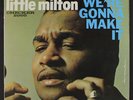
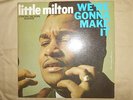
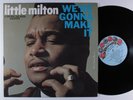
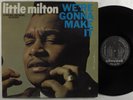
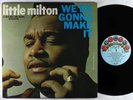
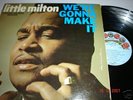
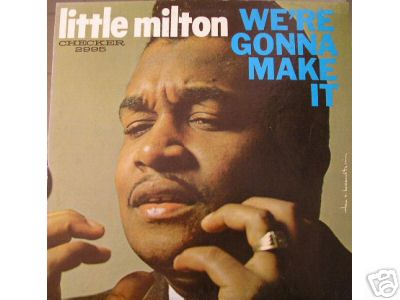
LITTLE MILTON-Gonna Make It 1st LP Checker black&silver
$
50


Favourite Auctions
To save auctions to your favourites, please login
If you don't have an account, please register
Description
EXCELLENT DEBUT ALBUM AND OH SO VERY RARE ON THE BLACK AND SILVER LABEL
Little Milton - "We're Gonna Make It", mono, on Checker 2995.Record Condition: VG++, nearly full gloss, some light hairlines, close to my Mint- grade, a 7.5 on a 1-10 scale
Cover Condition: VG++
Labels: Black and silver
Song Titles:
- We're Gonna Make It
- You're Welcome to the Club
- I'm Gonna Move to the Outskirts of Town
- Blues in the Night
- Country Style
- Who's Cheating Who?
- Blind Man
- Can't Hold Back the Tears
- Believe in Me
- Stand by Me
- Life is LIke That
- Ain't No Big Deal on You
About the Artist: by Steve Huey
He may not be a household name, but die-hard blues fans know Little Milton as a superb all-around electric bluesman — a soulful singer, an evocative guitarist, an accomplished songwriter, and a skillful bandleader. He's often compared to the legendary B.B. King — as well as Bobby "Blue" Bland — for the way his signature style combines soul, blues, and R&B, a mixture that helped make him one of the biggest-selling bluesmen of the '60s (even if he's not as well-remembered as King). As time progressed, his music grew more and more orchestrated, with strings and horns galore. He maintained a steadily active recording career all the way from his 1953 debut on Sam Phillips' legendary Sun label, with his stunning longevity including notable stints at Chess (where he found his greatest commercial success), Stax, and Malaco. James Milton Campbell was born September 7, 1934, in the small Delta town of Inverness, MS, and grew up in Greenville. (He would later legally drop the "James" after learning of a half-brother with the same name.) His father Big Milton, a farmer, was a local blues musician, and Milton also grew up listening to the Grand Ole Opry radio program. At age 12, he began playing the guitar and saved up money from odd jobs to buy his own instrument from a mail-order catalog. By 15, he was performing for pay in local clubs and bars, influenced chiefly by T-Bone Walker but also by proto-rock & roll jump blues shouters. He made a substantial impression on other area musicians, even getting a chance to back Sonny Boy Williamson II, and caught the attention of R&B great Ike Turner, who was doubling as a talent scout for Sam Phillips at Sun. Turner introduced the still-teenaged Little Milton to Phillips, who signed him to a contract in 1953. With Turner's band backing him, Milton's Sun sides tried a little bit of everything — he hadn't developed a signature style as of yet, but he did have a boundless youthful energy that made these early recordings some of his most exciting and rewarding. Unfortunately, none of them were hits, and Milton's association with Sun was over by the end of 1954. He set about forming his own band, which waxed one single for the small Meteor label in 1957, before picking up and moving to St. Louis in 1958. In St. Louis, Milton befriended DJ Bob Lyons, who helped him record a demo in a bid to land a deal on Mercury. The label passed, and the two set up their own label, christened Bobbin. Little Milton's Bobbin singles finally started to attract some more widespread attention, particularly "I'm a Lonely Man," which sold 60,000 copies despite being the very first release on a small label. As head of A&R, Milton brought artists like Albert King and Fontella Bass into the Bobbin fold, and with such a high roster caliber, the label soon struck a distribution arrangement with the legendary Chess Records. Milton himself switched over to the Chess subsidiary Checker in 1961, and it was there that he would settle on his trademark soul-inflected, B.B. King-influenced style. Initially a moderate success, Milton had his big breakthrough with 1965's "We're Gonna Make It," which hit number one on the R&B charts thanks to its resonance with the civil rights movement. "We're Gonna Make It" kicked off a successful string of R&B chart singles that occasionally reached the Top Ten, highlighted by "Who's Cheating Who?," "Grits Ain't Groceries," "If Walls Could Talk," "Baby I Love You," and "Feel So Bad," among others. The death of Leonard Chess in 1969 threw his label into disarray, and Little Milton eventually left Checker in 1971 and signed with the Memphis-based soul label Stax (also the home of his former protégé Albert King). At Stax, Milton began expanding his studio sound, adding bigger horn and string sections and spotlighting his soulful vocals more than traditional blues. Further hits followed in songs like "Annie Mae's Cafe," "Little Bluebird," "That's What Love Will Make You Do," and "Walkin' the Back Streets and Cryin'," but generally not with the same magnitude of old. Stax went bankrupt in 1975, upon which point Little Milton moved to the TK/Glades label, which was better known for its funk and disco acts. His recordings there were full-blown crossover affairs, which made "Friend of Mine" a minor success, but that label soon went out of business as well. Milton spent some time in limbo; he recorded one album for MCA in 1983 called Age Ain't Nothin' But a Number, and the following year found a home with Malaco, which sustained the careers of quite a few old-school Southern soul and blues artists. During his tenure at Malaco, Milton debuted the song that would become his latter-day anthem, the bar band staple "The Blues Is Alright," which was also widely popular with European blues fans. Milton recorded frequently and steadily for Malaco, issuing 13 albums under their aegis by the end of the millennium. In 1988, he won the W.C. Handy Award for Blues Entertainer of the Year, and was also inducted into the Blues Hall of Fame.
MY GRADING SYSTEMS: I’ve been told that I grade conservatively. My NM (near mint) is my highest grade for opened records (which would also include unplayed records). It’s a 9 or 10 on a 1-10 scale. M- would be equivalent to an 8; VG++ to a 7; VG+ to a 6; VG to a 5; VG- to a 4; G to a 3; F to a 2 and P to a 1. The same scale applies when I grade covers (jackets). Significant defects are specifically noted and taken into consideration in the grade.
GRADING DESCRIPTIONS
RECORDS:- GRADING Grading is based on the following criteria
- Sealed = store stock new
- Near Mint = like new or near new with only one or two small insignificant defects, a 9 or better on a 1-10 scale
- Mint- = extremely nice. Would be Near Mint, except for a couple of light hairlines or scuffs, which do not affect play
- VG++ = still a very nice record with all or nearly all of its original gloss but may have a few more light, surface marks, hairlines, needle tracks or the like which should not materially effect play
- VG+ = a nice, but used record that may have a series of light scuffs or scratches. It probably plays with a few pops, but has no serious problems.
- VG = a well-used record that still should sound OK when played, but may have moderate surface noise, pops, etc.
- VG- = a very well-worn record that plays through without skipping, but will do until a better copy comes along.
- Good = not actually good at all but probably will play through but with much in the way of surface noise, pops, crackles, etc. Still, will have no cracks, chips or the like
- Fair = you’re getting this record just to own but not to play
- Poor = the sky’s the limit, generally I will discard a record this bad (and sell the cover, jacket or sleeve alone) unless the label holds some particular interest
VISUAL GRADING: All records are visually graded only unless I state that they are play-graded. Some labels such as RCA, Capitol, Colpix, Atlantic, MGM were pressed on better quality vinyl and will sound better than a record which visually appears the same on labels such as Crown, Score or Design. Recording techniques also varied. The sound on live albums may be far inferior to studio recordings. There may also be defects in the pressing which are invisible. The point is that an album on RCA graded VG+ may sound far better than an album on Crown graded Near Mint. I have no problem issuing a refund if you are dissatisfied with the sound on a record as long as it’s requested as per my stated return policy below. But please don’t be shocked if a record visually graded Near Mint doesn’t sound state of the art. If I base my grade on a PLAY GRADE, I will state this specifically in my grading section.
COVERS: There are really too many possible defects regarding covers to be as specific in my definitions as I had been with my record grades. But please keep in mind these general grading guidelines:
- I will give greater weight to the condition of the front cover than back cover when assigning an overall grade
- No cover with a cut out hole or saw mark will be graded Near Mint even if it is still in factory shrink and there is no other wear
- I will not reduce the grade of a cover for stickers which are glued to the jacket by the record company (eg. Contains the hit song Tennessee Stud); but will reduce the grade for stickers glued on the cover by stores, previous owners, etc.
- If I write that a cover has a bb hole, I’m talking about a small cut out hole
- A saw mark is a narrow cut in the perimeter of the cover, could be anywhere and vary in length from 1/2” to 2” at the most.
- The overall grade takes into consideration any stated defects. For example, if I grade a cover VG+ and then state it has 6” top and bottom seam splits - I’ve already reduced the grade because of the seam splits. If the seams weren’t split, the cover would be graded higher such as VG++ or Mint-.
Shipping Costs:
The buyer pays for shipping. For one or two albums, the cost for priority mail in the United States is $6.50. For media rate postage within the U.S. the cost will be $3.50 for one or two albums.The cost for shipping a 7” record via 1st class is $2.50 and the cost for shipping a compact disc via 1st class is $3.20.
Save money when I mail 2 or more records in the same package.
Insurance is optional but highly recommended for “high ticket” purchases. Insurance is available only on purchases of over $50.00. The cost for insurance is $2.20 for up to $100; $3.20 for up to $200 and $1.00 additional for each additional $100 of insurance. Rates are quoted in my winning bid notices. The shipping charges for box sets, multi-record sets and other items of non-standard size and weight will be quoted.
International Shipments: Overseas customers are welcome to bid. Postage to the U.K., western Europe and Latin America is $12.00 for airmail and $6.50 for surface for one album. Canada is $6.00 airmail (no surface option). To all other countries, postage is $15.00 airmail and $7.00 surface. 7“ records are $5.50 airmail anywhere in the world. Save on shipping cost per record when I mail two or more records in one package.
Please check out my other eBay auctions
. I’ve been listing all types of records - mostly LP’s - including 50’s and 60’s rock ‘n’ roll, country, folk jazz, blues, personalities, new wave and punk, surf, psych, spoken word, comedy, etc., etc....... I try to list unusual, unique or obscure records, not the ones that you see all the time. While a majority of my listings are albums, you’ll often find a nice selection of 45’s, EP’s or picture sleeves...and an occasional 78 or two.My return policy: I don’t get many returns but customers are important to me so I like to offer a relatively hassle-free return policy. However, in order to return the record or other item, you must notify me by e-mail of your intent shortly after your receipt of the record or other item and within a reasonable time after the auction’s close. Also, the item must be returned in its original condition , i.e. the way it was shipped when it left my hands. While a very high percentage of my records arrive safe and sound (I use professional mailers and a filler or two, more for 78’s), they occasionally are damaged in transit. If that happens, I won’t accept the return of the record or other item - that’s why you have the option of obtaining insurance.
My Feedback Policy: Because I've been burnt on a few occasions, I've decided I'm only going to respond to feedback once it is left for me (and I'll try to do so on a weekly basis if not more often). Most recently, a fellow from Belgium e-mailed me after a couple of weeks and said he never received his Reparata & the Delrons album which he won for $7.50. I told him it was mailed about two weeks before and he should be a bit patient. A couple of weeks later, he e-mails me again and said it didn't arrive. I offered to mail him a copy of my postal receipt if that would make him feel better. Next thing I know, I get negative feedback. When I attempted to leave him an appropriate response, I discovered I had already left him positive feedback. This is about the 4th time this has happened over the years, getting unfavorable feedback thru no fault of my own. Unwarranted negative feedback can end up costing me $. Unfortunately a few bad apples ruin it for the large percentage of honest and reasonable folks.
Any other questions? About anything? Please e-mail me at ibuyvinyl@nc.rr.com .
price rating