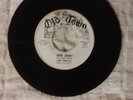
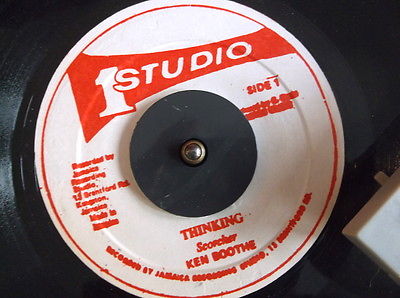
Ken Boothe - Thinking - on Studio 1 Produced by C Dodd JAMREC (Rare)
£
15
$
20


Favourite Auctions
To save auctions to your favourites, please login
If you don't have an account, please register
Description
Record Name: Ken Boothe - Thinking b/w Dub Version
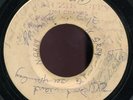
Label: 7 inch Vinyl Single - on Studio 1 Produced by C Dodd JAMREC Music
Record: in VGC
Sleeve: Plain
Other Information:
This record was part of a set of some fifty purchased recently from a house clearance and all have been played and tested. All play very well. Some placement of labels has been less than concentric and all display wear commensurate with their age. All are housed in plain white sleeves.
Dub Reggae…
Steve Barrow and Peter Dalton in their ‘Rough guide to reggae’ say the word 'dub' is now used throughout the world of dance music to describe a remix. It's not so widely recognised, however, that the technique of the remix was pioneered in Jamaica as far back as 1967, initially in the quest for sound-system exclusivity, but soon exploited as an economic and imaginative way of reusing already recorded rhythm tracks.
Broadly speaking, the history of dub in Jamaica has passed through three phases.
First there were the so-called 'instrumentals', not originally conceived as such, but becoming so by the removal of the vocal track. Initially these instrumentals were strictly for sound-system play, but before too long they were being issued commercially.
Versions on which the contribution of the studio engineer was more obvious then emerged around the end of 1968, and by 1970 these remixes – called 'versions' – were appearing on the B-sides of most Jamaican singles. The producer would have the engineer remove all, (or most), of the original vocal, leaving the raw rhythm track, which could be spiced up with a deejay adding shouted exclamations and/or extra instrumentation.
Besides offering further entertainment to dancers and record buyers, these 'versions' provided sound systems with tracks for their own deejays to talk, or 'toast', over.
King Tubby Dub, in the now familiar sense of radically remixed versions, arrived in 1972, and was largely the contribution of one man - Osbourne Ruddock, aka King Tubby, boss of the leading sound system in Kingston and a superb engineer.
Soon many of the leading producers were leaving their tracks at his studio to be given the Tubby treatment. During the remainder of the decade the remixes made by Tubby and his apprentices (Prince Jammy, Prince Phillip Smart and Scientist), and by other pioneers such as Errol Thompson (aka ET), added a further dimension to Jamaican music, eventually influencing dance culture worldwide.
During 1973-74 record buyers in Jamaica became accustomed to checking labels not just for the producer or artist, but also for the engineer. Records bearing a B-side credit like ‘King Tubby's Version’ or ‘Drum & Bass by King Tubby's were often selling on the strength of these, rather than their official top sides. This was also the year in which the first handful of dub albums appeared. They were usually pressed in very small quantities and disappeared quickly, but their followers were the most committed of the reggae public, and over the next few years hundreds of dub albums were issued, as every producer maximized the financial return on his vintage rhythms.
Any questions please ask.
See Our Other Records For Sale
UK Shipping: 1 x Single £1.50 2 x Singles £1.80 3 x Singles £2.10 Should we be fortunate that you purchase more than three records then please contact us so we can work out the best price for you.
Please Note: We aim to ship within three working day but often ship the same day provided we have received cleared funds payments. Overseas buyers MUST contact us before buying or bidding so that we can determine whether we want to do business and work out the price of shipping. Any item not paid for seven days after listing will result in a case being opened for non-payment and the item being re-listed.