JOHN CAGE+YUJI TAKAHASHI 1966 LP MORTON FELDMAN-AVANT
$
135


Favourite Auctions
To save auctions to your favourites, please login
If you don't have an account, please register
Description
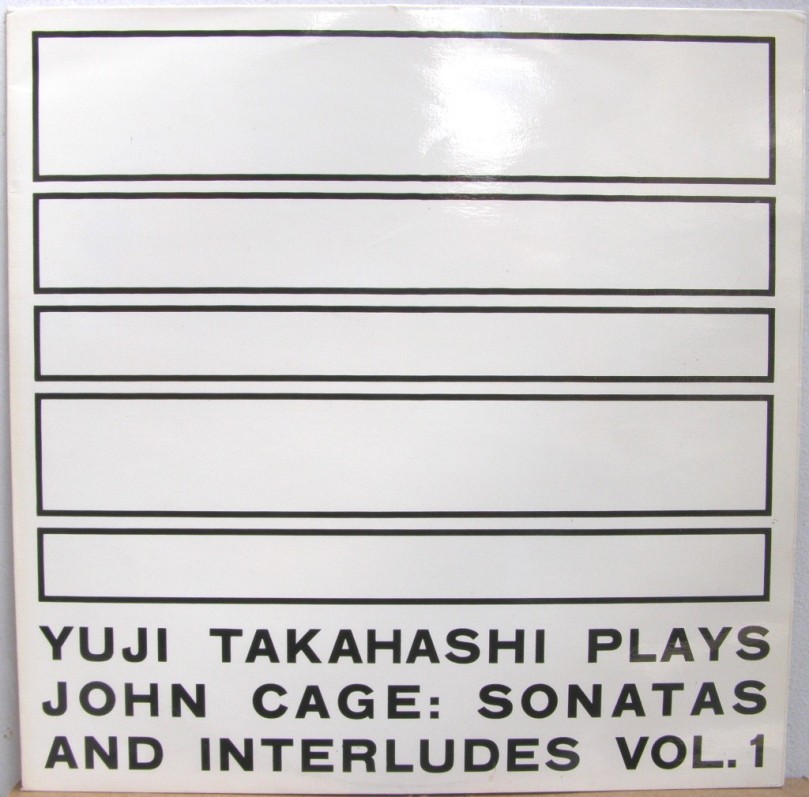
JOHN CAGE / YUJI TAKAHASHI
SONATAS AND INTERLUDES FOR PREPARED PIANO VOL.1 LP
Fylkingen Records / 1966
Very rare limited edition 1966 swedish release, this was the debut release for Fylkingen Records, Yuji Takahashi performs Cage's opus magnum.
Some info on the release: Very rare release by Yuji Takahashi performing John Cage's opus magnum on Fylkingen Records, Sweden (that released also the works of Ake Hodell, Sten Hanson, Akos Rozmann, Ake Parmerud, Lars-Gunnar Bodin, Small Cruel Party and others). Very rare 60's release, limited edition, very rarely seen offered for sale. This is your chance to get a pristine copy!!
In the text accompanying the first recording of Sonatas and Interludes, Cage specifically stated that the use of preparations is not a criticism of the instrument, but a simple practical measure. Cage started composing for prepared piano in 1940, when he wrote a piece called Bacchanale for a dance by Syvilla Fort, and by 1946 had already composed a large number of works for the instrument. However, in Sonatas and Interludes the preparation is very complex, more so than in any of the earlier pieces. Forty-five notes are prepared, mostly using screws and various types of bolts, but also with fifteen pieces of rubber, four pieces of plastic, several nuts and one eraser. It takes about two or three hours to prepare a piano for performance. Despite the detailed instructions, any preparation is bound to be different from any other, and Cage himself suggested that there is no strict plan to adhere to: "if you enjoy playing the Sonatas and Interludes then do it so that it seems right to you".
John Milton Cage Jr. was a pioneer of chance music, electronic music and non-standard use of musical instruments, Cage was one of the leading figures of the post-war avant-garde and, in the opinion of many, the most influential American composer of the 20th century. He was also instrumental in the development of modern dance, mostly through his association with choreographer Merce Cunningham, who was also Cage's romantic partner for the most part of the latter's life. Cage is perhaps best known for his 1952 composition 4?33?, the three movements of which are performed without a single note being played. A performance of 4?33? can be perceived as including the sounds of the environment that the listeners hear while it is performed, rather than merely as four minutes and thirty three seconds of silence and has become one of the most controversial compositions of the century. Another famous creation of Cage's is the prepared piano (a piano with its sound altered by placing various objects in the strings), for which he wrote numerous dance-related works and a few concert pieces, the most well-known of which is Sonatas and Interludes (1946–48).
His teachers included Henry Cowell (1933) and Arnold Schoenberg (1933–35), both known for their radical innovations in music, but Cage's major influences lay in various Eastern cultures. Through his studies of Indian philosophy and Zen Buddhism in the late 1940s, Cage came to the idea of chance-controlled music, which he started composing in 1951. The I Ching, an ancient Chinese classic text on chance events, became Cage's standard composition tool for the rest of his life. In a 1957 lecture, Experimental Music, he described music as "a purposeless play" which is "an affirmation of life – not an attempt to bring order out of chaos nor to suggest improvements in creation, but simply a way of waking up to the very life we're living". Cage collaborated with David Tudor, Robert Rauschenberg, and Charles Olson at Black Mountain College where a performance took place amongst the audience. "Happenings", as set forth by Cage, are theatrical events that abandoned the traditional concept of stage-audience and occur without a sense of definite duration; instead, they are left to chance. They have a minimal script, with no plot. In fact, a "Happening" is so-named because it occurs in the present, attempting to arrest the concept of passing time. Cage believed that theater was the closest route to integrating art and (real) life. The term "Happenings" was coined by Allan Kaprow, one of his students, who was to define it as a genre in the late fifties. In following these developments Cage was strongly influenced by Antonin Artaud’s seminal treatise The Theatre and Its Double, and the “Happenings” of this period can be viewed a forerunner to the ensuing Fluxus movement. In October of 1960, Mary Baumeister's Cologne studio hosted a joint concert by Cage and the video artist Nam June Paik, who in the course of his 'Etude for Piano' cut off Cage's tie and then washed his co-performer’s hair with shampoo.
Condition: Vinyl and cover lie in excellent condition. Despite its' age, cover looks like it was released last year, nearly new, while vinyl looks crystal clear and plays with minor crackle.
Tracklist
A1 Sonata I 2:32 A2 Sonata II 1:52 A3 Sonata III 2:28 A4 Sonata IV 2:38 A5 First Interlude 3:23 B1 Sonata V 1:20 B2 Sonata VI 1:41 B3 Sonata VII 1:48 B4 Sonata VIII 2:34 B5 Second Interlude 3:27SHIPPING & PAYMENT
Shipping: Shipping for this LP is 7$ airmail in Europe / 9$ for the rest of the world
Registered mail: +5$
Insurance: optional
Combined shipping: BIG discounts
Payment: Paypal
Packaging: I am a collector too and i know


![MONEY DISC/NEW BROOM - HORACE ANDY [ROOTS REGGAE] 7](https://www.popsike.com/php/thumbnail.php?url=https://www.popsike.pics/pix/20160922/302082525713.jpg)