JOHN CAGE+FRANCES-MARIE UITTI+PUGLIESE LP FLUXUS-AVANT
$
28


Favourite Auctions
To save auctions to your favourites, please login
If you don't have an account, please register
Description
JOHN CAGE w/FRANCES-MARIE UITTI / MICHAEL PUGLIESE / ISABELLE GANZ
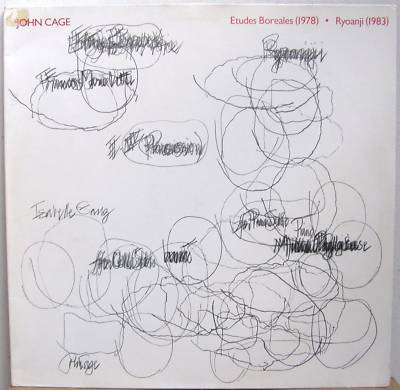
ETUDES BOREALES / RYOANJI 2-LP
Mode Records
Very rare original edition, world premiere performance and release of John Cage's Etudes Boreales & Ryoanji, performed by Frances-Marie Uitti, Michael Pugliese and Isabelle Ganz.
Some info on the release: This is the first original 1985 us pressing of John Cage's Etudes Boreales /Ryoanji released by Mode Records (that released also records from Morton Feldman, Alvin Curran, Pauline Oliveros, Earle Brown, Iannis Xenakis and others). Etudes Boreales is a set of etudes for cello and/or piano composed by John Cage in 1978. The set is a small counterpart to Cage's other etude collections - Etudes Australes for piano and Freeman Etudes for violin. Etudes Boreales were composed for, and dedicated to, Jack and Jeanne Kirstein. The latter performed Cage's piano works in the 1970s, but found Etudes Boreales unplayable; the first performer to find a way to play the pieces was percussionist Michael Pugliese. The set comprises four pieces. The cello parts are technically similar to Freeman Etudes: they are extremely demanding pieces composed using chance operations, every aspect of the work meticulously detailed in the score. The difference between the works is that in Etudes Boreales the pitch range is limited at any given time, and changes throughout the pieces, whereas in Freeman Etudes the range was unlimited. An excerpt from one of the etudes shows that the technique required involves the ability to jump accurately to any point on the fingerboard or beyond, which is particularly difficult in these pieces as they are to be played without vibrato. The piano parts of Etudes Boreales were composed using star charts, as in Atlas Eclipticalis, Etudes Australes and Song Books (here Cage chose the maps of Atlas Boreales, an atlas of the northern sky by Antonín Be?vá?, hence the title of the work), however the charts were used not to determine actual pitches, as in these works, but to determine where on the piano the performer is to play (the keyboard, the frame, the strings, etc.). This effectively transforms the piano etudes into percussion works. In 1983 started a composition in progress called Ryoanji, named after the rock garden in Kyoto, Japan. This garden is a collection of 15 rocks, placed in a landscape of raked, white sand. In the summer of 1983 Cage started a series of drawings entitled Where R=Ryoanji, using 15 different stones and drawing around these. Around that time the oboist James Ostryniec asked Cage to write a piece for him, which resulted in the first part of Ryoanji. Between 1983 and 1985 Cage added 4 more parts for voice, flute, double bass and trombone.
John Milton Cage Jr. was a pioneer of chance music, electronic music and non-standard use of musical instruments, Cage was one of the leading figures of the post-war avant-garde and, in the opinion of many, the most influential American composer of the 20th century. He was also instrumental in the development of modern dance, mostly through his association with choreographer Merce Cunningham, who was also Cage's romantic partner for the most part of the latter's life. Cage is perhaps best known for his 1952 composition 4?33?, the three movements of which are performed without a single note being played. A performance of 4?33? can be perceived as including the sounds of the environment that the listeners hear while it is performed, rather than merely as four minutes and thirty three seconds of silence and has become one of the most controversial compositions of the century. Another famous creation of Cage's is the prepared piano (a piano with its sound altered by placing various objects in the strings), for which he wrote numerous dance-related works and a few concert pieces, the most well-known of which is Sonatas and Interludes (1946–48).
His teachers included Henry Cowell (1933) and Arnold Schoenberg (1933–35), both known for their radical innovations in music, but Cage's major influences lay in various Eastern cultures. Through his studies of Indian philosophy and Zen Buddhism in the late 1940s, Cage came to the idea of chance-controlled music, which he started composing in 1951. The I Ching, an ancient Chinese classic text on chance events, became Cage's standard composition tool for the rest of his life. In a 1957 lecture, Experimental Music, he described music as "a purposeless play" which is "an affirmation of life – not an attempt to bring order out of chaos nor to suggest improvements in creation, but simply a way of waking up to the very life we're living". Cage collaborated with David Tudor, Robert Rauschenberg, and Charles Olson at Black Mountain College where a performance took place amongst the audience. "Happenings", as set forth by Cage, are theatrical events that abandoned the traditional concept of stage-audience and occur without a sense of definite duration; instead, they are left to chance. They have a minimal script, with no plot. In fact, a "Happening" is so-named because it occurs in the present, attempting to arrest the concept of passing time. Cage believed that theater was the closest route to integrating art and (real) life. The term "Happenings" was coined by Allan Kaprow, one of his students, who was to define it as a genre in the late fifties. In following these developments Cage was strongly influenced by Antonin Artaud’s seminal treatise The Theatre and Its Double, and the “Happenings” of this period can be viewed a forerunner to the ensuing Fluxus movement. In October of 1960, Mary Baumeister's Cologne studio hosted a joint concert by Cage and the video artist Nam June Paik, who in the course of his 'Etude for Piano' cut off Cage's tie and then washed his co-performer’s hair with shampoo.
Frances-Marie Uitti is a composer and cellist known for her performances of the most esoteric and virtuoso contemporary classical music. She was born in Chicago to Finnish parents, and she studied classical music at Meadowmount with Ronald Leonard and Josef Gingold, Boston University with Leslie Parnas and University of Texas with George Neikrug. In Europe she worked at the Academia Chigiana with Andre Navarra, winning their top award two years in a row. Uitti invented a radically extended technique using two bows simultaneously in one hand- being the first to transform the cello into a 4 part chordal instrument. This technique expands the harmonic and timbral possibilities of the instrument in extraordinary ways: for example, one can play simultaneously 4, 3, 2, and 1 string, with contrasting polyrhythmic articulations between the two bows. Non-adjacent strings can also be accessed. One bow can be played near the bridge while the other is near the fingerboard. She has used over 75 different tunings in her compositions using this technique, each producing new harmonic possibilities and exotic timbres plus a polyphony and independence of voices that her previous work with a single curved bow couldn't obtain. Early on, she combined singing with the cello and premiered Louis Andriessen's masterpiece La Voce which is dedicated to her. Other works featuring her voice include James Tenney's concerto, "Ain't I a Woman?" with text by Sojourner Truth, David Dramm's Crosshair, Rodney Sharman's The Ecstacy of St. Teresa, Vinko Globokar's Janus, William Kirkpatrick's Stations of the Cross. Uitti has collaborated with and is the dedicatee of composers Luigi Nono, Louis Andriessen, James Tenney, Jonathan Harvey, John Cage, Karen Tanaka, Per Norgaard, Giacinto Scelsi, Elliott Sharp, György Kurtág, Richard Barrett, Guus Janssen, Jay Alan Yim, Vinko Globokar, Clarence Barlow, David Dramm, Geoffrey King, Martijn Padding, Horatiu Radulescu, Calliope Tsoupaki, and Peter Nelson, among many others. She collaborates in duo with Mark Dresser, and with Evan Parker, Joel Ryan, Misha Mengelberg, David Wessel, and other legends out the jazz world as well as with DJ Low, Scanner etc, and artists Hooykaas Stansfield, Marina Abromovic, Steina Vasulka, Frank Scheffer. While living in Rome, she worked closely with Giacinto Scelsi, not only as dedicatee of all the cello works, but also transcribing from his archive and improvising together- from 1975 until his death in 1988. Uitti premiered his newly discovered cello concerto at the Angelica Festival, Teatro Communale Bologna in 2006. She was guest professor at Oberlin Conservatory for 2 years, and was awarded the Regents' Lectureship both at the University of California Berkeley and at University of California San Diego. She gives master classes worldwide for composers and string players at conservatories and universities including Yale, Princeton, Stanford, University of Illinois, as well as having the Fromm Foundation Fellowship to teach a residency at Harvard University. Ms. Uitti is finishing a massive book commissioned by the University of California Press on New Cello Techniques covering music from 1915 Kodaly Sonata, to the present day. In 2003, Uitti commissioned a custom-designed electric 6 string cello from Seattle luthier, Eric Jensen, which she later enhanced ergonomically with sensors at CNMAT (University of California, Berkeley) working with David Wessel and Adrian Freed and Michael F. Zbyszynski. She is returning to CNMAT in 2008 to design and construct a 12-stringless meta cello with Adrian Freed. She recently acquired an aluminum cello made by the Pfretzner luthier family in 1929- aluminum instruments were also used by Jasha Heifetz and Efram Zimbalist. She has recorded and performed on the Mongolian Morin Choor, a custom built Uzbeki Sato, and an original Stroh one-stringed cello. As inventor Uitti has developed a difference-tone resonator that strongly amplifies the beating and subtle "ghost tone" produced by chordal playing. She has redesigned and built 5 prototype-bows under tutelage of bowmaker Andreas Grutter, to further facilitate her work with two bows in one hand. At the request of G Scelsi, she redesigned the metallic mutes used in the String Quartet #2 and Triphon for solo cello. Uitti has recorded on ECM records, Wergo, Hat Hut Records, CRI, and BvHaast, JdKproductions, Cryptogrammophone, Sargasso, CRI.
Condition: Vinyl lie in excellent condition, looks and plays great, while cover lies in very good++ condition, is in great shape except from a small sticker removal that has left a sign on the top left corner, beggining of ring and some minor corner bending.
Tracklist Etudes Boreales For Piano Solo A1 Etudes Boreales 4:21 A2 Etudes Boreales 5:49 A3 Etudes Boreales 4:24 A4 Etudes Boreales 5:44 Etudes Boreales For Cello Solo B1 Etudes Boreales 4:12 B2 Etudes Boreales 5:35 B3 Etudes Boreales 4:09 B4 Etudes Boreales 5:38 Etudes Boreales (Duo Version) C1 Etudes Boreales 4:17 C2 Etudes Boreales 5:45 C3 Etudes Boreales 4:18 C4 Etudes Boreales 5:43 Ryoanji (Solos For Voice, Solo For Percussion) D Ryoanji 21:27SHIPPING & PAYMENT
Shipping: Shipping for this double LP is 9$ airmail in Europe / 12$ for the rest of the world
Registered mail: +5$
Insurance: optional
Combined shipping: BIG discounts
Payment: Paypal
Packaging: I am a collector too and i know
price rating