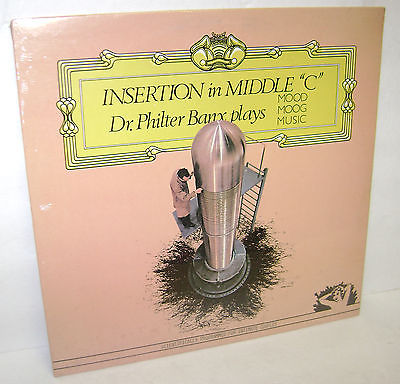
Insertion in Middle "C"- Dr. Philter Banx plays Mood Moog music LP
$
400



Favourite Auctions
To save auctions to your favourites, please login
If you don't have an account, please register
Description
This record is still factory shrink wrapped.
Produced and recorded at Fanshaw College in London back in 1975. Here is a youtube link> http://www.youtube.com/watch?v=_HfSJmku-go
Great art work for the day with interesting Moog synthesizer music. Below is a brief history as told the the records producer Robert Leth.
Long Story, Short:
We are a group of alumni of a very unique and special media arts program at Fanshawe College, known originally as "Creative Electronics". What started out life as merely a spinoff of the Radio & TV Arts program, went on to take on quite a life of its own as a pioneering school of various media art forms, both standalone and in concert. It is probably best described as a creative hive, both in technique and spirit, and as set within the context of the ancient Chinese curse, "May You Live in Interesting Times".
39 years later, we have recently come back together, due to the apparent ongoing lifespan of an album which we produced in our graduate year, entitled:
Insertion in Middle "C".
(Quite) A Bit of History:
Insertion in Middle “C”, by artist Dr. Philter Banx, was initially a studio album project, conceived of and recorded by a student collective who were attending Fanshawe College in 1975, in London, Ontario, Canada within a groundbreaking and highly experimental media program called Creative Electronics. The course was the brainchild of Tom Lodge, former Music Director for the original UK pirate radio ship, Radio Caroline. Eric McLuhan, son of media philosopher Marshall, was also an instructor in the program, as was internationally acclaimed artist Michael Hadyn. The students were therefore enrolled in one of the first post-secondary programs which included the teaching of Recording Music Techniques, and with a particular focus also on electronic music, which was just starting to gain popularity at that time.
The entire album was recorded at Creative Electronics Studio, the 8 track recording studio located within the College, one of a only a handful of fully equipped recording studios in all of Canada, at that time, institutional or otherwise.
And so, while producing their media project, back in that most romantic era of 1975, the students stumbled upon a scientific report, one which published evidence that the average mating cycle of a typical sexual human interlude apparently lasted about 22 minutes; which just happened to coincide with the exact length of time occupied by one side of a vinyl LP.
And thus, the seed for the “Insertion” project was born.
Namely, to produce an electronic soundtrack for just such an intimate interlude, as synchronized to the timings of the various stages of the overall event, from the subtleties of the opening introduction and initial overture, to the building of the waves towards the ultimate climax, and as followed by the serenity of the afterglow, thereafter.
Phillip Ross was perhaps the original “Doctor Phil” and the key musician and composer for the project. He was credited as the “Phil” in “Dr. Philter Banx”; being a spoonerism for the filter bank, a synthesizer module which controls the sound and shapes of various audio signals as they pass through analog filters. He was also the proud owner of the massive Moog Modular Series III Synthesizer, which forms the cornerstone of the entire production.
Robert Leth was the producer of the album for the Big Production Number, and and is credited/blamed for developing the original concept. Robert later went on to serve as Chief Recording Engineer for nearby Springfield Sound Studios from 1975 until 1990, and while there worked with numerous recording artists over the years, such as Jethro Tull, Budgie, Todd Rundgren, Buddy Myles and Canadian folk icon Stan Rogers.
The album was initially released on the students own private label Criminal Records (the only recording ever, on that label). It appeared on the shelves of local record stores regionally, and was also made available by mail order through classified ads, in the back pages of Rolling Stone Magazine.
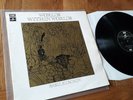
Upon release of the album, and following an initial successful first pressing of around 500 copies, they decided that a second pressing was definitely now in order. However, that idea was quickly quashed when Germany's largest Classical Record company of the day decided to contest the validity of the album, especially the album artwork. They claimed that the album was mocking their own label and that Dr. Philter Banx had utilized their floral frame design, in a fashion which they found "highly unacceptable". Although the claim was essentially hogwash, the financially challenged students decided to relent when they were hit with a Cease and Desist Order by said German record label; ordering them to appear in court in Dusseldorf, if they wished to contest. Clearly intimidated, the team decided to cut and run, and so the album lay dormant for almost 35 years.
Until:
Copies of Insertion in Middle “C” have resurfaced periodically over the past 35 years. There was an initial flurry of activity surrounding this album around 6 years ago. At the time, it was changing hands for around $200 to $300 a copy, mostly on eBay, and reportedly the album fetched $1,000.00, after a club DJ in New York who went by the handle “Green Tea” started tea-totaling it (sampling).





![Rift [LP] by Phish (Vinyl, Sep-2015, Jemp Records)](https://www.popsike.com/php/thumbnail.php?url=https://www.popsike.pics/pix/20210315/284220970301.jpg)