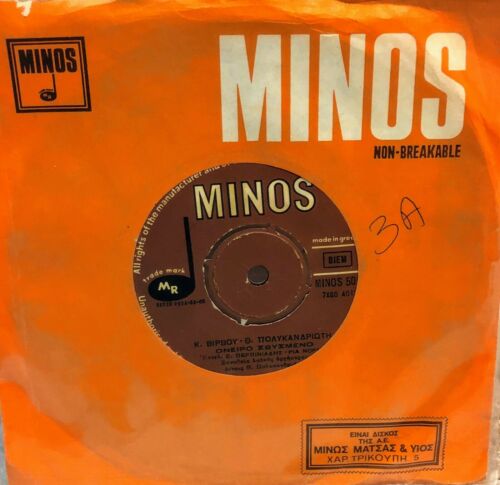
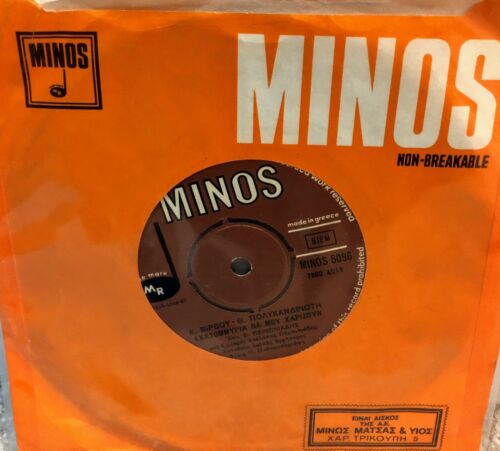
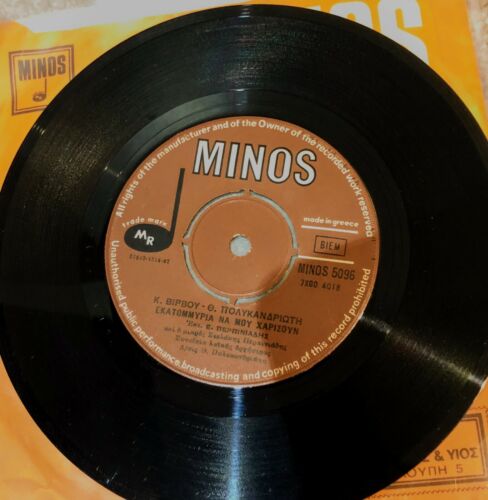
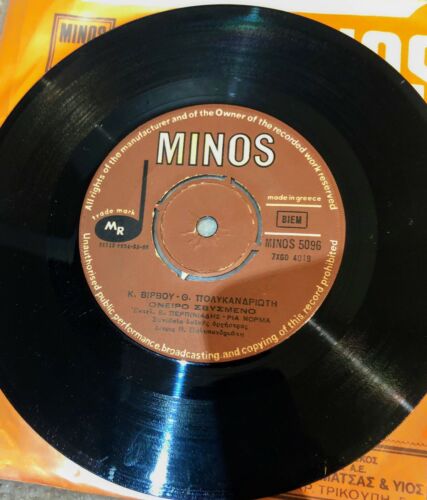
HOLY GRAIL HIPPY BOYS BROKEN DREAMS GREEK PRESSING 45 RPM MINOS 5096 VG+ RARE
$
123

Favourite Auctions
To save auctions to your favourites, please login
If you don't have an account, please register
Description
HIPPY BOYS BROKEN DREAMS GREEK PRESSING 45 MINOS. Condition is Used. Shipped with USPS Media Mail.
Extremely rare single from The Hippy Boys that is nearly impossible to find. Seize this opportunity.
Vinyl grade: VG+
Has some hairline scratches and a small mark, which causes a minor pop
Sleeve grade: EX
Has writing on the sleeve, which is the original sleeve from the label.
Audio samples available on request
The Hippy Boys will be familiar to collectors of ska and reggae; they were one of the studio wrecking crews who pumped out an endless supply of grooves cut in Jamaica in the 60s and 70s. Like many studio groups – and the earth itself for that matter – the actual genesis moment for the band is hard to fathom, but The Hippy Boys coalesced around 1967 and began backing Max Romeo, then the lead singer of The Emotions, at gigs around this time. Romeo sang for the Caltone label with his group, as did Alva Lewis, who was at the heart of The Hippy Boys. Despite some fluidity in the line-up, it settled around Glen Adams (organ), Aston Barrett (bass), Carlton Barrett (drums), Ronnie ‘Ranny Bop’ Williams (guitar) and Alva ‘Reggie’ Lewis (guitar).
As new faces on the scene, the group were no doubt viewed as an opportunity to save a few pounds by Jamaica’s producers, as they would have been hungry for experience – and therefore cheap. Plus they were fully versed in American grooves; Ranny and Carlton in particular were highly tuned-in to the work of Steve Cropper, King Curtis, and by 1969, the New Orleans funk laid down by The Meters under various guises. It gave their music an edge that not all their rivals could deliver, a bonus on the highly-competitive Kingston studio scene.
The Hippy Boys began unfurling a rhythmic red carpet for singers to walk upon; they worked under the yoke of producers like Lee Perry and Bunny Lee among many. As well as appearing behind other artists on a number of labels, Hippy Boys’ records began to be released in the late 60s – the exact players might vary from session to session although the Barrett Brothers rhythm section remained the core. Producers would rename the band according to their own brands; if they worked for Bunny Lee they’d be called the Bunny Lee All Stars; Lee Perry tagged them The Upsetters; for Joe Gibbs they’d be The Destroyers. Under their own moniker, they cut thrilling sides for Lloyd Chalmers (Look-Ea-Py-Py, on the UK Explosion label, adding reggae perfectly to a Meters’ tune) and Lloyd Daley (Voo-doo, JA Syndicate/ UK Big Shot, fingered by many experts as the first genuine dub record), but w hatever name they traded under, the groove they laid down was invariably tough, sinuous and perfectly funky for late-60s reggae. And the group were successful, without outsiders realising it Their backing rhythm for Tony Scott’s What Am I To Do was retooled by producer Harry Johnson, given an splash of organ melody nicked from King Curtis’s Soul Serenade, and became The Liquidator, a smash credited to the Harry J All Stars.
As well as producers like Perry, Lee, Joel Gibson and Ranny’s own productions, The Hippy Boys delivered a selection of particularly tasty tunes for Jamaica’s sole established female producer Sonia Pottinger. A unique figure in reggae, Pottinger had progressed from running a Kingston record shop – Tip Top – to scoring hits on her own labels SEP, Tip Top, High Note and Gay Feet, which were initially run in tandem with her husband Lyndon, whose Gay Disc label was established in the early 1960s. By 1969 the formidable “Miss Pott” was a force to be reckoned with in the Jamaican music scene. The Hippy Boys’ Pottinger-produced tunes were released on the UK-pressed LP Reggae With The Hippy Boys on the High Note label in 1969, an subsidiary of Trojan set up specifically to issue Pottinger’s work.
The album showcases The Hippy Boys’ raw groove to perfection. All 10 tracks are instrumentals, and the group’s versatility within the genre is impeccably demonstrated. Their influences come from far and wide. Tom cat patrols like Nurse J’kel and Spicy are driven by organ, whilst a track like Moon Walk is actually a medley dominated by wondrous guitar picking of Pete Seeger’s ever “green” Where Have All The Flowers Gone and The Rays’ doo-wop classic Silhouettes, resurrected in 1965 by Herman’s Hermits. This Is It borrowed the bassline for The Ethiopians’ Train To Skaville and it is the perfect example of “skinhead reggae”.
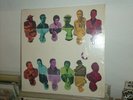
Challenge is another guitar workout underpinned by a solid rhythm that pulsates throughout. Like Seventh Heaven, the final track, Wondering, is led to the altar by a wonderful piano lead over a truly sweaty rhythm. And there’s a version of the moody reggae classic Drum Song, here titled Mad Movie, although in true reggae style the album’s credits are somewhat jumbled and even today there is some debate as to which track is really meant to be known under which title. (Just to make matters worse, the same tune was pressed up as Nigeria on a now-sought-after 45.) Confusion aside, all told it made a knockout album – even if the jury is still out on the cover art, which looks like something out of the Jackson 5’s cartoon TV series! It’s certainly the perfect evocation of the naivety of its era.
Commercial success also came for the band as one of the many manifestations of The Upsetters in the wake of Lee Perry’s hit Return Of Django, which even saw an appearance on Top Of The Pops – sadly not available for viewing on You Tube – as well as a six-week UK tour undertaken by Perry with Aston Barrett, Carlton Barrett, Glen Adams and Reggie Lewis.
There was even a recording session for the band in a Chalk Farm, North London, studio which yielded the album The Good, The Bad And The Upsetters (Trojan 1970) which had a wonderful gun-toting spaghetti Western sleeve straight out of Sergio Leone’s Dollars trilogy – possibly to warn off Lee Perry who was none too pleased about the use of his band’s name as he had flown home by then and had nothing to do with the LP! The producer was so miffed that he put out his own version of the album, using his own tracks, on a limited-edition Jamaican spoiler, much of which featured the same band as The Upsetters. The anger didn’t last: when they returned to Kingston, the boys were soon in the studio again with Perry adding musical stuffing behind Bob Marley.
The band eventually went their separate ways to differing fortunes. The Barrett brothers became the underpinning of the Wailers, a fact that caused some friction between Lee Perry and Bob Marley. Ranny Williams came to live in the UK in the early 70s and produced singers throughout the 1970s on and off. Many of his 45s appeared on the Pama group of labels and are highly-prized by collectors today. Glen Adams worked for Lee Perry until 1974, and was his right-hand man when it came to getting the producer’s often extreme ideas across to the artists and session players. He then shipped off to New York to try his luck there, recording for the Clocktower label as well as his own Capo company, which enjoyed success with the original pressing of Dr Alimantado’s Best Dressed Chicken In Town 45. He later turned up on the legendary Studio 1 label in the 1980s, recording at its Brooklyn studio, as well as producing the early rap artist T Ski Valley. Adams passed away in December last year. Alva Lewis cut vocal sides with Glen Adams as The Reggae Boys, and was a mainstay in Jamaica’s studios during the 1970s before emigrating to Toronto and recording on the city’s underground reggae scene. This then, was an outfit of some pedigree: a session team forced to trade under flags of convenience they may have been, but collectively and individually The Hippy Boys made their mark. Mrs Pottinger, their album’s producer, went on to work with The Melodians, Marcia Griffiths of the I-Threes and punk-reggae crossover favourites Culture, among others. She died in November 2010.
As for Reggae With The Hippy Boys, it was one of a number of LPs these musicians were involved with – like The Upsetters’ Return Of Django (Trojan, 1969) – that were bought and played to death at West Indian house parties in 1969 and probably 1970, 1971 … and investigated by a growing number of white boys in England turned on to Jamaican sounds through labels like Island, Blue Beat, Coxsone and many others. The album didn’t sell that heavily, however, because much of reggae was bought on 45s or on multi-artist compilations like the Tighten Up and its rival Straighten Up series, and perhaps because the skinhead fraternity saw the word “Hippy” and were turned off by it. As a result, Reggae With The Hippy Boys remains scarce and has been trading for up to £90 in Mint condition. But make no mistake: the generally dreadful state of most copies is testament to the pleasure these grooves gave the original fans of The Hippy Boys.
price rating