George Harrison electronic Sound Zapple ST3358
£
27
$
35


Favourite Auctions
To save auctions to your favourites, please login
If you don't have an account, please register
Description
A beautiful US pressing of George's second solo lp.
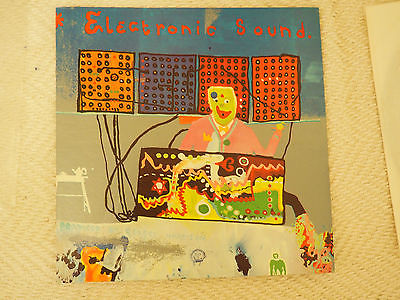
Electronic Sound is the second studio album by George Harrison. Originally released in 1969, it was the second and final record released on the Beatles' short-lived Zapple Records label, a subsidiary of Apple Records. The album comprises two lengthy pieces performed on the Moog synthesizer. Harrison subsequently introduced the instrument to the Beatles' sound; the band featured synthesizer for the first time on their 1969 albumAbbey Road.
Marix
A side SN1 3358 A1
B aisw SN2 3358 B2
History[edit]
Zapple was intended as a creative outlet for avant-garde musical works. Not long after the release of this album, the label was folded at the insistence of the Beatles' then-manager Allen Klein. Because of its experimental and highly non-commercial nature, Electronic Sound failed to chart in the United Kingdom, and barely made the United States Billboard 200 album chart, peaking at number 191.
Synthesist Bernie Krause later pursued legal action against Harrison, claiming that "No Time Or Space" (LP side two) was essentially a recording of him demonstrating the Moog III to Harrison (this is detailed in Krause's book Into a Wild Sanctuary). Krause also claimed that the demonstration was recorded and released without his knowledge or consent. Krause's name was originally credited on the front cover under Harrison's cover credit, but it was painted over at Krause's insistence.[1] Despite this, the words "Assisted by Bernie Krause" can still be read from under the silver ink on original LP pressings.
The music was performed on a Moog IIIc modular system which Harrison bought from directly from Robert Moog. The synthesizer is still owned by the Harrison family and is pictured in the centre photo spread on the 2014 CD reissue.
Original US LP label for Side Two of Electronic Sound. (Note the 18 minute timing of this track, which indicates that it is actually the recording which Harrison intended for Side One.)Release[edit]
Professional ratings Review scores Source Rating AllMusic [2] MusicHound 1/5[3] Rolling Stone (mixed)[4] The Rolling Stone Album Guide [5] Uncut [6]The album was released on Zapple Records in the UK on 9 May 1969.[7] On some vinyl versions, such as the original US and Canadian pressings, the order of the recordings was accidentally switched, though the titles were not. This mistake has caused many listeners to confuse the two titles. When the album was issued on CD for the first time in late 1996, the correct UK running order was used. Other editions, such as the 2014 digital download version use the same CD running order.
LP side one "Under the Mersey Wall" (18 minutes) uses the sound of two Moog instruments playing at the same time, an effect made possible through the use of overdubbing. At the beginning of this recording different instruments can be heard from the left and right stereo speakers.
LP side two "No Time or Space" (25 minutes) begins with a series of firecracker-like sounds and appears to be a performance of a single Moog instrument, though it often makes use of tape delay and echo effects. Portions ofwhite noise from this track are used throughout "I Remember Jeep", one of several jams included on Harrison's third solo album, All Things Must Pass, released in 1970.
The cover of Electronic Sound was painted by Harrison himself.The words "Produced by George Harrison" appear on front cover of the original LP pressings printed in light blue ink (as on this copy) , but were recolored in dark blue and red on later re-issues.
Track listing[edit]
All pieces credited to George Harrison.
Side one- "Under the Mersey Wall" – 18:41
- Recorded in Esher, England, in February 1969 with the assistance of Rupert and Jostick, the Siamese Twins[8]
- "No Time or Space" – 25:10
- Recorded in California in November 1968 with the assistance of Bernie Krause[8]
price rating


