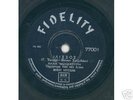
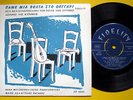
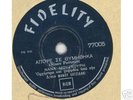
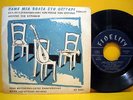
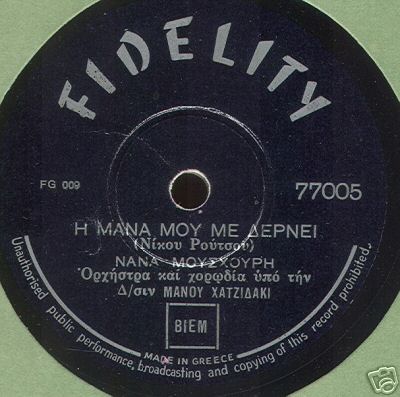
GREEK 78 NANA MOUSKOURI on FIDELITY 77005 E
$
85


Favourite Auctions
To save auctions to your favourites, please login
If you don't have an account, please register
Description
Nana Mouskouri
I Mana Moy Me Dernei / Apopse Se Thymithika Fidelity 77005, black label, GreeceCondition: E, pressing flaw A-side
sorry for any mis-transliteration of the Greek...
Comments: from allmusic.com : ...Ioana Mouskouri (Joanna in English; nicknamed "Nana" from a young age) was born October 13, 1934, on the island of Crete, in the town of Chania (or Carée in French). Her father worked as a movie projectionist, and moved the family to Athens when she was three. Much of her childhood was colored by the Nazi occupation of Greece — during which time her father worked for the resistance movement — and the four-year civil war that broke out on the heels of World War II. She started taking singing lessons at age 12, and listened regularly to radio broadcasts of American jazz singers (Frank Sinatra, Ella Fitzgerald, and Billie Holiday in particular) and French chanson stars (Edith Piaf, etc.). In 1950, Mouskouri was accepted into the Athens Conservatory, where she studied classical music with an emphasis on singing opera. In 1957, it was discovered that Mouskouri had been singing with a jazz group by night, and she was summarily kicked out of the Conservatory.Mouskouri began singing jazz in nightclubs, concentrating especially on Ella Fitzgerald repertory. In 1958, she met the emerging songwriter Manos Hadjidakis, who would become her mentor in the field of popular music, and recorded an EP featuring four of his compositions for a small record label that year. The following year she performed his "Kapou Iparchi Agapi Mou" (co-written with poet Nikos Gatsos) at the inaugural Greek Song Festival; it won first prize, and Mouskouri's high-profile performance began to make a name for her. At the 1960 festival, she performed two more Hadjidakis compositions, "Timoria" and "Kiparissaki," which tied for first prize; not long after, she made her first appearance outside of Greece at the Mediterranean Song Festival, held in Barcelona. She performed the Kostas Yannidis composition "Xypna Agapi Mou," which again won first prize, and attracted interest from several international record companies. She wound up signing with the Paris-based Philips-Fontana axis.In 1961, Mouskouri sang on the soundtrack of a German documentary about Greece, which resulted in the German-language single "Weisse Rosen aus Athen" ("The White Rose of Athens"). Adapted from a folk melody by Manos Hadjidakis, it was an enormous hit, selling over a million copies in Germany; later translated into several different languages, it went on to become one of her signature tunes. In 1962, she met producer Quincy Jones, who flew her to New York to record an album of American standards titled The Girl From Greece Sings; not long after, she had a sizable U.K. hit with the pop standard "My Colouring Book." In 1963, she settled permanently in Paris and recorded a Greek-language album; she also sang Luxembourg's entry in the Eurovision Song Contest that year, "À Force de Prier," which became an international hit, and helped win her the prestigious Grand Prix du Disque in France. She attracted the notice of composer Michel Legrand, who supplied her with two major French hits in "Les Parapluies de Cherbourg" (1964) and "L'Enfant au Tambour" (1965). Also in 1965, she recorded her second English-language album in America, Nana Sings, and found a patron in Harry Belafonte, who brought her on tour with him through 1966, and teamed with her for the live duo album An Evening With Belafonte/Mouskouri.Mouskouri ascended to superstardom in France with her 1967 album Le Jour Où la Colombe, which featured much of the core of her French repertoire: "Au Coeur de Septembre," "Adieu Angélina," "Robe Bleue, Robe Blanche," and a cover of the French pop classic "Le Temps des Cerises," among others...
Please have a look at my other current auctions!
These discs have not been play-graded. All grades are visual, and I try to be conservative. I follow the P, G, V, E system, where a "wall hanger" gets a P, a very worn but still playable disc gets a G, a decent disc with half its sheen left will get a V, and a pretty disc with most of its sheen will get an E. I will note any faults to the disc and the labels, as I notice them.
Any record may be returned for full refund for any reason. You must be happy.
Shipping starts at $4.00 for media mail and $10.00 for priority mail. It gets much cheaper for you with multiple purchases, add 50 cents media shipping for each additional disc. For multiple disc priority shipping we will make special arrangements (amount will depend on weight and zip code). International shipping at cost (depends on weight and country).
Insurance is suggested for domestic mail. I pack securely, but one never knows, and I won't assume responsibility for loss or damage. Insurance costs follow the USPS rate schedule. $1.65 for insured value up to $50; $2.05 up to $100, $2.45 up to $200, and so on.
Payment: PayPal, check or money order drawn on US bank, e-check through PayPal (there is a delay with these as they must clear).
price rating