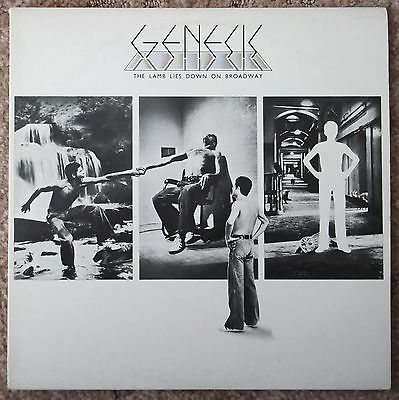
GENESIS - LAMB LIES DOWN IN BROADWAY - Gatefold sleeve - NM - Double Vinyl LP
£
17
$
22


Favourite Auctions
To save auctions to your favourites, please login
If you don't have an account, please register
Description
GENESIS "LAMB LIES DOWN IN BROADWAY"
Vinyl LP
1974 original release vinyl LP on the CHARISMA (Mad Hatter) record label Cat n# CGS 101 Made in ENGLAND
The album cover is in EX/NM condition. no splits or tears, some wear on the extreme edges, minor soiling ,the inner picture/lyric sleeves are in EX/NM condition, no splits or tears
The vinyl itself is in NM condition. there are 2 or 3 light papercuts/scuffs seen under a 1500watt strong light which can barely be heard when the LP is played, there are no deep scratches on this LP.
If you need anymore information and pictures please get in touch, thanks.
Sorry if the shipping charges seem a bit high, the reason being i use heavy/strong packaging and the high cost of the Royal Mail price structure
THIS IS AS GOOD EXAMPLE OF WELL LOOKED AFTER OLD LP RECORD
Full track list
Side one
1. "The Lamb Lies Down on Broadway" 4:55
2. "Fly on a Windshield" 2:47
3. "Broadway Melody of 1974" 1:58[19]
4. "Cuckoo Cocoon" 2:14
5. "In the Cage" 8:15
6. "The Grand Parade of Lifeless Packaging" 2:45 .
Side two
1. "Back in N.Y.C." 5:49
2. "Hairless Heart" 2:25
3. "Counting Out Time" 3:45
4. "The Carpet Crawlers" 5:16
5. "The Chamber of 32 Doors" 5:40 .
Side three
1. "Lilywhite Lilith" 2:40
2. "The Waiting Room" 5:28
3. "Anyway" 3:18
4. "Here Comes the Supernatural Anaesthetist" 2:50
5. "The Lamia" 6:57
6. "Silent Sorrow in Empty Boats" 3:06 .
Side four
1. "The Colony of Slippermen" a) "The Arrival"
b) "A Visit to the Doktor"
c) "Raven"
8:14
2. "Ravine" 2:05
3. "The Light Dies Down on Broadway" 3:32
4. "Riding the Scree" 3:56
5. "In the Rapids" 2:24
6. "it" 4:58 .
The Band
Tony Banks – Hammond T-102 organ, RMI 368x Electra piano, Mellotron M400, Elka Rhapsody synthesizer, ARP 2600 & ARP Pro Soloist synthesizers, acoustic piano
Phil Collins – drums, percussion, vibraphone, backing vocals
Peter Gabriel – lead vocals, flute, oboe, tambourine, experiments with foreign sounds
Steve Hackett – electric guitar, classical acoustic guitar
Mike Rutherford – bass guitar, 12-string guitar, bass pedals, fuzz bass
Additional personnel
Brian Eno – enossification (treatments) .
The Lamb Lies Down on Broadway (often shortened to The Lamb) is a double concept album recorded and released in 1974 by the British progressive rock band Genesis. It was their sixth studio album, and the last to feature original singer and frontman Peter Gabriel.
Premise
The album tells the surreal story of a half Puerto Rican juvenile delinquent named Rael living in New York City, who is swept underground to face bizarre creatures and nightmarish dangers to rescue his brother John.[1] Several of the story's occurrences and places were derived from Peter Gabriel's dreams,[2] and the protagonist's name is a play on his surname (Rael=Gabriel).[3] In reference to the live performance of "it" (where Gabriel appears onstage with an identically dressed mannequin), Phil Collins remarked that the entire concept was about split personality.[4] In this context, Rael would believe he is looking for John but is actually looking for a missing part of himself. The individual songs also make satirical allusions to mythology, the sexual revolution, advertising, and consumerism.[2] The title track, "The Carpet Crawlers", and "In the Cage" were live favourites for the band. Both "In the Cage" and "The Carpet Crawlers" were included in 2007's Turn It On Again: The Tour, with "The Carpet Crawlers" performed as the closing number.
Background
Following their Selling England by the Pound tour, the band went on retreat to Headley Grange to write and develop their next album. Used previously by Bad Company and Led Zeppelin, this was where the band hoped living together away from other distractions would help inspire creativity and develop unity between the members. The house, however, was in poor condition and infested by rats. Several band members had difficulty sleeping, believing the house was haunted.[3]
Peter Gabriel was absent from the album's writing and rehearsal sessions due to personal problems – his first wife was having difficulties with her first pregnancy.[4] For this reason, most of the music was written by Tony Banks, Phil Collins, and Mike Rutherford, with some contribution from Steve Hackett. Gabriel, for his part, insisted on writing the story and all the lyrics himself, which caused friction, in particular because Rutherford had originally suggested another project for the band, an album based on Antoine de Saint Exupéry's The Little Prince. Banks and Rutherford composed lyrics for "The Light Dies Down on Broadway", as Gabriel could not come up with a linking piece between "Ravine" and "Riding the Scree". In addition, when Gabriel put lyrics to a piece of music written by one of the other band members (such as Banks' "The Lamia" and Hackett's "Here Comes the Supernatural Anaesthetist") the composer would often insist on adjusting the lyrics to better fit the music, an action Gabriel did not take kindly to.[2]
"Fly on a Windshield" originally came about through a band improvisation, sparked by an idea from Mike Rutherford. Keyboardist Tony Banks said, "We used a lot of moods (on the album), at times things were little more than improvisations on an idea. For instance, Mike would say, 'Pharaohs going down the Nile', and he would just play two chords and instantly the rest of us would conjure up that particular mood. That one ended up on the album as 'Fly on a Windshield'."[5] Gabriel's then-wife Jill noted that he wrote the main melody for "The Carpet Crawlers", of which he is especially proud.[6] Tracks like "Anyway" and "Lilywhite Lilith" were developed from earlier unused 1969 compositions ("Frustration" and "The Light" respectively) which were likely to have been group efforts.[3]
During pre-production, Gabriel was contacted by filmmaker William Friedkin (at the time enjoying success with The Exorcist), about a possible film project after Friedkin read Gabriel's short story on the sleeve of the Genesis Live album.[1] Despite his bandmates' disapproval, Gabriel left them to work on some early script drafts. However, the project came to nothing (Friedkin instead working with Tangerine Dream to score his next film, Sorcerer), and Gabriel returned to the band.[3] One of the influences Peter Gabriel had was the movie El Topo ("The Mole") by Chilean director Alejandro Jodorowsky. This film, which depicts a spiritual journey, maintains a cult following.
Live performance
The Lamb Lies Down on Broadway reached number 10 in the UK, and number 15 in Canada, while nearly cracking the US Top 40, reaching number 41 and eventually going Gold, although it met with mixed reviews. Upon its release, Genesis went on a world concert tour, performing the album in its entirety 102 times. The tour was slated to begin on 29 October 1974, but due to an injury to Steve Hackett's hand, the tour was postponed until 12 November.[6] Opening night for the tour commenced at the Auditorium Theatre in Chicago, Illinois on 20 November 1974. The final show on was 22 May 1975 at the Palais des Sports in Besançon, France. (The final show of the tour had been scheduled for 27 May 1975 at the Palais des Sports in Paris, but was cancelled due to poor ticket sales, as was the penultimate date of 24 May 1975 at the Parc des Expositions in Toulouse.)[4] Early into the tour, Gabriel decided he would leave Genesis, and made the decision clear to his band mates, although he finished the tour amicably with the band and did not announce his severance in public until August 1975.[3]
The tour became the high point of Peter Gabriel's interest in theatrical presentation, masks and costumes, which had initially been introduced into the stage act to help his shyness and to give the band a distinctive stage feature. In addition to Gabriel's theatrics, three screens above the band showed slides to accompany the story.[2]
For the first half of the show, Gabriel dressed as Rael in a leather jacket, T-shirt and jeans, while relying on lighting and dramatic expression without the use of props or costumes. In the second half, the costumes and other visuals became much more elaborate. During "The Lamia", for instance, Gabriel was surrounded by a spinning cone-like structure decorated with images of snakes. For the last verse of the song, the cone would collapse to reveal Gabriel wearing a body suit that glowed under the stage's dark lights. However, the most notorious of Gabriel's costumes was the Slipperman, a naked monster with inflatable genitalia and covered in lumps, who emerged onto the stage by crawling out of a phallus-shaped tube.[2] At the intro to the final song, "it", a huge explosion set off twin strobes, and the audience was faced with both Gabriel and a dummy dressed identically, clueless as to which was real. "it" also featured an alternate ending with Gabriel vanishing from the stage in a flash of light and a puff of smoke.[4]
Although these visuals were meant to enhance the experience, the band became frustrated with the press focusing only on the theatrical side of the show and not the musicianship.[4] Another problem was that many fans reacted as if Gabriel was the star and the rest of the group merely his backing band. Collins later commented that backstage after a Lamb concert, "people would steam straight past Tony, Mike, Steve and I, go straight up to Peter and say, 'You're fantastic, we really enjoyed the show.' It was becoming a one-man show to the audience."[3]
The show featured some of Genesis' most famous instruments, including Mike Rutherford's double neck electric guitar that consisted of a MicroFret six-string bass and a Rickenbacker 12-string guitar, and Phil Collins' largest drum kit featuring four timbales, a red seven-piece Ludwig kit (and later, a natural finish Premier kit in same configuration), a Fibes Crystallite snare, a set of five red temple blocks, a vibraphone, tubular bells, and a set of tuned tambourines (used on "In the Cage.")
The tour was fraught with other difficulties. According to Banks, the slides which accompanied the music never worked well and only came close to working perfectly on four or five occasions.[4] Gabriel often had difficulty getting a microphone near enough to his mouth to be heard in some of his costumes, especially the Slipperman.[4] During a performance of "it" in Oslo, a stage manager's error resulted in an explosion so intense that it caused the band to stop playing, fearing for their safety.[2]
At the final Lamb concert in Besançon, roadie Geoff Banks, just for a joke and without telling the band beforehand, put on the dummy's leather jacket and – wearing nothing else – replaced the Gabriel dummy on stage for the intro to "it".[3]
No complete performance of The Lamb Lies Down on Broadway was recorded, although several pieces were filmed, including some bootleg footage taken by audience members. The 5.1 DVD edition of The Lamb Lies Down on Broadway, released in November 2008, features a visual "reconstruction" of the concert, utilising all of the band's original slides from the show, some bootleg footage, and photographs. There is also a nearly-complete audio recording of the performance from 24 January 1975 at the Shrine Auditorium in Los Angeles that is available on the box set, Genesis Archive 1967–75, although it has some re-recorded vocals and guitar parts by Gabriel and Hackett. In addition, the band used a re-mixed studio version of "it", also with re-recorded vocals by Gabriel, instead of the live version of the song. Contrary to Tony Banks' assertion in the accompanying booklet to the Genesis Archive, the tape did not run out; the live version of "it" exists on the King Biscuit Flower Hour broadcast of the Shrine concert.[7]
Genesis considered reuniting for a brief reunion tour of The Lamb Lies Down on Broadway in 2004. All five former band members met in November to discuss a possible tour, but ultimately Gabriel bowed out due to his solo commitments. In 2007, Banks, Collins, and Rutherford went ahead with the Genesis reunion tour without Gabriel and Hackett, playing two Lamb songs during the show, the standard live numbers "In the Cage" and "Carpet Crawlers." In March 2011, Collins announced his retirement from the music industry, ending any chances for future Genesis reunions.[8][9] However, two years later, he came out of retirement and started to make music again, collaborating with Adele.
Critical reception
Writing in the NME in 1978, Nick Kent claimed the album "had a compelling appeal that often transcended the hoary weightiness of the mammoth concept that held the equally mammoth four sides of vinyl together."[14]
In the Q & Mojo Classic Special Edition Pink Floyd & The Story of Prog Rock, the album came No.14 in its list of "40 Cosmic Rock Albums".[15]
The album came 3rd in Uncut's "10 best concept albums", where it was described as an "impressionistic, intense album" and "pure theatre (in a good way) and still Gabriel's best work".[16]
In 2012, the album ranked fifth in Rolling Stone's "Readers' Poll: Your Favorite Prog Rock Albums of All Time".[17]
The album's dense lyrical and musical complexity is the subject of a book[18] authored by Kevin Holm-Hudson, a professor of music theory. Holm-Hudson writes, "...The Lamb emerges as one of the richest creative works of the 1970s."
BBC Review
The band's final album with Gabriel is a conceptual masterpiece...
Daryl Easlea 2007
It's no wonder that Peter Gabriel left Genesis after this album. It's the sound of a leader moving sharply in the opposite direction to their band. A showman onstage and a painfully shy man off, he’d been approached by The Exorcist director William Friedkin, impressed with short story Gabriel had written on the back of Genesis Live, with regards to him writing a screenplay. Gabriel took himself away from the rest of the group, who retreated to the country to write the music for what was to become The Lamb Lies Down On Broadway. Although the film idea came to nothing, the resulting album is occasionally confused, yet frequently brilliant.
The first disc contains some of the most visceral, thrilling music the group ever recorded – the dense “In The Cage” condenses the side-long pomp of previous epics into eight exhilarating minutes; “Back In N.Y.C”, later covered by Jeff Buckley, is raw, aggressive rock; “The Chamber Of 32 Doors” contains one of Gabriel’s most soulful vocals; and “The Carpet Crawlers” gave the group a standard which remained in their live set for years. The second disc, some very real highlights aside (“it.” “Lilywhite Lilith”), could have benefited from editing. However, it is never less than interesting and still impossible not to listen to all the way through.
The Lamb Lies Down On Broadway, along with Tales From Topographic Oceans by Yes has come to be dismissed as reductive shorthand for all that is grim about progressive rock. However, concept aside (a sort of modern day Pilgrim's Progress centering on Rael, a Puerto-Rican leather clad street punk), this is dense, brittle music, that looks as much to harder-edge rock than to anything resembling a madrigal. The problem was, the rest of the band would have rather gone down the madrigal route. At the end of the world tour to support the album, Gabriel left the band.
REVIEW
Review Summary: Yeah, it's just that good.
Genesis' "The Lamb Lies Down Broadway" is essentially one of the most complex concept albums ever written, and has been interpreted differently for decades. The story refers to a half-Puerto Rican boy named Rael living in New York City. At the beginning of the story, Rael is described as a "punk," and a troubled boy to say the least. Throughout the two-disc record, Rael encounters and battles creatures that seem like something out of a fantasy novel. With that said, what appears to be a conventional concept album virtually develops into a mythological and truly intriguing story. Peter Gabriel's obsession with fanaticism becomes very clear here, and is accentuated not only through Rael's journey, but also the music. The obscurity and wonder that "The Lamb Lies Down Broadway" provides defines the band with tremendous precision; it's quirky, strange, beautiful, and terrifying at all different points, with the music and lyrics being a testament to this.
Often with concept albums, a certain member appears to be responsible for the bulk of the record, or the release in its entirety, and this is no different. Like Pete Townsend with "Quadrophenia" and Roger Waters with "The Wall," "The Lamb Lies Down Broadway" was the vision of frontman Peter Gabriel. With the exception of a few tracks, Gabriel is the lone faciliator of the album's lyrics, with the rest of the band members delivering the record's obscure music. In the early 1970's, Genesis displayed their ability to produce unique and consistently outstanding albums, for "Nursery Cryme" "Foxtrot," especially "Selling England by the Pound" were critically praised. "The Lamb Lies Down Broadway" is no different in this respect, but is much more ambitious and on a grander scale than any of its predecessors.
The record opens with Rael committing acts of mischief in order to maintain his reputation with his Puerto Rican mob, spray painting his name on the subway walls. Attempting to dodge policemen to avoid getting into any trouble, Rael walks by as if he hasn't done anything wrong. This is essentially when, the "lamb" lies down on Broadway. The "lamb" is not elaborated on by Gabriel's lyrics, and is rather open to interpretation like much of the album is. The purpose of the opening track The Lamb Lies Down on Broadway is not only to introduce Rael as a character, but to demonstrate that he has done something seriously wrong. Looking past the petty vandalism that is conveyed by Rael's spray painting of his name, this action is just the pawn of a much more significant issue. This horrific action, is also not revealed, but hints are sprinkled throughout the record. At the conclusion of the title track, the “wall of death” presents itself to Rael, and attacks him. Terrified and confounded, Rael attempts to run from the wall, but cannot escape it and battles both the wall and his perception of reality. This represents the death of reality for Rael, who is now thrown into a purgatory-type of realm in which he must improve as a human being to escape.
Some sort of consciousness is reached in Cuckoo Cocoon, where Rael discovers that he is in some type of place he has never been or heard of before. Like the relaxing feel of the music itself, Rael has found some sort of tranquility in this strange place, and is not afraid to drift off to sleep. Once again however, Rael is completely befuddled on whether or not what he is experiencing is real. In the Cage is where Rael wakes up, no longer in the cocoon, but in a dreary cave. He stumbles upon a series of cages that humans are locked in, and unable to move. As the bars of a cage close on Rael, he catches his first glimpse of “Brother” John, who doesn't seem to be affected by what is happening to Rael, despite his screams for help. As John walks away, the cage disintegrates, Rael finds himself back in a conventional building in which he believes to be real. Recognizing several people in the building as members of his gang, Rael makes a run to escape the building only to see Brother John once again. He finds the streets of New York once again, but they appear to be modernized and re-done. The sights make Rael think back to his times with the gang, and how he gained the respect of his mob when he was incarcerated.
At a time when a break is needed from all the darkness and obscurity, comes Rael's first encounter with love. Both musically and lyrically, Counting Out Time is light and beautiful, accentuating his experience perfectly. “Erogenous zones I love you. Without you, what would a poor boy do? Found a girl I wanted to date, Thought I'd better get it straight.” The track even offers a bit of comic relief that is often associated with Genesis, providing what is reminiscent to a kazoo. This bright point in the story is only an introduction to a much more melodic and wondrous piece, The Carpet Crawlers. Considered one of Genesis' most incredible works, (if not the most incredible) The Carpet Crawlers utilizes a harp-like synthesizer and very serene lead guitar. “Carpet Crawlers” refer to people that cannot make it up a spiral staircase, where at the top is their escape from this purgatory-type circumstance. “Mild mannered supermen are held in kryptonite.” This draws a direct parallel with the situation that Rael is in, for he cannot escape this strange and fictional (what he believes to be) world. Rael does make it up the stairs however, but is faced with a choice of 32 doors and the obstacle of many others who are attempting to get out. Not wanting to face this crowd, Rael begs, “This chamber of so many doors; I've nowhere to hide. I'd give you all of my dreams, if you'd help me, Find a door That doesn't lead me back again, take me away.”
Within the chaos that Rael encounters with the 32 doors, he meets a woman, “Lilywhite Lilith,” in which guides him to what he believes will be the light. Rael is deceived however, because he is left in darkness and hears a terrifying noise approaching. Rael's wait in fear is represented by The Waiting Room which is the record's most obscure track. The noise of the creature approaching is developed tremendously with enough bizzare musical sounds to make the Flaming Lips' creativity pale in comparison. Developing into a somewhat usual instrumental, The Waiting Room is the segue into musical masterpiece Anyway. Beginning harmlessly, the piano builds to a foreboding and terrifying level as Rael throws a rock at his unknown target, which is enough to destroy the cave entirely. Now cornered with nowhere to go, Rael faces death once again. Gabriel personifies death in his instance, and refers to it as “The Supernatural Anaesthetist.” Rael finds him to be a fine and decent person, who left nothing but a memorable appearance in this short encounter.
Considering what had just happened to Rael, he discovers that he is still very alive. In the rubble he is lying in, Rael smells a sort of perfume and makes his way towards it. Eventually coming upon a pool of water, he all of a sudden is faced with three serpents in which look as though they will attack. The serpents deceive him however, because each give off a pleasant and sensual appearance with female breasts. Although unclear, this encounter could very well be an allusion to Rael's crime at the very beginning of the story. The crime is believed to be of a sexual nature, and the breasts on the serpents is a test to see if Rael can overcome his sexual urges. The serpents do succeed in seducing Rael, and begin to devour his body. They become the victims however, for Rael's blood is poisonous to them. Finally leaving the pool, Rael discovers a group of homely looking individuals in which inform him that the same incident with the serpents has happened to all of them. Their bodies are mutilated due to this occurrence, and the same happens with Rael. Among these individuals is Brother John, who seems to be going through everything that Raels has gone through. John explains to Rael that, in order to look normal again, they must visit Dokter Dyper, who will castrate them. After the operation takes place, both of the boys are given their testicles in a tube. A black raven steals Rael's tube, and John refuses to run after it. He says, “Now can't you see Where the raven flies there's jeopardy.” To Rael's horror, the raven drops the tube into a waterfall, never to be seen again.
The Light Lies Down Broadway while having a great deal of musical similarities to the first disc opener, is another turning point in the record. Reality begins to set in for Rael once again, although this time he discovers John drowning in rushing waters. The ultimate theme of the concept becomes clear, for Rael must rescue John in order to experience complete reality again. Throughout the course of the final three tracks, Rael is diving in the water, and dragging the nearly dead John to safety. When he reaches the comfort of dry land, John appears to be dead and Rael helplessly tries to bring him back. Rael comes to the realization that he is John; an alternate personality.
“When you eat right fruit you see everything alive, it is inside spirit, with enough grit to survive If you think that it's pretentious, you've been taken for a ride.”
Genesis' “The Lamb Lies Down Broadway” is an absolutely breathtaking journey, a concept record that the world may never see the likes of again. Not only is the story brilliant and intriguing, but the music fits the concept perfectly. This is Gabriel's final stand as a member of Genesis, and a damn incredible one at that. Everything from his lyricism to his vocals are outstanding. His usage of his voice is both innovative and versatile; delivering passion and creativity on songs such as the title track. None of the other members deserve to be overlooked either, for the synthesizers are a tremendous factor in the success of the album, as is Phil Collins' drumming and Steve Hackett's guitar work. “The Lamb Lies Down Broadway” is a masterpiece that may be overlooked by other concept records such as Pink Floyd's “The Wall” and The Who's “Quadrophenia,” and maybe even its predecessor, “Selling England by the Pound.” When it comes down to all of the factors; the musicianship, the storyline, the lyrics, and the atmosphere, “The Lamb Lies Down Broadway” is as damn near perfect as it gets.
Recommended Tracks:
The Lamb Lies Down Broadway
Cuckoo Cocoon
In the Cage
Counting Out Time
The Carpet Crawlers
Lilywhite Lilith
Anyway
The Lamia
It.
Thanks for taking the time to look at this auction
RECORD COLLECTOR GRADING SYSTEM
In order to assist everyone who buys and sells rare discs, Record Collector magazine has originated a set of standards for the condition
of second-hand records, cassettes and CDs. Anyone buying or selling records through the magazine must use our conditions to state what
amount of wear and tear the disc, its sleeve and/or contents have been subject to. The seven standard condition categories, and a description
of what each one means, are listed below:
MINT: The record itself is in brand new condition with no surface marks
or deterioration in sound quality. The cover and any extra items such
as the lyric sheet, booklet or poster are in perfect condition. Records
advertised as Sealed or Unplayed should be Mint.
EXCELLENT: The record shows some signs of having been played, but there
is very little lessening in sound quality. The cover and packaging
might have slight wear and/or creasing.
VERY GOOD: The record has obviously been played many times, but
displays no major deterioration in sound quality, despite noticeable
surface marks and the occasional light scratch. Normal wear and tear on
the cover or extra items, without any major defects, is acceptable.
GOOD: The record has been played so much that the sound quality has
noticeably deteriorated, perhaps with some distortion and mild
scratches. The cover and contents suffer from folding, scuffing of
edges, spine splits, discoloration, etc.
FAIR: The record is still just playable but has not been cared for
properly and displays considerable surface noise; it may even jump.
The cover and contents will be torn, stained and/or defaced.
POOR: The record will not play properly due to scratches, bad surface
noise, etc. The cover and contents will be badly damaged or partly
missing.
BAD: The record is unplayable or might even be broken, and is only of use as a collection-filler.
price rating