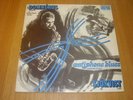
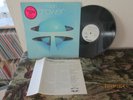
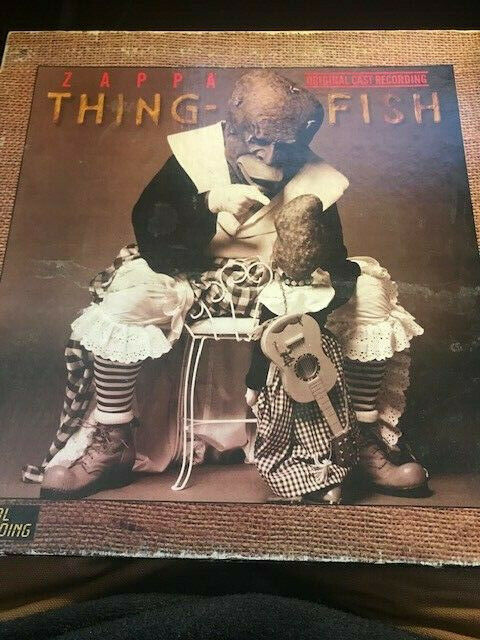
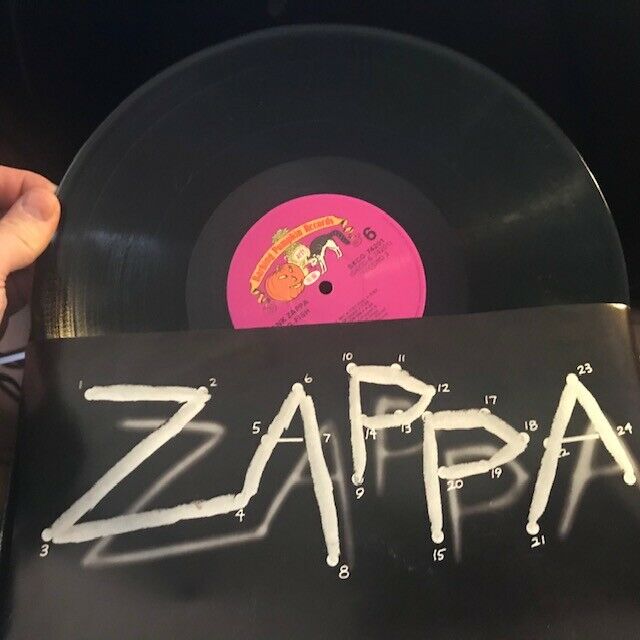
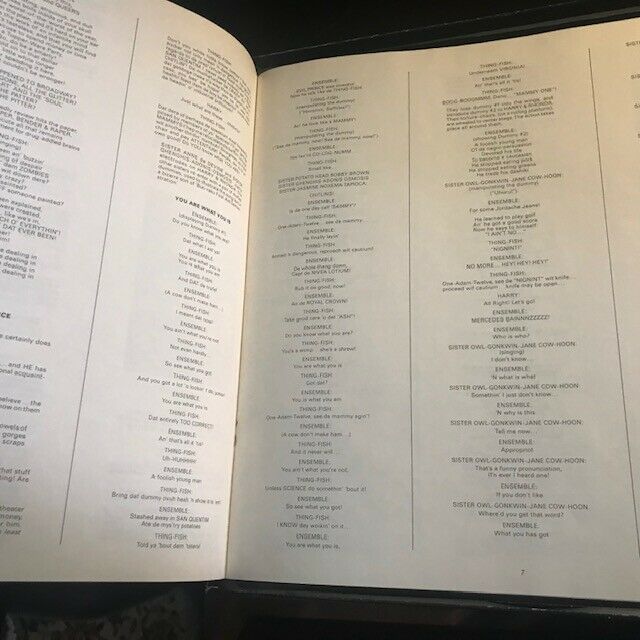
FRANZ ZAPPA THING FISH 3 discs libretto boxed set
$
40


Favourite Auctions
To save auctions to your favourites, please login
If you don't have an account, please register
Description
THING FISH. some weird shit here, kids
Very good shape. Looks played very little, no scuffs or scratches noted.
Will Ship for $5 very well packaged in cardboard.
WIKIPEDIA:
Frank Vincent Zappa[nb 1] (December 21, 1940 ? December 4, 1993) was an American multi-instrumentalist musician, composer, and bandleader. His work is characterized by nonconformity, free-form improvisation, sound experiments, musical virtuosity, and satire of American culture.[2] In a career spanning more than 30 years, Zappa composed rock, pop, jazz, jazz fusion, orchestral and musique concrète works, and produced almost all of the 60-plus albums that he released with his band the Mothers of Invention and as a solo artist.[3] Zappa also directed feature-length films and music videos, and designed album covers. He is considered one of the most innovative and stylistically diverse rock musicians of his era.[4][5]
As a self-taught composer and performer, Zappa's diverse musical influences led him to create music that was sometimes difficult to categorize. While in his teens, he acquired a taste for 20th-century classical modernism, African-American rhythm and blues, and doo-wop music.[6] He began writing classical music in high school, while at the same time playing drums in rhythm and blues bands, later switching to electric guitar. His 1966 debut album with the Mothers of Invention, Freak Out!, combined songs in conventional rock and roll format with collective improvisations and studio-generated sound collages. He continued this eclectic and experimental approach, irrespective of whether the fundamental format was rock, jazz or classical.
Zappa's output is unified by a conceptual continuity he termed "Project/Object", with numerous musical phrases, ideas, and characters reappearing across his albums.[2] His lyrics reflected his iconoclastic views of established social and political processes, structures and movements, often humorously so, and he has been described as the "godfather" of comedy rock.[7] He was a strident critic of mainstream education and organized religion, and a forthright and passionate advocate for freedom of speech, self-education, political participation and the abolition of censorship. Unlike many other rock musicians of his generation, he personally disapproved of drugs, but supported their decriminalization and regulation.
Zappa was a highly productive and prolific artist with a controversial critical standing; supporters of his music admired its compositional complexity, while critics found it lacking emotional depth. He had some commercial success, particularly in Europe, and worked as an independent artist for most of his career. He remains a major influence on musicians and composers. His honors include his 1995 induction into the Rock and Roll Hall of Fame and the 1997 Grammy Lifetime Achievement Award. In 2000, he was ranked number 36 on VH1's 100 Greatest Artists of Hard Rock.[8] In 2004, Rolling Stone magazine ranked him at number 71 on its list of the "100 Greatest Artists of All Time",[9] and in 2011 at number 22 on its list of the "100 Greatest Guitarists of All Time".[10]
Contents
- 1 1940s?1960s: early life and career
- 1.1 Childhood
- 1.2 First musical interests
- 1.3 Studio Z
- 2 Late 1960s: the Mothers of Invention
- 2.1 Formation
- 2.2 Debut album: Freak Out!
- 2.3 New York period (1966?1968)
- 2.4 Disbandment
- 3 1970s
- 3.1 Rebirth of the Mothers and filmmaking
- 3.2 Accident, attack, and aftermath
- 3.3 Top 10 album: Apostrophe (')
- 3.4 Business breakups and touring
- 3.5 Independent label
- 3.6 Producing
- 4 1980s?1990s
- 4.1 "Valley Girl" and classical performances
- 4.2 Synclavier
- 4.3 Digital medium and last tour
- 4.4 Health deterioration
- 4.5 Death
- 5 Musical style and development
- 5.1 Genres
- 5.2 Influences
- 5.3 Project/Object
- 5.4 Techniques
- 5.4.1 Guitar playing
- 5.4.2 Tape manipulation
- 6 Personal life
- 7 Beliefs and politics
- 7.1 Drugs
- 7.2 Government and religion
- 7.3 Anti-censorship
- 8 Legacy
- 8.1 Acclaim and honors
- 8.2 Artists influenced by Zappa
- 8.3 References in arts and sciences
- 9 Discography
- 10 See also
- 11 Notes
- 12 References
- 13 Bibliography
- 14 External links
1940s?1960s: early life and career
Childhood
Zappa was born on December 21, 1940, in Baltimore, Maryland. His mother, Rosemarie (née Collimore), was of Italian (Neapolitan and Sicilian) and French ancestry; his father, whose name was anglicized to Francis Vincent Zappa, was an immigrant from Partinico, Sicily, with Greek and Arab descent.[nb 2]
Frank, the eldest of four children, was raised in an Italian-American household where Italian was often spoken by his grandparents.[1]:6[11] The family moved often because his father, a chemist and mathematician, worked in the defense industry. After a time in Florida in the 1940s, the family returned to Maryland, where Zappa's father worked at the Edgewood Arsenal chemical warfare facility of the Aberdeen Proving Ground run by the U.S. Army. Due to their home's proximity to the arsenal, which stored mustard gas, gas masks were kept in the home in case of an accident.[1]:20?23 This living arrangement had a profound effect on Zappa, and references to germs, germ warfare, ailments and the defense industry occur frequently throughout his work.[12]:8?9
Zappa was often sick as a child, suffering from asthma, earaches and sinus problems. A doctor treated his sinusitis by inserting a pellet of radium into each of Zappa's nostrils. At the time, little was known about the potential dangers of even small amounts of therapeutic radiation,[12]:10 and although it has since been claimed that nasal radium treatment has causal connections to cancer, no studies have provided significant enough evidence to confirm this.[13]
Nasal imagery and references appear in his music and lyrics, as well as in the collage album covers created by his long-time collaborator Cal Schenkel. Zappa believed his childhood diseases might have been due to exposure to mustard gas, released by the nearby chemical warfare facility, and his health worsened when he lived in Baltimore.[1]:20?23[12]:10 In 1952, his family relocated for reasons of health to Monterey, California, where his father taught metallurgy at the Naval Postgraduate School.[1]:22 They soon moved to Claremont, California,[14]:46 and then to El Cajon, before finally settling in San Diego.[15]
First musical interests
Since I didn't have any kind of formal training, it didn't make any difference to me if I was listening to Lightnin' Slim, or a vocal group called the Jewels ..., or Webern, or Varèse, or Stravinsky. To me it was all good music.? Frank Zappa, 1989[1]:34
Zappa joined his first band at Mission Bay High School in San Diego as the drummer.[1]:29 At about the same time, his parents bought a phonograph, which allowed him to develop his interest in music, and to begin building his record collection.[12]:22 According to The Rough Guide to Rock (2003), "as a teenager Zappa was simultaneously enthralled by black R&B (Johnny 'Guitar' Watson, Guitar Slim), doo-wop (The Channels, The Velvets), the modernism of Igor Stravinsky and Anton Webern, and the dissonant sound experiments of Edgard Varese."[6]
R&B singles were early purchases for Zappa, starting a large collection he kept for the rest of his life.[12]:36 He was interested in sounds for their own sake, particularly the sounds of drums and other percussion instruments. By age 12, he had obtained a snare drum and began learning the basics of orchestral percussion.[1]:29 Zappa's deep interest in modern classical music began[16] when he read a LOOK magazine article about the Sam Goody record store chain that lauded its ability to sell an LP as obscure as The Complete Works of Edgard Varèse, Volume One.[1]:30?33 The article described Varèse's percussion composition Ionisation, produced by EMS Recordings, as "a weird jumble of drums and other unpleasant sounds". Zappa decided to seek out Varèse's music. After searching for over a year, Zappa found a copy (he noticed the LP because of the "mad scientist" looking photo of Varèse on the cover). Not having enough money with him, he persuaded the salesman to sell him the record at a discount.[1]:30?33 Thus began his lifelong passion for Varèse's music and that of other modern classical composers. He also liked the Italian classical music listened to by his grandparents, especially Puccini's opera arias.
Zappa's senior yearbook photo, 1958By 1956, the Zappa family had moved to Lancaster, a small aerospace and farming town in the Antelope Valley of the Mojave Desert close to Edwards Air Force Base; he would later refer to Sun Village (a town close to Lancaster) in the 1973 track "Village of the Sun".[17] Zappa's mother encouraged him in his musical interests. Although she disliked Varèse's music, she was indulgent enough to give her son a long-distance call to the composer as a 15th birthday present.[1]:30?33 Unfortunately, Varèse was in Europe at the time, so Zappa spoke to the composer's wife and she suggested he call back later. In a letter Varèse thanked him for his interest, and told him about a composition he was working on called "Déserts". Living in the desert town of Lancaster, Zappa found this very exciting. Varèse invited him to visit if he ever came to New York. The meeting never took place (Varèse died in 1965), but Zappa framed the letter and kept it on display for the rest of his life.[16][nb 3]
At Antelope Valley High School, Zappa met Don Glen Vliet (who later changed his name to Don Van Vliet and adopted the stage name Captain Beefheart). Zappa and Vliet became close friends, sharing an interest in R&B records and influencing each other musically throughout their careers.[14]:29?30 Around the same time, Zappa started playing drums in a local band, the Blackouts.[19]:13 The band was racially diverse and included Euclid James "Motorhead" Sherwood who later became a member of the Mothers of Invention. Zappa's interest in the guitar grew, and in 1957 he was given his first instrument. Among his early influences were Johnny "Guitar" Watson, Howlin' Wolf and Clarence "Gatemouth" Brown. (In the 1970s/80s, he invited Watson to perform on several albums.) Zappa considered soloing as the equivalent of forming "air sculptures",[20] and developed an eclectic, innovative and highly personal style.[21] He was also influenced by Egyptian composer Halim El-Dabh.[22]
Zappa's interest in composing and arranging flourished in his last high-school years. By his final year, he was writing, arranging and conducting avant-garde performance pieces for the school orchestra.[12]:40 He graduated from Antelope Valley High School in 1958, and later acknowledged two of his music teachers on the sleeve of the 1966 album Freak Out![23]:23 Due to his family's frequent moves, Zappa attended at least six different high schools, and as a student he was often bored and given to distracting the rest of the class with juvenile antics.[12]:48 In 1959, he attended Chaffey College but left after one semester, and maintained thereafter a disdain for formal education, taking his children out of school at age 15 and refusing to pay for their college.[12]:345
Zappa left home in 1959, and moved into a small apartment in Echo Park, Los Angeles. After meeting Kathryn J. "Kay" Sherman during his short period of private composition study with Prof. Karl Kohn of Pomona College, they moved in together in Ontario, and were married December 28, 1960.[12]:58 Zappa worked for a short period in advertising as a copywriter. His sojourn in the commercial world was brief, but gave him valuable insights into its workings.[1]:40 [24] Throughout his career, he took a keen interest in the visual presentation of his work, designing some of his album covers and directing his own films and videos.
Studio Z
Zappa attempted to earn a living as a musician and composer, and played different nightclub gigs, some with a new version of the Blackouts.[12]:59 Zappa's earliest professional recordings, two soundtracks for the low-budget films The World's Greatest Sinner (1962) and Run Home Slow (1965) were more financially rewarding. The former score was commissioned by actor-producer Timothy Carey and recorded in 1961. It contains many themes that appeared on later Zappa records.[12]:63 The latter soundtrack was recorded in 1963 after the film was completed, but it was commissioned by one of Zappa's former high school teachers in 1959 and Zappa may have worked on it before the film was shot.[12]:55 Excerpts from the soundtrack can be heard on the posthumous album The Lost Episodes (1996).
During the early 1960s, Zappa wrote and produced songs for other local artists, often working with singer-songwriter Ray Collins and producer Paul Buff. Their "Memories of El Monte" was recorded by the Penguins, although only Cleve Duncan of the original group was featured.[25] Buff owned the small Pal Recording Studio in Cucamonga, which included a unique five-track tape recorder he had built. At that time, only a handful of the most sophisticated commercial studios had multi-track facilities; the industry standard for smaller studios was still mono or two-track.[1]:42 Although none of the recordings from the period achieved major commercial success, Zappa earned enough money to allow him to stage a concert of his orchestral music in 1963 and to broadcast and record it.[12]:74 He appeared on Steve Allen's syndicated late night show the same year, in which he played a bicycle as a musical instrument.[26]:35?36 Using a bow borrowed from the band's bass player, as well as drum sticks, he proceeded to pluck, bang, and bow the spokes of the bike, producing strange, comical sounds from his new found instrument. With Captain Beefheart, Zappa recorded some songs under the name of the Soots. They were rejected by Dot Records for having "no commercial potential", a verdict Zappa subsequently quoted on the sleeve of Freak Out![19]:27
In 1964, after his marriage started to break up, he moved into the Pal studio and began routinely working 12 hours or more per day recording and experimenting with overdubbing and audio tape manipulation. This established a work pattern that endured for most of his life.[1]:43 Aided by his income from film composing, Zappa took over the studio from Paul Buff, who was now working with Art Laboe at Original Sound. It was renamed Studio Z.[12]:80?81 Studio Z was rarely booked for recordings by other musicians. Instead, friends moved in, notably James "Motorhead" Sherwood.[12]:82?83 Zappa started performing in local bars as a guitarist with a power trio, the Muthers, to support himself.[19]:26
An article in the local press describing Zappa as "the Movie King of Cucamonga" prompted the local police to suspect that he was making pornographic films.[12]:85 In March 1965, Zappa was approached by a vice squad undercover officer, and accepted an offer of $100 (equivalent to $811 in 2019) to produce a suggestive audio tape for an alleged stag party. Zappa and a female friend recorded a faked erotic episode. When Zappa was about to hand over the tape, he was arrested, and the police stripped the studio of all recorded material.[12]:85 The press was tipped off beforehand, and next day's The Daily Report wrote that "Vice Squad investigators stilled the tape recorders of a free-swinging, a-go-go film and recording studio here Friday and arrested a self-styled movie producer".[27] Zappa was charged with "conspiracy to commit pornography".[1]:57 This felony charge was reduced and he was sentenced to six months in jail on a misdemeanor, with all but ten days suspended.[12]:86?87 His brief imprisonment left a permanent mark, and was central to the formation of his anti-authoritarian stance.[12]:xv Zappa lost several recordings made at Studio Z in the process, as the police only returned 30 out of 80 hours of tape seized.[12]:87 Eventually, he could no longer afford to pay the rent on the studio and was evicted.[26]:40 Zappa managed to recover some of his possessions before the studio was torn down in 1966.[12]:90?91
Late 1960s: the Mothers of Invention
Formation
In 1965, Ray Collins asked Zappa to take over as guitarist in local R&B band the Soul Giants, following a fight between Collins and the group's original guitarist.[11] Zappa accepted, and soon assumed leadership and the role as co-lead singer (even though he never considered himself a singer[28]). He convinced the other members that they should play his music to increase the chances of getting a record contract.[1]:65?66 The band was renamed the Mothers, coincidentally on Mother's Day.[14]:42 They increased their bookings after beginning an association with manager Herb Cohen, while they gradually gained attention on the burgeoning Los Angeles underground music scene.[23]:58 In early 1966, they were spotted by leading record producer Tom Wilson when playing "Trouble Every Day", a song about the Watts riots.[12]:103 Wilson had earned acclaim as the producer for Bob Dylan and Simon & Garfunkel, and was notable as one of the few African-Americans working as a major label pop music producer at this time. Wilson signed the Mothers to the Verve division of MGM, which had built up a strong reputation for its releases of modern jazz recordings in the 1940s and 1950s, but was attempting to diversify into pop and rock audiences. Verve insisted that the band officially rename themselves the Mothers of Invention as Mother was short for motherfucker?a term that, apart from its profane meanings, can denote a skilled musician.[29]
Debut album: Freak Out!
With Wilson credited as producer, the Mothers of Invention, augmented by a studio orchestra, recorded the groundbreaking Freak Out! (1966), which, after Bob Dylan's Blonde on Blonde, was the second rock double album ever released. It mixed R&B, doo-wop, musique concrète,[30]:25 and experimental sound collages that captured the "freak" subculture of Los Angeles at that time.[23]:60?61 Although he was dissatisfied with the final product, Freak Out immediately established Zappa as a radical new voice in rock music, providing an antidote to the "relentless consumer culture of America".[12]:115 The sound was raw, but the arrangements were sophisticated. While recording in the studio, some of the additional session musicians were shocked that they were expected to read the notes on sheet music from charts with Zappa conducting them, since it was not standard when recording rock music.[12]:112 The lyrics praised non-conformity, disparaged authorities, and had dadaist elements. Yet, there was a place for seemingly conventional love songs.[31]:10?11 Most compositions are Zappa's, which set a precedent for the rest of his recording career. He had full control over the arrangements and musical decisions and did most overdubs. Wilson provided the industry clout and connections and was able to provide the group with the financial resources needed.[12]:123 Although Wilson was able to provide Zappa and the Mothers with an extraordinary degree of artistic freedom for the time, the recording did not go entirely as planned. In a surviving 1967 radio interview, Zappa explained that the album's outlandish 11-minute closing track, "Return of the Son of Monster Magnet" was in fact an unfinished piece. The track (as it appears on the album) was created to act as the backing track for a much more complex work, but MGM refused to approve the additional recording time Zappa needed to complete it, so (much to his chagrin) it was issued in this unfinished form.[32]
Hungry Freaks Daddy Menu 0:00 The opening track on Freak Out!. The album has "consistently been voted as one of top 100 greatest albums ever made".[12]:115Problems playing this file? See media help.
During the recording of Freak Out!, Zappa moved into a house in Laurel Canyon with friend Pamela Zarubica, who appeared on the album.[12]:112 The house became a meeting (and living) place for many LA musicians and groupies of the time, despite Zappa's disapproval of their illicit drug use.[12]:122 After a short promotional tour following the release of Freak Out!, Zappa met Adelaide Gail Sloatman. He fell in love within "a couple of minutes", and she moved into the house over the summer.[1]:65?66 They married in 1967, had four children and remained together until Zappa's death.
Wilson nominally produced the Mothers' second album Absolutely Free (1967), which was recorded in November 1966, and later mixed in New York, although by this time Zappa was in de facto control of most facets of the production. It featured extended playing by the Mothers of Invention and focused on songs that defined Zappa's compositional style of introducing abrupt, rhythmical changes into songs that were built from diverse elements.[30]:5 Examples are "Plastic People" and "Brown Shoes Don't Make It", which contained lyrics critical of the hypocrisy and conformity of American society, but also of the counterculture of the 1960s.[30]:38?43 As Zappa put it, "[W]e're satirists, and we are out to satirize everything."[12]:135?38 At the same time, Zappa had recorded material for an album of orchestral works to be released under his own name, Lumpy Gravy, released by Capitol Records in 1967. Due to contractual problems, the album was pulled. Zappa took the opportunity to radically restructure the contents, adding newly recorded, improvised dialogue. After the contractual problems were resolved, the album was reissued by Verve in 1968.[12]:140?41 It is an "incredible ambitious musical project",[30]:56 a "monument to John Cage",[23]:86 which intertwines orchestral themes, spoken words and electronic noises through radical audio editing techniques.[30]:56[33][nb 4]
New York period (1966?1968)
The Mothers of Invention played in New York in late 1966 and were offered a contract at the Garrick Theater (at 152 Bleecker Street, above the Cafe au Go Go) during Easter 1967. This proved successful and Herb Cohen extended the booking, which eventually lasted half a year.[34]:62?69 As a result, Zappa and his wife, along with the Mothers of Invention, moved to New York.[12]:140?141 Their shows became a combination of improvised acts showcasing individual talents of the band as well as tight performances of Zappa's music. Everything was directed by Zappa using hand signals.[12]:147 Guest performers and audience participation became a regular part of the Garrick Theater shows. One evening, Zappa managed to entice some U.S. Marines from the audience onto the stage, where they proceeded to dismember a big baby doll, having been told by Zappa to pretend that it was a "gook baby".[1]:94
Zappa uniquely contributed to the avant-garde, anti-establishment music scene of the 1960s, sampling radio tape recordings and incorporating his own philosophical ideals to music and freedom of expression in his pieces. Bands such as AMM and Faust also contributed to the radio sampling techniques of the 1960s. Situated in New York, and only interrupted by the band's first European tour, the Mothers of Invention recorded the album widely regarded as the peak of the group's late 1960s work, We're Only in It for the Money (released 1968).[35] It was produced by Zappa, with Wilson credited as executive producer. From then on, Zappa produced all albums released by the Mothers of Invention and as a solo artist. We're Only in It for the Money featured some of the most creative audio editing and production yet heard in pop music, and the songs ruthlessly satirized the hippie and flower power phenomena.[23]:90[31]:15 He sampled plundered surf music in We're only in It for the Money, as well as the Beatles' tape work from their song Tomorrow Never Knows.[36] The cover photo parodied that of the Beatles' Sgt. Pepper's Lonely Hearts Club Band.[nb 5] The cover art was provided by Cal Schenkel whom Zappa met in New York. This initiated a lifelong collaboration in which Schenkel designed covers for numerous Zappa and Mothers albums.[19]:88
Reflecting Zappa's eclectic approach to music, the next album, Cruising with Ruben & the Jets (1968), was very different. It represented a collection of doo-wop songs; listeners and critics were not sure whether the album was a satire or a tribute.[30]:58 Zappa later noted that the album was conceived in the way Stravinsky's compositions were in his neo-classical period: "If he could take the forms and clichés of the classical era and pervert them, why not do the same ... to doo-wop in the fifties?"[1]:88 A theme from Stravinsky's The Rite of Spring is heard during one song.
During the late 1960s, Zappa continued to develop the business sides of his career. He and Herb Cohen formed the Bizarre Records and Straight Records labels, distributed by Warner Bros. Records, as ventures to aid the funding of projects and to increase creative control. Zappa produced the double album Trout Mask Replica for Captain Beefheart, and releases by Alice Cooper, The Persuasions, Wild Man Fischer, and the GTOs, as well as Lenny Bruce's last live performance.[12]:173?175
In 1967 and 1968, Zappa made two appearances with the Monkees. The first appearance was on an episode of their TV series, "The Monkees Blow Their Minds", where Zappa, dressed up as Mike Nesmith, interviews Nesmith who is dressed up as Zappa. After the interview, Zappa destroys a car with a sledgehammer as the song "Mother People" plays. He later provided a cameo in the Monkees' movie Head where, leading a cow, he tells Davy Jones "the youth of America depends on you to show them the way." Zappa had respect for what the Monkees were doing, and offered Micky Dolenz a position in the Mothers. RCA/Columbia/Colgems would not allow Dolenz out of his contract.[12]:158?59
In the Mothers' second European tour in September/October 1968 they performed for the Internationale Essener Songtage [de] at the Grugahalle in Essen, Germany; at the Tivoli in Copenhagen, Denmark; for TV programs in Germany (Beat-Club), France, and England; at the Concertgebouw in Amsterdam; at the Royal Festival Hall in London; and at the Olympia in Paris.[37]
Disbandment
Peaches En Regalia Menu 0:00 The opening track on Hot Rats is considered one of Zappa's most enduring compositions.[30]:74[38] Problems playing this file? See media help.Zappa and the Mothers of Invention returned to Los Angeles in mid-1968, and the Zappas moved into a house on Laurel Canyon Boulevard, only to move again to one on Woodrow Wilson Drive.[12]:178 This was Zappa's home for the rest of his life. Despite being a success with fans in Europe, the Mothers of Invention were not faring well financially.[23]:116 Their first records were vocally oriented, but Zappa wrote more instrumental jazz and classical oriented music for the band's concerts, which confused audiences. Zappa felt that audiences failed to appreciate his "electrical chamber music".[12]:185?187[14]:119?120
Zappa with the Mothers of Invention, Theatre de Clichy, Paris, 1971In 1969 there were nine band members and Zappa was supporting the group himself from his publishing royalties whether they played or not.[23]:116 1969 was also the year Zappa, fed up with MGM Records' interference, left them for Warner Bros. Records' Reprise subsidiary where Zappa/Mothers recordings would bear the Bizarre Records imprint.
In late 1969, Zappa broke up the band. He often cited the financial strain as the main reason,[1]:107 but also commented on the band members' lack of sufficient effort.[14]:120 Many band members were bitter about Zappa's decision, and some took it as a sign of Zappa's concern for perfection at the expense of human feeling.[12]:185?187 Others were irritated by 'his autocratic ways',[12]:123 exemplified by Zappa's never staying at the same hotel as the band members.[12]:116 Several members played for Zappa in years to come. Remaining recordings with the band from this period were collected on Weasels Ripped My Flesh and Burnt Weeny Sandwich (both released in 1970).
After he disbanded the Mothers of Invention, Zappa released the acclaimed solo album Hot Rats (1969).[12]:194[39] It features, for the first time on record, Zappa playing extended guitar solos and contains one of his most enduring compositions, "Peaches en Regalia", which reappeared several times on future recordings.[30]:74 He was backed by jazz, blues and R&B session players including violinist Don "Sugarcane" Harris, drummers John Guerin and Paul Humphrey, multi-instrumentalist and previous member of the Mothers of Invention Ian Underwood, and multi-instrumentalist Shuggie Otis on bass, along with a guest appearance by Captain Beefheart (providing vocals to the only non-instrumental track, "Willie the Pimp"). It became a popular album in England,[1]:109 and had a major influence on the development of the jazz-rock fusion genre.[12]:194[30]:74
1970s
Rebirth of the Mothers and filmmaking
Frank Zappa in Paris, early 1970sIn 1970 Zappa met conductor Zubin Mehta. They arranged a May 1970 concert where Mehta conducted the Los Angeles Philharmonic augmented by a rock band. According to Zappa, the music was mostly written in motel rooms while on tour with the Mothers of Invention. Some of it was later featured in the movie 200 Motels.[1]:109 Although the concert was a success, Zappa's experience working with a symphony orchestra was not a happy one.[1]:88 His dissatisfaction became a recurring theme throughout his career; he often felt that the quality of performance of his material delivered by orchestras was not commensurate with the money he spent on orchestral concerts and recordings.[1]:142?56
Later in 1970, Zappa formed a new version of the Mothers (from then on, he mostly dropped the "of Invention"). It included British drummer Aynsley Dunbar, jazz keyboardist George Duke, Ian Underwood, Jeff Simmons (bass, rhythm guitar), and three members of the Turtles: bass player Jim Pons, and singers Mark Volman and Howard Kaylan, who, due to persistent legal and contractual problems, adopted the stage name "The Phlorescent Leech and Eddie", or "Flo & Eddie".[12]:201
This version of the Mothers debuted on Zappa's next solo album Chunga's Revenge (1970),[12]:205 which was followed by the double-album soundtrack to the movie 200 Motels (1971), featuring the Mothers, the Royal Philharmonic Orchestra, Ringo Starr, Theodore Bikel, and Keith Moon. Co-directed by Zappa and Tony Palmer, it was filmed in a week at Pinewood Studios outside London.[19]:183 Tensions between Zappa and several cast and crew members arose before and during shooting.[19]:183 The film deals loosely with life on the road as a rock musician.[12]:207 It was the first feature film photographed on videotape and transferred to 35 mm film, a process that allowed for novel visual effects.[40] It was released to mixed reviews.[30]:94 The score relied extensively on orchestral music, and Zappa's dissatisfaction with the classical music world intensified when a concert, scheduled at the Royal Albert Hall after filming, was canceled because a representative of the venue found some of the lyrics obscene. In 1975, he lost a lawsuit against the Royal Albert Hall for breach of contract.[1]:119?37
After 200 Motels, the band went on tour, which resulted in two live albums, Fillmore East ? June 1971 and Just Another Band from L.A.; the latter included the 20-minute track "Billy the Mountain", Zappa's satire on rock opera set in Southern California. This track was representative of the band's theatrical performances?which used songs to build sketches based on 200 Motels scenes, as well as new situations that often portrayed the band members' sexual encounters on the road.[12]:203?04[nb 6]
Accident, attack, and aftermath
Zappa with the Mothers, 1971 "Waka/Jawaka" (1971) Menu 0:00 The closing track on Waka/Jawaka, one of Zappa's jazz-oriented albums. Problems playing this file? See media help.On December 4, 1971, Zappa suffered his first of two serious setbacks. While performing at Casino de Montreux in Switzerland, the Mothers' equipment was destroyed when a flare set off by an audience member started a fire that burned down the casino.[1]:112?115 Immortalized in Deep Purple's song "Smoke on the Water", the event and immediate aftermath can be heard on the bootleg album Swiss Cheese/Fire, released legally as part of Zappa's Beat the Boots II compilation. After losing $50,000 (equivalent to $316,000 in 2019) worth of equipment and a week's break, the Mothers played at the Rainbow Theatre, London, with rented gear. During the encore, an audience member jealous because of his girlfriend's infatuation with Zappa pushed him off the stage and into the concrete-floored orchestra pit.[41] The band thought Zappa had been killed?he had suffered serious fractures, head trauma and injuries to his back, leg, and neck, as well as a crushed larynx, which ultimately caused his voice to drop a third after healing.[1]:112?115
This attack resulted in an extended period of wheelchair confinement, making touring impossible for over half a year. Upon return to the stage in September 1972, Zappa was still wearing a leg brace, had a noticeable limp and could not stand for very long while on stage. Zappa noted that one leg healed "shorter than the other" (a reference later found in the lyrics of songs "Zomby Woof" and "Dancin' Fool"), resulting in chronic back pain.[1]:112?115 Meanwhile, the Mothers were left in limbo and eventually formed the core of Flo and Eddie's band as they set out on their own.
During 1971?72 Zappa released two strongly jazz-oriented solo LPs, Waka/Jawaka and The Grand Wazoo, which were recorded during the forced layoff from concert touring, using floating line-ups of session players and Mothers alumni.[30]:101 Musically, the albums were akin to Hot Rats, in that they featured extended instrumental tracks with extended soloing.[12]:225
price rating