FELIX WERDER AUSTRALIAN AVANT-GARDE PRIVATE LP RARE-NWW
$
75


Favourite Auctions
To save auctions to your favourites, please login
If you don't have an account, please register
Description
FELIX WERDER / ROBERT HUGHES / KEITH HUMBLE / ROBIN TEESE / MARK FOSTER
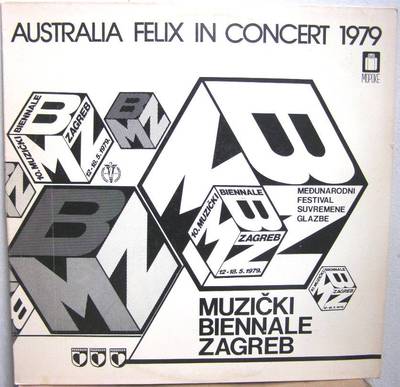
AUSTRALIA FELIX IN CONCERT 1979 LP
Mopoke
w/4-page polygraphed program notes
Very big rarity, private australian issue, compositions by australian composers performed at the 1979 Zagreb Biennale, Yugoslavia.
Some info on the release: Bloody rare private issue, released in Australia back in 1979 on the Mopoke label, that had also published the 2 solo records of Felix Werder. This one features pieces from 5 australian composers moving in the direction of avant-garde and new music.
Felix Werder (born Berlin, Germany 24 February 1922) is an Australian-based German composer of classical and electronic music; also a noted critic and educator. The son of a distinguished liturgical composer, he has composed all his life; he has an international reputation and is one of Australia's most performed composers. His published and recorded music includes symphonies, chamber music for all combinations, solo concerti, choral works and operas.
Werder studied Fine Arts and Architecture in London before arriving in Australia in 1940 on the Dunera. He was interned at a camp in Tatura in Australia during World War II. In 1943 he wrote his first symphony. During the 1960s and early 1970s, Werder wrote seven operas which were popularly received. His opera, Private, was commissioned for television by ABC and was broadcast in 1969. He has also written works for Deutsche Oper Berlin and Opera Australia among others.
Werder lives in Melbourne and his teaching included influential courses in electronic music and sound synthesis. He received the Order of Australia in 1976, the Stamitz Performance Prize (1984), the Australia Council Fellowship (1986), and the Arts Guild of Germany Composition Prize and the Stamitz Prize in 1988, and an honorary doctorate in Music from The University of Melbourne.
He formed the performance ensemble Australia Felix which toured Europe, and included Bruce Clarke, Merlyn Quaife, Brian Brown, Alex Grieve, Judy Easton, Tony Conolan, Kevin Makin and Peter Clinch. For many years, during the 1960s and 1970s, he wrote music criticism for the Melbourne newspaper The Age.
Robert Watson Hughes (27 March 1912 – 1 August 2007) was a Scottish-born Australian composer. His music was characterised as muscular, assertive, pugnacious, with a dark, troubled, even driven quality; but it was also deeply sensitive, lyrical and tender. His capacity to view a complex landscape of diverse musical activity with clarity and with wisdom has been noted. He was said to have a unique understanding of tonality. His melodies are driven by short motives and unrelenting ostinato figures. He was fascinated by unorthodox divisions of tones and semitones in scales (an interest found in key 20th century composers like Scriabin, Stravinsky, Bartók and Messiaen).
Hughes wrote orchestral works (his 1951 Symphony has been described as the finest symphony composed by an Australian), music for ballet and film, some chamber works and an opera that has never been performed. While some of his works are available in published form, there are a number of well-crafted orchestral works that were recorded but never commercially published. Like other composers of his generation, including Dorian Le Gallienne, Raymond Hanson and Margaret Sutherland, Hughes has been considered by musicologists to write in a style reminiscent of the English pastoral school. However, Hughes listened to a wide range of music and surrounded himself with a variety of musical influences which included Bizet, Prokofiev and Sibelius.
Hughes was also a champion for other Australian composers, through roles that drew on his administrative skills. Ironically, his music has of recent times only infrequently been heard either in the concert hall or on recordings: it has become eclipsed by the compositions of the younger generation whose work he espoused. However, his music was earlier championed by many notable conductors including Sir Bernard Heinze, Joseph Post, Sir Eugene Goossens, Nikolai Malko, Willem van Otterloo, Hiroyuki Iwaki, John Hopkins and Myer Fredman - and overseas by Sir John Barbirolli, Sir Malcolm Sargent, Norman Del Mar, Josef Krips, Walter Susskind and Sir Colin Davis.
Keith Humble was born in Geelong, Victoria, in 1927. He started to learn the piano at the age of five, and while in high school began to perform with jazz groups. In 1946 he enrolled at the Melbourne University Conservatorium, where he studied traditional harmony, composition and counterpoint. The awarding of an AMEB Commonwealth Scholarship enabled him to travel to Britain in 1950 to study at the Royal College of Music, London. Here he studied under Howard Ferguson and Paul Steinitz to obtain his Licentiate Diploma, before travelling to Paris on another scholarship to attend the Ecole Normale de Musique, where he studied piano with Madame Bascourret, Alfred Cortot's assistant. Humble was accepted as a private composition student by Rene Leibowitz, who introduced him to the concept of serialism.
In 1964 Humble undertook a lecture/recital tour of colleges and universities in the USA and also visited Australia briefly to present a composers' workshop, which has been regarded as being the impetus for the formation of the Melbourne Branch of the International Society for Contemporary Music. He returned permanently in 1966, taking up the position of Senior Lecturer at the Melbourne Conservatorium, where he established the Electronic Music Studio at the Grainger Centre, re-established the Opera School and formed the Society for the Private Performance of New Music.
Humble helped to found the Australian Contemporary Music Ensemble (ACME) in 1975, with the purpose of promoting contemporary music and encouraging and performing the work of young Australian composers. His vision for this ensemble was that it would be a national group, which would present the best of contemporary music played by the best available performers. He himself performed with the group and was their musical director until 1978.
In 1977 Humble won the National Critics Award as the most outstanding recitalist working in Australia and he was awarded the Order of Australia (AM) for his services to music in 1982. On his retirement from La Trobe in 1989, he was nominated emeritus professor. He continued his activities in America and France after his retirement, which included acting as consultant on the formation of New Music Literacy projects for the European Community. In Australia, Humble was involved at various times between 1988 and 1995 as a Member of the Board of Management of Deakin University's Institute of the Arts, music consultant to the Victorian College of the Arts, and a Member of the Board of Studies in Music at Monash University.
Condition: Vinyl and cover lie in excellent condition, a really pristine copy for its' age. Vinyl looks super clean with some light scuffs and plays perfectly, while cover lies in great shape, with light ring (see photo).
Tracklist
A1 Felix Werder - Lilith A2 Robert Hughes - To The God Of Pain Lyrics By - Sarojni Naidu B1 Keith Humble - Songs Sadly B2 Robin Teese - Never To Repair B3 Mark Foster -Two Songs
Credits
Clarinet - Peter ClinchComposed By - Robert Hughes (tracks: A2)
Composed By, Lyrics By - Felix Werder (tracks: A1), Keith Humble (tracks: B1), Mark Foster (tracks: B3), Robin Teese (tracks: B2)
Conductor - Felix Werder
Guitar - Bruce Clarke
Horn - Alex Grieve
Oboe - Judith Grieve
Other [Artistic Director] - Felix Werder
Percussion - Mark Foster
Piano - Daniel Herscovitch
Soprano Vocals - Loris Synon
Violin - Rotraud Schneider
SHIPPING & PAYMENT
Shipping: Shipping for this LP is 7$ airmail in Europe / 9$ for the rest of the world
Registered mail: +5$
Insurance: optional
Combined shipping: BIG discounts
Payment: Paypal
Packaging: I am a collector too and i know
price rating







![Elbow - The Definitive Vinyl Album Box Set [VINYL] Box set](https://www.popsike.com/php/thumbnail.php?url=https://www.popsike.pics/pix/20160815/182244083629.jpg)