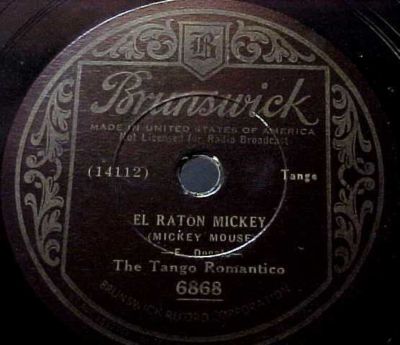
DISNEY 1933-MICKEY MOUSE TANGO-RARE BRUNSWICK 78
$
42


Favourite Auctions
To save auctions to your favourites, please login
If you don't have an account, please register
Description
=> The World of Movies and Movie Stars.....
This week, I offer a kaleidoscope of rare MOVIE sound treasures.
Enter Disney's MICKEY MOUSE...in a rare and most unusual showcse: @1933 Mickey Mouse TANGO by the Brunswick Recording artists, THE TANGO ROMANTICO.
This rare gem is in E- condition ..... NOT to be seen again soon.
About MICKEY MOUSE.....courtesy of Wikipedia
Mickey Mouse is a cartoon character who has become an icon for The Walt Disney Company. Mickey Mouse was created in 1928 by Walt Disney andUb Iwerks. He was voiced by Walt Disney from 1928–1946 theatrically, and again from 1955–1959 for the original ABC TV The Mickey Mouse Clubtelevision series. The Walt Disney Company celebrates his birth as November 18, 1928, upon the release of Steamboat Willie, although Mickey had already appeared six months earlier in an unfinished test screening of Plane Crazy (Steamboat Willie being the first Mickey Mouse Cartoon to be released). The anthropomorphic mouse has evolved from being simply a character in animated cartoons and comic strips to become one of the most recognizable symbols in the world. Mickey is currently the main character in the Disney Channel's Disney Junior series "Mickey Mouse Clubhouse".Mickey is the leader of The Mickey Mouse Clubhouse, with help from Minny Mouse, Donald Duck, and other friendly friends of his.
In late 2009, The Walt Disney Company announced that they will begin to re-brand the Mickey Mouse character by putting a little less emphasis on his pleasant, cheerful side and reintroducing the more mischievous and adventurous sides of his personality, starting with the newly released Epic Mickey.
Mickey Mouse was created as a replacement for Oswald the Lucky Rabbit, an earlier cartoon character created by the Disney studio for Charles Mintz ofUniversal Studios.
Creation and debutWhen Disney asked for a larger amount for his budget for the popular Oswald series, Mintz announced that Disney could keep doing the Oswald series, as long as he agreed to a budget cut and went on the payroll. Mintz owned Oswald and thought he had Disney over a barrel. Angrily, Disney refused the deal and returned to produce the final Oswald cartoons he contractually owed Mintz. Disney was dismayed at the betrayal by his staff, but determined to restart from scratch. The new Disney Studio initially consisted of animator Ub Iwerks and a loyal apprentice artist, Les Clark. One lesson Disney learned from the experience was to thereafter always make sure that he owned all rights to the characters produced by his company.
In the spring of 1928, Disney asked Ub Iwerks to start drawing up new character ideas. Iwerks tried sketches of various animals, such as dogs and cats, but none of these appealed to Disney. A female cow and male horse were also rejected. They would later turn up as Clarabelle Cow and Horace Horsecollar. (A male frog, also rejected, would later show up in Iwerks' own Flip the Frog series.) Walt Disney got the inspiration for Mickey Mouse from his old pet mouse he used to have on his farm. In 1925, Hugh Harman drew some sketches of mice around a photograph of Walt Disney. These inspired Ub Iwerks to create a new mouse character for Disney. "Mortimer Mouse" had been Disney's original name for the character before his wife, Lillian, convinced him to change it, and ultimately Mickey Mouse came to be. ActorMickey Rooney has claimed that, during his Mickey McGuire days, he met cartoonist Walt Disney at the Warner Brothers studio, and that Disney was inspired to name Mickey Mouse after him.
"We felt that the public, and especially the children, like animals that are cute and little. I think we are rather indebted to Charlie Chaplin for the idea. We wanted something appealing, and we thought of a tiny bit of a mouse that would have something of the wistfulness of Chaplin — a little fellow trying to do the best he could. When people laugh at Mickey Mouse, it's because he's so human; and that is the secret of his popularity. I only hope that we don't lose sight of one thing — that it was all started by a mouse."[Plane Crazy, The Gallopin Gaucho, and Steamboat Willie
Disney had Ub Iwerks secretly begin animating a new cartoon while still under contract with Universal. The cartoon was co-directed by Walt Disney and Ub Iwerks. Iwerks was the main animator for the short, and reportedly spent six weeks working on it. In fact, Iwerks was the main animator for every Disney short released in 1928 and 1929. Hugh Harman and Rudolf Ising also assisted Disney during those years. They had already signed their contracts with Charles Mintz, but he was still in the process of forming his new studio and so for the time being they were still employed by Disney. This short would be the last they animated under this somewhat awkward situation.
Mickey and Minnie debuted in a test screening of the cartoon short Plane Crazy, on May 15, 1928, but it failed to impress audiences, and to add insult to injury, Walt could not find a distributor. Though understandably disappointed, Walt went on to produce a second Mickey short: "The Gallopin' Gaucho" which was also not released for lack of a distributor.
Mickey Mouse in Steamboat Willie(1928)Steamboat Willie was first released on November 18, 1928 in New York. It was co-directed by Walt Disney and Ub Iwerks. Iwerks again served as the head animator, assisted by Johnny Cannon, Les Clark, Wilfred Jackson and Dick Lundy. This short was intended as a parody of Buster Keaton's Steamboat Bill Jr., first released on May 12 of the same year. Although it was the third Mickey cartoon produced, it was the first to find a distributor, and thus is considered by The Disney Company as Mickey's debut. Willie featured changes to Mickey's appearance (in particular, simplifying his eyes to large dots) that established his look for later cartoons and in numerous Walt Disney films.
The cartoon was not the first cartoon to feature a soundtrack connected to the action. Fleischer Studios, headed by brothers Dave and Max Fleischer, had already released a number of sound cartoons using the DeForest system in the mid-1920s. However, these cartoons did not keep the sound synchronized throughout the film. For Willie, Disney had the sound recorded with a click track that kept the musicians on the beat. This precise timing is apparent during the "Turkey in the Straw" sequence, when Mickey's actions exactly match the accompanying instruments. Animation historians have long debated who had served as the composer for the film's original music. This role has been variously attributed to Wilfred Jackson, Carl Stalling and Bert Lewis, but identification remains uncertain. Walt Disney himself was voice actor for both Mickey and Minnie, and would remain the source of Mickey's voice through 1946 for theatrical cartoons. Jimmy MacDonald took over the role in 1946, but Walt provided Mickey's voice again from 1955 to 1959 for the Mickey Mouse Club television series on ABC.
The script had Mickey serving aboard Steamboat Willie under Captain Pete. At first he is seen piloting the steamboat while whistling. Then Pete arrives to take over piloting and angrily throws him out of the boat's bridge. They soon have to stop for cargo to be transferred on board. Almost as soon as they leave, Minnie arrives. She was apparently supposed to be their only passenger but was late to board. Mickey manages to pick her up from the river shore. Minnie accidentally drops her sheet music for the popular folk song "Turkey in the Straw". A goat which was among the animals transported on the steamboat proceeds to eat the sheet music. Consequently Mickey and Minnie use its tail to turn it into a phonograph which is playing the tune. Through the rest of the short, Mickey uses various other animals as musical instruments. Captain Pete is eventually disturbed by all this noise and places Mickey back to work. Mickey is reduced to peeling potatoes for the rest of the trip. Aparrot attempts to make fun of him but is then thrown to the river by Mickey. This served as the final scene of this short.
Audiences at the time of Steamboat Willie's release were reportedly impressed by the use of sound for comedic purposes. Sound films or "talkies" were still considered innovative. The first feature-length movie with dialogue sequences, The Jazz Singer starring Al Jolson, was released on October 6, 1927. Within a year of its success, most United States movie theaters had installed sound film equipment. Walt Disney apparently intended to take advantage of this new trend and, arguably, managed to succeed. Most other cartoon studios were still producing silent products and so were unable to effectively act as competition to Disney. As a result Mickey would soon become the most prominent animated character of the time. Walt Disney soon worked on adding sound to both Plane Crazyand The Gallopin' Gaucho (which had originally been silent releases) and their new release added to Mickey's success and popularity. A fourth Mickey short, The Barn Dance, was also put into production; however, Mickey does not actually speak until The Karnival Kid in 1929 when his first spoken words were "Hot dogs, Hot dogs!" After Steamboat Willie was released, Mickey became a close competitor to Felix the Cat, and his popularity would grow as he was continuously featured in sound cartoons. By 1929, Felix would lose popularity among theater audiences, and Pat Sullivan decided to produce all future Felix cartoons in sound as a result. Unfortunately, audiences did not respond well to Felix's transition to sound and by 1930, Felix had faded from the screen.
<
price rating


