CONCORD STRING QUARTET: FELDMAN, CAGE, CRUMB, WOLPE
£
31
$
41


Favourite Auctions
To save auctions to your favourites, please login
If you don't have an account, please register
Description
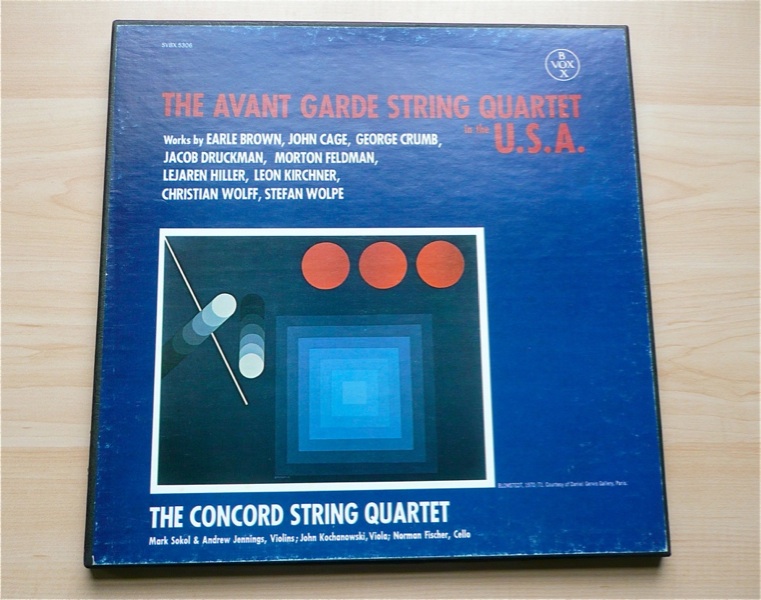
CONCORD STRING QUARTET: FELDMAN, CAGE, CRUMB, WOLPE SCARCE 3 LP VOX BOX SET OF STUNNING 20th CENTURY WORKS
THE AVANT GARDE STRING QUARTET IN THE USA
The Concord String Quartet
3 LP BOX SET w/INSERT
VOX ( SVBX 5306)
Programme notes by Lejaren Hiller
Recorded in 1972
RARE 3 LP BOX SET FROM VOX RECORDS OF NINE 20TH CENTURY AVANT-GARDE MASTERPIECES FROM Stefan Wolpe, Earle Brown, John Cage, George Crumb, Lejaren Hiller, Leon Kirchner, Christian Wolff, Jacob Druckman and Morton Feldman PLAYED BY THE CONCORD STRING QUARTET
THERE ARE SOME ABSOLUTELY ASTONISHING AND INCREDIBLY BEAUTIFUL PIECES ON THIS ALBUM (not at all 'difficult' music in my opinion, but I really love this stuff) SO I FIND IT HARD TO CHOOSE ANY INDIVIDUAL PIECES FOR PARTICULAR MERIT - EACH ONE STANDS OUT AS EXTRAORDINARY IN ITS OWN RIGHT
SIDE ONE:
Stefan Wolpe: String Quartet (1968/69) 17:24
Serialist in orientation, the String Quartet of 1969 in two movements features Wolpe's trademark outbursts of energy separated by silences, and interludes of rich contrapuntal melodies. In the approximately eight-minute first movement, there is much imitative crosstalk between the strings -- sweeping and scooping gestures and glissandi, emphatically marked statements, and nervous trilling and tremolo, all of which have a dialogue-like quality. The close interweaving of contrapuntal lines often creates tense tone clusters. The second movement, approximately nine and a half minutes long, opens with a steady emphatic row that maintains the tensions from the first movement. The row soon breaks apart into quickly rushing gestures that have only very brief resting points of a second or so. Some fleeting, beautifully composed passages containing harmonics and pizzicati seem to squeeze out harmonic sounds like a bubble bursting on top of flowing water. Swelling tone clusters underscore flying solos. Toward the end, the music seems to briefly settle into a series of contemplative movements surrounded by silences, and then to evolve into a grotesque dance. A single sustained note ends the work.
Wolpe was, throughout the 1960s, determined to continue work in spite of the developing effects of Parkinson's disease. Still, by late in the decade, his manual skills had deteriorated to a point that extended, multi-instrument works were very nearly beyond his scope. So the String Quartet -- his only work in the genre -- seems a truly mighty achievement, even if it has only two movements and lasts under 20 minutes; the effort could not have been a painless one for either mind or body.
Earle Brown: String Quartet (1965) 11:53
Earle Brown: "String Quartet is one of several works in which I have attempted to combine the 'graphic' and 'mobile' ... In composing these later works, which use more than one performer without conductor, I have fixed the overall form but have left areas of flexibility within the inner structures. The works achieve a strong formal identity while maintaining the 'performer process' spontaneity and the balance of collaboration between the composition and the performers that are characteristic of the ... 'open-form' and graphic works."
SIDE TWO:
John Cage: String Quartet in Four Parts (1950) 21:42
Cage began writing the quartet in 1949 in Paris. Prior to beginning to work on the piece, he told his parents that he wanted to compose a work which would praise silence without actually using it; after completing the first movement he was so fascinated with the new way to work that he wrote in a letter: "This piece is like the opening of another door; the possibilities implied are unlimited".
The String Quartet in Four Parts is based partly on the Indian view of the seasons, in which the four seasons are associated each with a particular force - those of creation, preservation, destruction and quiescence. The parts and their corresponding seasons are as follows:
1. Quietly Flowing Along - Summer
2. Slowly Rocking - Autumn
3. Nearly Stationary - Winter
4. Quodlibet - Spring
The general quietness and flatness of sound in the quartet may be an expression of tranquility, the uniting emotion of the nine permanent emotions of the Rasa aesthetic, which Cage explored earlier in Sonatas and Interludes for Prepared Piano. Another aspect of composition which Cage had used earlier was the use of counterpoint: the third movement uses a canon for a single melodic line, which repeats itself going backward, in a slightly rhythmically altered form, to the beginning.
To compose the quartet Cage used a new technique, which consisted of dealing with fixed sonorities, or chords. He called those 'gamuts', and each gamut was created independently of all others. After producing a fixed amount of gamuts, scored for each player in an unchanging way, a succession of them could be used to create a melody with harmonic background. Because at any particular point a gamut would be selected only for containing the note necessary for the melody, the resulting harmony would serve no purpose and any sense of progression, which was alien to Cage, would be eliminated. Since 1946 Cage's interest was in composing music to "sober and quiet the mind, thus rendering it susceptible to divine influences", rather than music to express feelings and ideas, and he would later give up control over music altogether by using chance operations, but already in the String Quartet in Four Parts "the inclusion of traditional harmonies was a matter of taste, from which a conscious control was absent."
SIDE THREE:
George Crumb: Black Angels (Images I) For Electric String Quartet (Thirteen Images from the Dark Land) (1970) 22:47
"There were terrifying things in the air," said George Crumb of the Vietnam War years and the events of the time provided inspiration for Black Angels, subtitled "Thirteen Images from the Dark Land." The score of this eerie, sometimes downright scary work (completed, by no means coincidentally given Crumb's fascination with numbers, on a Friday the 13th, in March 1970) is inscribed "in tempore belli" (in time of war). The Stanley Quartet gave Black Angels its premiere on October 23, 1970, in Ann Arbor, Michigan.
The quartet of stringed instruments is amplified "to the threshold of pain," and the musicians are called upon to play their instruments in many unusual ways, including trilling on the strings with thimble-capped fingers. The four players also whisper, chant, shout, and employ percussion instruments -- maracas, tam-tams, and water-tuned crystal goblets. Crumb wrote of the work: "Black Angels was conceived as a kind of parable on our troubled contemporary world. The work portrays a voyage of the soul. The three stages of this voyage are Departure (fall from grace), Absence (spiritual annihilation), and Return (redemption)."
The first movement, Departure, begins abruptly and frighteningly with "Threnody I: Night of the Electric Insects," and moves into "Sounds of Bones and Flutes" and the mysterious "Lost Bells." Crashes of the tam-tam punctuate the wild "Devil-music," and the last section is a submerged-sounding evocation of Camille Saint-Saëns' Danse macabre. The movement ends with whispered counting from the musicians.
The opening section of the second movement, Absence, is titled "Pavana Lachrymae"; Schubert's Death and the Maiden quartet is quoted here in an evocation of ancient viol music. Yelling and further insect sounds are heard in "Threnody II: Black Angels!" Viols are again imitated in "Sarabanda da la Muerte Oscura," and the movement closes with "Lost Bells (Echo)."
The final movement, Return, opens with "God-music," in which an ethereal glass harmonica effect from the water-tuned goblets combines with a wandering, nearly static melodic line. "Ancient Voices" consists mainly of a series of little pizzicato sounds. An almost silent "Ancient Voices (Echo)" leads into more pizzicato sounds and a reprise of the insect music in "Threnody III: Night of the Electric Insects."
SIDE FOUR:
Lejaren Hiller: String Quartet No. 5 (In quarter-tones) (1962) 26:58
Lejaren Hiller composed his String Quartet No. 5 in 1962. The work is written in an even-tempered, quarter-tone scale, demanding of the performers a new playing technique, as well as new ways of listening to each other. It makes extensive use of serial procedures applied to 24-note (quarter-tone) rows. Originally premiered by the Concord String Quartet
SIDE FIVE:
Leon Kirchner: Quartet No. 3 for String Quartet and Electronic Tape (1967) 18:01
A controlled experiment with quarter tones, the serial piece is structured as a set of variations, with movements of enormous contrast: slow, languid microtonal pools rub shoulders with violent, scratchy explosions.
Christian Wolff: Summer (1961) 4:40
Written for string quartet, this is the only really freely notated piece on the album and has no score as such - the players are given descriptions of their parts and a lengthy explanation of how to use them.What does happen however, in different performances of Summer, despite all the freedom of choice, is the creation of a definite atmosphere, rather delicate and restrained, that does indeed define the piece and give it its characteristic identity
SIDE SIX:
Jacob Druckman: String Quartet No. 2 (1966) 18:40
The work is cast in one continuous movement, and is formally quite loosely constructed, although there are elements of variation form in the treatment of the opening intervallic and metrical elements.
Much greater is the emphasis on contrasts in the relationship between pitch and timbre, mood and dynamic, achieved through the use of devices such as ricochet legno (allowing the back of the bow to bounce off the strings whilst altering the pitch on the fingerboard), sordini (mutes) ponticello, and exaggerated ponticello, where the bow presses against the mute almost totally obscuring the pitch. At times the player is required to choke the note on the string by dragging the bow too slowly to produce identifiable pitch. Although the thematic material receives quite liberal treatment, there is much dialogue and imitation between the voices, evident from the very opening G on the first violin, taken up in echo by the other instruments. Sometimes the parts follow one another, at other times they go in the opposite direction and end up in open conflict. If structure and form are elastic, metrical patterns are very precise and the aleatoric element is surprisingly small, and usually only affords the players limited freedom within prescribed intervals or parameters. As the work progresses, the mood becomes more intense as ideas briefly encountered earlier return almost falling over one another to be heard.
The piece ends calmly, as it began, on a single note.
Morton Feldman: Structures for String Quartet (1951) 5:56
Although Morton Feldman's best-known innovation is the devising of graphical scores that permit a range of choices (of, say, pitches to be made by the performer), the present composition is not such a work. It is as fully notated as any classical quartet. In fact, it has been remarked that it could well serve as an example of how the composer himself might realise one of his graphical scores. This is precisely what Feldman actually did. He sketched out a plot of what one might call musical events (versus elapsed performance time), filling in this graph until it satisfied him. It should be understood that this was not a literal plot of, say, frequency versus time but a general guide to laying out event successions. Once this was done, Feldman then transcribed the material into a precisely notated conventional score so that performances of this piece are relatively fixed. This particular compositional technique he has only used twice, once in the present instance and once in composing, also in 1951, a piano piece for Merce Cunningham, who then choreographed it as "Variations" for solo dancer.
Structures for String Quartet turns out to be a short composition in one movement always played as quietly as possible - another Feldman specialty. The "structures" of the piece follow one another in a quite straightforward linear pattern. The opening section is pointillistic and sparse in texture. This is followed by what I will call, for lack of a better word, a series of quasi-ostinato passages. Each one of these is almost but not quite a precisely fixed ostinato of a type almost resembling a tape loop in electronic music. Four of these occur in sequence separated by short rests or simple intervening chords. A second pointillistic passage, reminiscent of the opening, appears next and this is followed by two more quasi-ostinati and a concluding section again reminiscent of the opening.The dialectic of the piece is one of emptiness versus density, and of irregularity versus periodicity
LABELS: Clean and unmarked with no evident spindle traces. This set has seen little, if any, play
VINYL Visual: The vinyl surfaces retain their original deep, like-new glossy sheen and are practically unmarked (Side Three - the George Crumb piece - has a tiny white spot within the grooves which does briefly sound (see detailed audio assessment below otherwise, beautiful audio)
VINYL Audio: Superb - crystal clear, rich and warm sound. On playback at a loud volume (which is how I always listen to my LPs prior to listing and I adore these pieces) there are no scratches, no jumps/sticks and very, very little surface noise (which is quite remarkable as most of these works have very quiet, even silent passages which test the vinyl medium to its limit). There is the occasional light tick but these are very minor and unobtrusive. The aforementioned white spot on Side Three produces about 8 dull pops as it is passed over and there are a couple of split second patches of hiss on Side Four (the Lejaren Hiller piece) otherwise, the audio quality and delivery is outstanding. The audio is very critically graded as: Record One: EXCELLENT+, Record Two: VERY GOOD+ (at least) and Record Three: EXCELLENT+. In my opinion an absolutely superb set (and where are you going to find another one?) and these masterpieces are essential listening to anyone interested in the development of 20th century music - all of these works are absolutely sensational
BOX: Structurally sound with no breaks to any of the corners and very little wear, just some light rubbing to the colour on the front panel (please see photos) - EXCELLENT
INSERT: The 8 page booklet written by Lejaren Hiller has extended and informative notes on each of the pieces and their composers and is in NEAR MINT condition with NO marks, wear or signs of use
OVERALL, NINE OUTSTANDING 20TH CENTURY MASTERPIECES BEAUTIFULLY PERFORMED AND RECORED AND VERY, VERY HIGHLY RECOMMENDED
PLEASE HAVE A LOOK AT MY PICTURES - I USUALLY TAKE QUITE A FEW SO YOU CAN GET A CLEAR INDICATION OF EVERY DETAIL OF THE ITEM
I HAVE UPLOADED AS MANY AS I CAN BUT I WOULD BE MORE THAN HAPPY TO SUPPLY ANY ADDITIONAL PHOTOS ON REQUEST
PLEASE CHECK OUT MY OTHER AUCTIONS FOR MORE RARE AND COLLECTABLE VINYL
AND PLEASE DO NOT HESITATE TO CONTACT ME WITH ANY QUERIES YOU MAY HAVE
THANKS FOR LOOKING, CHEERS
PLEASE REFER TO MY 'ABOUT ME' PAGE FOR MORE DETAILED INFO ON MY PLAY-GRADING, EQUIPMENT USED, P&P etc
POST & PACKING
UK: 1st Class: FREE or £1.00 (recorded delivery)
EUROPE: Airmail: £7.00 or £10.50 (International Signed For delivery with tracking)
INTERNATIONAL: Airmail: £11.00 or £14.50 (International Signed For delivery with tracking)
***Any record (or combination of records) which sells for more than £40 MUST be sent by a trackable method ie INTERNATIONAL SIGNED FOR or RECORDED (UK)
UK bidders: PayPal or Cheque
INTERNATIONAL bidders: PayPal ONLY
REDUCED POSTAGE FOR MULTIPLE ITEMS (EACH ADDITIONAL LP: EUROPE & INTERNATIONAL £2.00)
I will combine postage for items purchased within any 10 day period. However, at the end of each 10 day period, all outstanding items will need to be paid for in full and will be posted to you. Any items purchased after payment will be included in the next 10 period. I am continually adding new items which may be of interest to you and it is impractical for me to allow payment to be postponed indefinitely in the expectation that you might wish to bid on future items. Thank you for your understanding and cooperation
Guarantee: I try to be as accurate and honest as possible when describing the condition of any LP but of course if you feel that I am mistaken and the description is inaccurate I will offer a complete, no quibble refund (through Paypal) upon return of the item
IMPORTANT NOTE: Due to a recent spate of bidders with no feedback not paying for records I must insist that all bidders with 0 feedback contact me first before bidding to confirm their genuine intention to buy the record otherwise their bid will be cancelled and they will be blocked. Sorry to sound so authoritarian but non payers are a real waste of not only my time but genuine eBayers
ALL RECORDS ARE PROFESSIONALLY CLEANED BEFORE DISPATCH AND PACKAGED WITH THE VINYL OUTSIDE OF THE SLEEVE TO PREVENT ANY 'KNIFING' DURING TRANSIT.
A PROTECTIVE POLY SLEEVE, QUALITY WRAPRO MAILER AND STIFFENERS ARE ALWAYS USED TO ENSURE THAT YOUR RECORD ARRIVES SAFELY
I will email you when payment has been received to let you know when the item will be posted. Please leave feedback upon receipt of the item so that I know you have received it safely. Any problems please email me. Thanks
308 (GS 5.3.7 (308))
price rating