CLASH PROMO POSTER ROPE LP PHOTO FOLDER PUNK
£
222
$
294


Favourite Auctions
To save auctions to your favourites, please login
If you don't have an account, please register
Description
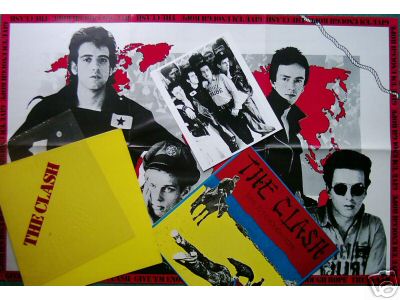
YOU ARE BIDDING ON A TRULY RARE PROMOTIONAL ITEM
THE CLASH
GIVE 'EM ENOUGH ROPE
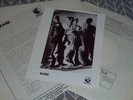
PROMO ONLY PACKAGE
CONSISTING OF
PRINTED PVC COVER
YELLOW FOLDER ( PRINTED INSIDE )
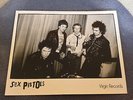
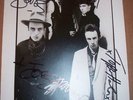
10" X 8" BLACK & WHITE PROMOTIONAL PHOTO
& DOUBLE SIDED PROMOTIONAL POSTER
ALL ITEMS ARE IN EX CONDITION
The Sex Pistols may have been the first British punk rock band, but the Clash were the definitive British punk rockers. Where the Pistols were nihlistic, the Clash were fiery and idealistic, charged with righteousness and a leftist political ideology. From the outset, the band was more musically adventurous, expanding their hard rock & roll with reggae, dub, and rap rockabilly among other roots musics. Furthermore, they were blessed with two exceptional songwriters in Joe Strummer and Mick Jones, each with a distinctive voice and style. The Clash copped heavily from classic outlaw imagery, positioning themselves as rebels with a cause. As a result, they won a passionately devoted following on both sides of the Atlantic. While they became rock & roll heroes in the UK, second only to the Jam in terms of popularity, it took the Clash several years to break into the American market and when they finally did in 1982, they imploded several months later. Though the Clash never became the superstars they always threatened to become, they restored passion and protest to rock & roll. For a while, they really did seem like "the only band that mattered."
For a band that constantly sang about revolution and the working class, the Clash had surprisingly traditional roots. Joe Strummer (b. John Graham Mellor, August 21, 1952) had spent most of his childhood in boarding school. By the time he was in his early '20s, he had busked on the streets of London and had formed a pub-rock band called the 101'ers. Around the same time, Mick Jones (b. June 26, 1955) was leading a hard rock group called the London SS. Unlike Strummer, Jones came from a working class background in Brixton. Throughout his teens, he was fascinated with rock & roll, and he had formed the London SS with the intent of replicating the hard-driving sound of Mott the Hoople and Faces. Jones' childhood friend Paul Simonon (b. December 15, 1956) joined the group as a bassist in 1976 after hearing the Sex Pistols; he replaced Tony James, who would later join Generation X and Sigue Sigue Sputnik. At the time, the band also featured drummer Tory Crimes (b. Terry Chimes), who had recently replaced Topper Headon (b. Nicky Headon, May 30, 1955). After witnessing the Sex Pistols in concert, Joe Strummer decided to break up the 101'ers in early 1976 in order to pursue a new, harder-edged musical direction. He left the band just before their first single, "Keys to Your Heart," was released. Along with fellow 101'er guitarist Keith Levene, Strummer joined the revamped London SS, now renamed the Clash.
The Clash performed its first concert in the summer of 1976, supporting the Sex Pistols in London. Levene left the band shortly afterward. Hiring Bernard Rhodes, a former business associate of the Sex Pistols' manager Malcolm McLaren, as their manager, the Clash set out on the Pistols' notorious "Anarchy Tour" late in 1976. Though only three concerts were performed on the tour, it nevertheless raised the Clash's profile and the band secured a record contract in February of 1977 with British CBS. Over the course of three weekends, the group recorded their debut album. Once the sessions were completed, Terry Chimes left the group, and Headon came aboard as the band's drummer. In the spring, the Clash's first single "White Riot" and eponymous debut album were released to great critical acclaim and sales in the UK, peaking at number 12 on the charts. The American division of US decided The Clash wasn't fit for radio play, so it decided to not release the album, but the import of the record became the largest-selling import of all-time. Shortly after the UK release of The Clash, the band set out on the whirlwind "White Riot" tour supported by the Jam and the Buzzcocks; the tour was highlighted by a date at London's Rainbow Theatre, when the audience tore the seats out of the venue. During the "White Riot" tour, CBS pulled "Remote Control" off of the album as a single, and as a response, the Clash recorded "Complete Control" with reggae icon Lee "Scratch" Perry.
Throughout 1977, Strummer and Jones were in and out of jail for a myriad of minor indescretions, ranging from vandalism to stealing a pillowcase, while Simonon and Headon were arrested for shooting racing pigeons with an air gun. The Clash's outlaw image was bolstered considerably by such events, but the band also began to branch out into social activism, such as headling a Rock Against Racism concert. Released in the summer of 1978, the single "(White Man) In Hammersmith Palais" demonstrated the band's growing social consciousness. Shortly after the single peaked at number 32, the Clash began working on their second album with producer Sandy Pearlman, a former member of Blue Öyster Cult. Pearlman gave Give 'Em Enough Rope a clean but powerful sound designed to break the American market. While that didn't happen — the album peaked at 128 on the US charts in the spring of 1979 — the record became an enormous hit in Britain, debuting at number two on the charts.
Early in 1979, the Clash began their first American tour, entitled "Pearl Harbor '79." That summer, the band released the UK-only EP The Cost of Living, which featured a cover of the Bobby Fuller Four's "I Fought the Law." Following the later summer release of The Clash in America, the group set out on their second US tour, hiring Mickey Gallagher of Ian Dury's Blockheads as a keyboardist. On both of their US tours, the Clash had R&B acts like Bo Diddley, Sam & Dave, Lee Dorsey and Screamin' Jay Hawkins support them, as well as neo-traditionalist country-rocker Joe Ely and the punk rockabilly band, the Cramps. The choice of supporting acts indicated that the Clash were becoming fascinated with older rock & roll and all of its legends. That fascination became the driving force behind their breakthrough double-album, London Calling. Produced by Guy Stevens, who formerly worked with Mott the Hoople, London Calling boasted an array of styles, ranging from rockabilly and New Orleans R&B to anthemic hard rock and reggae. Retailing at the price of a single album, the record debuted at number nine on the UK charts in late 1979 and climbed to number 27 on the US charts in the spring of 1980.
FUTURA 2000 / TYMON DOGG / B.A.D. BIG AUDIO DYNAMITE / JANIE JONES & THE LASH
On 05-Aug-04 at 22:50:26 BST, seller added the following information: