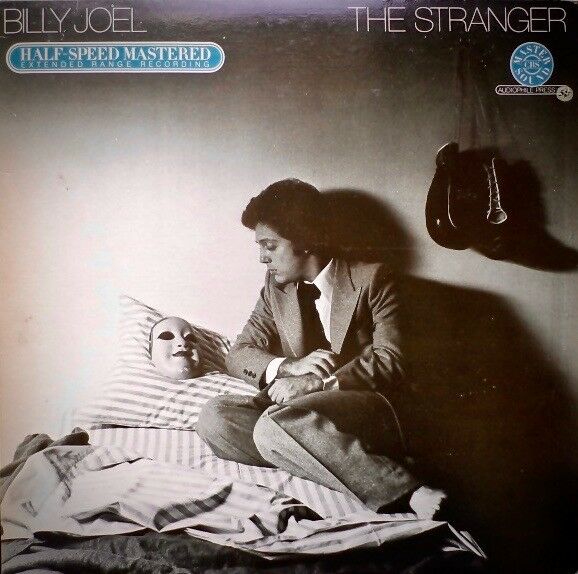
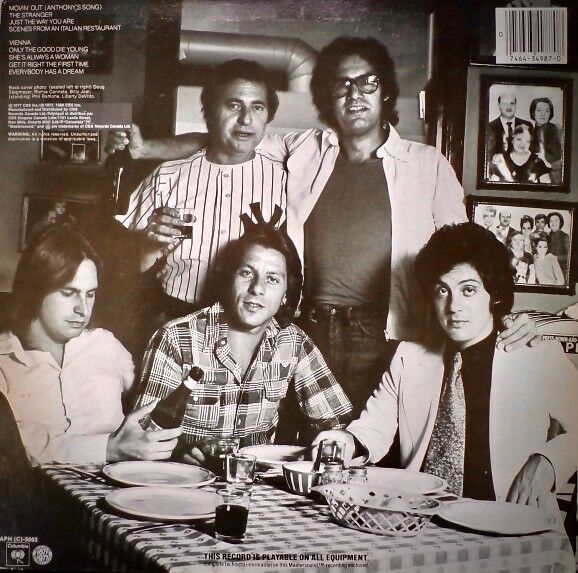
CBS Master Sound LP APHC-5002: Billy Joel - The Stranger - 1980 CANADA NM
C$
60
$
43

Favourite Auctions
To save auctions to your favourites, please login
If you don't have an account, please register
Description
****Welcome to our listing, thanks very much for looking!
****See our own website! We have lots of out of print LPs and CDs! Find us on the web at -
hearthedifference.net
****Please see our other listings - new items added daily!
****Shipping cost is only an estimate - it depends on the actual weight and size of the package as well as the service required. We do not profit from shipping costs, so if we overcharge, we will refund the difference back to you. It's always best to wait for our invoice before paying for your item. We will combine shipping for multiple items purchased.
Background -
Although Billy Joel never was a critic's favorite, the pianist emerged as one of the most popular singer/songwriters of the latter half of the '70s. Joel's music consistently demonstrates an affection for Beatlesque hooks and a flair for Tin Pan Alley and Broadway melodies. His fusion of two distinct eras made him a superstar in the late '70s and '80s, as he racked an impressive string of multi-platinum albums and hit singles.Born in the Bronx, Joel was raised in the Long Island suburb of Hicksville, where he learned to play piano as a child. As he approached his adolescence, Joel started to rebel, joining teenage street gangs and boxing as welterweight. He fought a total of 22 fights as a teenager, and during one of the fights, he broke his nose. For the early years of his adolescence, he divided his time between studying piano and fighting. Upon seeing the Beatles on The Ed Sullivan Show in 1964, Joel decided to pursue a full-time musical career and set about finding a local Long Island band to join. Eventually, he found the Echoes, a group that specialized in British Invasion covers. The Echoes became a popular New York attraction, convincing him to quit high school to become a professional musician.
While still a member of the Echoes, Joel began playing recording sessions in 1965, when he was just 16 years old. Joel played piano on several recordings George "Shadow" Morton produced -- including the Shangri-Las' "Leader of the Pack" -- as well as several records released through Kama Sutra Productions. During this time, the Echoes started to play numerous late-night shows.
Later in 1965, the Echoes changed their name twice -- once to the Emeralds and finally to the Lost Souls. For two years, he played sessions and performed with the Lost Souls. In 1967, he left the band to join the Hassles, a local Long Island rock & roll band that had signed a contract with United Artists Records. Over the next year and a half, the Hassles released two albums and four singles, all of which failed commercially. In 1969, the Hassles broke up. Joel and the band's drummer, Jon Small, formed an organ-and-drums duo called Attila. In Attila, Joel played his organ through a variety of effects pedals, creating a heavy psychedelic hard rock album completely without guitars. On the cover of the band's eponymous album, both Joel and Small were dressed as barbarians; in an interview on the back of the album, Joel claimed to forget the name of his previous band and stated that he only "sweated" two things -- perfecting his sound and the war in Southeast Asia. Epic released Attila early in 1970 and it was an immediate bomb and the duo broke up. While the group was still together, Joel began a romance with Small's wife, Elizabeth; she would eventually leave the drummer to marry the pianist.
After Attila's embarrassing failure, Joel wrote rock criticism for a magazine called Changes and played on commercial jingles, including a Chubby Checker spot for Bachman Pretzels. However, Joel entered a severe bout of depression, culminating with him drinking a bottle of furniture polish in an attempt to end his life. Following his failed suicide attempt, Joel checked himself into Meadowbrook Hospital, where he received psychiatric treatment for depression.
Joel returned to playing music in 1971, signing a deal with Family Productions. Under the terms of the contract, Joel signed to the label for life; the pianist was unaware of the clause at the time, but it would come back to haunt him -- Family Productions received royalties from every album Joel sold until the late '80s. Joel refashioned himself as a sensitive singer/songwriter for his debut album, Cold Spring Harbor, which was released in November of 1971. Due to an error in the mastering of the album, Cold Spring Harbor was released a couple of tape speeds too fast; the album remained in that bastardized form until 1984. Following the release of the album, Joel went on a small live tour, during which he would frequently delve into standup comedy. The tour received good reviews but Joel remained unhappy with the quality of his performance and, especially, the quality of the album. Furthermore, he lost a manager during this time and Family Productions was experiencing legal and financial difficulties, which prevented him from recording an immediate follow-up.
Early in 1972, he moved out to Los Angeles with his girlfriend Elizabeth. Joel adopted the name Bill Martin and spent half a year playing lounge piano at the Executive Room. Toward the end of the year, he began touring, playing various nightclubs across the country. At the beginning of 1973, Joel married Elizabeth Weber and she enrolled at UCLA's Graduate School of Management. Around the same time, a radio station began playing a live version of "Captain Jack" that was recorded at a Philadelphia radio broadcast. Soon, record companies were eagerly seeking to sign the pianist, and he eventually signed with Columbia Records. In order for Joel to sign with Columbia, the major label had to agree to pay Family Productions 25 cents for each album sold, plus display the Family and Remus logos on each record Joel released.
By the end of 1973, Billy Joel's first album for Columbia Records, Piano Man, had been released. The record slowly worked its way up the charts, peaking at number 27 in the spring of 1974. The title track -- culled from experiences he had while singing at the Executive Room -- became a Top 40 hit single. At the end of the summer, Joel assembled a touring band and undertook a national tour, opening for acts like the J. Geils Band and the Doobie Brothers. By the end of 1974, he had released his second album, Streetlife Serenade, which reached number 35 early in 1975. After its success, Joel signed a contract with James William Guercio and Larry Fitzgerald's management company, Caribou, and moved from California to New York. Through songs like "Say Goodbye to Hollywood" and "New York State of Mind," Joel celebrated the move on his 1976 album, Turnstiles. The sessions for Turnstiles were long and filled with tension, culminating with Joel firing the album's original producer, Guercio, and producing the album himself. Once he fired Guercio, Joel also left Caribou, and hired his wife as his new manager.
Turnstiles stalled on the charts, only reaching number 122. Joel's next album would prove to be the make-or-break point for his career, and the resulting album, The Stranger, catapulted him into super stardom. The Stranger was released in the fall of 1977. By the end of the year, it peaked at number two and had gone platinum, and within the course of a year, it would spawn the Top 40 singles "Just the Way You Are" (which would win the 1978 Grammy for Record of the Year and Song of the Year), "Movin' Out (Anthony's Song)," "She's Always a Woman," and "Only the Good Die Young." Over the next two decades, the album would sell over seven million copies. Joel followed The Stranger with 52nd Street, which was released in the fall of 1978. 52nd Street spent eight weeks at number one in the U.S., selling over two million copies within the first month of its release. The album spawned the hit singles "My Life," "Big Shot," and "Honesty," and won the 1979 Grammy award for Album of the Year. Although he had become a genuine star, critics had not looked kindly upon Joel's music, and the pianist became a vocal opponent of rock criticism in the late '70s. In one incident, he denounced Los Angeles Herald Examiner critic Ken Tucker on-stage and then, as a form of protest, tore up the critic's reviews.
In the spring of 1980, Joel released Glass Houses, theoretically a harder-edged album that was a response to the punk and new wave movement. Glass Houses reached number one in America, where it stayed for six weeks; the album spawned the Top 40 singles "You May Be Right" (number seven), "It's Still Rock'n'Roll to Me" (number one), "Don't Ask Me Why" (number 19), and "Sometimes a Fantasy" (number 36) and won the 1980 Grammy for Best Rock Vocal Performance, Male. In the fall of 1981, Joel released Songs in the Attic, a live album that concentrated on material written and recorded before he became a star in 1977. The album's "Say Goodbye to Hollywood" and "She's Got a Way" became Top 40 hits.
Songs in the Attic bought Joel some time as he was completing an album he had designed as his bid to be taken seriously as a composer. Before the album was finished, he suffered a serious motorcycle accident in the spring of 1982. He broke his wrist in the accident -- it would take major surgery to repair the wound. In July of 1982, Joel divorced his wife, Elizabeth. His new album, The Nylon Curtain, was finally released in the fall. A concept album about baby boomers and their experiences, the album was a commercial disappointment, only selling a million copies, but it did earn him some of his better reviews, as well as spawning the Top 20 hits "Pressure" and "Allentown." Joel quickly followed the album in 1983 with the oldies pastiche An Innocent Man.
An Innocent Man restored Joel to his multi-platinum status, eventually selling over seven million copies and spawning the hit singles "Uptown Girl" (number three), "Tell Her About It" (number one), "An Innocent Man" (number ten), and "Keeping the Faith" (number 18). Several of the songs on the album were about model Christie Brinkley, who was engaged to Joel by the time the album was released. During 1983 and 1984, Joel became one of the first '70s stars to embrace MTV and music videos, shooting a number of clips for the album that were aired frequently on the network. Brinkley and Joel were married in the spring of 1985.
Joel released a double-album compilation, Greatest Hits, Vols. 1-2 in the summer of 1985. Two new songs -- the Top Ten "You're Only Human (Second Wind)" and the Top 40 "The Night Is Still Young" -- were added to the hits collection; the album itself peaked at number six and would eventually sell over ten million copies. In the summer of 1986, Joel returned with the Top Ten single "Modern Woman," which was taken from the soundtrack of Ruthless People. "Modern Woman" was also a teaser from his new album, The Bridge, which was released in August. The Bridge was another success for Joel, peaking at number seven, selling over two million copies, and spawning the Top 40 hits "A Matter of Trust" (number ten) and "This Is the Time" (number 18), as well as "Big Man on Mulberry Street," which was used as the basis for an episode of the popular Bruce Willis/Cybill Shepherd television series Moonlighting.
In the spring of 1987, Joel embarked on a major tour of the U.S.S.R., during which he had an on-stage temper tantrum and shoved a piano off the stage. His Leningrad concert was recorded and released in the fall of 1987 as the live double album Kohuept, which means concert in Russian. Joel was quiet for much of 1988, only appearing as the voice of Dodger in the Walt Disney animated feature Oliver and Company.
Joel fired his longtime manager and former brother-in-law Frank Weber in August of 1989, after an audit revealed that there were major discrepancies in Weber's accounting. Following Weber's dismissal, Joel sued Weber for 90 million dollars, claiming fraud and breach of fiduciary duty. Immediately after filing suit, Joel was hospitalized with kidney stones. All of this turmoil didn't prevent the release of his 12th studio album, Storm Front, in the fall of 1989. It was preceded by the single "We Didn't Start the Fire," whose lyrics were just a string of historical facts. The single became a huge hit, reaching number one and inspiring history students across America. Storm Front marked a significant change for Joel -- he fired his band, keeping only Liberty DeVito, and ceased his relationship with producer Phil Ramone, hiring Mick Jones of Foreigner to produce the album. Storm Front was another hit for Joel, reaching number one in the U.S. and selling over three million albums.
During 1990, Joel undertook a major U.S. tour, which ran well into 1991. In January, the court awarded Joel two million dollars in a partial judgment against Frank Weber, and in April, the court dismissed a 30 million dollar countersuit. At the end of the year, the National Academy of Recording Arts and Sciences honored Joel with a Grammy Living Legend award; that same year, Quincy Jones, Johnny Cash, and Aretha Franklin were also given the honor.
Following the Storm Front world tour, Joel spent the next few years quietly. In 1991, he was awarded an honorary doctorate by Fairfield University in Connecticut. In the summer of 1992, Joel filed a 90 million dollar lawsuit charging his former lawyer Allen Grubman of fraud, breach of contract, and malpractice; in October of 1993, the two parties settled their differences out of court. Joel returned in the summer of 1993 with River of Dreams, which entered the charts at number one and spawned the Top Ten title track. Following the River of Dreams tour, Joel divorced Christie Brinkley. In 1996, he gave a series of lectures at a variety of American colleges. He performed at the 1999 New Year's Eve Party in Times Square, and 2000 Years: The Millennium Concert, a live album of this concert, was released early the following year.
His next studio record, Fantasies & Delusions, arrived in 2001 and was his first album of his own classical compositions. A year later, Twyla Tharp choreographed and directed Movin' Out, a Broadway musical based on Joel's music. A new venture as a children's author began in 2004 with the release of his first book, Goodnight, My Angel: A Lullaby. The 54-year-old Joel married the 23-year-old Katie Lee that same year and was making tabloid headlines again in March of 2005 when he checked into the Betty Ford Clinic for treatment of alcohol abuse. He checked out in April, and in November his four-CD/one-DVD career retrospective My Lives was released. Live in Madison Square Garden NYC and the accompanying 12 Gardens Live arrived in 2006.
In 2007, Joel released his first original composition since River of Dreams -- a ballad called "All My Life." He quickly followed it with "Christmas in Fallujah," a tune he wrote but did not sing; it was performed by Cass Dillon. After this brief burst of activity Joel returned to touring regularly, his most notable performance being the closing shows at the legendary Shea Stadium in July 2008. These two concerts were recorded and released as DVDs and CDs in the spring of 2011. On the heels of this live album came word that Joel was penning a memoir, but the book was quickly scrapped after the announcement.
Over the next couple of years, Joel transitioned toward performing in public frequently and, along with it, started to give more interviews. In 2013, he toured the United Kingdom and then performed at the Barclay Center in Brooklyn for his first New York solo headlining gig in five years. It wouldn't be his last: he soon announced that he'd have a regular residency at Madison Square Garden, performing 21 concerts in 2014 alone with an option to play there indefinitely. In addition to his New York shows, Joel also toured elsewhere in the U.S. He promoted these shows and the release of A Matter of Trust: The Bridge to Russia -- an expanded version of his 1987 live album Kohuept, containing two CDs of live performances from that Russian tour in addition to a documentary about the whole endeavor -- with a number of interviews, highlighted by a live "town hall" radio show with Howard Stern. - Stephen Thomas Erlewine
Billy Joel teamed with Phil Ramone, a famed engineer who had just scored his first producing hits with Art Garfunkel's Breakaway and Paul Simon's Still Crazy After All These Years for The Stranger, his follow-up to Turnstiles. Joel still favored big, sweeping melodies, but Ramone convinced him to streamline his arrangements and clean up the production. The results aren't necessarily revelatory, since he covered so much ground on Turnstiles, but the commercialism of The Stranger is a bit of a surprise. None of his ballads have been as sweet or slick as "Just the Way You Are"; he never had created a rocker as bouncy or infectious as "Only the Good Die Young"; and the glossy production of "She's Always a Woman" disguises its latent misogynist streak. Joel balanced such radio-ready material with a series of New York vignettes, seemingly inspired by Springsteen's working-class fables and clearly intended to be the artistic centerpieces of the album. They do provide The Stranger with the feel of a concept album, yet there is no true thematic connection between the pieces, and his lyrics are often vague or mean-spirited. His lyrical shortcomings are overshadowed by his musical strengths. Even if his melodies sound more Broadway than Beatles -- the epic suite "Scenes From an Italian Restaurant" feels like a show-stopping closer -- there's no denying that the melodies of each song on The Stranger are memorable, so much so that they strengthen the weaker portions of the album. Joel rarely wrote a set of songs better than those on The Stranger, nor did he often deliver an album as consistently listenable. - Stephen Thomas Erlewine
-
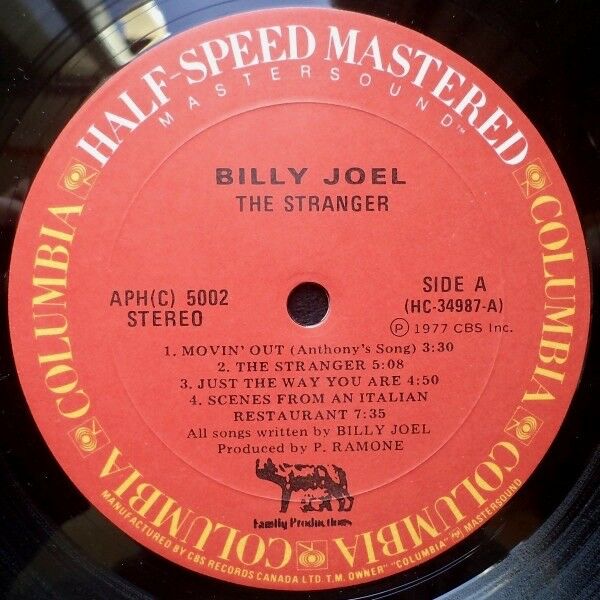
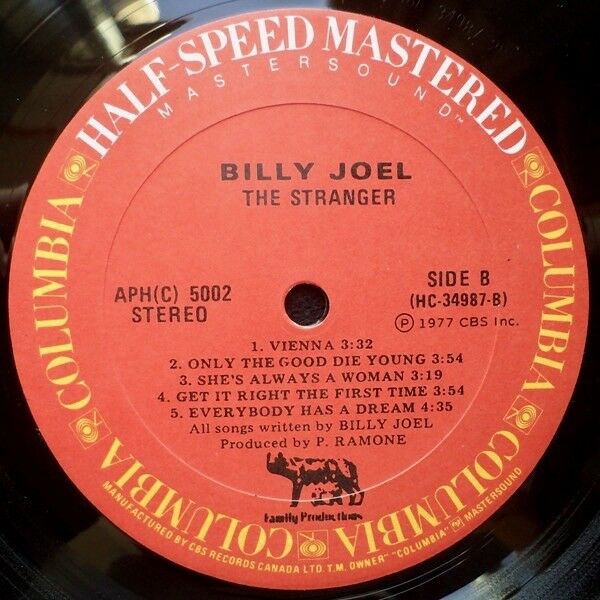
CBS MASTER SOUND (Audiophile, Half Speed LP) Record LP item - RED record labels with BLACK lettering
-
Record Made in CANADA
-
Pressing is in STEREO - recordings are from 1977 - originally issued on the COLUMBIA / CBS Record Label
-
Limited Edition LP
-
Record Speed: 33 1/3 rpm
-
Record Made / Issued in: 1980
-
Record Catalog Number: APH(C) 5002
Featured on this item:
Billy Joel
LP Title -
The Stranger
Track Listing -
A1. Movin' Out (Anthony's Song) - 3:30A2. The Stranger - Percussion – Ralph MacDonald - 5:08
A3. Just The Way Your Are - Acoustic Guitar – Hugh McCracken, Steve Burgh Percussion – Ralph MacDonald Saxophone [Alto] – Phil Woods - 4:50
A4. Scenes From An Italian Restaurant - Accordion – Dominic Cortese Acoustic Guitar – Hugh McCracken Guitar [Electric] – Steve Burgh - 7:35
B1. Vienna - Accordion – Dominic Cortese - 3:32
B2. Only The Good Die Young - 3:54
B3. She's Always A Woman - Acoustic Guitar – Hugh McCracken, Steve Burgh - 3:19
B4. Get It Right The First Time - Acoustic Guitar – Hugh McCracken Percussion – Ralph MacDonald - 3:54
B5. Everybody Has A Dream - Acoustic Guitar – Hugh McCracken Backing Vocals – Gwen Guthrie, Lani Groves, Patti Austin, Phoebe Snow Organ – Richard Tee Percussion – Ralph MacDonald - 4:35
Other Information / Performers / Credits on this LP include -
• Distributed & Manufactured By – CBS Records Canada Ltd.
• Acoustic Guitar [Rhythm] – Mr. Steve Khan
• Bass – Doug Stegmeyer
• Clarinet – Richie Cannata
• Drums – Liberty Devitto
• Engineer – Jim Boyer, Phil Ramone
• Flute – Richie Cannata
• Guitar [12-string] – Mr. Steve Khan
• Guitar [Electric] – Hiram Bullock, Mr. Steve Khan
• Guitar [High String] – Mr. Steve Khan
• Keyboards [Electric] – Billy Joel
• Orchestrated By – Patrick Williams
• Organ – Richie Cannata
• Piano [Acoustic] – Billy Joel
• Producer – Phil Ramone
• Saxophone [Soprano] – Richie Cannata
• Saxophone [Tenor] – Richie Cannata
• Synthesizer – Billy Joel
• Vocals – Billy Joel
• Barcode: 07464349870
CONDITION Details:
LP Jacket:-
The jacket is in Near MINT minus condition, with no seam splits.
-
The jacket has NO splits of any kind - it is completely solid and intact, and shows only some very minimal shelf wear along the seams and corners.
-
It has a tiny drill hole at the front, top, left corner.
-
There is NO writing on the front or back of the jacket.
-
The cover has clean and sharp colors and it comes with the paper insert describing the CBS Master Sound series of LPs.
-
The LP is in Near MINT minus condition - super glossy and appears as new!
-
This is the copy you want for your LP collection - any super picky audiophile should be happy with this one!
-
As for any record, even brand new, sealed ones, we always recommend a proper record cleaning before playing!
A Short Note About LP GRADING -
- Mint = Only used for sealed items.
- Near Mint = Virtually flawless in every way.
- Near Mint Minus = Item has some minor imperfections, some audible.
- Excellent = Item obviously played and enjoyed with some noise.
- Very Good Plus = Many more imperfections which are noticeable and obtrusive.
For best results, always properly clean your LPs before playing them.
The LP is an audiophile quality pressing (any collector of fine MFSL, half speeds, direct to discs, Japanese/UK pressings etc., can attest to the difference a quality pressing can make to an audio system).
Do not let this rarity slip by!
price rating