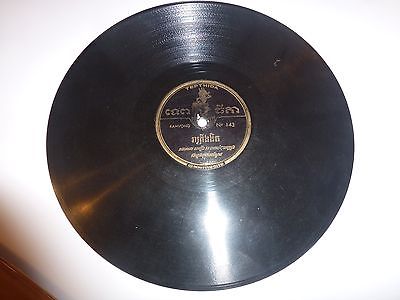
CAMBODIA 78 RPM RAMVONG RUMBA TEPTHIDA NO.142/143
$
61


Favourite Auctions
To save auctions to your favourites, please login
If you don't have an account, please register
Description
You are bidding on a CAMBODIA 78 RPM on the Tepthida label No.142/143
I don't know what the title is other than the inscription that it is a one side is a rumba and the other side is athe traditional folk ramvong
Visually shellac is a very glossy near mint ( looks unplayed ) However there is a manufacturing heat mark ( does not affect play .
Very unique small label form 100+ years ago.
Buyer pays $12 shipping to the US or $20 overseas by airmail.
Some info on the Ramvong:
Romvong is a type of Southeast Asian dance where both females and males dance in a circle. It is a popular folk-dance in Cambodia, Laos and Thailand. It is a slow round dance continuously moving in a circular manner, and incorporates graceful hand movements and simple footwork. Both men and women participate in the same circle. This dance is still popular at traditional festivities in Khmer, Lao and Thai culture.
Ramvong dance has been performed in Cambodia by Khmers and other ethnic groups such as Phnong, Krung, Tampuan and Prou people. This circular dance style is claimed as a traditional dance in the three countries of the region where it is often part of different types of events and popular celebrations.
In Thailand ramwong is deemed to have originated in ramthon (Thai: ?????), an older kind of folk dance where the rhythm was marked by a kind of drum known as thon (Thai: ???). The fine arts department of Thailand has identified over ten different styles of ramwong.[2]
Ramwong was patronized by Prime Minister Plaek Phibunsongkhram during the hard times of Thailand in World War II. In order to help people to forget their penury, the military dictator encouraged Thai women and men to enjoy themselves by dancing ramwong. Also, as part of the policy of Thaification during his tenure, Phibunsongkhram aimed to stem the popularity of non-Thai dances such as the foxtrot or waltz through the promotion of ramwong. Even government officials were given half a day during the work week to dance ramwong together at their offices. After the end of World War II ramwong was largely replaced by luk thung and cha-cha-cha although its influence survived in Thai society.[3]
DO NOT USE THE EBAY CHECKOUT AS IT IS INCORRECT AND WAIT FOR MY INVOICE.price rating



![IRON SIDE/TEN YEARS AGO - THE OFFICIALS [ROOTS REGGAE]](https://www.popsike.com/php/thumbnail.php?url=https://www.popsike.pics/pix/20080111/130189075065.jpg)