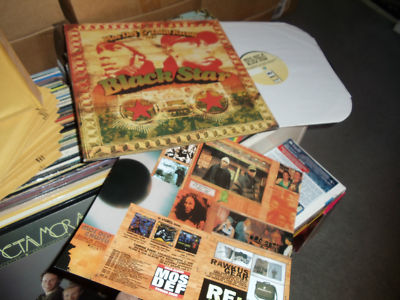
Black Star - Mos Def & Talib Kweli LP w/ insert
$
37


Favourite Auctions
To save auctions to your favourites, please login
If you don't have an account, please register
Description
LP NM
Jacket NM
Biography
Initially regarded as one of the most promising rappers to emerge in the late '90s, Mos Def turned to acting in subsequent years as music became a secondary concern for him. He did release new music from time to time, including albums such as The New Danger (2004), but his output was erratic and seemingly governed by whim. Mos Def nonetheless continued to draw attention, especially from critics and underground rap fans, and his classic breakthrough albums -- Black Star (1998), a collaboration with Talib Kweli and Hi-Tek; and Black on Both Sides (1999), his solo debut -- continued to be revered, all the more so as time marched forward. Mos Def often used his renown for political purposes, protesting in the wake of Hurricane Katrina in 2005 and the Jena Six incident in 2007, for instance.
Born Dante Terrell Smith on December 11, 1973, in Brooklyn, NY, Mos Def began rapping at age nine and began professionally acting at age 14, when he appeared in a TV movie. After high school, he began acting in a variety of television roles, most notably appearing in 1994 on a short-lived Bill Cosby series, The Cosby Mysteries. In 1994 Mos Def formed the rap group Urban Thermo Dynamics with his younger brother and sister, and signed a recording deal with Payday Records that didn't amount to much. In 1996 his solo career was launched with a pair of high-profile guest features on De La Soul's "Big Brother Beat" and Da Bush Babees' "S.O.S." A year later, in 1997, Mos Def released his debut single, "Universal Magnetic," on Royalty Records, and it became an underground rap hit. This led to a recording contract with Rawkus Records, which was just getting off the ground at the time, and he began working on a full-length album with like-minded rapper Talib Kweli and producer Hi-Tek. The resulting album, Black Star (1998), became one of the most celebrated rap albums of its time. A year later came Mos Def's solo album, Black on Both Sides, and it inspired further attention and praise. Yet, aside from appearances on the Rawkus compilation series Lyricist Lounge and Soundbombing, no follow-up recordings were forthcoming, as the up-and-coming rapper turned his attention elsewhere, away from music.
During the early 2000s, Mos Def acted in several films (Monster's Ball, Bamboozled, Brown Sugar, The Woodsman) and even spent some time on Broadway (the Pulitzer Prize-winning Topdog/Underdog). He simultaneously worked on the Black Jack Johnson project with several iconic black musicians: keyboardist Bernie Worrell (Parliament/Funkadelic), guitarist Dr. Know (Bad Brains), drummer Will Calhoun (Living Colour), and bassist Doug Wimbish (the Sugarhill Gang, Grandmaster Flash, Living Colour). This project aimed to reclaim rock music, especially the rap-rock hybrid, from such artists as Limp Bizkit frontman Fred Durst, who Mos Def openly despised. What made Black Jack Johnson so anticipated though was not so much the supergroup roster of musicians or even Mos Def himself, but rather the lack of black rock bands. Following the demise of Living Colour, there were few, if any, that had attained substantial success. Mos Def hoped to infuse the rock world with his all-black band, and during the early 2000s, he performed several small shows with his band around the New York area. In October 2004, he finally delivered a second solo album, The New Danger, which involved Black Jack Johnson on a few tracks.
Two years later, after a few more acting roles -- including the Golden Globe-winning Lackawanna Blues and the Emmy-winning Something the Lord Made, both of which were made-for-television movies -- Mos Def released his third solo album, True Magic (2006). A contract-fulfilling release for Geffen, which had absorbed Rawkus years prior, the album trickled out in a small run during the last week of 2006. Bizarrely, the disc came with no artwork and was sold in a clear plastic case -- though its single, "Undeniable," did manage to grab a Grammy nomination for Best Rap Solo Performance. The Ecstatic, released on the Universal-distributed Downtown label, followed in June 2009; at that point, Mos Def had significant acting roles in Michel Gondry's Be Kind Rewind (in which he co-starred with Jack Black) and Cadillac Records (he played Chuck Berry).
Biography
If skills sold, Talib Kweli would have been one of the most commercially successful rappers of his time. As it was, however, the earnest MC became one of the most critically successful rappers of his time, which dawned in the late '90s when he rapped alongside Mos Def and DJ Hi-Tek as part of the group Black Star. This trio of up-and-comers and their widely acclaimed self-titled 1998 album debut, Black Star, helped make Rawkus Records one of the premier underground rap outposts of the late '90s. Kweli and Hi-Tek then collaborated as a duo on Reflection Eternal (2000), which firmly established them apart from Mos Def, who had gone solo. For a moment there, Kweli and his Rawkus associates seemed like a full-fledged movement -- a return to the sort of hip-hop associated with the so-called golden age. However, it wasn't to be. Rawkus somehow lost its momentum, and its roster sadly dispersed, leaving Kweli on his own to carry the torch. He continued his output, beginning with a proper solo debut, Quality (2002), and though he didn't rack up towering sales numbers, he remained a critical favorite. In fact, he was one of the most admired and respected rappers on the major-label circuit during the mid-2000s, best evidenced by Jay-Z's famous Black Album rhyme: "If skills sold, truth be told/I'd probably be, lyrically, Talib Kweli."
Born in Brooklyn as the eldest of two sons born to college professors, Kweli's first name, Talib, is an Arabic name meaning "the seeker or student," while his last name is a Ghanaian name meaning "of truth or knowledge." He began developing his literary gift in elementary school, when he'd write short stories, poems, and that sort of stuff. It wasn't until years later in high school that he turned to hip-hop as an outlet for his self-expression. There in high school he met a young Dante Smith, better known today as Mos Def. This fateful meeting further drew Kweli toward hip-hop, and another fateful meeting further convinced him that he had a bright future as an MC. During a 1994 trip to Cincinnati he met Tony Cottrell, aka DJ Hi-Tek, who at the time was part of a local rap group called Mood. Kweli impressed Hi-Tek during their time together, and the DJ invited the MC to guest on several tracks for Mood's 1997 album Doom. Shortly afterward, Kweli and Hi-Tek formed a partnership as Reflection Eternal and recorded "Fortified Live," which a then-fledging Rawkus label released on its first Soundbombing compilation.
A year later in 1998, the two invited Mos Def into the mix, and the Black Star album resulted. And with it came a steady downpour of critical acclaim that turned these guys into media darlings overnight. They might not have sold millions of albums, but Kweli, Hi-Tek, and Mos Def most certainly impressed a great many people, among them critics, fellow rap artists, and a lot of folks who enjoyed a good old-fashioned hip-hop album with an emphasis on beats, rhymes, and life -- not dramatized gunplay or interpolations of proven pop songs. That was the end of Black Star, however. In 1999 Mos Def released his debut solo album, Black on Both Sides, and turned away from music and toward an acting career, leaving Kweli and Hi-Tek on their own. The duo returned to their Reflection Eternal partnership and released an album of the same name in 2000. It spawned a few minor hits: "Move Somethin'" and "The Blast."
When Kweli returned with his Quality album in 2002, things had changed a bit. For one, he was truly solo. Mos Def was long gone, and Hi-Tek was off focusing on his own solo career as a for-hire producer. So Quality featured Kweli collaborating with a host of different artists, among them a young and promising yet still largely unknown producer named Kanye West. "Get By" was the fruit of Kweli's collaboration with West, and it became the rapper's biggest hit to date, aided quite a bit by a non-album remix featuring Jay-Z of all people. The remix got a lot of radio play, but still, Quality didn't put up Jay-Z numbers and Kweli remained a critical favorite, a reputation cemented all the more in late 2003 when Jigga gave him the aforementioned high-profile shoutout in "Moment of Clarity."
All of this set the stage very well for The Beautiful Struggle, which dropped in fall 2004. The expectations for the album were gargantuan because of the Jay-Z rhyme, and also because a great many hip-hop disciples felt Kweli was long overdue for a commercial breakthrough. The album was undoubtedly his most commercial effort to date, featuring a few token radio-ready hook singers like Mary J. Blige and Anthony Hamilton, not to mention a roster of hitmaking producers like the Neptunes, Just Blaze, and Kanye. It was also Kweli's most self-conscious to date, however, as it was well apparent that the commercial pressures had begun to affect his mindset. He responded by splitting from his distributor, Universal, and lying low for a while, releasing a stopgap mixtape, Right About Now (2005) via Koch.
In anticipation of his next solo album, Kweli collaborated with producer Madlib on the digital-only Liberation, which was made available as a free download during the first week of 2007 on the Stones Throw website. Finally, in August of that same year, Kweli issued the full-length album Eardrum on his own label, Blacksmith, via a partnership with Warner Brothers. Debuting at number two on the Billboard 200 and selling about 60,000 copies in its first week, Eardrum was Kweli's best-selling album to date and features beats from not only Madlib but also Hi-Tek, Kanye West, Pete Rock, and will.i.am, among others, and features guests like Norah Jones, UGK, Justin Timberlake, and Strong Arm Steady.
Note: All Lps are sight graded
Note: I Do Not Grade inner sleeves, If these are Important to you then you may e-mail me)
RECORD GRADING Based On Goldmine Grading Standards:
Near Mint (NM): A nearly perfect record. There may be one or two small inaudible defects. The record should show no obvious signs of wear. A 45 RPM or EP sleeve should have no more than the most minor defects, such as almost invisible ring wear or other sights of slight handling. An LP jacket should have no creases, folds, seam splits or any other noticeable similar defect. No cut-out holes, either.
Near Mint Minus (NM-): A record that should play mint but has a few slight visible marks. The album will have as much luster as an NM, there just may be some superficial scuffs from the sleeve or very light hairlines that shouldn't be audible. An NM- album cover subjectively fits somewhere in between VG+ and NM.
Very Good Plus (VG+): A Very Good Plus record will show some signs that it was played and otherwise handled by a previous owner who took good care of it. Record surfaces may show some slight signs of wear and may have slight scuffs or very light scratches that don t significantly affect play. Slight warps that do not affect the sound are OK. The label may have some ring wear or discoloration, but it should be barely noticeable. The center hole will not have been misshapen by repeated play. 45 Picture sleeves will have some slight wear, lightly turned-up corners, or a slight seam-split. An LP jacket may have slight signs of wear also and may be marred by a cut-out hole, indentation or corner indicating it was taken out of print and sold at a discount.
Very Good (VG): Many of the defects found in a VG+ record will be more pronounced in a VG disc. Surface noise will be evident upon playing, especially in soft passages and during a song s intro and fade, but will not overpower the music otherwise. Groove wear will start to be noticeable, as will light scratches (deep enough to feel with a fingernail) that will affect the sound. Labels may be marred by writing, or have tape or stickers (or their residue) attached. The same will be true of picture sleeves or LP covers. However, it will not have all of these problems at the same time, just two or three of them.
Good (G), Good Plus (G+): Good does not mean Bad! A record in Good or Good Plus condition can be put onto a turntable and will play though without skipping. But it will have significant surface noise and scratches and visible groove wear. A jacket or sleeve will have seam splits, especially at the bottom or on the spine. Tape, writing, ring wear or other defects will start to overwhelm the subject.
Poor (P), Fair (F): Below good. imperfections will be described.
Please check out my other items for sale. (I offer shipping discounts) I'll Be adding More Daily except for Friday and Saturday.
ALL SHIPPING PRICES ARE FINAL
additional items are 1.50 per item up to 6 within USA (if you are bidding on multiple items lots I have in one listing. you pay each shipping total added together)
Priorty shipping is available e-mail for total
NOTE: Gatefold Lps Count as 2 Lps when shipping out of the country
CANADA Multiple LP Shipping Rates In USD
1 LP 7.75
2. Lps 9.25
3 Lps 12.50
4 Lps 15.50
5 Lps 16.50
6 Lps 18.00
Multiple Shipping Rates Rest Of The World Outside USA in USD
Note: Gatefold Lps Count as 2 Lps
1 LP 14.00
2 LP 17.00
3. Lps 22.50
4 Lps 25.25
5 Lps 28.00
6 Lps 33.00
7 Lps 39.00
8 LPs 42.00
9 Lps 45.00
10 Lps 48.00
11 Lps 51.00
12 Lps 54.00
The MAN has to get his cut so Texas residents must add 8.25 % Sales Tax
If you are unsure about shipping costs please do not hesitate to e-mail me.
QUESTIONS:? Please ask. That is what I am here for. (I may not get to them if you wait close to an item's ending.)
MORE PICTURES? Just ask and I'll send them to you
MEDIA MAIL: is not recommended for rare items. Priority mail is faster and safer.
I leave feedback after item arrives and it is left for me. (It's easier to keep up with that way) Please limit your feedback comments to things within the realm of my responsibility.
Thank you for reading all of this :-)
price rating



![RACCOMANDATA RICEVUTA RITORNO per... Italian Prog JAPAN orig LP w/OBI [FREE P+P]](https://www.popsike.com/php/thumbnail.php?url=https://www.popsike.pics/pix/20130515/370815355884.jpg)