Billie Holiday rare Japanese Pressing
$
50


Favourite Auctions
To save auctions to your favourites, please login
If you don't have an account, please register
Description
Small jazz groups brought out the best in Billie Holiday -- especially groups as good as the one heard on this classic 1957 recording. Ben Webster, Harry "Sweets" Edison, and the other members of this stellar ensemble were not just gifted soloists but sensitive accompanists as well. Lady Day was rarely more ably supported than she was on this program of sturdy standards, including three gems by the Gershwin brothers -- and she rarely sounded more luminous.
Personnel includes: Billie Holiday (vocals); Ben Webster (tenor saxophone); Harry "Sweets" Edison (trumpet); Jimmy Rowles (piano); Barney Kessel (guitar); Red Mitchell (bass); Alvin Stoller, Larry Bunker (drums).
Producer: Norman Granz.
Reissue producer: Bryan Koniarz.
Recorded at Capitol Studios, Hollywood, California in 1957. Includes liner notes by Al Young.
All tracks have been digitally remastered.
This is part of Verve's "Clef" series.
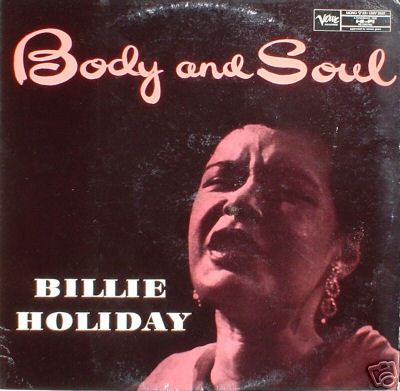
The Japanese re-mastering of the original tapes of selected Billie Holiday recordings became instant classics when release in limited editions in the 1980s. The vinyl is in very good + condition. The cover has some slight ware and fraying but is still in handsome condition (enlarge photo.)
These recordings made in Japan marked the first time that the fullness of Billie Holiday’s voice could be heard in all of its clarity since she began recording in 1933. All prior tapes and recordings by her are full of annoying background noise that, miraculously, the Japanese managed to eliminate by meticulousness, patience and the latest of technologies. They were immediate collectors items at the time of their release and are now increasingly hard to find.
Side 1: Date Matrix
1 Body and Soul 07.01.1957 20507-1
2 They Can't Take That Away... 09.01.1957 20568-6
3 Darn That Dream 07.01.1957 20505-3
4 Let's Call the Whole Thing Off 09.01.1957 20567-4
Side 2:
1 Comes Love 04.01.1957 20503-4
2 Gee Baby, Ain't I Good to You 09.01.1957 20565-3
3 Embraceable You 09.01.1957 20566-1
4 Moonlight in Vermont 03.01.1957 20499-1
BILLIE HOLIDAY - Painting by Loviscornith
Billie Holiday (1915-59) was one of jazz’s greatest song stylists. Her ability to make a song her own by imposing her personality on it in an era when most singers remained faithful to
the composer’s lead sheet anticipated many vocalists as stylistically diverse as Frank Sinatra and, in a later generation, Joni Mitchell.
She was born Eleanora Harris in Philadelphia to teenage parents. Her mother, Sadie Harris,
raised her in Baltimore while working as a domestic servant. Her father, Clarence Holiday,
was a professional musician who visited her on occasion but wasn’t around much while she was growing up. She was a problem child with constant truancy problems, and at the age
of nine she was sent to a Catholic home for wayward girls for several months.
When she was in her middle teens she moved to New York. She changed her name to
Billie Holiday in the late 1920s when she was working one of her first club jobs.
Louis Armstrong was an inevitable early influence, as was Bessie Smith, but by the
time she first recorded she sounded like no one else.
In 1933 John Hammond, a wealthy jazz lover with record company connections,
produced her first record date. By 1935 she had become a regular in a series of informal
recording sessions organized by Hammond and pianist Teddy Wilson, using leading
players and singers from whatever big bands were in town. By the following year she
had begun to record under her own name as well. She did brief stints with the big bands
of Count Basie (1938) and Artie Shaw (1939), but band singing didn’t suit her temperament.
More important to her career development was an engagement in 1939 at Café Society,
one of the first integrated nightclubs in New York. She attracted a sophisticated crowd
that was affluent and politically liberal — the perfect setting for her to introduce "Strange Fruit", an anti-lynching song a generation ahead of the protest hits of the Vietnam War
era. It became a signature piece for her, but it also signified a change in artistic direction
in another way. On her earlier recordings, Holiday had been used much like a horn, taking her solo after the opening instrumental chorus. Now the instrumental and vocal roles were reversed, with an occasional brief horn or piano solo in the middle of her vocal performance.
In 1943 Holiday signed a contract with Decca Records, The resulting recordings were more
pop-oriented then her previous output, surrounding her with large string-laden orchestras.
This period marked her peak as a vocalist from a commercial point of view. Unfortunately, her drug use and unstable love relationships were beginning to undermine her career, stunting her chances of broad acceptance. And many jazz aficionados longed for her to return to making the type of jazz-oriented records she had made in the 1930s.
In 1952 Holiday began a five-year association on record with jazz impresario Norman Granz, who put her in the studio with compatible musicians, often from his Jazz at the Philharmonic troupe. By now her voice was showing wear and tear from the years of hard living, but her true talent had always had been in the filtering of a song through her personality and experience, and plenty of both show through in the series of recordings she made for Granz.
In early 1958 Holiday recorded the album Lady in Satin with Ray Ellis’s orchestra. Her
voice was almost completely gone, but expressively the album is one of her finest. Holiday’s
health continued to decline, and in the spring of 1959 she was taken to a hospital for treatment of cirrhosis of the liver and malnutrition. Five days before her death she was arrested in her hospital bed on narcotics charges.
The facts of Billie Holiday’s life are tragic to say the least, but in her recordings she
made art out of that life.
Phil Bailey
price rating




![OK Computer: OKNOTOK 1997 2017 [Deluxe Vinyl Box Set] by Radiohead (Vinyl,...](https://www.popsike.com/php/thumbnail.php?url=https://www.popsike.pics/pix/20210321/224394158417.jpg)