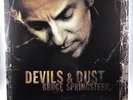
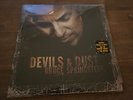
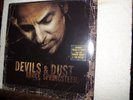
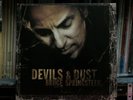
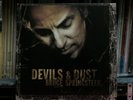
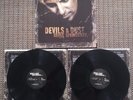
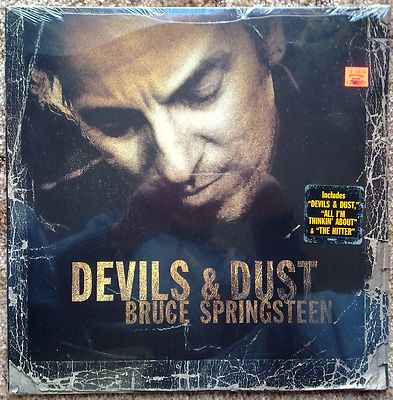
BRUCE SPRINGSTEEN - DEVILS & DUST - MINT SEALED - Vinyl LP
£
74
$
98


Favourite Auctions
To save auctions to your favourites, please login
If you don't have an account, please register
Description
BRUCE SPRINGSTEEN "DEVILS & DUST" MINT SEALED
Double LP
Vinyl LP
2005 original release vinyl LP on the SONY/COLUMBIA record label Cat n# C2 93900 Made in USA
The album cover is in MINT condition. there are a couple of creases through the edges.
The vinyl itself is in MINT condition UNPLAYED SEALED.
If you are not fully satisfied you may return this album with a full refund inc postage.If you need anymore information and pictures please get in touch, thanks.
Sorry if the shipping charges seem a bit high, the reason being i use heavy/strong packaging and the high cost of the Royal Mail price structure
THIS IS AS GOOD EXAMPLE OF WELL LOOKED AFTER OLD LP RECORD
Full track list
Side One
1."Devils & Dust" – 4:58
2."All the Way Home" – 3:38
3."Reno" – 4:08 .
Side Two
4."Long Time Comin'" – 4:17
5."Black Cowboys" – 4:08
6."Maria's Bed" – 5:35 .
Side Three
7."Silver Palomino" – 3:22
8."Jesus Was an Only Son" – 2:55
9."Leah" – 3:32 .
Side Four
10."The Hitter" – 5:53
11."All I'm Thinkin' About" – 4:22
12."Matamoros Banks" – 4:00 .
All songs by Bruce Springsteen.
The Band
Bruce Springsteen – vocals, guitar, keyboards, bass guitar, drums, harmonica, tambourine, percussion
Marty Rifkin – steel guitar
Brendan O'Brien – hurdy-gurdy, sarangi, sitar, bass guitar, tambora
Soozie Tyrell – violin, backing vocals
Nashville String Machine – strings
Brice Andrus, Susan Welty, Thomas Witte, Donald Strand – horns
Chuck Plotkin – piano
Danny Federici – keyboards
Steve Jordan – drums
Patti Scialfa, Lisa Lowell – backing vocals
Mark Pender – trumpet
.
Devils & Dust is the 13th studio album by American recording artist Bruce Springsteen, and his third folk album (after Nebraska and The Ghost of Tom Joad). It was released on April 25, 2005 in Europe and on April 26 in the US. It debuted at the top of the US Billboard 200 album chart.
Background
Springsteen was very open about the fact that many of the songs from Devils & Dust dated back a decade (or more).
Springsteen wrote the song "All The Way Home" for Southside Johnny to use in his album Better Days which was released in 1991. The songs "Long Time Comin'" and "The Hitter" were written and performed during Springsteen's solo Ghost of Tom Joad Tour in 1996. "Devils & Dust" is also known to have been written previously, and was featured in soundchecks during The Rising Tour beginning in the summer of 2003 and the following year during the Vote for Change Tour in late 2004. (Springsteen had "Devils & Dust" on his set list for at least one Vote for Change show, but at the last moment decided to perform a 12 string guitar rendition of the "Star Spangled Banner", which he would later release for free through his official website).
Album themes
The title track is about a soldier in a war, assumed to be an American one who had participated in the 2003 Invasion of Iraq or the subsequent occupation. It could also relate to a Western setting in some way. Most of the songs are about souls in turmoil. Much of the imagery is taken from the American West as Springsteen had previously done in his The Ghost of Tom Joad album, as well as Nebraska. This album also deals with the relationship between mothers and children, which marked a departure for Springsteen, who'd previously written frequently about his relationship with his father, but little about his mother.
The songs "Reno" and "Long Time Comin'" came as a surprise to many listeners. "Reno" describes in graphic detail a sexual encounter with a prostitute, while "Long Time Comin'" has the word "fuck" in the lyrics. Springsteen explained the two songs by revealing that "Reno" was about a man so in love with his lost wife that his desperation could not be vanquished even by a prostitute ("It wasn't the best I ever had / not even close") and that the expletive in "Long Time Comin'" was not negative but, in fact, a positive affirmation ("I ain't gonna fuck it up this time," referring to raising his new child).
The closing song, "Matamoros Banks", is told in backwards time and explores the thoughts of a dying immigrant crossing the border from Mexico. It seems to continue a story first told in "Across the Border" in The Ghost of Tom Joad.
Marketing
On March 28, 2005, the title track was featured as an exclusive "first listen" on AOLmusic.com. The next day it was released for purchase on the iTunes music store.
The disc was also released in the DualDisc format. This puts the regular album on one side of the disc, and special content, like 5.1 surround sound and videos on the other side of the disc in DVD format. The DVD side of the disk features Springsteen performing and commenting on the writing/creation of "Devils and Dust", "Long Time Comin'", "Reno", "All I'm Thinkin' About", and "Matamoros Banks". Lyrics to the songs accompany the playing of the Surround Sound portion in a karaoke style.
In Japan this album was released as separate compact disc and DVD video.
The album was also released as a double vinyl record, which omitted the video materials.
The marketing was successful. It granted Springsteen his seventh #1—and fourth #1 debut—on the Billboard album chart, his second for an album containing only previously unreleased content and his first ever without the E Street Band. After the initial release period, however, sales quieted down; as of February 2006 it had attained gold but not platinum status in the US, where it has sold 650,000 copies as of November 2008.[1]
Starbucks had been considered a possible retail outlet for the album, as it had accounted for about a quarter of all sales for the recently successful Ray Charles's Genius Loves Company. Starbucks, however, declined to sell copies of Springsteen's new album, sparking some headlines. Starbucks rejected the album not only because of the song "Reno", but because of stances that Springsteen had taken on corporate politics and Springsteen not granting approval for a cobranded disc and promotional deal that prominently featured the Starbucks name. Springsteen's label, Columbia Records, balked when the idea was floated, citing the blue-collar champion's well-known opposition to merchandising his music.
"There were a number of factors involved...[Lyrics] was one of the factors, but not the only reason," Ken Lombard, president of Starbucks Entertainment, told Reuters.
Springsteen's solo Devils & Dust Tour commenced with the release of the album.
Awards
Springsteen received five Grammy Award nominations for this work, three for the song "Devils & Dust", Song of the Year, Best Rock Song, and Best Solo Rock Vocal Performance, and two for the album as a whole, Best Contemporary Folk Album and Best Long Form Music Video. His sole award came for Best Solo Rock Vocal, an award he garnered in previous years for "Code of Silence" and "The Rising".
During the February 8, 2006 Grammy telecast, Springsteen gave an impassioned live solo performance of "Devils & Dust", adding on "Bring 'em home" at the finish, then immediately turned and left the stage without staying to receive his partial standing ovation. His Grammy appearance was somewhat reminiscent of his performance of "My City of Ruins" during the post-September 11, 2001 America: A Tribute to Heroes telethon.
REVIEW
Bruce Springsteen: Devils & Dust
By Hank Kalet 25 April 2005
To truly understand the power of Bruce Springsteen’s newest disc, Devils & Dust, one need only listen to its final track. The song, “Matamoros Banks”, contains all of the contradictions that make this—his 13th studio effort -– such an emotionally resonating collection.
Opening with a simple, solemn acoustic guitar line, its opening verses speak of death and decay along the Rio Grande. “The turtles eat the skin from your eyes” and clothes give way to the river’s current. And yet, “Matamoros Banks” is as pure and sweet a love song as one will find, a poem of faith and connection offered by a lover separated by distance. “I long, my darling, for your kiss, for your sweet love I give God thanks,” he sings. The distance is palpable, almost physically felt. “Your sweet memory comes on the evenin’ wind,” he sings later. “I sleep and dream of holding you in my arms again.” “Matamoros Banks” can be read as a poem of redemption through faith and love or as a story in the Steinbeck mold, of love denied in a world that constrains the individual, beats on him.
In these competing claims, this tension between the harshness of the world and the holiness of the soul lies the power of Devil & Dust. And it is what both connects it to Springsteen’s previous work, while also giving its distinctiveness.
Devils & Dust has echoes of earlier Springsteen albums -— most notably Nebraska, his 1982 rebuke of Ronald Reagan’s America, and The Ghost of Tom Joad, his prayer for those left behind during the go-go ‘90s—it also pushes Springsteen’s themes onto a different plane and makes greater use of traditional non-rock musical styles and instrumentation than he has at any time in his career. There is a liberal use of country-tinged strings (a sweet fiddle line runs through “Long Time Comin’”) and dobro and -– what will be shocking to some -– a complete absence of electric guitar.
Taken as a whole, Devils & Dust can seem a bit difficult to categorize. It is, by turns, a country record, a folk record and even a bit of a rock record. It is thick with atmosphere, awash in violence and a shadowy mythology redolent of the Old West -— or the Old West that exists in John Ford and Howard Hawks films -— old noir films and detective novels. It is political record without any overt mention of politics, a collection of 12 songs that explore the edge of hope and loss and failure. This may not make a lot of traditional Springsteen fans happy, those fans clamoring for a reprise of 2002’s flawed gem, The Rising, a return to the working-class fire of Darkness on the Edge of Town or the fiery, end-of-youth masterpiece Born to Run.
This is the disc that had to be recorded now, the album that the times called for, an album for the age of George W. Bush and the war on terror. Devils & Dust is, at its core, a political allegory, a musical exploration of the theme explored by Langston Hughes in his poem “Let America Be America Again”, a poem that mourns the nation’s unfulfilled potential. It is a theme fleshed out through a song cycle in which the promise of love is subverted or unrequited, in which life beats the speakers down -— ultimately ending with the strange and beautiful “Matamoros Banks”.
It is, as Jon Pareles writes in his review-cum-feature on the album in The New York Times, Springsteen’s “family values album”, though I would argue with anyone who views Springsteen’s values-driven agenda as a turn to the right. He remains popular music’s most consistent humanist, the one artist we can always count on to bring us back to the humanity in us all.
Devils & Dust, like his best work, is a re-imagining of America in the new millennium, a reconnection with the darkness deep in the country’s soul, a darkness evident in the rush to war in Iraq and the thirst for revenge, in the Abu Ghraib torture scandal, in the meanness of a presidential administration that has no allegiance to the most vulnerable of our citizens. This is, of course, what the best art has always done, create something whole and new and boiling with energy from the moment in which the artist lives, from the lives around him.
The album, as David Fricke writes in Rolling Stone, “is… as immediate and troubling as this morning’s paper. These people are our neighbors, and these worries are Springsteen’s, too.” Bruce pulls no punches, biting off angry lines and spitting out a rare expletive on the sad yet jaunty “Long Time Comin’”, seeking redemption through a prostitute on the graphic but tender “Reno” or recounting the slow fall of a broken boxer who takes a fall on the brooding “The Hitter”.
Devils & Dust is an album of false hopes and busted connections, of lies and deceit and the need to somehow find that last little bit of strength that keeps us going but can’t. “I’ve got God on my side”, he sings in the mesmerizing title cut that opens the disc. It is a song that easily could be about Abu Ghraib. “I’m just trying to survive / But if what you do to survive / Kills the thing you love / Fear’s a powerful thing / It can turn your heart black you can trust / It’ll take your God filled soul / And fill it with devils and dust.”
There is an anger bubbling to the surface, a self-loathing—he wrote he song in 2003, after the start of the Iraq War, a war he opposed and criticized from the stage while on tour. The narrator knows he has crossed some unspoken line in some hazy desert war. He wants to do right, to “take a righteous stand / Find the love that God wills / The faith that He commands.” But faith is no longer enough to cleanse the stain from his heart and the mission—the president’s grand, God-inspired crusade, one based on a lie—has left him dead inside. There is little variation in the verses and the instrumentation is uncluttered—just Bruce’s guitar, producer Brendan O’Brien’s bass, Steve Jordan’s drums, some strings, some horns and Springsteen’s gut-wrenching harmonica break. And while the song has the feel of “Blood Brothers”, an E Street Band song from 1995’s Greatest Hits disc (and some of the late ‘90s outtakes included on the Tracks box-set), it is far darker, burrows much deeper somehow, tunneling into the darkest part of the soul.
The songs that follow turn the disc into a search for redemption through the minefield of broken dreams and frayed relations, chance encounters and temporary salvation that lies, ultimately, just out of reach. Some of it is uplifting, but always undercut by desperation, the message being that you must take what you can of life while you can.
“Maybe your first choice, he’s gone”, the narrator sings to a woman in a bar in “All the Way Home”, the disc’s hardest rocker. “Well that’s all right / Baby I could walk you all the way home”. The song touches on the same theme as “Let’s Be Friends (Skin to Skin)” from The Rising, but the narrator is more badly beaten in the newer song, and the song’s final resolution is left unclear. Does he get to walk this woman home? Does she leave him at the bar? The questions are left unanswered leaving the listener to wonder.
“Maria’s Bed”, which has an unvarnished sweetness, is really a song of desperation -– “I keep my heart in my work”, the narrator (who appears to be a border patrol agent) sings, “but trouble’s in my head / And I keep my soul in Maria’s bed”.
Ultimately, Devils & Dust does not break new ground. In many ways, it is rather conventional—a mostly acoustic collection that hearkens back to Bruce’s origins as a singer-songwriter—but it is this conventionality, in its acceptance of older American forms of music, where the disc hits its mark. The dobro, pedal steel and strings that flesh out the sometimes spare arrangements, the surprisingly nimble finger-picking, the falsetto yawps of the tender, rock-a-billy “All I’m Thinkin’ About”—all of it creates an emotional momentum characteristic of the best country and folk music and results in one of the most fully realized and satisfying collections of songs in Springsteen’s long career.
And it while it remains to be seen whether the disc storms up the charts the way The Rising did, it is clear—to me, at least—that Springsteen remains a vital and relevant voice at a time when so many artists do little more than explore their own vanity.
Thanks for taking the time to look at this auction
RECORD COLLECTOR GRADING SYSTEM
In order to assist everyone who buys and sells rare discs, Record Collector magazine has originated a set of standards for the condition
of second-hand records, cassettes and CDs. Anyone buying or selling records through the magazine must use our conditions to state what
amount of wear and tear the disc, its sleeve and/or contents have been subject to. The seven standard condition categories, and a description
of what each one means, are listed below:
MINT: The record itself is in brand new condition with no surface marks
or deterioration in sound quality. The cover and any extra items such
as the lyric sheet, booklet or poster are in perfect condition. Records
advertised as Sealed or Unplayed should be Mint.
EXCELLENT: The record shows some signs of having been played, but there
is very little lessening in sound quality. The cover and packaging
might have slight wear and/or creasing.
VERY GOOD: The record has obviously been played many times, but
displays no major deterioration in sound quality, despite noticeable
surface marks and the occasional light scratch. Normal wear and tear on
the cover or extra items, without any major defects, is acceptable.
GOOD: The record has been played so much that the sound quality has
noticeably deteriorated, perhaps with some distortion and mild
scratches. The cover and contents suffer from folding, scuffing of
edges, spine splits, discoloration, etc.
FAIR: The record is still just playable but has not been cared for
properly and displays considerable surface noise; it may even jump.
The cover and contents will be torn, stained and/or defaced.
POOR: The record will not play properly due to scratches, bad surface
noise, etc. The cover and contents will be badly damaged or partly
missing.
BAD: The record is unplayable or might even be broken, and is only of use as a collection-filler.
price rating





![Solution .45 - For Eons Past [New Vinyl]](https://www.popsike.com/php/thumbnail.php?url=https://www.popsike.pics/pix/20151106/361424293816.jpg)