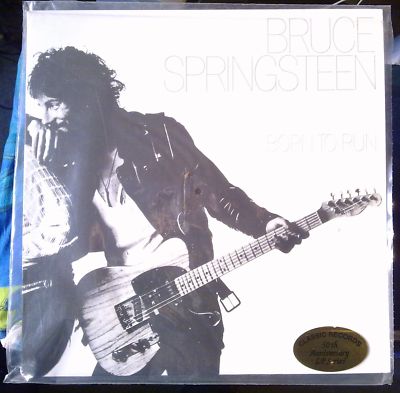
BRUCE SPRINGSTEEN - BORN TO RUN - NM/MINT - 180 Gram CLASSIC RECORDS -Vinyl LP
£
33
$
44


Favourite Auctions
To save auctions to your favourites, please login
If you don't have an account, please register
Description
BRUCE SPRINGSTEEN
"BORN TO RUN"
US remastered 180gm Virgin Vinyl
'Classic Records 50th Anniversary LP Series'
Contrary to all the information found on the internet this version has a single sleeve with lyric/picture insert and not a Gatefold Sleeve
Vinyl LP
1975 original release vinyl LP on the COLUMBIA record label Cat n# PC 33795 Made in USA
Matrix / Runout: PC 33795 / CLASSIC A
Matrix / Runout: PC 33795 / CLASSIC B LEC Gateway
The album cover is in NM/MINT condition. no problems, the inner plain white poly lined sleeve is in NM condition it has a 40mm split on one side,the picture/lyric insert is in NM/MINT condition.
The vinyl itself is in NM/MINT condition, this LP has only been played once at the most AS NEW.
If you need anymore information and pictures please get in touch, thanks.
Sorry if the shipping charges seem a bit high, the reason being i use heavy/strong packaging
THIS IS AS GOOD EXAMPLE OF WELL LOOKED AFTER OLD LP RECORD
Full track list
Side One
1."Thunder Road" – 4:49
2."Tenth Avenue Freeze-Out" – 3:11
3."Night" – 3:00
4."Backstreets" – 6:30 .
Side Two
1."Born to Run" – 4:31
2."She's the One" – 4:30
3."Meeting Across the River" – 3:18
4."Jungleland" – 9:34 .
All songs were written by Bruce Springsteen .
The Band
The E Street Band
Bruce Springsteen – lead vocals, lead and rhythm guitars, harmonica, percussion
Roy Bittan – piano, Fender Rhodes, background vocals
Ernest "Boom" Carter – drums on "Born to Run"
Clarence Clemons – saxophones, tambourine, background vocals
Danny Federici – organ, glockenspiel on "Born to Run"
Suki Lahav – violin on "Jungleland"
David Sancious – piano, organ on "Born to Run"
Garry W. Tallent – bass guitar
Steven Van Zandt – background vocals on "Thunder Road", horn arrangements
Max Weinberg – drums
Additional musicians
Wayne Andre – trombone
Mike Appel – background vocals
Michael Brecker – tenor saxophone
Randy Brecker – trumpet, flugelhorn
Richard Davis – double bass
David Sanborn – baritone saxophone.
Born to Run was a critical and commercial success and became Springsteen's breakthrough album. It peaked at number three on the Billboard 200, eventually selling six million copies in the US by the year 2000. Two singles were released from the album: "Born to Run" and "Tenth Avenue Freeze-Out"; the first helped Springsteen to reach mainstream popularity. The tracks "Thunder Road" and "Jungleland" became staples of album-oriented rock radio and Springsteen concert high points. The album has been placed on several "best ever" lists and is listed in the Library of Congress' National Recording Registry of historic recordings.
On November 14, 2005, a "30th Anniversary" remaster of the album was released as a box set including two DVDs: a production diary film and a concert movie. Having been ranked number 18 on Rolling Stone's "The 500 Greatest Albums of All Time"[1], it is widely considered his magnum opus.
History
Springsteen began work on the album after touring in support of its previous album, The Wild, the Innocent and the E Street Shuffle, released in 1973. Given an enormous budget in a last-ditch effort at a commercially viable record, Springsteen became bogged down in the recording process while striving for a wall of sound production. But, fed by the release of an early mix of "Born to Run" to progressive rock radio, anticipation built toward the album's release. All in all the album took more than 14 months to record, with six months alone spent on the song "Born to Run" itself. During this time Springsteen battled with anger and frustration over the album, saying he heard "sounds in [his] head" that he could not explain to the others in the studio. During the process, Springsteen brought in Jon Landau to help with production. This was the beginning of the breakup of Springsteen's relationship with producer and manager Mike Appel, after which Landau assumed both roles.
Once released, Born to Run was a breakthrough hit and catapulted his career from a northeast regional act to an acclaimed national and worldwide recording artist. This was his first album to feature pianist Roy Bittan and drummer Max Weinberg (although David Sancious and Ernest "Boom" Carter played the piano and drums, respectively, on the title track). Born to Run was released to overwhelming critical acclaim which swiftly spiralled into hype. While his previous two albums, Greetings from Asbury Park, N.J. and The Wild, the Innocent & the E Street Shuffle, received good reviews, popular success had been scarce; Born to Run cemented Springsteen's reputation among critics and established his first mainstream fanbase.
The album is noted for its use of introductions to set the tone of each song (all of the record was composed on piano, not guitar), and for the Phil Spector-like "Wall of Sound" arrangements and production. Indeed, Springsteen has said that he wanted "Born to Run" to sound like "Roy Orbison singing Bob Dylan, produced by Spector." Most of the tracks were first recorded with a core rhythm section band comprising Springsteen, Weinberg, Bittan, and bassist Garry Tallent, with other members' contributions then added on.[2]
In terms of the original LP's sequencing, Springsteen eventually adopted a "four corners" approach, as the songs beginning each side ("Thunder Road", "Born to Run") were uplifting odes to escape, while the songs ending each side ("Backstreets", "Jungleland") were sad epics of loss, betrayal, and defeat. (Originally, he had planned to begin and end the album with alternative versions of "Thunder Road".)
Also, original pressings have "Meeting Across the River" billed as "The Heist." The original album cover has the title printed in a graffiti style font. These copies are very rare and considered to be the "holy grail" for Springsteen collectors.
Release and reception
The album's release was accompanied by a $250,000 promotional campaign by Columbia directed at both consumers and the music industry, making good use of Landau's "I saw rock 'n' roll's future—and its name is Bruce Springsteen" quote. With much publicity, Born to Run vaulted into the top 10 in its second week on the charts and soon went Gold. Time and Newsweek magazines put Springsteen on the cover in the same week (October 27, 1975) – in Time, Jay Cocks praised Springsteen, while the Newsweek article took a cynical look at the "next Dylan" hype that haunted Springsteen until his breakthrough. The question of hype became a story in itself as critics began wondering if Springsteen was for real or the product of record company promotion.[10][11]
Upset with Columbia's promotion department, Springsteen said the decision to label him as the "future of rock was a very big mistake and I would like to strangle the guy who thought that up." When Springsteen arrived for his first UK concert at the Hammersmith Odeon, he personally tore down the "Finally the world is ready for Bruce Springsteen" posters in the lobby and ordered that the buttons with "I have seen the future of rock 'n' roll at the Hammersmith Odeon" printed on them not be given out. Now fearing the hype might backfire, Columbia suspended all press interviews with Springsteen. When the hype died down, sales tapered off and the album was off the chart after 29 weeks. But the album had established a solid national fan base for Springsteen which he would build on with each subsequent release.
The album debuted on the Billboard album chart on September 13, 1975 at #84. The following week it made an impressive increase entering the top 10 at #8, then spent two weeks at #4, and finally, during the weeks of October 11 and October 18, Born to Run reached its peak position of #3.
Born to Run continued to be a strong catalog seller through the years, re-entering the Billboard chart in late 1980 after The River was released, and again after the blockbuster success of Born in the U.S.A., spending most of 1985 on the chart. It was certified triple-platinum by the Recording Industry Association of America in 1986, the first year in which pre-1976 releases were eligible for platinum and multi-platinum awards.
In 1987, Born to Run was ranked #8 by Rolling Stone in its "100 Best Albums of the Last Twenty Years"[12] and in 2003, in its "The 500 Greatest Albums of All Time" ranked Born to Run at number 18.[1] In 2001, the TV network VH1 named it the 27th-greatest album of all time,[13] and in 2003, it was ranked as the most popular album in the first Zagat Survey Music Guide.[14]
Born to Run is listed in the Library of Congress' National Recording Registry of historic recordings.[15]
In December 2005, U.S. Representative Frank Pallone (who represents Asbury Park) and 21 co-sponsors sponsored H.Res. 628, "Congratulating Bruce Springsteen of New Jersey on the 30th anniversary of his masterpiece record album 'Born to Run', and commending him on a career that has touched the lives of millions of Americans." In general, resolutions honoring native sons are passed with a simple voice vote. This bill, however, was referred to the House Committee on Education and the Workforce and died there.[16]
Live performance
Songs from Born To Run were performed live as early as mid-1974 and by 1975, all had made their way into his shows and (with the rare exception of "Meeting Across The River") continued to be a regular staple of Springsteen concerts on subsequent tours through 2009. Springsteen and the E Street Band performed Born to Run in its entirety and in order for the first time at a benefit performance at the Count Basie Theatre in Red Bank, NJ on May 7, 2008. It was again performed at their September 20, 2009 show at the United Center in Chicago, Illinois[17] as well as at two of the five shows at Giants Stadium in East Rutherford, New Jersey, on September 30 and October 8, 2009, and at several other cities on the Fall, 2009 tour.
Album cover
The photo shows Springsteen holding an electric guitar, a cross between a Fender Telecaster (body and pickups) and a Fender Esquire (neck), while leaning against saxophonist Clarence Clemons.[18] That image became famous as the cover art. "Other things happened," says Meola, "but when we saw the contact sheets, that one just sort of popped.[18] Instantly, we knew that was the shot." Ultra-thin lettering graced the mass-produced version: an unusual touch then; a design classic since.[18]
The Springsteen and Clemons cover pose has been imitated often, from Cheap Trick on the album Next Position Please, to Tom and Ray Magliozzi on the cover of the Car Talk compilation Born Not to Run: More Disrespectful Car Songs, to Kevin & Kell on a Sunday strip entitled "Born to Migrate" featuring Kevin Dewclaw as Bruce with a carrot and Kell Dewclaw as Clarence with a pile of bones, to Bert and the Cookie Monster on the cover of the Sesame Street album Born to Add.[18] It has also been used as the cover art for Frank Turner's cover of Thunder Road
BBC ReviewHis success, like that of this LP, will doubtless continue to run and run.
Lou Thomas 2007-04-18
.Born To Run’s eight songs run to less than 40 minutes in length, but comprise a whole as satisfying as a portion of exquisitely rich chocolate cake. It seems Springsteen truly went for broke in 1975 after his first two albums had been critically well-received but less so commercially. Music critic Jon Landau became his producer and joined Bruce with his E-Street band in the studio to make what remains a classic, honest musical expression of hope, dreams and survival.
The colossal wall of sound production would make Phil Spector proud. Clarence Clemons’ triumphant yet bittersweet saxophone wailing and Roy Bittan’s nagging piano riffs augment the tough Telecaster guitar sound, while chiming glockenspiel and Max Weinberg’s drumming cement the heady mix.
Lyrically, it’s a dramatic collection of blue-collar tales of love and making ends meet that could only come from New Jersey’s favourite son. He clearly took a few ideas from storytellers like Van Morrison and Bob Dylan but also forged his own uplifting style. In ''Meeting Across The River'', a street tale Lou Reed would be proud of, listeners can ponder on a great deluded hustler’s line: 'That two grand’s practically sitting here in my pocket.' ''Thunder Road'' meanwhile, is almost effortlessly cinematic. In two lines there’s imagery more striking than most songwriters can manage on a whole album: 'In the skeleton frames of burned-out Chevrolets… Your graduation gown lies in rags at their feet.' On the excellent title track familiar BS motifs are returned to, particularly running away and the allure of fast cars, 'Chrome-wheeled, fuel-injected and stepping out over the line…We gotta get out while we’re young.' Few tunesmiths can make a bad situation sound so good.
Like Ry Cooder, over a lengthy career the working-class NJ hero has proved himself to be a remarkably versatile operator. He’s taken on rootsy American folk material, written about 9/11 and, of course, had gargantuan commercial success with Born In The USA. Contemporary bands are never slow in praising him and his influence is still keenly felt. In songwriting terms alone Arcade Fire, REM and Mercury Rev have all clearly borrowed his ideas down the years and it’s unlikely they’ll be the last.
ROLLING STONE REVIEW
Bruce Springsteen spent everything he had — patience, energy, studio time, the physical endurance of his E Street Band — to ensure that his third album was a masterpiece. Springsteen's reputation as a perfectionist on record begins here: There are a dozen guitar overdubs on the title track alone. He was also spending money he didn't have. Engineer Jimmy Iovine had to hide the mounting recording bills from the Columbia paymasters. "The album became a monster," Springsteen told his biographer, Dave Marsh. "It just ate up everyone's life." But in making Born to Run, Springsteen was living out the central drama in the album's tenement-love operas ("Backstreets," "Jungleland") and gun-the-engine rock & roll ("Thunder Road," "Born to Run"): the fight to reconcile big dreams with crushing reality. He found it so hard to get on tape the sound in his head — the Jersey-bar dynamite of his live gigs, Phil Spector's Wagnerian grandeur, the heartbreaking melodrama of Roy Orbison's hits — that Springsteen nearly scrapped Born to Run for a straight-up concert album. But his make-or-break attention to detail — including the iconic cover photo of Springsteen leaning onto saxman Clarence Clemons, a perfect metaphor for Springsteen's brotherly reliance on the E Street Band — assured the integrity of Born to Run's success. In his determination to make a great album, Springsteen produced a timeless, inspiring record about the labors and glories of aspiring to greatness .
Thanks for taking the time to look at this auction
RECORD COLLECTOR GRADING SYSTEM
In order to assist everyone who buys and sells rare discs, Record Collector magazine has originated a set of standards for the condition
of second-hand records, cassettes and CDs. Anyone buying or selling records through the magazine must use our conditions to state what
amount of wear and tear the disc, its sleeve and/or contents have been subject to. The seven standard condition categories, and a description
of what each one means, are listed below:
MINT: The record itself is in brand new condition with no surface marks
or deterioration in sound quality. The cover and any extra items such
as the lyric sheet, booklet or poster are in perfect condition. Records
advertised as Sealed or Unplayed should be Mint.
EXCELLENT: The record shows some signs of having been played, but there
is very little lessening in sound quality. The cover and packaging
might have slight wear and/or creasing.
VERY GOOD: The record has obviously been played many times, but
displays no major deterioration in sound quality, despite noticeable
surface marks and the occasional light scratch. Normal wear and tear on
the cover or extra items, without any major defects, is acceptable.
GOOD: The record has been played so much that the sound quality has
noticeably deteriorated, perhaps with some distortion and mild
scratches. The cover and contents suffer from folding, scuffing of
edges, spine splits, discoloration, etc.
FAIR: The record is still just playable but has not been cared for
properly and displays considerable surface noise; it may even jump.
The cover and contents will be torn, stained and/or defaced.
POOR: The record will not play properly due to scratches, bad surface
noise, etc. The cover and contents will be badly damaged or partly
missing.
BAD: The record is unplayable or might even be broken, and is only of use as a collection-filler.
price rating