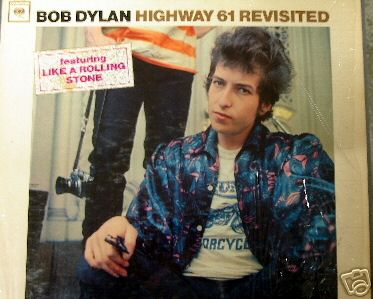
BOB DYLAN rare WLP White Label Promo HWY 61 MONO LP
$
357


Favourite Auctions
To save auctions to your favourites, please login
If you don't have an account, please register
Description
ARTIST: Bob Dylan
TITLE: Highway 61 revisited
LABEL: Columbia 2389
CONDITION: super clean VG disc (plays very well!), M- cover in shrink (w/ 'like a rolling stone' title sticker), just very slightly yellowed.
COMMENTS:
One of the most celebrated recordings in rock history, "Like A Rolling Stone" is a song directed at a woman who once lived a life of privilege but has now experienced a reversal in fortune. Soon after recording the master, Dylan cut a test pressing for his music publisher and played it for several friends. It made an immediate, strong impression. One early listener was producer Paul Rothchild, who said "I knew the song was a smash, and yet I was consumed with envy because it was the best thing I'd heard any of our crowd do and knew it was going to turn the tables on our nice, comfortable lives." Dylan's friend, Paul Nelson, was recording a folk album at the time, and upon hearing it, he thought, "Oh boy, this just makes what we did obsolete."
When the single was released, Paul McCartney recalls hearing it at John Lennon's house: "It seemed to go on and on forever. It was just beautiful ... He showed all of us that it was possible to go a little further." A very young Bruce Springsteen would hear the recording on WMCA while driving in a car with his mother: "That snare shot that [kicked it off] sounded like somebody'd kicked open the door to your mind." Frank Zappa later recalled, "When I heard 'Like A Rolling Stone,' I wanted to quit the music business, because I felt: 'If this wins and it does what it's supposed to do, I don't need to do anything else.' ... It sold, but nobody responded to it the way that they should have."
Robert Christgau described it as "the poor boy's put-down" while Clinton Heylin calls it "a truly vengeful song — on a level of misogyny even the Stones had yet to scale..." Salon.com critic Bill Wyman wrote that "Like a Rolling Stone" "portrays an entire youth generation as a slumming sorority girl — and that's just the first verse. Then he gets nasty: The rest of the song is the rock 'n' roll equivalent of one of those scenes in The Sopranos in which a mobster systematically kicks the bejesus out of someone who's already down. Is 'Like a Rolling Stone' the most powerful, difficult, unexpected and unrelenting performance in rock? Got another candidate?"
Some people claim that "Like A Rolling Stone" is a song about Edie Sedgwick, who was also linked to Andy Warhol But Dylan had written and recorded the song before meeting Sedgwick. Dylan was in conflict with Warhol, as he accused him of letting Sedgwick become addicted to heroin. This may suggest that Napoleon in rags refers exactly to Warhol.
"If Salvador Dalí or Luis Buñuel had picked up a Fender Strat to head a blues band, they might have come up with something like 'Tombstone Blues,'" writes critic Bill Janovitz. "Like the work of these surrealists, Dylan's song is rich with non sequiturs like 'The Commander-in-Chief answers him while chasing a fly / Saying, 'Death to all those who would whimper and cry' / And dropping a barbell he points to the sky / Saying, 'The sun's not yellow it's chicken',' and takes irreverent jabs at religious, political, and bureaucratic figures ('The ghost of Belle Starr she hands down her wits / To Jezebel the nun she violently knits / A bald wig for Jack the Ripper who sits/At the head of the chamber of commerce')."
In 1986, Dylan said that "Ballad of a Thin Man" was written "in response to people who ask questions all the time ... I figure a person's life speaks for itself, right? So every once in a while you gotta do this kinda thing — put somebody in their place ... This is my response to something that happened over in England, I think it was '63 or '64..." The song's lyrics are directed at a 'Mr. Jones,' whom NPR's Tim Riley describes as "a pedigreed archetype, a person to whom knowledge is a class distinction. ('You're very well read / It's well known.') As usual, there's more to it than that. When Dylan notes his pride in having read the complete F. Scott Fitzgerald, he's saying that the 1960's scene makes the Roaring Twenties look quaint ... 'Ballad of a Thin Man' taunts its subject so thoroughly it almost makes you sympathetic toward the poor scribe,"
On "Queen Jane Approximately," Dylan "sounds simultaneously condescending, self-righteous, sneering, contemptuous, and compassionate," writes Janovitz. "The narrator in the song ... seems to be warning someone of a great fall from grace, an awakening, as if he has either been through it all himself already or is just too smart to fall into such traps ('Now when all of the flower ladies want back what they have lent you / And the smell of their roses does not remain / And all of your children start to resent you / Won't you come see me, Queen Jane?')."
Wyman describes the song "Highway 61 Revisited" as possibly "Dylan's most disturbing composition, a tone poem of brutal capitalism, incest, biblical farce, warmongering and family entertainment, all set to a carnival beat that to this day gets his yuppie fans up to boogie at his live performances." Riley called it a "leering salute to America's heartland [that] goes after authority with a broad stroke, evoking his own father's name ('God said to Abraham, kill me a son / Abe said, 'Man, you must be puttin' me on")."
Janovitz calls "Just Like Tom Thumb's Blues" a "masterpiece ... For anyone else, its extravagant imagery and literary references would make it a sophisticated, comic tour de force...the singer comes in sounding tired and telling a tale about being lost in the rain in Juárez, Mexico, at Easter time ... [The singer] encounters shady women like Saint Annie and Sweet Melinda, as well as corrupt authorities ... drinks and drugs his way into helplessness, and having done so, declares ironically at the end, 'I'm going back to New York City / I do believe I've had enough.'" Like many songs on Highway 61 Revisited, "Just Like Tom Thumb's Blues" is overflowing with literary references, including images recalling Malcolm Lowry's novel Under the Volcano, a street name taken from Edgar Allan Poe's short story "The Murders in the Rue Morgue," and the title's reference to Rimbaud's "My Bohemian Life (Fantasy)," in which Rimbaud refers to himself as "Tom Thumb in a daze."
At the time, "Desolation Row" was arguably Dylan's most ambitious song and for many years his longest recording. Heylin describes it as an "eleven-minute voyage through a Kafkaesque world of gypsies, hoboes, thieves of fire, and historical characters beyond their rightful time."
Years after its release, Dave Marsh wrote that Highway 61 Revisited was one of Dylan's "best albums, and [one] of the greatest in the history of rock & roll." Subsequent polls in recent years prove that it remains a fixture in the rock pantheon. In 1995 Highway 61 Revisited was named the fifth greatest album of all time in a poll conducted by Mojo Magazine. In 1998 Q magazine readers voted Highway 61 Revisited the 57th greatest album of all time; in 2001 the TV network VH1 placed it at number 22. Then in 2003, Rolling Stone magazine placed it fourth on its list of the greatest albums of all time and named "Like a Rolling Stone" and "Highway 61 Revisited" the first and 364th greatest songs respectively.
Clinton Heylin wrote it was "an album that consolidated everything 'Like A Rolling Stone' (and Bringing It All Back Home) proffered ... an amalgamation of every strand in American popular music from 'Gypsy Davey' to the Philly Sound." Tim Riley said it was "the first Dylan record to posit protest as a way of life, a state of mind, something as psychologically bound as it is socially incumbent."
A massive influence on Dylan's contemporaries, it also coincided with greater commercial success as singles like "Like A Rolling Stone" and "Positively 4th Street" brought him to a wider audience. The controversy that ignited with Newport would continue to follow Dylan throughout 1965, but he had no intention in turning back.
Track listing
- "Like a Rolling Stone" – 6:09
- "Tombstone Blues" – 5:57
- "It Takes a Lot to Laugh, It Takes a Train to Cry" – 4:05
- "From a Buick 6" – 3:15
- "Ballad of a Thin Man" – 5:55
- "Queen Jane Approximately" – 5:28
- "Highway 61 Revisited" – 3:26
- "Just Like Tom Thumb's Blues" – 5:28
- "Desolation Row" – 11:21
Total running time: Approx. 51:04
Personnel
- Michael Bloomfield - Guitar
- Harvey Brooks aka Harvey Goldstein - Bass
- Bob Dylan - Guitar, Harmonica, Piano, Vocals, Liner notes, Police car
- Bobby Gregg - Drums
- Paul Griffin - Organ, Piano
- Al Kooper - Organ, Piano
- Sam Lay - Drums
- Charlie McCoy - Guitar.
- Frank Owens - Piano
- Russ Savakus - Bass
- Tom Wilson - Producer, "Like A Rolling Stone"
- Bob Johnston - Producer
CLICK HERE to check our other current auctions, and please bookmark us - many more rarities will be listed soon.
Also be sure to check our ebay store for over 110,000 LP's and 45's of all genres!
NOTE: We do not end auctions early, so please do not ask.
price rating