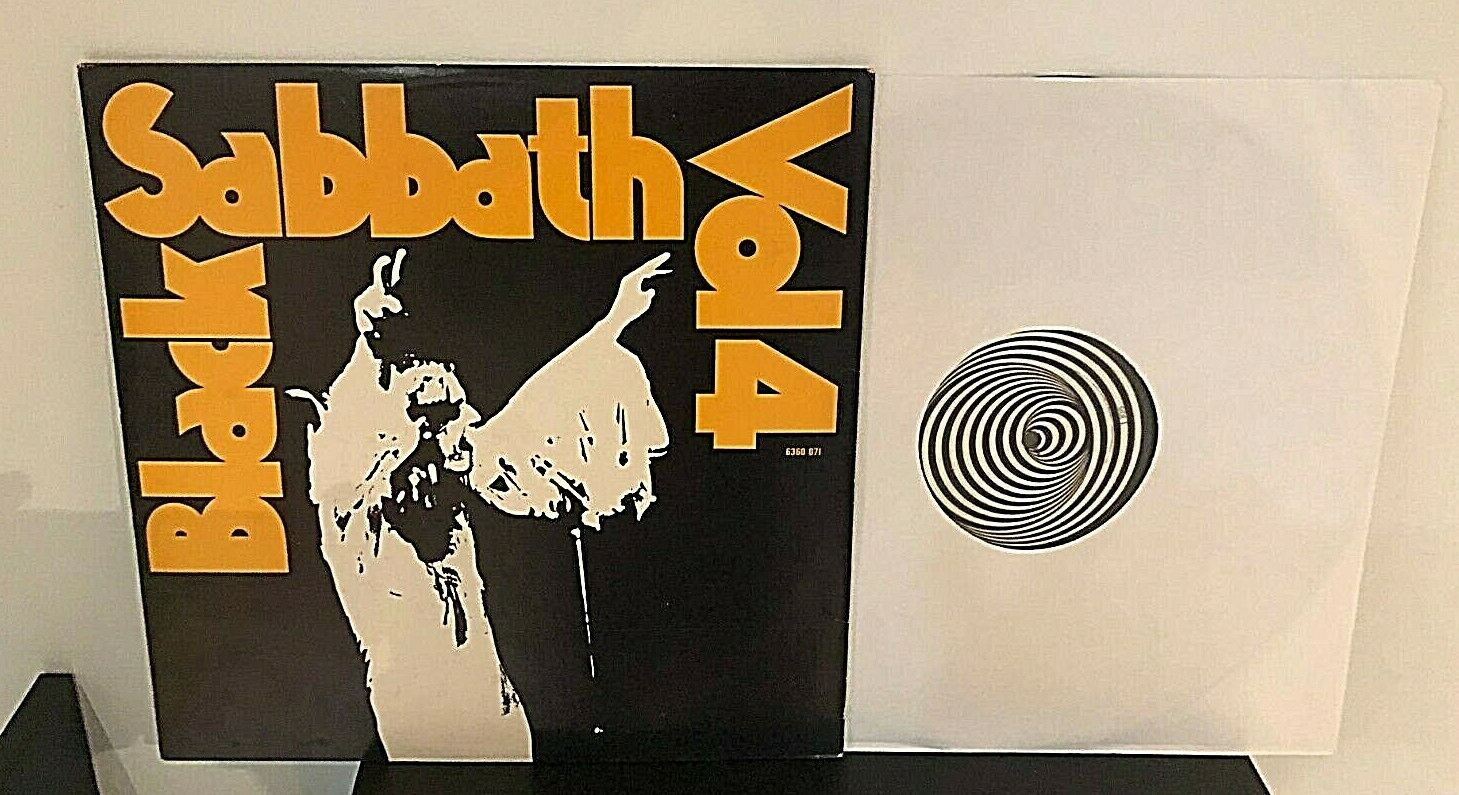
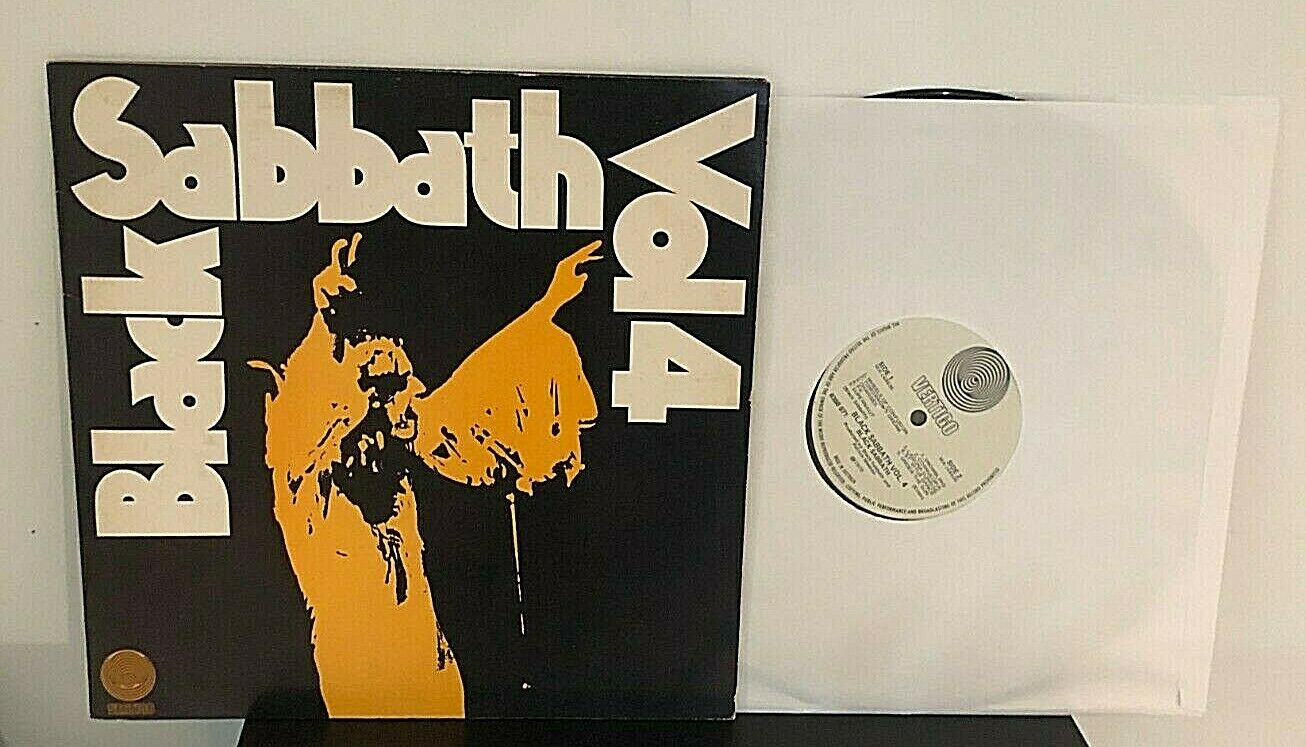
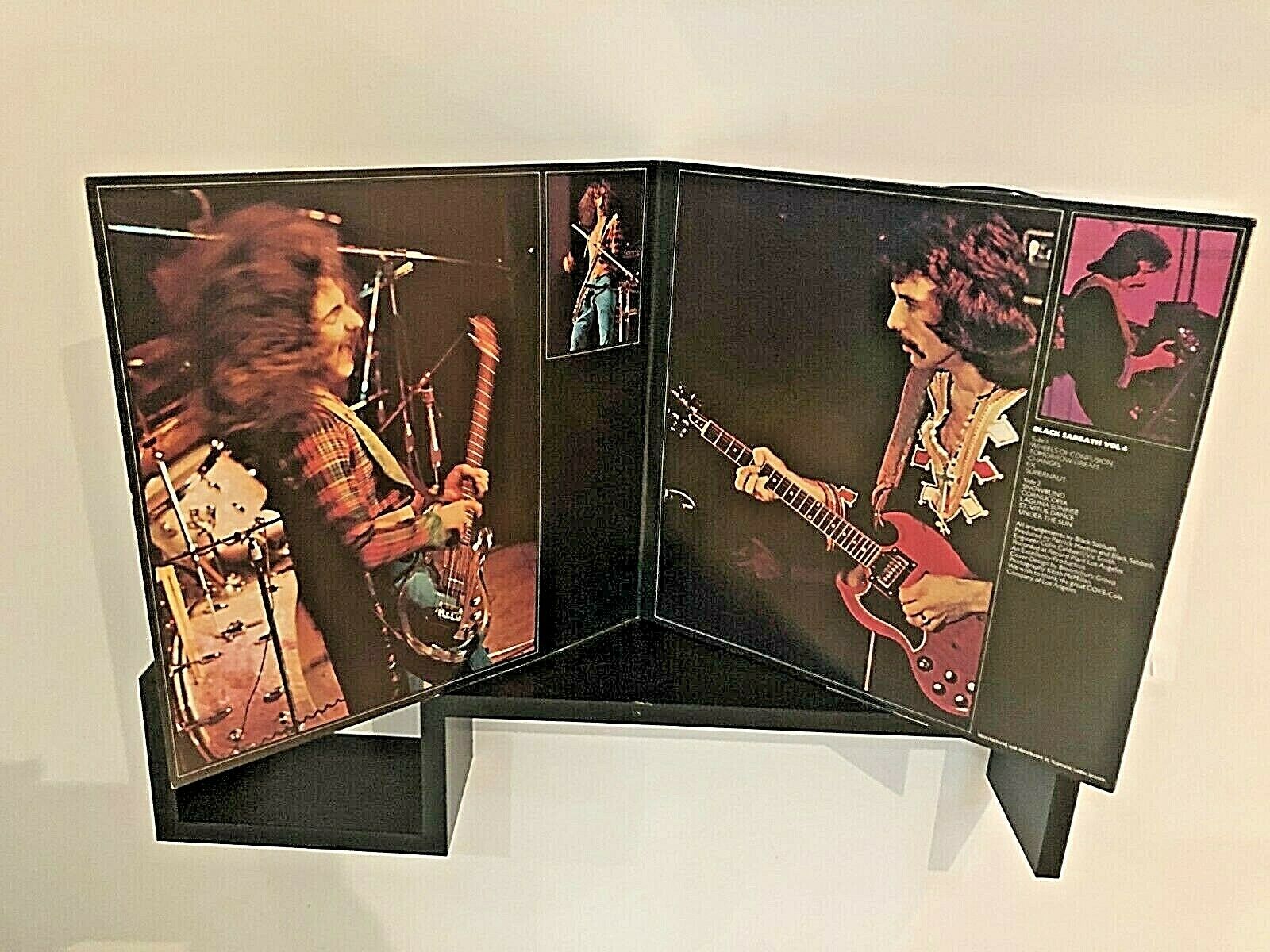
BLACK SABBATH VOL 4 VERTIGO SWIRL 1972 1ST PRESS NEAR MINT OZZY
$
101


$ 101
Sold For
Jun 8, 2020
Sold Date
Jun 1, 2020
Start Date
16
Number Of Bids
USA
Country Of Seller
eBay
Auctioned at
Favourite Auctions
To save auctions to your favourites, please login
If you don't have an account, please register
Description
Selling off my rare rock, prog rock and jazz records - check out my other auctions! All auctions start at $0.99
Black Sabbath - Vol. 4 Vertigo 6360 071 Original Pressing
Sleeve: VG+
Shows some signs of wear
Vinyl: NM
An incredible copy, shiny and clean
----
As it is, Vol. 4 is a curious result of the clash of two conflicting factors — Black Sabbath's desire to chart out new territories, and Black Sabbath's personal decline under the pressures of fame, fortune, and everything that went together with the rags-to-riches transformation, most notably, booze and drugs. There is no better track to illustrate that clash than ?FX?, a short non-musical interlude that walks the line between «avantgarde» and «coke-fueled stupidity» — apparently, Tony discovered that his crucifix could make a funny noise when accidentally hit against the guitar strings, and the band members then took turns hitting the strings with various objects and adding echo effects for extra giggly fun. Wheeee! (And no, there has been no positive evidence so far for Ozzy's ding-a-ling being one of the «various objects», but I wouldn't be surprised).
On a more serious note, Vol. 4 sees the addition of keyboards (used sparingly and all of them played by the band members themselves, although ?Changes? is pretty much all keyboards), elements of «soulful» soloing (such as the short intro to ?Wheels Of Confusion?), and even an actual orchestra (on ?Snowblind? and most prominently on the instrumental ?Laguna Sunrise?). Progress ahoy, but it comes at the expense of some of that earth-rumbling brutality: the «soul» component that suddenly appears out of nowhere takes the place of the «doom» component, and, above all, if you want to love Vol. 4, you have to have a little love for Ozzy, whose presence here is far more crucial than on Master Of Reality — no wonder they put him up on the album cover.
Riff-wise, Tony seems to be temporarily short on great ideas. This becomes obvious almost immediately: the main chord sequence that drives ?Wheels Of Confusion? is sort of a «basic» blues-rock pattern that carries little meaning in and out of itself (no «crashing waves» impressionism of ?Sweet Leaf? here). ?Cornucopia?, melody-wise, seems like a hybridization of Sabbath's own ?After Forever? with Cream's ?Politician? — not a good sign at all. The «boogie» mid-section of ?Under The Sun? unexpectedly rips off Deep Purple's ?Flight Of The Rat? — no big crime, but sort of a «telling» detail, I'd say.
And, finally, neither ?Tomorrow's Dream?, nor ?St. Vitus Dance? have ever managed to stick with me, the former sounding like a failed attempt to do something different with the «fat» psychedelic distorted guitar tone of Leslie West from Mountain, and the latter trying to glue together a «power-poppy» part with a colorful guitar merry-go-round and a generic metal part that, again, sounds like a re-stringing of several chord sequences from Paranoid and Master Of Reality. (Even so, I think the descriptions themselves suggest that at least they're trying to go in all these different directions).
The only song that is a total classic in all respects is ?Supernaut?, which has even managed to draw praise from Frank Zappa (one of the least likely persons you'd expect to go wild about a band like Black Sabbath). Its riff actually feels as if it should be played on a fiddle — there's a distinct Celtic folk dance flavor to it — but the psychedelic effect is even more strongly enhanced by Geezer's bass «zoops» on the verses, which go along pretty well with Ozzy's stated intention "to reach out and touch the sky". Throw in the mad percussion romp in the middle and the disorienting multi-layer solo guitar wobble overdubs, and the song becomes an exuberant celebration of self-exaltation, or something like that. As heavy as the riff is, ?Supernaut? is one of the happiest and proudest anthems in the band's history...
...but it is quite telling that, once ?Supernaut? finalizes Side A and you turn over the LP (well, that's how it used to be, kids), ?Snowblind? greets you with the flipside of that exuberance — it doesn't have a particularly great riff to match ?Supernaut?'s, but it has its own doom-laden atmosphere. "What you get and what you see / Things that don't come easily", Ozzy warns us from the outset, and pretty soon we get to the midsection, which (maybe unintentionally, but who really knows?) borrows some tragic coldness from the Beatles' ?She's So Heavy? with fantastic results: when Ozzy begins his "My eyes are blind but I can see..." part, it is not only the most touching moment on the entire album, but it is the first time ever that they have allowed to open the door to a bit of depressed sentimentalism, and it totally works — just a couple minutes ago, you were sharing the band's happiness, and now they work you up to share their despair. No contradiction there, either — heavy use of cocaine has its ups and downs.
To be perfectly accurate, depressed sentimentalism is all over ?Changes?, which comes before ?Snowblind? and, in defiance of the formulaic Sabbath image, is a soft piano ballad decorated with some Mellotron atmospherics in the background. But even though it was inspired by a real life event (Bill Ward's breakup with his wife), it is way too clichéd lyrically and too trivial melodically to qualify for heart-touching genius. It's not as if Ozzy cannot sing a romantic ballad (it might have come as a shock back in 1972, but he's done plenty of them quite convincingly since then) — it's just that, as a first-time experiment, the song feels about as stiff as the Rolling Stones' ?Tell Me? from 1964 (maybe even stiffer, since «formulaic sentimentalism» by the standards of 1972 would be judged far more sternly than by the standards of 1964). Some reviewer went as far as to call ?Changes? «the scariest thing about the album», but at least I like the Mellotron touch.
All in all, I'd never rate Vol. 4 as being on par with its three predecessors, but for the most part, it still works well enough to be consistently listenable. Even when the «meat» of the song is only so-so, it can still redeem itself in other respects — ?Wheels Of Confusion?, for instance, starts out fine with those several bars of soulful soloing, and fades out equally nobly, with a moody electric piano rhythm as the backdrop for another grand solo (which, by the way, reflects Tony's impressive progress a lead guitar player — ironically, the more his riff genius deteriorated, the better his knack for spirited blues-rock improvisation seemed to become). ?Under The Sun? may be ripping off Deep Purple, but its coda still manages to supply a properly bombastic, decisive conclusion to the album. A «transitional» effort, for sure — closing the book on the first chapter of the Sabbath story and already opening it on the second, «artsy» one — but still, at the very least, always intriguing and interesting, and occasionally brilliant, so a thumbs up is fully guaranteed even despite all the criticism.
Grading System:
MINT - Only an unplayed or sealed record gets this grade NM (Near Mint) - Shows very little sign of play with very minimal or no scratches EX (Excellent) - Close to near mint, but with more than one or two small scratches that do not impact play VG+ (Very Good+) - Only has hairline scratches that are not obtrusive, may play with some surface noise at parts VG (Very Good) - Has multiple hairline scratches of varying sizes, possibly a feel-able scratch that would impact play if noted G+ (Good plus) - Has many scratches, including feelable ones that impact play G (Good) - Never understood why this is called "good", a record with this grade is far from it. Many feelable scratches, possibly a skip P (Poor) - I typically do not auction records in this condition
Shipping:
US Shipping via Media Mail: $6.00 ($1 each additional record) Shipping to Canada via Canada Post (no customs fees): $13 ($2 each additional record) Worldwide shipping (untracked/uninsured): $19 ($5 each additional record) Worldwide shipping (tracked/insured): $27 ($7 each additional record)
Combined shipping is available.
price rating