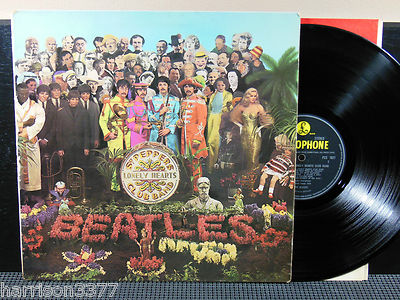
BEATLES Sgt Peppers Lonely Hearts Club Band PARLOPHONE PCS 7027 STEREO Orig UK
$
34


Favourite Auctions
To save auctions to your favourites, please login
If you don't have an account, please register
Description
Please see the photos!
The BEATLES Sgt. Pepper's Lonely Hearts Club Band!
Parlophone PCS-7027 Stereo!
Original LP Vinyl Record Album!
Upate soon...
Original analog sound - this is the original LP vinyl record, Not a CD or MP3!
Starting at one penny it's hard to lose!
Good luck!
All questions welcome.
Will combine shipping
click to see other auctions
Add to favoriteshttp://shop.ebay.com/harrison3377
eBay Mobile
On Jan-27-13 at 20:12:24 PST, seller added the following information:Original First Pressing U.K. - June 1967!
The original heavy vinyl weights about 145 grams.Rare!
The record was played once on a professional turntable & stylus with light weight.
As you already know this is a brilliant recording very well put together and a legend in it's own right. In part due to the quality recording techniques of the music and in part the high quality of this particular vinyl pressing created from the mother master by the prestigious UK Parlophone label in 1967, this record sounds Excellent!
The vinyl has nice gloss and looks VG+, very nice and clean with only some minor superficial surface marks a few light rubs or some very small ultra light surface scratch marks none of which are feel able or audible. The sound has excellent gain, loud and clear, and sounds excellent throughout. This is a very nice LP, especially for it's age and most likely due in part to the excellent quality. The vast majority of the LP sounds excellent! The majority of the audio is clean and "busy" or loud enough to drown out any background surface noise but in a few quite parts if you are listening for it very closely such as at the very end of side two at the fade out or in between some tracks, but very minor. Any surface tic or pop is very faint, infrequent and none (if you hear any) are obtrusive.The record is not perfect or brand new but very well made, well preserved, and the sound is warm, full, loud, and clear, as they intended when it was made more than 45 years ago. The sound is so good it is well worth recording and listening over and over again.
Trail off/ dead wax: Side 1: YEX-637-1 Side 2:YEX-638-1 KT Tax code on label.
NOTE: Unlike other versions out there this ORIGINAL pressing will literally play FOREVER.'
At the end of side 2, the trail off ends in a loop (COOL!) after the long fade, you will hear a crazy giggle, followed by some incomprehendable voices, a woman saying "lucy annie on the way"? with a man in the background that sounds like "a run tan taaaa" and ends with "bah" ( a third voice) that pans from one side to the other. Awesomely strange and innovative especially for the 1960's!
Produced by George Martin
Original first issue cover: Fully laminated flip back gatefold. includes mis-titled song: "A Little Help From My Friends"
The cover has some wear/ foxing mostly in the middle and lower parts of the spine and corners, a few creases and a piece has torn on the back and a couple of smaller pieces torn toward the bottom, there are some indentions made from writing also. The top and bottom seams are solid and firm and the inner gatefold looks very glossy, nice & clean with only a few very minor creases but very solid and flat for the most part looking inside out. The original inner sleeve is solid, flat, and firm with 2-3 inch middle split on one side and the bottom.
Cover Design: Peter Blake and Jann Haworth Printed and made by Garrod & Lofthouse Ltd
Songs:
1. Sgt. Pepper's Lonely Hearts Club Band
2. With A Little Help From My Friends
3. Lucy In The Sky With Diamonds
4. Getting Better
5. Fixing A Hole
6. She's Leaving Home
7. Being For The Benefit Of Mr. Kite
8. Within You, Without You
9. When I'm Sixty-Four
10. Lovely Rita
11. Good Morning, Good Morning
12. Sgt. Pepper's Lonely Hearts Club Band - Reprise
13. A Day In The Life
This article is about the 1967 album. For other uses, see Sgt. Pepper's Lonely Hearts Club Band (disambiguation). Sgt. Pepper's Lonely Hearts Club Band Studio album by The Beatles Released 1 June 1967 Recorded 6 December 1966 – 21 April 1967,
EMI and Regent Sound studios, London Genre Psychedelic rock,[1] baroque pop[2] Length 39:42 Label Parlophone (UK), Capitol (US) Producer George Martin The Beatles chronology Revolver
(1966) Sgt. Pepper's Lonely Hearts Club Band
(1967) The Beatles
(1968) The Beatles American chronology Revolver
(1966) Sgt. Pepper's Lonely Hearts Club Band
(1967) Magical Mystery Tour
(1967)
Sgt. Pepper's Lonely Hearts Club Band (often referred to simply as Sgt. Pepper's) is the eighth studio album by English rock band the Beatles. Released in June 1967, the album included songs such as "With a Little Help from My Friends", "Lucy in the Sky with Diamonds", and "A Day in the Life".
During the Sgt. Pepper's sessions, the group improved upon the quality of their music's production while exploring experimental recording techniques. Producer George Martin's innovative approach included the use of an orchestra. The songs on the album range from music hall, rock and roll and pop to traditional Indian music.[citation needed] Widely acclaimed and imitated, the album cover design by English pop artists Peter Blake and Jann Haworth, was inspired by a sketch by Paul McCartney that depicted the band posing in front of a collage of some of their favourite celebrities.
Sgt. Pepper's was a worldwide critical and commercial success, spending a total of 27 weeks at the top of the UK Album Chart and 15 weeks at number one on the US Billboard 200. A seminal work in the emerging psychedelic rock style, the album was critically acclaimed upon release and won four Grammy Awards in 1968. In 1994, it was ranked number one in the book All Time Top 1000 Albums. In 2005, the album was placed at number one on Rolling Stone magazine's list of "The 500 Greatest Albums of All Time". Sgt. Pepper is one of the world's best selling albums.
By late 1965, the Beatles had grown weary of touring, and by the end of their 1966 US tour they decided to retire from live performance.[3] Lennon commented: "We're fed up with making soft music for soft people, and we're fed up with playing for them too."[4] Upon their return to England, rumours began to circulate that the band had decided to break up.[5] They subsequently took an almost two-month vacation and individually became involved in their own interests. George Harrison travelled to India for six weeks to develop his sitar playing at the instruction of Ravi Shankar.[6] In 1966, McCartney and producer George Martin collaborated on a soundtrack for the filmThe Family Way.[7][nb 1] Also in 1966, John Lennon acted in How I Won the War, and he attended art showings, such as one at the Indica Gallery where he met his future wife Yoko Ono. Ringo Starr used the break to spend more time with his wife and first child.[6] In November, during a return flight to London from Kenya, where he had been on holiday with tour manager Mal Evans, McCartney had the creative idea that would first become a song, and would eventually inspire the Sgt Pepper's Lonely Heart's Club Band concept.[6] McCartney commented: "We did try performing some songs off [Revolver], but there were so many complicated overdubs we can't do them justice. Now we can record anything we want, and it won't matter. And what we want is to raise the bar a notch, to make our best album ever."[4]
[edit]Concept
When the Beatles had given up touring, Lennon said that they could "send out four waxworks ... and that would satisfy the crowds",[8] and McCartney later explained, "We were fed up with being the Beatles. We really hated that fucking four little mop-top approach. We were not boys, we were men ... and thought of ourselves as artists rather than just performers".[9] In early February McCartney had the idea of recording an album that would represent a performance by a fictitious band.[10] This alter ego group would give the band the freedom to experiment musically. McCartney explained: "I thought, let's not be ourselves. Let's develop alter egos ... it won't be us making all that sound, it won't be the Beatles, it'll be this other band, so we'll be able to lose our identities in this".[11] Martin wrote of the fictitious band concept: "'Sergeant Pepper' itself didn't appear until halfway through making the album. It was Paul's song, just an ordinary rock number ... but when we had finished it, Paul said, 'Why don't we make the album as though the Pepper band really existed, as though Sergeant Pepper was making the record? We'll dub in effects and things.' I loved the idea, and from that moment on it was as though Pepper had a life of its own".[12]
The album starts with the title song, which introduces Sgt. Pepper's band itself; this song segues into a sung introduction for bandleader "Billy Shears" (Starr), who performs "With a Little Help from My Friends". A reprise version of the title song appears on side two of the album just prior to the climactic "A Day in the Life", creating abookend effect. However, the band effectively abandoned the concept other than the first two songs and the reprise. Lennon was unequivocal in stating that the songs he wrote for the album had nothing to do with the Sgt. Pepper concept, and further noted that none of the other songs did either, saying "Every other song could have been on any other album".[13] In spite of Lennon's statements to the contrary, the album has been widely heralded as an early and groundbreaking example of the concept album.[14]
[edit]Production
The poster for Pablo Fanque's Circus Royal which inspired the lyrics for "Being for the Benefit of Mr. Kite!"The Beatles began sessions for the album in late November 1966 with a series of recordings that were to form an album thematically linked to their childhood.[15] The initial results of this effort produced "Strawberry Fields Forever", "When I'm Sixty-Four" and "Penny Lane". "Strawberry Fields Forever" and "Penny Lane" were released as a double A-sided single in February 1967 after EMI and Epstein pressured Martin for a single.[16] Once the single was released the childhood concept was abandoned in favour of Sgt. Pepper,[15] and in keeping with the group's usual practice, the single tracks were not included on the LP (a decision Martin states he now regrets).[17] They were released only as a single in the UK and Canada at the time, but were included as part of the American LP version of Magical Mystery Tour (which was issued as a six-track double EP in Britain). The Harrison composition "Only a Northern Song" was also recorded during the Sgt. Pepper sessions but did not see a release until the soundtrack album for the animated film Yellow Submarine, released in January 1969.
As EMI's premier act and the world's most successful rock group, the Beatles had almost unlimited access to Abbey Road Studios.[18] By 1967, all of the Sgt. Pepper tracks could be recorded at Abbey Road using mono, stereo and four-track recorders. Although eight-track tape recorders were already available in the US, the first eight-tracks were not operational in commercial studios in London until late 1967, shortly after the album was released. Like its predecessors, the recording made extensive use of the technique known as "bouncing down" (also known at that time as a "reduction mix"), in which a number of tracks were recorded across the four tracks of one recorder, which were then mixed and dubbed down onto one or several tracks of the master four-track machine. This enabled the Abbey Road engineers to give the group a virtual multi-trackstudio.[19]
New modular effects units were used, like the wah-wah pedal and fuzzbox, and running voices and instruments through a Leslie speaker. Several then-new production effects feature extensively on the recordings. One of the most important was automatic double tracking (ADT), a system that used tape recorders to create a simultaneous doubling of a sound. Although it had long been recognised that using multitrack tape to record "doubled" lead vocals produced a greatly enhanced sound, it had always been necessary to record such vocal tracks twice; a task which was both tedious and exacting. ADT was invented especially for the band by EMI engineer Ken Townsend in 1966, mainly at the behest of Lennon, who hated tracking sessions and regularly expressed a desire for a technical solution to the problem. ADT quickly became a near-universal recording practice in popular music. Martin, having fun at Lennon's expense, described the new technique to an inquisitive Lennon as a "double-bifurcated sploshing flange". The anecdote explains one variation of how the term "flanging" came to be associated with this recording effect.[20] Also important was varispeeding, the technique of recording various tracks on a multi-track tape at slightly different tape speeds, which was used extensively on their vocals in this period. The speeding up of vocals became a widespread technique in pop production. The band also used the effect on portions of their backing tracks (as on "Lucy in the Sky with Diamonds") to give them a "thicker" and more diffuse sound.
"Within You Without You" was recorded on 15 March with Harrison on vocals, sitar and tambura; the other instruments (tabla, dilruba, swarmandel, and an additional tambura) were played by four London-based Indian musicians. None of the other Beatles participated in the recording.[21] For the 17 March recording of "She's Leaving Home", McCartney hired Mike Leander to arrange the string section as Martin was occupied producing one of his other artists, Cilla Black.[22]
The lyrics for Lennon's song "Being for the Benefit of Mr. Kite!", were adapted from a Victorian circus poster for Pablo Fanque's circus, which Lennon had bought at an antique shop in Kent on the day of filming the promotional clip for "Strawberry Fields Forever" there. The sound collage was created by Martin and his engineers, who collected recordings of calliopes and fairground organs, which were then cut into strips of various lengths, thrown into a box, mixed up and edited together in random order, creating a long loop which was mixed in during final production.
This album also makes heavy use of keyboard instruments: a grand piano is used on tracks such as "A Day in the Life", a Lowrey organ is used for "Lucy in the Sky with Diamonds", a harpsichord can be heard on "Fixing a Hole", and Martin played a harmonium on "Being for the Benefit of Mr. Kite!". An electric piano, upright piano, Hammond organ and glockenspiel can also be heard on the record. Harrison used a tambura on several tracks, including "Lucy in the Sky with Diamonds" and "Getting Better".
The thunderous piano chord that concludes "A Day in the Life", and the album, was produced by assembling three grand pianos in the studio and playing an E chord on each simultaneously. Together on cue, Lennon, Starr, McCartney and assistant Mal Evans hammered the keys on the assembled pianos and held down the chord. The sound from the pianos was then mixed up with compression and increasing gain on the volume to draw out the sound to maximum sustain.[23]
British pressings of the album (in its original LP form that was later released on CD), end with a 15-kilohertz high-frequency tone (put on the album at Lennon's suggestion and said to be "especially intended to annoy your dog"), followed by an endless loop of laughter and gibberish made by the run-out groove looping back into itself. The loop (but not the tone) made its US debut on the 1980 Rarities compilation, titled "Sgt. Pepper Inner Groove". However, it is only featured as a two-second fragment at the end of side two rather than an actual loop in the run-out groove. The CD version of "Sgt. Pepper Inner Groove" is actually a bit shorter than that one found on the original UK vinyl pressing. The sound in the loop caused some controversy when it was interpreted as a secret message. McCartney later told his biographer Barry Miles that in the summer of 1967 a group of kids came up to him complaining about a lewd message hidden in it when played backwards. He told them, "You're wrong, it's actually just 'It really couldn't be any other'". He took them to his house to play the record backwards to them, and it turned out that the passage sounded to him very much like "We'll fuck you like Superman". McCartney recounted to Miles that "we had certainly had not intended to do that but probably when you turn anything backwards it sounds like something ... if you look hard enough you can make something out of anything".[17] When the album was remastered for LP release in 2012, it took several attempts to successfully reproduce the run-out groove effect.[24]
[edit]Lyrics
Concerns that lyrics in Sgt. Pepper referred to recreational drug use led to several songs from the album being banned by the BBC. The album's closing track, "A Day in the Life", includes the phrase "I'd love to turn you on". The BBC banned the song from airplay on the basis of this line, claiming it could "encourage a permissive attitude toward drug-taking". Both Lennon and McCartney denied any drug-related interpretation of the song at the time,[25] although McCartney's later comments in The Beatles Anthology documentary regarding the writing of the lyric make it clear that the drug reference was indeed deliberate.
"Lucy in the Sky with Diamonds" also became the subject of speculation regarding its meaning, as many believed that the words of the chorus were code for LSD. The BBC used this as their basis for banning the song from British radio. Again, Lennon consistently denied this interpretation of the song, maintaining that the song describes a surreal dreamscape inspired by a picture drawn by his son Julian.[26] However, during a newspaper interview in 2004, McCartney was quoted as saying:[27]
'Lucy in the Sky,' that's pretty obvious. There's others that make subtle hints about drugs, but, you know, it's easy to overestimate the influence of drugs ... Just about everyone was doing drugs in one form or another and we were no different, but the writing was too important for us to mess it up by getting off our heads all the time. — Paul McCartneyAt other times, though, McCartney seems to have contradicted himself. "When [Martin] was doing his TV program on Pepper," McCartney is quoted as saying, "he asked me, 'Do you know what caused Pepper?' I said, 'In one word, George, drugs. Pot.' And George said, 'No, no. But you weren't on it all the time.' 'Yes, we were.' Sgt. Pepper was a drug album." [28]
[edit]Cover artwork
Further information: List of images on the cover of Sgt. Pepper's Lonely Hearts Club Band The gatefoldThe Grammy Award-winning album packaging was art-directed by Robert Fraser, designed by Peter Blake andJann Haworth, his wife and artistic partner, and photographed by Michael Cooper. It featured a colourful collage of life-sized cardboard models of famous people on the front of the album cover and the lyrics printed in full on the back cover, the first time this had been done on a rock LP.[29] In the guise of the Sgt. Pepper band, the Beatles were dressed in custom-made military-style outfits made of satin dyed in day-glo colours. The suits were designed by Manuel Cuevas.[30] Among the insignia on their uniforms are: MBE medals on McCartney's and Harrison's jackets, the Royal Coat of Arms of the United Kingdom on Lennon's right sleeve and an Ontario Provincial Police flash on McCartney's sleeve.
The inner sleeveIn the centre of the cover, the Beatles stand behind a drum on which are painted the words of the album's title; the drum was painted by fairground artist Joe Ephgrave.[31] The collage depicted around 60 famous people, including writers, musicians, film stars, and (at Harrison's request) a number of Indian gurus. The final grouping included Marlene Dietrich, Carl Gustav Jung, W.C. Fields,Diana Dors, Bob Dylan, Issy Bonn, Marilyn Monroe, Aldous Huxley, Karlheinz Stockhausen, Sigmund Freud, Aleister Crowley,T. E. Lawrence, Lewis Carroll, Edgar Allan Poe, Karl Marx, Sir Robert Peel, Oscar Wilde, H. G. Wells, Marlon Brando, Stan Laurel and Oliver Hardy, and Lenny Bruce.[32] Also included was the image of the original Beatles' bassist, the late Stuart Sutcliffe. Pete Best said in a later NPR interview that Lennon borrowed family medals from his (Best's) mother Mona for the shoot, on condition that he did not lose them. Adolf Hitler and Jesus Christ were requested by Lennon, but ultimately they were left out.[33] A photo also exists of a rejected cardboard printout with a cloth draped over its head; its identity is unknown. The final cost for the cover art was nearly £3,000 (equivalent to £40,606 today) an extravagant sum for a time when album covers would typically cost around £50.[34]
[edit]Reception
Professional ratings Review scores Source Rating Allmusic [35] Robert Christgau A[36] Crawdaddy! [37] The Daily Telegraph [38] Encyclopedia of Popular Music [39] Pitchfork Media 10/10[40] Rolling Stone favourable[41] The Rolling Stone Album Guide(2004) [42] The Rolling Stone Record Guide(1979) [43] Sputnikmusic 5/5[44]Upon its release on 1 June 1967,[45] Sgt. Pepper received both popular and critical acclaim.[46] The album was a global hit, with huge sales in Europe, North and South America, Africa, Japan, Australia, and even in the black market in the Soviet Union, where their albums were very popular and widely available.[47] Various reviews appearing in the mainstream press and trade publications throughout June 1967, immediately after the album's release, were generally positive. In The Times, prominent critic Kenneth Tynan described Sgt. Pepper as "a decisive moment in the history of Western civilisation".[48]Richard Poirier wrote "listening to the Sgt. Pepper album one thinks not simply of the history of popular music but the history of this century."[49]
In a negative review, Richard Goldstein of The New York Times found the album "spoiled. It reeks of horns and harps, harmonica quartets, assorted animal noises, and a 41-piece orchestra", and added that it was an "album of special effects, dazzling but ultimately fraudulent".[50] Having received a negative reaction for this review,[51] he published a response a month later, writing that the album is "better than 80 per cent of the music around today; it is the other 20 per cent (including the best of the Beatles' past performances) which worries me as a critic." He also called it an "in-between experience, a chic ..." and "When the slicks and tricks of production on this album no longer seem unusual, and the compositions are stripped to their musical and lyrical essentials, Sergeant Pepper will be Beatles baroque—an elaboration without improvement ..."[52] Robert Christgau of The Village Voice wrote in an article at the time that the album is "a consolidation, more intricate than Revolver but not more substantial. Part of Goldstein's mistake, I think, has been to allow all the filters and reverbs and orchestral effects and overdubs to deafen him to the stuff underneath, which was pretty nice, and to fall victim to overanticipation."[51]
Christgau later gave it an "A" in a 1977 retrospective on 1967 for Creem, and stated, "A dozen good songs and true. Perhaps they're too precisely performed, but I'm not going to complain."[36] In a 1987 review for Q, Charles Shaar Murray commented that the album "remains a central pillar of the mythology and iconography of the late '60s."[53] In his Encyclopedia of Popular Music, Colin Larkin wrote that the album "turned out to be no mere pop album but a cultural icon embracing the constituent elements of the 60s' youth culture: pop art, garish fashion, drugs, instant mysticism and freedom from parental control."[39]
Frank Zappa, whose Freak Out! was cited as an influence on the album,[54][55] accused the group of co-opting the flower power aesthetic for monetary gain, saying in aRolling Stone article that he felt "they were only in it for the money".[56] That criticism later became the title of the Mothers of Invention album (We're Only in It for the Money), which mocked Sgt. Pepper with a similar album cover.[citation needed] In April 1967, Brian Wilson (who was suffering growing mental problems) was deeply affected by hearing a tape of the song "A Day in the Life", which McCartney played to him in Los Angeles. Soon after, Smile was abandoned, and Wilson would not return to complete it until 2003. Van Dyke Parks later said, "Brian had a nervous collapse. What broke his heart was Sgt. Pepper."[57] Within days of its release, Jimi Hendrixbegan to perform the title track in concert, first for an audience that included Harrison and McCartney, who were greatly impressed by his unique version of their song and his ability to learn it so quickly.[58]
The chart performance of the album was similarly exceptional. In the UK it debuted at number eight and the next week reached number one where it stayed for 23 consecutive weeks. It was knocked off the top by The Sound of Music on the week ending 18 November 1967. Eventually it spent more weeks at the top, including the competitive Christmas week. When the CD edition was released on 1 June 1987, it reached number 3. In June 1992, the CD was re-promoted to commemorate its 25th Anniversary, and charted at number six. In 2007, commemorating 40 years of its release, Sgt. Pepper again re-entered the charts at number 47 in the UK. In all, the album spent a total of 201 weeks on the UK charts, and is the second biggest-selling album in UK chart history behind Queen's Greatest Hits.[59][60] Sgt. Pepper won theGrammy Award for Album of the Year, the first rock album to do so, and Best Contemporary Album in 1968. Sgt. Pepper is one of the world's best selling albums, with 11 million RIAA certified copies sold in the US.[61] The album won Best British Album at the first Brit Awards in 1977.
[edit]Legacy
Sgt. Pepper has been named on many lists of the best rock albums. In 1997 Sgt. Pepper was named the number one greatest album of all time in a "Music of the Millennium" poll conducted by HMV, Channel 4, The Guardian and Classic FM. In 1998 Q magazine readers placed it at number seven, while in 2003 the TV network VH1placed it at number 10.[62] In 2005, the album was ranked number 1 on Rolling Stone magazine's list of the 500 greatest albums of all time. The publisher called it "the most important rock & roll album ever made ... by the greatest rock & roll group of all time."[63] In 2006, the album was chosen by Time magazine as one of the 100 best albums of all time.[64] In 2002, Q magazine placed it at number 13 in its list of the 100 Greatest British Albums Ever.[65] The album was named as one of Classic Rockmagazine's "50 Albums That Built Prog Rock".[66] In 2003, it was one of 50 recordings chosen by the Library of Congress to be added to the National Recording Registry.[67] In July 2008 the "iconic bass drum skin" used on the front cover sold at auction for €670,000 (US$879,000).[68] In November 2009, the entire album was made available to download for The Beatles: Rock Band on the Xbox 360, PlayStation 3 and Wii. The game disc already had the album's title track, "With a Little Help from My Friends", "Lucy in the Sky with Diamonds", "Getting Better" and "Good Morning Good Morning"; the download provides the remaining tracks from the album.
[edit]Tributes
Sgt. Pepper has inspired a number of tribute albums, such as NME's Sgt. Pepper Knew My Father in 1988.[69] In 2008, celebrating the 40th anniversary of the album's release, rock pioneer and long-time associate of Starr, Todd Rundgren headlined a live performance tour of Sgt. Pepper featuring an all star cast. In the show were formerWings member Denny Laine, former American Idol Bo Bice, Foreigner vocalist Lou Gramm, and Grammy Award winner Christopher Cross.[70] The American rock bandCheap Trick performed the entire Sgt. Pepper album live in New York and released the live recording in both CD and DVD formats in September 2009, with all proceeds benefiting prostate cancer research. This recording was engineered by Geoff Emerick, the original engineer for the Sgt. Pepper album. In April 2009, the reggae groupEasy Star All-Stars released a dub reggae tribute cover of Sgt. Pepper, Easy Star's Lonely Hearts Dub Band. Sgt. Pepper's Lonely Hearts Club Band, a feature film based on the album and other Beatles songs, was released in 1978.
[edit]Awards
Grammy AwardsNominated for seven Grammys in 1968, it won four, including Album of the Year, the first rock album to receive this honour.
Year Winner Award 1968 Sgt. Pepper's Lonely Hearts Club Band Album of the Year 1968 Sgt. Pepper's Lonely Hearts Club Band Best Album Cover, Graphic Arts 1968 Sgt. Pepper's Lonely Hearts Club Band Best Engineered Recording, Non-Classical 1968 Sgt. Pepper's Lonely Hearts Club Band Contemporary Album Grammy Award nominations Year Nominee Award 1968 Sgt. Pepper's Lonely Hearts Club Band Group Vocal Performance 1968 Sgt. Pepper's Lonely Hearts Club Band Contemporary Vocal Group 1968 "A Day in the Life" Best Instrumental Arrangement Accompanying Vocalist(s)[edit]Planned television film
On 10 February 1967, during the orchestral recording sessions for "A Day in the Life", six cameramen filmed the chaotic events with the purpose of using the footage for a planned but unfinished Sgt. Pepper television special. The TV special was to have been written by Ian Dallas and directed by Keith Green. The shooting schedule included all the songs from the album set to music video style scenes: for example, "Within You Without You" scenes would have been set throughout offices, factories and elevators. There were even production numbers planned involving "meter maids" and "rockers". Although production was cancelled, the "A Day in the Life" footage was edited down with stock footage into a finished clip.[71] This clip was not released to the public until the Lennon documentary Imagine: John Lennon was released in 1988. A more complete version was later aired in The Beatles Anthology documentary. In 1992, an hour-long feature produced by London Weekend Television called The Making of Sgt. Pepper was aired, and featured George Martin, the three surviving Beatles and Neil Aspinall discussing the album and the songs, with George Martin running through the tapes, similar in fashion to VH1's Classic Albums documentaries.
[edit]Track listing
Sgt. Pepper was the first Beatles album to be released with identical track listings in the UK and the US.[72] The American release did not originally contain the side two runout groove and inner groove sound effects that were restored for the worldwide CD issue, released on 1 June 1987.
All songs written and composed by Lennon–McCartney except where noted.
Side one No. Title Lead vocals Length 1. "Sgt. Pepper's Lonely Hearts Club Band" McCartney 2:02 2. "With a Little Help from My Friends" Starr 2:44 3. "Lucy in the Sky with Diamonds" Lennon 3:28 4. "Getting Better" McCartney 2:48 5. "Fixing a Hole" McCartney 2:36 6. "She's Leaving Home" McCartney with Lennon[nb 2] 3:35 7. "Being for the Benefit of Mr. Kite!" Lennon 2:37 Side two No. Title Lead vocals Length 1. "Within You Without You" (George Harrison) Harrison 5:04 2. "When I'm Sixty-Four" McCartney 2:37 3. "Lovely Rita" McCartney 2:42 4. "Good Morning Good Morning" Lennon 2:41 5. "Sgt. Pepper's Lonely Hearts Club Band (Reprise)" Lennon, McCartney and Harrison[nb 3] 1:19 6. "A Day in the Life" Lennon and McCartney 5:39Track list information according to Graham Calkin, Mark Lewisohn and Ian MacDonald.[77][75][78]
[edit]Personnel
According to Mark Lewisohn[23] and Alan W. Pollack[79]
The Beatles- John Lennon – lead, harmony and background vocals; lead, rhythm and acoustic guitars; piano and Hammond organ; harmonica, tape loops, sound effects and comb and tissue paper; handclaps, tambourine and maracas
- Paul McCartney – lead, harmony and background vocals; lead and bass guitars; piano, Lowrey and Hammond organs; handclaps; vocalizations, tape loops, sound effects and comb and tissue paper
- George Harrison – lead, rhythm and acoustic guitars; sitar; lead, harmony and background vocals; tamboura; harmonica and kazoo; handclaps and maracas
- Ringo Starr – drums, congas, tambourine, maracas, handclaps and tubular bells; lead vocals; harmonica; final piano E chord
- Neil Aspinall – tamboura and harmonica
- Geoff Emerick – recording and mixing engineer; tape loops and sound effects
- Mal Evans – counting, alarm clock and final piano E chord
- Matthew Deyell – tambourine
- George Martin – producer and mixer; tape loops and sound effects; harpsichord (on "Fixing a Hole"), harmonium, Lowrey organ and glockenspiel (on "Being for the Benefit of Mr. Kite!"), Hammond organ (on "With a Little Help from My Friends"), and piano (on "Getting Better" and the solo in "Lovely Rita"); final harmonium chord.
- Session musicians – four French horns (on "Sgt. Pepper's Lonely Hearts Club Band"), (Neil Sanders, James W. Buck, John Burden, Tony Randall),[80] arranged and conducted by Martin and McCartney; string section and harp (on "She's Leaving Home"), arranged by Mike Leander and conducted by Martin; harmonium, tabla, sitar,dilruba, eight violins and four cellos (on "Within You, Without You"), arranged and conducted by Harrison and Martin; clarinet trio (on "When I'm Sixty Four"), as arranged and conducted by Martin and McCartney; saxophone sextet (on "Good Morning, Good Morning"), arranged and conducted by Martin and Lennon; and forty-piece orchestra (strings, brass, woodwinds and percussion) (on "A Day in the Life"), arranged by Martin, Lennon and McCartney and conducted by Martin and McCartney
[edit]Charts
Chart (1967) Peakposition Australian Albums Chart 1 Norwegian Albums Chart[81] 1 UK Albums Chart[82] 1 US Billboard 200[83] 1 Chart (2009) Peak
position Australian Albums Chart[84] 16 Brazilian Albums Chart[85] 20 Finnish Albums Chart[86] 9 Italian Albums Chart[87] 9 Mexican Albums Chart[88] 13 Norwegian Albums Chart[89] 31 Portuguese Albums Chart[90] 4 Spanish Albums Chart[91] 22 New Zealand Albums Chart[92] 12 UK Albums Chart[93] 5 US Billboard 200[94] 114
The album entered the UK Albums Chart on 3 June 1967 and remained there for 201 weeks.[citation needed] In the US the album stayed in the Billboard 200 chart for 175 weeks. It remained at number one in the US for 15 weeks, longer than any other Beatles album released in the US during the sixties.[citation needed]
[edit]Certifications
Region Certification Sales/shipments Argentina (CAPIF)[95] 2× Platinum 120,000x Argentina (CAPIF)[95]1987 CD issue 3× Platinum 180,000x Australia (ARIA)[96] 4× Platinum 280,000^ Brazil (ABPD)[97] Gold 100,000* Canada (Music Canada)[98] 8× Platinum 800,000^ Germany (BVMI)[99] Platinum 500,000^ New Zealand (RIANZ)[100] 6× Platinum 90,000^ United Kingdom 5,045,000[101] United States (RIAA)[102] 11× Platinum 11,000,000^
*sales figures based on certification alone
^shipments figures based on certification alone
[edit]
http://en.wikipedia.org/wiki/Sgt._Pepper's_Lonely_Hearts_Club_Band
On Jan-27-13 at 20:31:06 PST, seller added the following information:RECORD looks and sounds VG+!
price rating