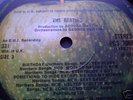
BEATLES STEREO BUTCHER COVER 3STATE EXCELLENT CONDITION
€
310
$
360


Favourite Auctions
To save auctions to your favourites, please login
If you don't have an account, please register
Description
LOOK MY OTHER SIGNED, AUTOGRAPH IN EBAY
Hola amigos, voy a poner a la venta en ebay diversos lp, 7", 12", cd, memorabillia, signed... en los proximos dias.
Estos articulos han sido obtenidos y coleccionados durante 30 años. Espero que os gusten y mucha suere en las pujas, un saludo.
Hello friends, I am going to on sale put in ebay lp, 7 ", 12 ", CD, memorabillia, signed… in the next days diverse.
These articles have been obtained and collected during 30 years. I hope that you like and much suere in you bid up them, a greeting
The "Butcher cover"
In early 1966, photographer Robert Whitaker had the Beatles in the studio for a conceptual art piece entitled "A Somnambulant Adventure." For the shoot, Whitaker took a series of pictures of the group dressed in butcher smocks and draped with pieces of meat and body parts from plastic baby dolls. The group played along as they were tired of the usual photo shoots and the concept was compatible with their own "black humour".[5] Although not originally intended as an album cover, the Beatles submitted photographs from the session for their promotional materials. According to a 2002 interview published in Mojo magazine, former Capitol president Alan W. Livingston stated that it was Paul McCartney who pushed strongly for the photo's inclusion as the album cover, and that McCartney reportedly described it as "our comment on the war".[8] A photograph of the band smiling amid the mock carnage was used as promotional advertisements for the British release of the "Paperback Writer" single. Also, a similar photograph from this shoot was used for the cover of the 11 June 1966 edition of the British music magazine Disc.[9]
In the United States, Capitol Records printed approximately 750,000 copies of Yesterday and Today with the same photograph as "Paperback Writer".[9] They were assembled in Capitol's four US plants situated in different cities: Los Angeles, California; Scranton, Pennsylvania; Winchester, Virginia; and Jacksonville, Illinois. Numbers designating where the covers originated were printed near the RIAA symbol on the back; for example, stereo copies from the Los Angeles plant are designated "5" and mono Los Angeles copies are marked "6". Mono copies outnumbered stereo copies by about 10 to 1, making the stereo copies far more rare and valuable to collectors. A small fraction of the original covers were shipped to disc jockeys and store managers as advance copies. Reaction was immediate, as Capitol received complaints from some dealers. The record was immediately recalled under orders from Capitol parent company EMI chairman Sir Joseph Lockwood[10] and all copies were ordered shipped back to the record label, leading to its rarity and popularity among collectors. It has been substantiated that the record was indeed for sale in some stores, including Wallich's Music City in Hollywood and some Sears stores, in limited areas and probably for only one day.[11]
Capitol initially ordered plant managers to destroy the covers, and the Jacksonville plant delivered most of its copies to a landfill. However, faced with so many jackets already printed, Capitol decided instead to paste a much more conventional cover over the old ones. The new cover, featuring a picture of a less-than-content band posed around an open steamer trunk, had to be trimmed on the open end by about 1/8 inch because the new sheet, known as a "slick", was not placed exactly "square" on top of the original cover. Tens of thousands of these so-called "Trunk" covers were sent out. As word of this manoeuvre became known to the public, owners of the altered cover attempted, usually unsuccessfully, to peel off the pasted-over cover, hoping to reveal the original image hidden beneath. Eventually, the soaring value and desirability of unpasted-over Butcher covers spurred the development of intricate and complex techniques for peeling the Trunk cover off in such a way that only faint horizontal glue lines remained on the original cover.
Copies that have never had the white cover pasted onto them, known as "first state" covers, are very rare and command the highest prices. Copies with the pasted-on cover intact above the butcher image are known as "second state" or "pasteovers"; today, pasteover covers that have remained unpeeled are also becoming increasingly rare and valuable. Covers that have had the Trunk cover removed to reveal the underlying butcher image are known as "third state" covers; these are now the most common (and least valuable, although their value varies depending on how well the cover is removed) as people continue to peel second state covers. The most valuable and highly prized First and Second State Butcher Covers are those that were never opened and remain still sealed in their original shrink wrap. Since the first documented collector's sale of a mono Butcher cover LP in 1974, which fetched US$457.00, the value of first state mono versions has consistently appreciated by around 100% per year[12].
In 1987, former president of Capitol Records, Alan Livingston released for sale twenty-four "first state" butcher covers from his private collection. When the original cover was scrapped in June 1966, Livingston took a case of already-sealed "Butcher" albums from the warehouse before they were to be pasted over with the new covers, and kept them in a closet at his home. These albums were first offered for sale at a Beatles convention at the Marriott Hotel near Los Angeles International Airport on Thanksgiving weekend 1987 by Livingston's son. These still-sealed pristine items, which included nineteen mono and five stereo versions, are the very rarest "pedigree" specimen "Butcher Covers" in existence. These so-called "Livingston Butchers" today command premium prices among collectors, the five stereo versions being the most rare and valuable of these. In April 2006, Heritage Auction Galleries sold one of the sealed mono "Livingston Butchers" at auction in Dallas for about $39,000.[13]
An extremely rare original "first state" stereo copy that was not from the Livingstone collection was presented for appraisal at a 2003 Chicago taping of the PBS series Antiques Roadshow. It was still in the possession of the original owner, who had bought it at Sears & Roebuck on the day of release in 1966, the only day that the original Butcher cover versions were on sale before being recalled by Capitol. Although not in its original shrink-wrap, it had rarely been played and was still in excellent condition, and Roadshow appraiser Gary Sohmers valued it at US$10,000 - $12,000[14].
RIAA #5 IN BACK COVER
COVER - VINYL - LETTER LP ULTRA RARE
IN EXCELLENT CONDITIONCOMBINATED SHIPPING
1LP-12" SPAIN-7EUROS, EUROPE-12EUROS, WORLD-15EUROS CERTIFICATED
1 CD-7" SPAIN-4EUROS, EUROPE-9EUROS, WORLD-12EUROS CERTIFICATED
PAYPAL, TRANSFER BANK, MONEY IN CERTIFICATED LETTER.
price rating