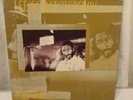
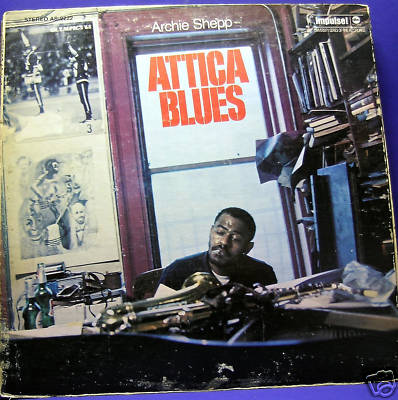
Archie Shepp "Attica Blues" Impulse LP 1972
$
27


Favourite Auctions
To save auctions to your favourites, please login
If you don't have an account, please register
Description
Archie Shepp "Attica Blues" Impulse LP 1972
Label: Impulse AS-9222 Stereo
Condition
Record: NM- (Play Grade)
Jacket: VG+ gatefold, slight signs of general wear front & back, taped bottom seam (back), clean inside
About This Artist
Archie Shepp has been at various times a feared firebrand and radical, soulful throwback and contemplative veteran. He was viewed in the '60s as perhaps the most articulate and disturbing member of the free generation, a published playwright willing to speak on the record in unsparing, explicit fashion about social injustice and the anger and rage he felt.
His tenor sax solos were searing, harsh, and unrelenting, played with a vivid intensity. But in the '70s, Shepp employed a fatback/swing-based R&B approach, and in the '80s he mixed straight bebop, ballads, and blues pieces displaying little of the fury and fire from his earlier days. Shepp studied dramatic literature at Goddard College, earning his degree in 1959. He played alto sax in dance bands and sought theatrical work in New York. But Shepp switched to tenor, playing in several free jazz bands. He worked with Cecil Taylor, co-led groups with Bill Dixon and played in the New York Contemporary Five with Don Cherry and John Tchicai. He led his own bands in the mid-'60s with Roswell Rudd, Bobby Hutcherson, Beaver Harris, and Grachan Moncur III.
His Impulse albums included poetry readings and quotes from James Baldwin and Malcolm X. Shepp's releases sought to paint an aural picture of African-American life, and included compositions based on incidents like Attica or folk sayings. He also produced plays in New York, among them The Communist in 1965 and Lady Day: A Musical Tragedy in 1972 with trumpeter/composer Cal Massey.
But starting in the late '60s, the rhetoric was toned down and the anger began to disappear from Shepp's albums. He substituted a more celebratory, and at times reflective attitude. Shepp turned to academia in the late '60s, teaching at SUNY in Buffalo, then the University of Massachusetts. He was named an associate professor there in 1978. Shepp toured and recorded extensively in Europe during the '80s, cutting some fine albums with Horace Parlan, Niels-Henning Ørsted Pedersen, and Jasper van't Hof. Shepp continued to tour and record throughout the '90s and '00s. Moving from provocative free-jazz icon in his youth to elder jazz journeyman in his latter years, Shepp has appeared on a variety of labels over the years including Impulse, Byg, Arista/Freedom, Phonogram, Steeplechase, Denon, Enja, EPM, and Soul Note. Ron Wynn, Scott Yanow/AMG
About This Record
Refining his large-ensemble experiments of 1971, Attica Blues is one of Archie Shepp's most significant post-'60s statements, recorded just several months after authorities ended the Attica prison uprising by massacring 43 inmates and hostages. Perhaps because Shepp's musical interests were changing, Attica Blues isn't the all-out blast of rage one might expect; instead, it's a richly arranged album of mournful, quietly agonized blues and Ellingtonian swing, mixed with a couple of storming funk burners.
Of course, Shepp doesn't quite play it straight, bringing his avant-garde sensibilities to both vintage big band and contemporary funk, with little regard for the boundaries separating them all. His soloing on tenor and soprano is typically sharp-edged and modal, and his nasal, slicing tone on soprano is featured quite heavily.
The stylishness of the slow numbers is undercut with quivering, faintly unsettling dissonances, and the up-tempo funk cuts recall the way Sly Stone's arrangements ping-ponged many different elements off each other in a gleeful organized chaos. That's especially true on the gospel-inflected title song, a monster of a groove that later became a hit on the acid jazz revival circuit (and stands up to anything recorded by straight-up funk bands of the era).
In the same vein, "Blues for Brother George Jackson" sounds like an edgier Isaac Hayes-style blaxploitation soundtrack cut. Vocal ballads are plentiful, and Joe Lee Wilson ("Steam," a song Shepp would return to often) and Carl Hall (aka Henry Hull) both acquit themselves well; more debatable are the poetic recitations and the choice of flügelhornist/composer Cal Massey's young daughter Waheeda to sing "Quiet Dawn" (although Waheeda's almost-there intonation is effectively creepy). Still, in the end, Attica Blues is one of Shepp's most successful large-group projects, because his skillful handling of so many different styles of black music produces such tremendously groovy results. Steve Huey/AMG
Personnel
Archie Shepp, tenor & soprano saxes with 31-piece band and six singers
Tracks
Side 1: Attica Blues 4:49, Invocation: Attica Blues 0:18, Steam (part 1) 5:08, Invocation To Mr. Parker 3:17, Steam (part 2) 5:10
Side 2: Blues For Brother George Jackson 4:00, Invocation: Ballad For A Child 3:37, Good Bye Sweet Pops 4:23, Quiet Dawn 6:12
Check out our other items! - a great mix of rare jazz you won't want to miss
Be sure to add us to your favorites list!
About Shipping
Domestic
Charges calculated based on 1 of 2 USPS services - Media Mail and Priority Mail.
Media Mail generally takes 7 days to reach destination, but can take less time when destinations are located closest to the shipper's state - Pennsylvania.
Priority Mail takes 2-3 days to reach most destinations in the Continental US.
Single LP via First Class $7.00
Single LP via Media Mail $4.00
Single CD or 45rpm via First Class Mail $4.00
All shipping charges based on prevailing USPS rates at the time of shipment.
International
Shipping charges shown as a general guide and should be calculated based on shipping service selected (Airmail) and ultimate ‘ship to’ destination.
Shipment of multiple
Shipment of multiple records should be calculated based on package weight. Here's a general guide:
1 LP 2 lbs (USPS shipped weight) 2 LPs 3 lbs 3 LPs 4 lbs 4 LPs 5 lbs 5 LPs 6 lbs etc. (approximate)
PLEASE NOTE: Cost to ship single LP via Air Mail: $13.00 (UK/Europe), $16.00 (Japan/Far East/South America), $10.00 (Canada) – reaches most destinations within week to 10 days.
Insured Items – please read: USPS stipulates that insured items shipped by Air to overseas destinations must be sent via Air Parcel Post only. Approximate cost to ship items by Air Parcel Post is roughly twice that of Air Letter Post - $18.00 (European destinations) $25.00 (Far East destinations).
The cost to ship a single LP via Economy Mail (surface) is approximately $7.00, but can take as long as 10 weeks to reach certain destinations, depending on the level of inspections carried out by Customs Authorities at receiving ports – not recommended.
Single CD or 45rpm record via Air Letter Mail - $7.50 (UK/Europe), $10.00 (Japan/Far East), $8.00 (South America), $6.00 (Canada)
price rating