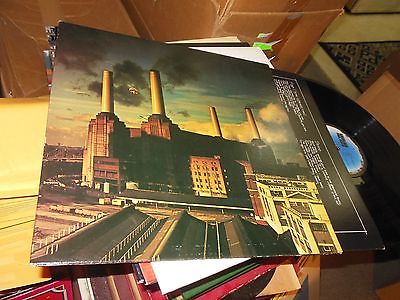
Animals - Pink Floyd LP GATEFOLD w BARCODE
$
28


Favourite Auctions
To save auctions to your favourites, please login
If you don't have an account, please register
Description
LP NM
Jacket NM-
Artist Biography by Stephen Thomas Erlewine
Some bands turn into shorthand for a certain sound or style, and Pink Floydbelongs among that elite group. The very name connotes something specific: an elastic, echoing, mind-bending sound that evokes the chasms of space.Pink Floyd grounded that limitless sound with exacting explorations of mundane matters of ego, mind, memory, and heart, touching upon madness, alienation, narcissism, and society on their concept albums of the '70s. Of these concept albums, Dark Side of the Moon resonated strongest, earning new audiences year after year, decade after a decade, and its longevity makes sense. That 1973 concept album distilled the wild psychedelia of their early years -- that brief, heady period when they were fronted by Syd Barrett -- into a slow, sculpted, widescreen epic masterminded by Roger Waters, the bassist who was the band's de facto leader in the '70s. Waters fueled the band's golden years, conceiving such epics as Wish You Were Here and The Wall, but the band survived his departure in the '80s, with guitarist David Gilmourstepping to forefront on A Momentary Lapse of Reason and The Division Bell. Throughout the years, drummer Nick Mason and keyboardist Rick Wright appeared in some capacity, and the band's sonic signature was always evident: a wide, expansive sound that was instantly recognizable as their own yet was adopted by all manner of bands, from guitar-worshipping metal-heads to freaky, hippie, ambient electronic duos. Unlike almost any of their peers, Pink Floydplayed to both sides of the aisle: they were rooted in the blues but their heart belonged to the future, a dichotomy that made them a quintessentially modern 20th century band. That blues influence, quickly sublimated and only surfacing on the occasional Gilmour guitar solo, was the foundation for the band's very name, as the group decided to splice the names of two old bluesmen -- Pink Anderson and Floyd Council -- as a tribute to the American music they loved so. These members of the early Floyd -- guitarist/singer Syd Barrett, bassistRoger Waters, keyboardist Rick Wright, and drummer Nick Mason -- were all architecture students at London Polytechnic, with the exception of Barrett, who was an art student and a friend of Waters since childhood. This version of the band started gigging regularly in 1965, with Barrett becoming the group's lead singer quite quickly. During this time, the group relied on blues and R&B covers, not unlike many of their British peers, but they wound up extending the time of their sets through extended instrumental jams, planting the seeds of space rock that would come to fruition not much later. During 1966, the group's increasingly adventurous sets became something of a sensation in the London underground, leading to a contract with EMI early in 1967. Their first single, "Arnold Layne," backed with "Candy and a Currant Bun," appeared in March of 1967, and it was banned from some radio stations due to its gender-bending lyrics, but the single wound up in the U.K. Top 20 and the group's second single, "See Emily Play" -- a menacing, mincing stomp with a profound, lasting influence -- went into the Top 10, paving the way for the release ofThe Piper at the Gates of Dawn. On their full-length LP, Pink Floyd veered toward the experimental and avant-garde, particularly on the elastic, largely instrumental vamps "Astronomy Domine" and "Interstellar Overdrive," resulting in an album that had a significant influence not only upon its release but well beyond. It was also a hit in the U.K., reaching number six on the British charts.This was a sudden rush to stardom and complications arose nearly as quickly. Not long after the release of Piper,Barrett began showing clear signs of mental illness, to the point he would often freeze on-stage, not playing a note. At this point, David Gilmour -- a friend and associate of the band -- was brought in as a second guitarist, with the intention that he'd buttress the group's live performances while Barrett continued to write and record new material. This soon proved to be an impossible situation, and Barrett left the group, at which point the band's management also jumped ship, leaving the band without any kind of leader.
In the wake of Barrett's departure, the remaining members of Pink Floyddeveloped a different musical identity, one that was expansive and eerie, characterized by the band's spacy, somber explorations and, eventually,Waters' cutting, sardonic lyrics. This transition took some time. In 1968, they released A Saucerful of Secrets, which contained Barrett's final composition for the group "Jugband Blues" and found the group moving forward, particularly on the instrumental sections. A Saucerful of Secretsalso saw the group begin a long, fruitful collaboration with Storm Thorgerson's design team Hipgnosis; they'd wind up designing many iconic album covers for the band, including Dark Side of the Moon and Wish You Were Here. Hipgnosis emphasized album art, and albums are where Pink Floyd concentrated from this point forward. After the soundtrack to More, the group moved to EMI's progressive rock imprint Harvest and became the label's flagship artist beginning with the 1969 double-LP Ummagumma. Divided between live performances and experimental compositions from each member, the record wound up in the Top 10 in Britain and sowed the seeds of a cult following in the United States. Pink Floyd's next album, Atom Heart Mother, featured extensive contributions from composer Ron Geesin and wound up as the band's first number one album in the U.K.. The band embarked on an extensive supporting tour for the album and when they returned they delved even further into studio experimentation, learning the contours of the studio. Their next studio album, 1971's Meddle, bore the fruit from this labor, as did 1972's Obscured by Clouds, which was effectively a soundtrack to Barbet Schroeder's film La Vallee. All the experiments of the early '70s were consolidated on their 1973 album Dark Side of the Moon, an album for which there simply was no precedent in their catalog. Deepening their music while sharpening their songwriting, Floyd created a complex, luxurious album with infinite space and depth. Partially helped by the single "Money," it was an immediate success, reaching number one on the U.S. Billboard charts and peaking at number 2 in the U.K., but what was striking was its longevity. Dark Side of the Moon found space on the Billboard charts and then it just stayed there, week after week for years -- a total of 741 weeks in all (once it finally dropped off the charts, Billboard began the Catalog charts, where Dark Side was a fixture as well). Dark Side of the Moon was a staple on classic rock radio but it also was a rite of passage, an album passed down to teenagers when they were turning to serious music, and it was an album that stayed with listeners as they aged. Now established superstars, Pink Floyd dug deep on Wish You Were Here, their 1975 sequel to Dark Side of the Moon which functioned as an album-long tribute to Syd Barrett. Compared to Dark Side, Wish You Were Herewasn't quite a blockbuster but it was certainly a hit, debuting at number one in the U.K. and reaching that peak in the U.S., as well. Floyd continued to tour steadily, often working out new material on the road. This is particularly true of 1977's Animals, which had its roots in several songs aired during the 1975 tour. During the Animals tour, Waters had a difficult experience with a Montreal crowd where he spit on a heckler, and he used this incident as the genesis for 1979's rock opera The Wall. Co-produced by Bob Ezrin, The Wallmay be Floyd's most ambitious album, telling a semi-autobiographical story about a damaged rock star, and it's one of the band's most successful records, topping the charts throughout the '80s and turning into a pop music perennial along the lines of Dark Side. Part of its success in 1980 was due to "Another Brick in the Wall, Pt 2," where an instrumental motif from the album was given a disco beat and an anti-authoritarian spin, leading to a genuine number one hit single from a band. Certainly, the single had more to do with the album's success than the live production of the album, as Pink Floyd only did a handful of dates in major cities. Nevertheless these shows, consisting of a wall being built across the stage during the first act and the band performing behind it during the second, were legendary (Waters would revive and update the production years later to great success). Pink Floyd did attempt to film The Wall for a documentary film, but the footage was botched, so they decided to pursue a feature film directed by Alan Parker and featuring Boomtown Rat Bob Geldof in the lead role. The Wallarrived in theaters in 1982 and turned into a midnight movie staple. A year later, The Final Cut -- a further autobiographical work from Waters, its title a sly dig to his battles with Parker on the film -- arrived and it didn't come close to matching the chart success of any of its predecessors. Behind the scenes, things were tense. Rick Wright had been fired during the making of The Wall-- he was hired as a contract player during the recording and tour -- andWaters split after the release of The Final Cut, assuming that it was the end of the band. Waters released his debut solo album The Pros and Cons of Hitchhiking -- a piece that was pitched to Floyd in 1978, but the band chose The Wall instead -- in 1984 and not long afterward, Gilmour and Mason indicated they intended to carry on as Pink Floyd, so the bassist sued the duo for the rights to the Pink Floyd name. Waters lost and Pink Floyd released A Momentary Lapse of Reason in 1987, just months after Roger released his own Radio KAOS. Bad blood was evident -- t-shirts on Waters' tour bore the question, "Which One's Pink?," an old lyric that now had greater resonance -- but Pink Floyd emerged victorious, as A Momentary Lapse of Reason turned into an international hit, and along with it racked up some hit singles, including "Learning to Fly" which was supported by the band's first music video. Most importantly, the band racked up significant box office returns on tour, playing to sold-out stadiums across the globe. This tour was documented on the Delicate Sound of Thunder live album. The success of A Momentary Lapse of Reason allowed Pink Floyd to dictate their own schedule and they took their time to return with a new album, eventually emerging in 1994 with The Division Bell. Greeted by warmer reviews than its predecessor, The Division Bell was another international success, and the accompanying tour -- which featured a performance of the entirety of The Dark Side of the Moon -- was a smash success. As before, the tour was documented with a live album -- this one was called Pulse, packaged in an eye-catching artwork with a pulsing LED light -- and it performed respectably. After that, Pink Floyd went into effective retirement. The group was inducted to the Rock & Roll Hall of Fame in 1996, whileGilmour released some solo albums, including the acclaimed On an Island, but most of their efforts were devoted to managing their catalog. Long a beloved band of audiophiles, the group saw their catalog boxed and remastered several times, including 5.1 mixes on SACD in the early 2000s.As the new millennium progressed, a détente between the Floyd and Waters camps, culminating in an unexpected reunion of the original lineup of Waters, Gilmour, Mason, and Wright at the 2005 charity concert Live 8. The reunion was a rousing success, sparking rumors of a more permanent arrangement, but Gilmour declined. Instead, Watersramped up his touring -- he performed Dark Side in its entirety, then turned his attention to The Wall, touring that for years; Gilmour and Mason wound up appearing at a 2011 show in London, signaling that there was no ill will between the members. Barrett passed in 2006 from cancer and in 2008, Wright also died from the disease. In 2011, Pink Floyd launched an ambitious reissue project called Why Pink Floyd…? spearheaded by multi-disc, rarity-laden box set reissues of Dark Side of the Moon, Wish You Were Here, and The Wall; among the newly released exclusives was the original Alan Parsons mix of Dark Side, heavily bootlegged live tracks like "Raving and Drooling," and demos. Pink Floyd brought its catalog to the Spotify streaming music service in 2013.
All Lps are sight graded
Note: I Do Not Grade inner sleeves, If these are Important to you then you may e-mail me)
RECORD GRADING Based On Goldmine Grading Standards:
Near Mint (NM): A nearly perfect record. There may be one or two small inaudible defects. The record should show no obvious signs of wear. A 45 RPM or EP sleeve should have no more than the most minor defects, such as almost invisible ring wear or other sights of slight handling. An LP jacket should have no creases, folds, seam splits or any other noticeable similar defect. No cut-out holes, either.
Near Mint Minus (NM-): A record that should play mint but has a few slight visible marks. The album will have as much luster as an NM, there just may be some superficial scuffs from the sleeve or very light hairlines that shouldn't be audible. An NM- album cover subjectively fits somewhere in between VG+ and NM.
Very Good Plus (VG+): A Very Good Plus record will show some signs that it was played and otherwise handled by a previous owner who took good care of it. Record surfaces may show some slight signs of wear and may have slight scuffs or very light scratches that don t significantly affect play. Slight warps that do not affect the sound are OK. The label may have some ring wear or discoloration, but it should be barely noticeable. The center hole will not have been misshapen by repeated play. 45 Picture sleeves will have some slight wear, lightly turned-up corners, or a slight seam-split. An LP jacket may have slight signs of wear also and may be marred by a cut-out hole, indentation or corner indicating it was taken out of print and sold at a discount.
Very Good (VG): Many of the defects found in a VG+ record will be more pronounced in a VG disc. Surface noise will be evident upon playing, especially in soft passages and during a song s intro and fade, but will not overpower the music otherwise. Groove wear will start to be noticeable, as will light scratches (deep enough to feel with a fingernail) that will affect the sound. Labels may be marred by writing, or have tape or stickers (or their residue) attached. The same will be true of picture sleeves or LP covers. However, it will not have all of these problems at the same time, just two or three of them.
Good (G), Good Plus (G+): Good does not mean Bad! A record in Good or Good Plus condition can be put onto a turntable and will play though without skipping. But it will have significant surface noise and scratches and visible groove wear. A jacket or sleeve will have seam splits, especially at the bottom or on the spine. Tape, writing, ring wear or other defects will start to overwhelm the subject.
Poor (P), Fair (F): Below good. imperfections will be described.
Please check out my other items for sale. (I offer shipping discounts) I'll Be adding More Daily except for Friday and Saturday.
ALLSHIPPING PRICES ARE FINAL
additional items are 1.50 per item up to 6 within USA (if you are bidding on multiple items lots I have in one listing. you pay each shipping total added together)
Priorty shipping is available e-mail for total
Please Do A One Time payment for combined shipping on all all items won. Request a Final invoice if I have not already combined them for you
NOTE: Gatefold Lps Count as 2 Lps when shipping out of the country
SHIPPING TO CANADA Multiple LP Shipping Rates In USD
1 LP 11.50
2. Lps 13.00
3 Lps 15.00
4 Lps 17.00
5 Lps 26.00
6 Lps 29.00
Multiple Shipping Rates SHIPPING TO Rest Of The World Outside USA in USD
Note: Gatefold Lps Count as 2 Lps
1 LP 17.25
2 LP 20.00
3. Lps 26.50
4 Lps 30.00
5 Lps 48.00 (price jump becuse weight usually takes it to priority mail rate)
6 Lps 51.00
7 Lps 54.00
8 LPs 58.00
9 Lps 61.00
10 Lps 64.00
11 Lps 67.00
12 Lps 70.00
The MAN has to get his cut so Texas residents must add 8.25 % Sales Tax
If you are unsure about shipping costs please do not hesitate to e-mail me.
QUESTIONS:? Please ask. That is what I am here for. (I may not get to them if you wait close to an item's ending.)
MORE PICTURES? Just ask and I'll send them to you
MEDIA MAIL: is not recommended for rare items. Priority mail is faster and safer.
I leave feedback after item arrives and it is left for me. (It's easier to keep up with that way) Please limit your feedback comments to things within the realm of my responsibility.
Thank you for reading all of this :-)
price rating



![Paramore – Re: This Is Why [VINYL, NEW]](https://www.popsike.com/php/thumbnail.php?url=https://www.popsike.pics/pix/20240422/296383901020.jpg)