8/7/87 LEGENDARY DJ MIKE HARRISON ALBUM ROCK CONNECTIONS LOST BUT NOT FORGOTTEN
$
29


Favourite Auctions
To save auctions to your favourites, please login
If you don't have an account, please register
Description
HI BOYS AND GIRLS!
DO YOU ENJOY CLASSIC ROCK SPECIALS?
PRESENTED BY ONE OF ROCK'S MOST INFLUENTIAL DJs, MIKE HARRISON
WHO IN A LIMITED SUMMER MEMORIAL DAY TO LABOR DAY SERIES DEVOTED TO THE HISTORY OF CLASSIC ROCK WAS SO POPULAR THAT THE SHOW WAS EXTENDED AGAIN AND AGAIN, FINALLY ENDING AFTER 72 SHOWS.
NOT BAD FOR A 11 OR 12 SHOW COMMITMENT!
AS THE LEGENDARY L.A. COP JOE FRIDAY OFTEN SAID ON THE 50's SHOW 'DRAGNET' 'ALL WE WANT ARE THE FACTS, MA'AM'
WHICH LATER BECAME 'JUST THE FACTS, MA'AM' AFTER THE HUGE STAN FREBERG MULTI MILLION SELLER (IN ITS FIRST TWO WEEKS AFTER BEING RELEASED) 'ST GEORGE AND THE DRAGONET' "JUST THE FACTS, MA'M"
SO STAND BY FOR THE FACTS!!!!
WELCOME EBAY FRIENDS, TO KEITH'S KOLLECTABLES, ONE OF EBAYS PREMIERE BUYERS AND SELLERS OF PRISTINE RADIO SHOWS IN ALL GENRES AND ALL FORMATS FROM REEL TO REEL TO CD ALONG WITH OTHER GREAT RARE UNIQUE AMERICANA.
PLEASE CHECK OUT THIS SPECIAL OFFER TO YOU. IF YOU BUY ANY FIVE SHOWS OR MORE SHOWS AT ONE TIME FROM MY STORE, EBAY WILL DISCOUNT YOUR TOTAL BY 20% AT CHECKOUT, A HUGE SAVINGS. I AM PLEASED TO OFFER THIS TO ALL YOU WHO LIKE A GREAT DEAL AS MUCH AS I DO.
AND IF YOU CHOOSE TO COMBINE THE ABOVE 20% DISCOUNT WITH ONE OR MORE OF MY WEEKLY HALF PRICE SPECIALS WHICH YOU CAN FIND IN THE TAB ON KEITH'S KOLLECTABLES HOME PAGE, YOU WILL SAVE EVEN MORE. A LOT MORE!!!
AND PERIODICALLY EBAY WILL SEND YOU 17% - 20% DISCOUNT OFFERS FOR ITEMS IN KEITH'S KOLLECTABLES YOU HAVE SHOWN AN INTEREST IN.
AND, REMEMBER FOR US BUYERS, SHIPPING IS ABSOLUTELY FREE NO MATTER HOW MANY YOU BUY AND FOR INTERNATIONAL BUYERS, SHIPPING IS MANAGED THROUGH THE EBAY INTERNATIONAL SHIPPING SERVICE.
BROUGHT TO YOU BY KEITH'S KOLLECTABLES, ONE OF EBAY'S PREMIERE BUYERS AND SELLERS OF PRISTINE RADIO SHOWS OF EVERY GENRE ALONG WITH OTHER GREAT RARE AND UNIQUE AMERICANA.
AT KEITH'S KOLLECTABLES YOU CAN ENJOY THE BEST OF RADIO SHOWS THAT FIT YOUR BUDGET.
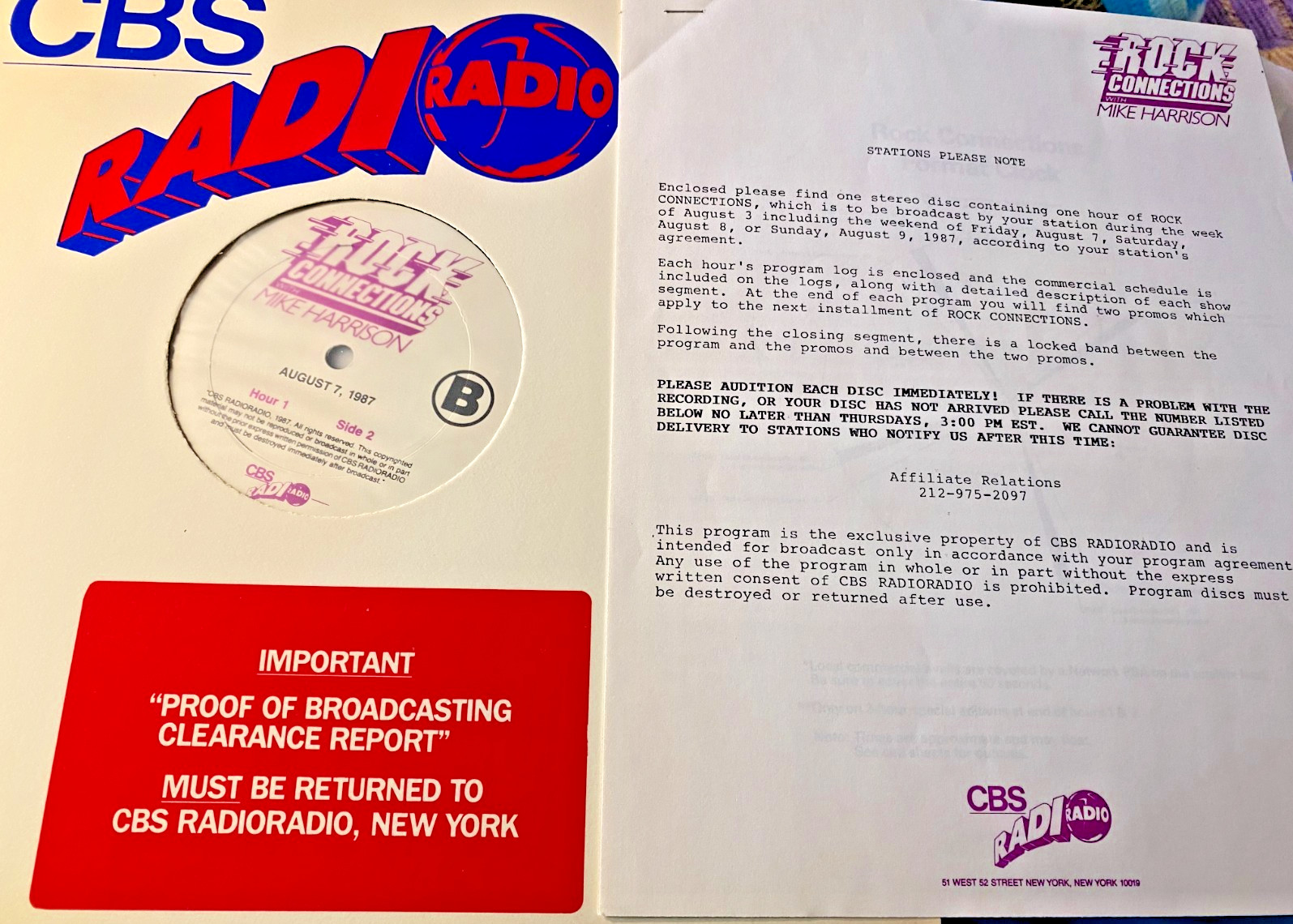
THIS SHOW IS CALLED: "Rock Connections with Mike Harrison' and was provided to affiliate radio stations through the CBS Radio Networks
THIS SHOW WAS 1 HOUR LONG WITH CLASSIC ROCK HITS FROM THE LATE 60'S THROUGH THE MID 80'S, SOME RARELY HEARD, AND WITH MANY INTERVIEWS AND SPECIAL FEATURES
EACH SHOW HAD A SPECIFIC THEME PROVIDING A TRULY ECLECTIC EXPERIENCE ON EVERY SHOW
THIS SHOW AIRED ON AUGUST 7, 1987 AS A ONE HOUR SPECIAL AND WITH LIMITED DISTRIBUTION IS VERY HARD TO FIND. IT IS SHOW # 64
At various times in my radio show collecting life now approaching 40 years, I have tried to track down every one of the 72 shows in the entire run but was never able to find them all.
Part of the problem was that it was not only a time limited production but also a limited distribution series with no more than 100 radio stations carrying the weekly show.
For a major radio show network like CBS, it was highly unusual to showcase a show with so few affiliates and it was a tribute to CBS that they ever decided to air and then continue it for almost two years.
The problem with the show was not the host for he is a cornerstone of FM classic rock programming, not the themes or the stories behind the tunes and bands. There were just a relatively finite number of radio stations to air it. Unlike today where there are tons of album rock radio stations, in the mid and late 80's that was not the case.
Mike Harrison is one of the most important 20th century DJ's for not only bringing the music to millions but providing the incisive commentary on the theme and tune and band. He lived classic album rock and loved it. And the rock bands he featured loved him and were always ready to join him on air for exclusive interviews.
Michael (“Mike”) Harrison, whose fascination with radio extends to 1950s’ Long Island, where the pre-Teen enjoyed listening to WINS/New York’s Alan Freed.
“I’d compare charts from each station when they did their [weekly countdowns],” he recalls. “I began seeing this wasn’t something written in stone but rather based on subjective determination.
I figured out how to track music and rooted for [certain] records as I became interested in public sentiment-based research.”
In summer 1967, the 18-year-old landed a job as a department store announcer at Modell’s Shopper’s World. “I loved radio but never made the connection I could do it,” notes Harrison, who attended Nassau College before transferring to Hofstra. “I auditioned at [Hofstra’s WVHC] and they put me on that night to [read the weather forecast].”
Then located in the Garden City Hotel’s basement, Easy Listening WLIR/Long Island was the site of Harrison’s first on-air commercial experience. A three-year staff announcer stint culminated in being named PD (1970) and Harrison shifted (the late) John Rieger-owned WLIR to progressive Rock. “If it weren’t for [Rieger],” Harrison notes, “I don’t know if I ever would have gotten into the business.”
It was one year later when he ascended to mornings at legendary WNEW-FM/New York, whose on-air staff included Scott Muni and Alison (“The Nightbird”) Steele. “I did very well but didn’t quite get along with the culture,” Harrison admits.
“I had my own ideas and [my run there] lasted about [18 months].” Research-oriented Harrison played “too many” hits, a philosophy stemming from the fact he approached radio from the listener’s perspective. “You have to give [listeners] what they want. It was apparent when I played the best progressive Rock music I had better ratings than when I showed hippie friends how much esoteric music I knew. It sounds quaint today, but those were major issues in FM music radio’s [early] days.”
Instantly after Harrison’s WNEW-FM tenure concluded, he received fill-in inquiries from cross-town WCBS-FM and Top 40 WPIX. “I suddenly went from being a progressive morning [air talent] to doing part-time work on two different stations,” he recounts.
“I did five shifts a week and learned a lot about other formats. I was never good but had [an aptitude] for radio mechanics.” Shortly thereafter, John Gehron-programmed WCBS-FM switched to Oldies and Harrison stayed on.
Former co-worker Scott Muni suggested Harrison return to WNEW-FM so for about a year, “I did as many as nine shifts a week on all three stations. I was very much a student of radio and took it terribly seriously.”
This daunting on-air schedule notwithstanding, Harrison had designs of re-occupying a PD chair. After scouring the country for the best opportunity, he found it at KPRI/San Diego, a progressive station he describes as “getting its clock cleaned” by Ron Jacobs-programmed KGB AM & FM.
I had the opportunity to go head-to-head [against] Jacobs with this weak-signal station.”
Within Harrison’s first few months in America’s Finest City, he became friendly with label promoters and ran into KDAY/Los Angeles PD Bob Wilson at a record company party. “Meeting him changed my life,” Harrison matter-of-factly states. “He said he was thinking about beginning a trade publication to compete [against] Billboard and it would be the Tiffany of tip-sheets. I had a beef with Billboard because they only wrote about Ron Jacobs. They didn’t show any interest whatsoever in what I was doing. I told Bob I’d be his FM Rock Editor and began [Radio & Records’] AOR section.
For about 18 months Harrison executed those duties from his San Diego apartment – not R&R’s Los Angeles headquarters.
“Radio & Records didn’t become an overnight success,” he explains. “There was a small staff and it was a struggle for us [but] I became extremely close with Bob. We reached the point in 1975 where R&R was doing well enough that I moved in Los Angeles and became Managing Editor.” It was Harrison’s contention that FM Rock radio’s biggest problem was ad agencies didn’t take it seriously because they thought it was underground, kid radio. “MOR [Middle of the Road] was a very popular term and I thought `AOR’ would work,” he reasons. “`Progressive’ was more descriptive about subjective determination [while] `Album Oriented Rock’ was objective. Radio didn’t know how to research albums – they just researched singles.”
In the days Harrison bounced around New York, Metromedia KMET/Los Angeles VP/GM L. David Morehead became aware of him. “ABC was [involved in] the research trip [with Los Angeles Rocker KLOS while] KMET had every [air personality] do his own thing,” Harrison recounts. “The first day I was at R&R, [Morehead] called and asked if I missed radio, [because] he needed a PD for KMET. I said I couldn’t imagine I’d take the job because I had a commitment with Bob Wilson.” Ironically however, one of Harrison’s fantasies was to program “The Mighty Met” and he told Morehead KMET’s music had to be tighter and the station needed to be more disciplined. “Those were sacrilegious things in those days.” A deal was struck where Harrison “very quietly” consulted KMET. “They appointed a bright woman, Sam Bellamy, as PD,” he points out. “There were no computers then and we set up a rotation of `reds,’ `blues’ and `greens.’ We instituted [various] techniques to make the music better and create a station atmosphere.”
The thing Harrison truly coveted from the KMET experience was a weekend talk show. “Alex Bennett did a hippy-dippy weekend talk show on WMCA/ New York that fascinated me. KMET gave me my own Saturday morning talk show.”
While Harrison’s KMET relationship would endure for ten years, the R&R connection soured and ended in three. “Talkers Magazine has always maintained the spirit of the early Radio & Records,” Harrison comments. “Bob Wilson was the right man at the right time. In many ways, he [is] a genius and understood radio’s essence from the listener’s perspective. Considering the volatility and changing nature of those times, Bob Wilson and I were a great team.” Both men at the time however were only in their late-20s. (Wilson is presently progressing after a series of devastating strokes several months ago.) “We were young and very egotistical,” Harrison concedes. “By 1978 our egos clashed and it became a love/hate relationship. Bob felt the AOR section operated in its own universe. We became petty with each other. I look back and regret it greatly because both of us were jerky. I learned a lesson from that experience I never, ever forgot. Don’t go to war against any individual or company – unless you really have to.
I left in 1978 and took several people with me.” That association’s denouement led to Goodphone, which Harrison says reverted to the tip-sheet mode. “It was very futuristic and geared to Rock radio [PDs who] realized the 1980s were coming. By that point, I was already onto the concept of track research. It was clear record company A&R departments didn’t have a clue regarding what kind of singles to release. Album Rock radio couldn’t use singles research to program their tracks.”
But by 1980, Harrison was ready for another challenge. “Of all people, I became friendly with Billboard Publisher Lee Zito and he [proposed Billboard] take over Goodphone Weekly,” he points out. “I was also producing `The Great American Radio Show’ for Westwood One; `Album Greats’ for TM; and other radio specials for my company, Goodphone Communications.” Once Billboard acquired Goodphone Weekly, Harrison maintains they “dismantled” it. “The deal was I couldn’t publish anything in radio trades for at least five years,” he remarks. “I became a Billboard consultant/columnist.”
The dream of programming KMET was realized in late-1983, but by 1985 for “various reasons,” Harrison determined it was time to depart. “I’m not a corporate kind of guy. I thought Talk radio was going to be the big thing in the 1990s [and it’s been] my deep passion. I always recognized the presenter [the on-air talent] is the very core of what makes radio great and what makes it culturally relevant.”
Acting on his theory that Talk radio was simply an extension of AOR – minus the music – Harrison in 1985 accelerated his plan to buy AM stations, joining forces with Los Angeles friend Al Herskovitz. “We weren’t big money guys - we basically just had our savings,” Harrison remarks. “After a year, we located [WSPR/Springfield, MA] that was primed to be turned into a Talk station.” Harsh Reality H&H Broadcasting bought WSPR in 1986. “The idea was [to be] high energy, pop culture-oriented and politics as a spectator sport – everything happening in Talk radio today,” Harrison recounts. “It was a wonderful station.”
Turning WSPR around in six months and buying more facilities was the game plan but Harrison chuckles, “It didn’t work out that way. I was President/morning man; Al was GM/Sales Manager.
I didn’t get a call my first three days on-air. We sold the station in 1988 and doubled our money [but] it wasn’t a fun couple of years and for the first time in my career, I found myself with not much left to do.”
At the same time though, about 100 stations were airing “Mike Harrison’s Rock Connection” via CBS Radio, enabling the host to make a living.
“I must tell you – there wasn’t a lot of money to be made owning WSPR,” Harrison laments. “That was a financial stretch. It’s real hard to sell advertising in a small market.”
Following a brief programming go-round at WZLX/Boston (where Alan Colmes did mornings), Harrison decided in early-1990 he wanted to revisit Talk radio; the first Talkers issue was published in July 1990. “I’ve never looked back,” he notes. “The history of Talkers is colorful unto itself [but] I don’t feel I’ve ever left radio. I’m doing it on my terms. I’ve done projects that have put me on the air and run Talkers extremely hands-on in terms of my relationship with its readers. I have constant dialogues with broadcasters and feel I’m involved with radio.” Candid Comments In addition to producing documentaries, Harrison also owns Washington, DC’s Talk Radio News Service. “I don’t have the patience to sit in a studio to do a daily four-hour radio show,” he confides. “One hour in the studio is all I can take before I get bored.” A certain degree of objectivity is required in Harrison’s position, although he admits to having favorite personalities (particularly if they are in the mold of Westwood One’s Jim Bohannon). “They’re the ones who work hard; remember that this is an industry; and are kind to their fellow broadcasters. Those no longer feeling any kind of responsibility to anyone else but themselves are the ones I don’t go out of my way to help [but] I don’t go out of my way to hurt them. Today’s most pertinent talent could be obsolete tomorrow.”
As much as he listens to spoken word radio, Harrison also samples a nearly equal amount of music radio and as usual doesn’t pull any punches. “Music radio is horrible,” he asserts. “The [PD] in me goes crazy when I listen because it’s clearly being programmed by `B’ and `C’ students. Really, really good programmers left music radio. I find it outrageously out-of-sync with true categories of demographic tastes. Great radio doesn’t come from corporate offices. It rises up from the sidewalks.” Remarkably, the nationally syndicated personality-consultantPD-station owner-trade paper publisher never considered himself to be that accomplished. “I see myself as having tremendous experiences,” Harrison humbly states. “We tend to view our own careers by what we didn’t accomplish. At this point, I’m happy with what I’ve done [although] my dream of putting together a giant conglomerate of AM Talk stations was a disappointment. I’ve done it all but never achieved prominence as a radio personality like Rush Limbaugh or Sean Hannity. Most people don’t know my background because radio doesn’t have good historians. Its history evaporates the same way its product does. I’ve always seen myself as a pioneer – not someone from the good old days.”
SO HERE ARE THE BIG QUESTIONS IF YOU DO NOT KNOW MUCH ABOUT RADIO SHOWS:
EXACTLY WHAT IS A RADIO SHOW?
WHY COLLECT THEM?
WHERE DO THEY COME FROM?
Well, those are good questions, especially if you have never known of them.
First allow me tell you my own personal story of discovering the wonder of radio shows.
I discovered radio shows quite by accident while reading one of my favorite (long since departed) magazines called "Discoveries" (It was later bought by the same company that publishes "Goldmine" which I personally always considered a lesser publication, but that is another story.
This was before ebay became the driving force in radio show sales (and everything else) in the later 1990's.
I was especially attracted in "Discoveries" to a two page (or more) spread in each issue by a guy called "The Old Hippie".
Let me tell you, the Old Hippie had it all. He was a real pioneer. Way before anyone knew what radio shows even were let alone that they could be bought as rarities, he had the market cornered.
Most shows that he advertised were way beyond my budget but I drooled over those pages every issue and once in awhile I could afford one or two.
Now, I have attempted in my own humble way to take on the mantle of "The Old Hippie". I have listed over 11,000 unique radio shows of all genres for you all to drool over, and most at prices, hopefully, that collectors can better afford! I want to make available to collectors what I could not afford and especially in these days of higher prices and lesser availability.
Radio shows are harder and harder to find in quantity and the prices for the ones still out there just go higher and higher as they disappear from the market. However, because of my large presence on eBay, I am always being contacted with selling offers, some of which I take advantage of and some I have to pass on because of the prices. I have found that by buying in bulk, even when many or most of the shows are lesser known but still amazing shows, I can offer the best prices on all titles.
So, again, what is a radio show?
Radio Shows are syndicated productions by one of several large and small distributors who supply broadcast product to radio stations normally during weekends when the usual air personalities have a break.
Many air on Saturday or Sunday mornings, afternoons or evenings or less often during overnight segments or weekdays. They often feature some of the best known voices for their genre from across the country thus the Dick Clark's and Casey Kasem's and Rick Dees and Dick Bartley and so many others.
People collect them for various reasons.
Some just collect the series because they like it and want them all.
Some collect their favorite artists or genre of music. Rather than an album by the artist or a compilation, they have a unique presentation of their favorite artist or music not available anywhere else and often with dj presentation which is very entertaining.
Some collect interviews with their favorite artists as most shows had interview segments.
Some collect commercials especially old car commercials but certainly not limited to only those.
AND, these shows are in limited quantity.
They were pressed just for affiliate stations and many have just a few in circulation. Some of the more popular shows had as many as 170 shows pressed for each edition of the show. Smaller, less successful, but still entertaining shows had significantly fewer shows pressed.
The 170 shows pressed is not just a random number. It reflected the top 170 radio markets in the country as measured through the Nielsen ratings system. Radio stations outside the 170 markets could still air the show but had to take the satellite feed for which, of course, there was never a tangible LP or cd of the show.
On top of that, many radio stations just tossed them away after airing because they could never be aired again due to the time limited commercials to one airing and the limited storage space at most radio stations (believe me I know, I hosted a nightly oldies shows at one for over seven glorious years!) Radio station affiliates had to sign contracts in order to air the show and were legally bound to air the week's show only one time and then return it to the network or destroy it.
SO they are increasingly hard to find and there is no way of determining exactly how many of each week's show survived.
But the bottom line is that there could never be more than 170. Compare that to the popular pressings of commercially released lps (for example Michael Jackson's Thriller album sold over 70 million copies.)
Radio shows were first distributed on reel to reel tape or on lp, later on CD and even later (after 2000 for most shows) on CDR. Now they are not available at all to collectors since they are distributed to radio stations through digital download
These shows become rarer and rarer every day because the people who buy them hold on to them.
Most music lovers do not even know that there are such things as radio shows pressed on LP or cd
So,the shows that you get now and hold on to will never decrease in value and only increase.
I have prided myself since the start to provide the best and fairest cost with a no holds barred guarantee that you will be happy or I refund your money. I sell them for near what I bought them for. I give volume discounts and discount postage always.
And, I have one of the biggest radio show libraries in the world consisting of over fifteen thousand unique shows, so many that I don't even know all that I have and am sometimes amazed when I go to look for one show and find another that I did not realize I had.
Finally, it is Americana at its best.
Whether the show be from the 60's or 2000's, rock, countdown, oldies, country, classical, religious, jazz or big band, it is unique and home grown. And you just can't find them anywhere. Even record stores that still exist will rarely have any.
Radio shows are wonderful representations of the real golden age of radio at least music wise. And every one you buy is an original, not a copy, not a remake - all limited editions in the 170 number or less. I know of a couple of shows that had as few as 20 station affiliates. Once you get hooked, like me, it is a love affair for life! Welcome to the Club!
Remember, when you buy this show, not only will you own the tunes but also interspersed between songs is fascinating commentary on the artists and songs and wonderful interview segments and other features.
Also, keep in mind that this and all shows are not just about the music - the music can be found anywhere. It is the mixture of great music and great announcing that makes it so entertaining.
Most people even enjoy the national commercials that are included on the show because some 40 years later they sound fresh and bring back more innocent time! It is a great show and would be a valuable addition to your collection
Good Luck and God Bless You.
I HAVE TRIED IN MY COLLECTING LIFE OF OVER 20 YEARS TO GET EVERY ONE OF THE 72 SHOWS IN THIS SERIES
I HAVE FAILED MISERABLY. THEY JUST CANNOT BE FOUND.
PART OF THE PROBLEM WAS THAT IT WAS ONLY A LIMITED DISTRIBUTION SERIES WITH AT THE MOST 100 STATIONS AIRING IT. FOR A MAJOR DISTRIBUTOR LIKE CBS, THIS WAS VERY UNUSUAL AND IT WAS A TRIBUTE TO THEIR FAITH IN MIKE HARRISON THAT THE SHOW EVER AIRED IN THE FIRST PLACE.
THE SHOW WAS DOOMED FROM THE START EVEN THOUGH CBS RADIO, ONE OF THE BIGGEST PLAYERS IN DISTRIBUTION OF RADIO SHOWS, WAS THE DISTRIBUTOR AND STOOD BEHIND IT. THE PROBLEM WAS NOT THE HOST FOR HE IS MAGNIFICENT NOR THE MUSIC BECAUSE THE MUSIC MIX AND THEMES ARE UNEXCELLED IN RADIO SHOWS.
THE PROBLEM WAS THAT SINCE THE SHOW FOCUSED ON ALBUM ROCK, THERE WERE A RELATIVELY FINITE NUMBER OF STATIONS TO AIR IT. TODAY WE HAVE TONS OF ALBUM ROCK STATIONS, BUT IN THE 80'S, THERE WERE NOT AS MANY. SO FOR ADVERTISERS, THEY DID NOT FEEL THEY WERE GETTING THE BANG FOR THEIR BUCK THAT THEY WANTED.
AS YOU WILL SEE FROM THE INFORMATION BELOW, THE SHOW LASTED A YEAR AND A HALF AND ON A MAJOR MARKET RADIO NETWORK LIKE CBS IT IS BEYOND BELIEF.
TIP YOUR HATS TO CBS, THE NETWORK THAT CANCELLED THE SMOTHERS BROTHERS IN THE LATE 60'S BEFORE BRINGING THEM BACK MANY YEARS LATER FOR HAVING SOME INSIGHT INTO THE MOST IMPORTANT MUSIC OF OUR LIVES AND STICKING WITH THIS SHOW FOR THE YEAR AND A HALF THAT IT AIRED
I HAVE DECIDED THAT IT IS TIME TO SHARE THOSE MOST SPECIAL SHOWS THAT I HAVE WITH THE WORLD.
NOTE FROM THE START THAT YOU HAVE NEVER EXPERIENCED A MUSIC PROFESSIONAL LIKE MIKE HARRISON.
I SHARE THESE WITH YOU TO BRING TO THE WORLD WHAT MIKE HARRISON PRESENTED IN THIS ONE OF A KIND SERIES.
THEY ARE EXPENSIVE, BUT THE VALUE TO YOU AND YOUR COLLECTION OF RADIO SHOWS IS INESTIMABLE.
MIKE HARRISON IS ONE OF THE MOST IMPORTANT DJ'S IN THE 20TH CENTURY MUSIC SCENE BRINGING NOT ONLY THE BEST MUSIC BUT THE BEST COMMENTARY ON THE MUSIC. HE LIVED IT AND LOVED IT. AND THE BEST ARTISTS LOVED HIM. HE ATTRACTED ALL OF THEM AND THE INTERVIEWS THAT YOU HEAR ON THIS SHOW ARE LONG FORM, INSIGHTFUL, AND FASCINATING.
HERE FOLLOWS A BIOGRAPHY WITH MIKE'S PHILOSOPHY ABOUT MUSIC AND HOW TO PRESENT IT TO THOSE WHO REALLY LOVE THE MUSIC THAT WE ALL GREW UP WITH. IT IS REPRINTED FROM THE PUBLICATION 'INSIDE RADIO'.
Michael (“Mike”) Harrison, whose fascination with radio extends to 1950s’ Long Island, where the pre-Teen enjoyed listening to WINS/New York’s Alan Freed.
“I’d compare charts from each station when they did their [weekly countdowns],” he recalls. “I began seeing this wasn’t something written in stone but rather based on subjective determination.
I figured out how to track music and rooted for [certain] records as I became interested in public sentiment-based research.”
In summer 1967, the 18-year-old landed a job as a department store announcer at Modell’s Shopper’s World. “I loved radio but never made the connection I could do it,” notes Harrison, who attended Nassau College before transferring to Hofstra. “I auditioned at [Hofstra’s WVHC] and they put me on that night to [read the weather forecast].”
Then located in the Garden City Hotel’s basement, Easy Listening WLIR/Long Island was the site of Harrison’s first on-air commercial experience. A three-year staff announcer stint culminated in being named PD (1970) and Harrison shifted (the late) John Rieger-owned WLIR to progressive Rock. “If it weren’t for [Rieger],” Harrison notes, “I don’t know if I ever would have gotten into the business.”
It was one year later when he ascended to mornings at legendary WNEW-FM/New York, whose on-air staff included Scott Muni and Alison (“The Nightbird”) Steele. “I did very well but didn’t quite get along with the culture,” Harrison admits.
“I had my own ideas and [my run there] lasted about [18 months].” Research-oriented Harrison played “too many” hits, a philosophy stemming from the fact he approached radio from the listener’s perspective. “You have to give [listeners] what they want. It was apparent when I played the best progressive Rock music I had better ratings than when I showed hippie friends how much esoteric music I knew. It sounds quaint today, but those were major issues in FM music radio’s [early] days.”
Instantly after Harrison’s WNEW-FM tenure concluded, he received fill-in inquiries from cross-town WCBS-FM and Top 40 WPIX. “I suddenly went from being a progressive morning [air talent] to doing part-time work on two different stations,” he recounts.
“I did five shifts a week and learned a lot about other formats. I was never good but had [an aptitude] for radio mechanics.” Shortly thereafter, John Gehron-programmed WCBS-FM switched to Oldies and Harrison stayed on.
Former co-worker Scott Muni suggested Harrison return to WNEW-FM so for about a year, “I did as many as nine shifts a week on all three stations. I was very much a student of radio and took it terribly seriously.”
This daunting on-air schedule notwithstanding, Harrison had designs of re-occupying a PD chair. After scouring the country for the best opportunity, he found it at KPRI/San Diego, a progressive station he describes as “getting its clock cleaned” by Ron Jacobs-programmed KGB AM & FM.
I had the opportunity to go head-to-head [against] Jacobs with this weak-signal station.”
Within Harrison’s first few months in America’s Finest City, he became friendly with label promoters and ran into KDAY/Los Angeles PD Bob Wilson at a record company party. “Meeting him changed my life,” Harrison matter-of-factly states. “He said he was thinking about beginning a trade publication to compete [against] Billboard and it would be the Tiffany of tip-sheets. I had a beef with Billboard because they only wrote about Ron Jacobs. They didn’t show any interest whatsoever in what I was doing. I told Bob I’d be his FM Rock Editor and began [Radio & Records’] AOR section.
For about 18 months Harrison executed those duties from his San Diego apartment – not R&R’s Los Angeles headquarters.
“Radio & Records didn’t become an overnight success,” he explains. “There was a small staff and it was a struggle for us [but] I became extremely close with Bob. We reached the point in 1975 where R&R was doing well enough that I moved in Los Angeles and became Managing Editor.” It was Harrison’s contention that FM Rock radio’s biggest problem was ad agencies didn’t take it seriously because they thought it was underground, kid radio. “MOR [Middle of the Road] was a very popular term and I thought `AOR’ would work,” he reasons. “`Progressive’ was more descriptive about subjective determination [while] `Album Oriented Rock’ was objective. Radio didn’t know how to research albums – they just researched singles.”
In the days Harrison bounced around New York, Metromedia KMET/Los Angeles VP/GM L. David Morehead became aware of him. “ABC was [involved in] the research trip [with Los Angeles Rocker KLOS while] KMET had every [air personality] do his own thing,” Harrison recounts. “The first day I was at R&R, [Morehead] called and asked if I missed radio, [because] he needed a PD for KMET. I said I couldn’t imagine I’d take the job because I had a commitment with Bob Wilson.” Ironically however, one of Harrison’s fantasies was to program “The Mighty Met” and he told Morehead KMET’s music had to be tighter and the station needed to be more disciplined. “Those were sacrilegious things in those days.” A deal was struck where Harrison “very quietly” consulted KMET. “They appointed a bright woman, Sam Bellamy, as PD,” he points out. “There were no computers then and we set up a rotation of `reds,’ `blues’ and `greens.’ We instituted [various] techniques to make the music better and create a station atmosphere.”
The thing Harrison truly coveted from the KMET experience was a weekend talk show. “Alex Bennett did a hippy-dippy weekend talk show on WMCA/ New York that fascinated me. KMET gave me my own Saturday morning talk show.”
While Harrison’s KMET relationship would endure for ten years, the R&R connection soured and ended in three. “Talkers Magazine has always maintained the spirit of the early Radio & Records,” Harrison comments. “Bob Wilson was the right man at the right time. In many ways, he [is] a genius and understood radio’s essence from the listener’s perspective. Considering the volatility and changing nature of those times, Bob Wilson and I were a great team.” Both men at the time however were only in their late-20s. (Wilson is presently progressing after a series of devastating strokes several months ago.) “We were young and very egotistical,” Harrison concedes. “By 1978 our egos clashed and it became a love/hate relationship. Bob felt the AOR section operated in its own universe. We became petty with each other. I look back and regret it greatly because both of us were jerky. I learned a lesson from that experience I never, ever forgot. Don’t go to war against any individual or company – unless you really have to.
I left in 1978 and took several people with me.” That association’s denouement led to Goodphone, which Harrison says reverted to the tip-sheet mode. “It was very futuristic and geared to Rock radio [PDs who] realized the 1980s were coming. By that point, I was already onto the concept of track research. It was clear record company A&R departments didn’t have a clue regarding what kind of singles to release. Album Rock radio couldn’t use singles research to program their tracks.”
But by 1980, Harrison was ready for another challenge. “Of all people, I became friendly with Billboard Publisher Lee Zito and he [proposed Billboard] take over Goodphone Weekly,” he points out. “I was also producing `The Great American Radio Show’ for Westwood One; `Album Greats’ for TM; and other radio specials for my company, Goodphone Communications.” Once Billboard acquired Goodphone Weekly, Harrison maintains they “dismantled” it. “The deal was I couldn’t publish anything in radio trades for at least five years,” he remarks. “I became a Billboard consultant/columnist.”
The dream of programming KMET was realized in late-1983, but by 1985 for “various reasons,” Harrison determined it was time to depart. “I’m not a corporate kind of guy. I thought Talk radio was going to be the big thing in the 1990s [and it’s been] my deep passion. I always recognized the presenter [the on-air talent] is the very core of what makes radio great and what makes it culturally relevant.”
Acting on his theory that Talk radio was simply an extension of AOR – minus the music – Harrison in 1985 accelerated his plan to buy AM stations, joining forces with Los Angeles friend Al Herskovitz. “We weren’t big money guys - we basically just had our savings,” Harrison remarks. “After a year, we located [WSPR/Springfield, MA] that was primed to be turned into a Talk station.” Harsh Reality H&H Broadcasting bought WSPR in 1986. “The idea was [to be] high energy, pop culture-oriented and politics as a spectator sport – everything happening in Talk radio today,” Harrison recounts. “It was a wonderful station.”
Turning WSPR around in six months and buying more facilities was the game plan but Harrison chuckles, “It didn’t work out that way. I was President/morning man; Al was GM/Sales Manager.
I didn’t get a call my first three days on-air. We sold the station in 1988 and doubled our money [but] it wasn’t a fun couple of years and for the first time in my career, I found myself with not much left to do.”
At the same time though, about 100 stations were airing “Mike Harrison’s Rock Connection” via CBS Radio, enabling the host to make a living.
“I must tell you – there wasn’t a lot of money to be made owning WSPR,” Harrison laments. “That was a financial stretch. It’s real hard to sell advertising in a small market.”
Following a brief programming go-round at WZLX/Boston (where Alan Colmes did mornings), Harrison decided in early-1990 he wanted to revisit Talk radio; the first Talkers issue was published in July 1990. “I’ve never looked back,” he notes. “The history of Talkers is colorful unto itself [but] I don’t feel I’ve ever left radio. I’m doing it on my terms. I’ve done projects that have put me on the air and run Talkers extremely hands-on in terms of my relationship with its readers. I have constant dialogues with broadcasters and feel I’m involved with radio.” Candid Comments In addition to producing documentaries, Harrison also owns Washington, DC’s Talk Radio News Service. “I don’t have the patience to sit in a studio to do a daily four-hour radio show,” he confides. “One hour in the studio is all I can take before I get bored.” A certain degree of objectivity is required in Harrison’s position, although he admits to having favorite personalities (particularly if they are in the mold of Westwood One’s Jim Bohannon). “They’re the ones who work hard; remember that this is an industry; and are kind to their fellow broadcasters. Those no longer feeling any kind of responsibility to anyone else but themselves are the ones I don’t go out of my way to help [but] I don’t go out of my way to hurt them. Today’s most pertinent talent could be obsolete tomorrow.”
As much as he listens to spoken word radio, Harrison also samples a nearly equal amount of music radio and as usual doesn’t pull any punches. “Music radio is horrible,” he asserts. “The [PD] in me goes crazy when I listen because it’s clearly being programmed by `B’ and `C’ students. Really, really good programmers left music radio. I find it outrageously out-of-sync with true categories of demographic tastes. Great radio doesn’t come from corporate offices. It rises up from the sidewalks.” Remarkably, the nationally syndicated personality-consultantPD-station owner-trade paper publisher never considered himself to be that accomplished. “I see myself as having tremendous experiences,” Harrison humbly states. “We tend to view our own careers by what we didn’t accomplish. At this point, I’m happy with what I’ve done [although] my dream of putting together a giant conglomerate of AM Talk stations was a disappointment. I’ve done it all but never achieved prominence as a radio personality like Rush Limbaugh or Sean Hannity. Most people don’t know my background because radio doesn’t have good historians. Its history evaporates the same way its product does. I’ve always seen myself as a pioneer – not someone from the good old days.”
THE SHOW IS CALLED 'ROCK CONNECTIONS WITH MIKE HARRISON and aired on the COLUMBIA BROADCASTING SYSTEM NETWORK (CBS).
It was an enormously popular show in its day AND AS WE HAVE SHARED WAS A LIMITED EDITION SERIES WHICH MADE IT EVEN RARER.
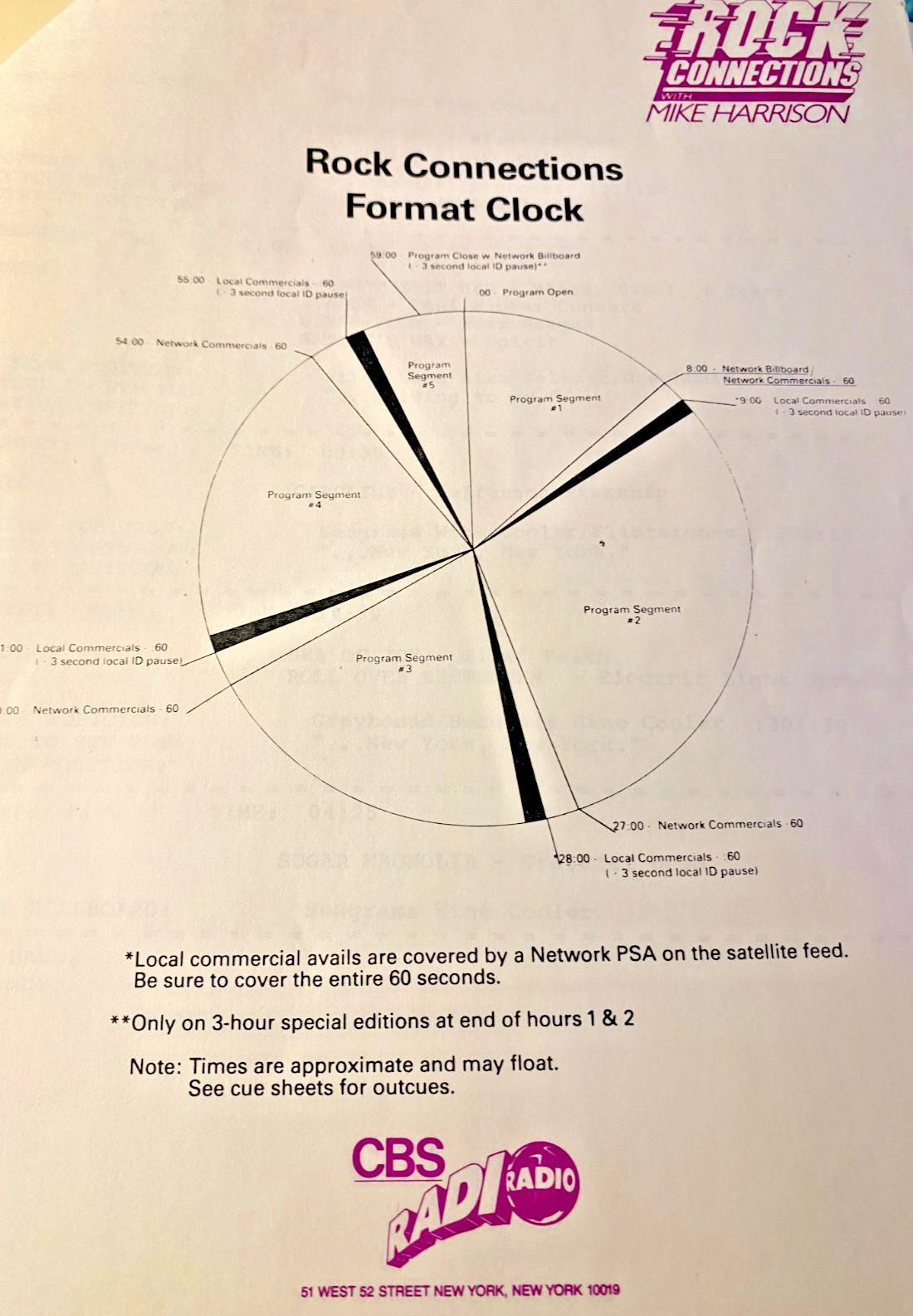
It was composed of a one hour weekly special, each week with occasional three hour specials on July 4 weekend and Labor Day and Memorial Day.
Each show had a specific theme with many in depth interviews.
This show is in mint new condition played only on its date of network national broadcast and then professionally stored since. It is a rare find and belongs in your most special collection.
It is an enthralling show that will captivate you. You will be disappointed when it is over.
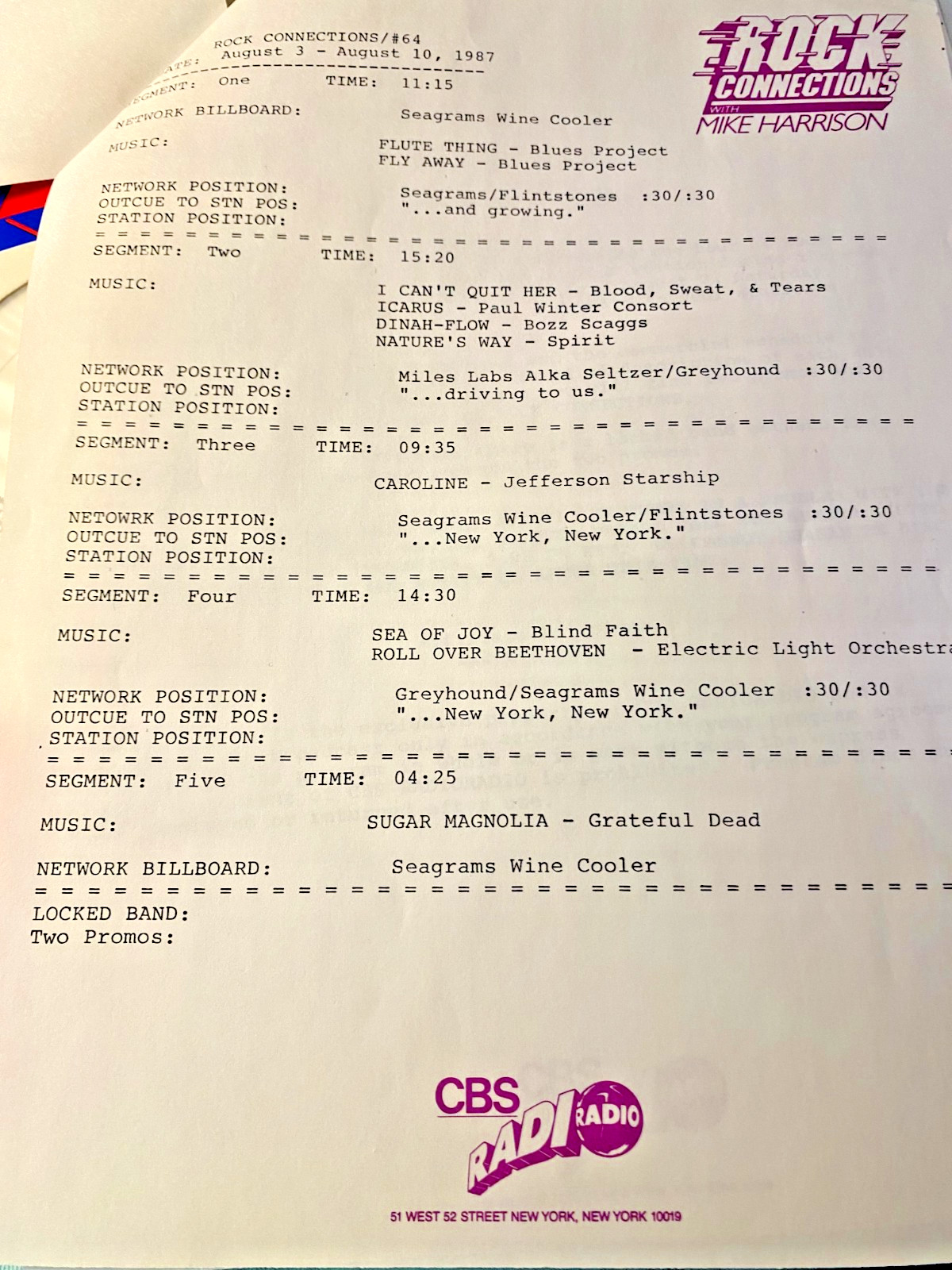
Most have their cue sheets. If they do, they are listed in the listing picture. If there are not cue sheets, I have reproduced from my personal copy the contents of the program.
Please note that the interviews are not listed on the cue sheets but you will be absolutely delighted when you hear them. And of course some shows have co hosts with Mike and they are live the whole hour with him.
This show aired on JULY 31, 1987.
IT FEATURED A SPECIAL TRIBUTE TO THE BEST OF ALBUM ROCK IN A MOST SPECIAL HOUR.
PLEASE NOTE AGAIN THAT THE INTERVIEWS ARE NOT LISTED ON THE CUE SHEETS BUT THEY ARE THROUGHOUT THE HOUR
What you will learn about the music we love is alone worth the cost of the show let alone the great music.
The show contents are presented in the listing pictures.
price rating