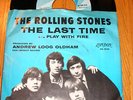
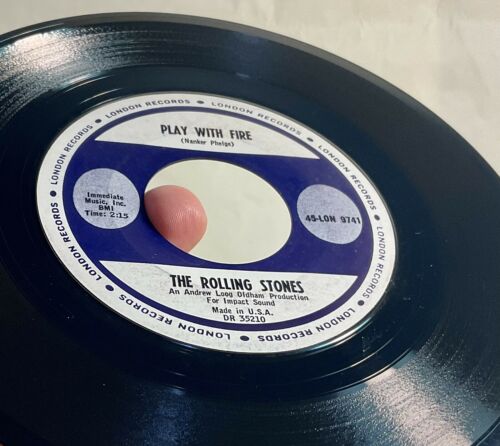
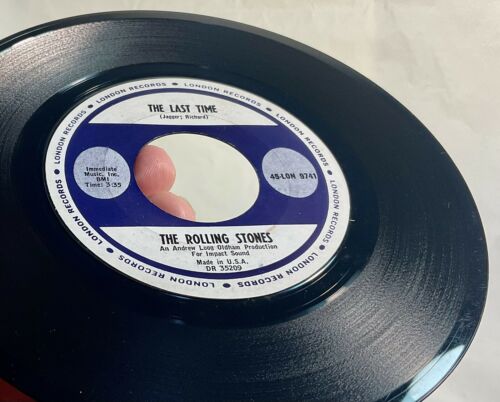
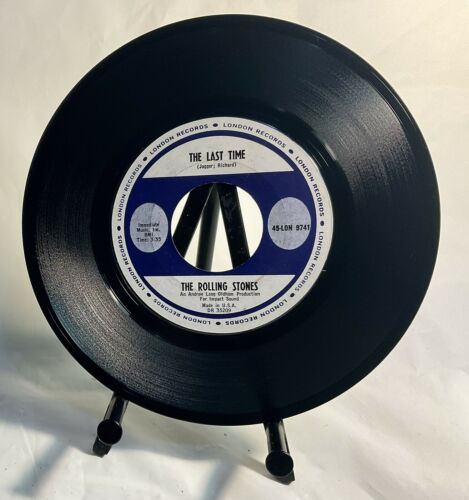
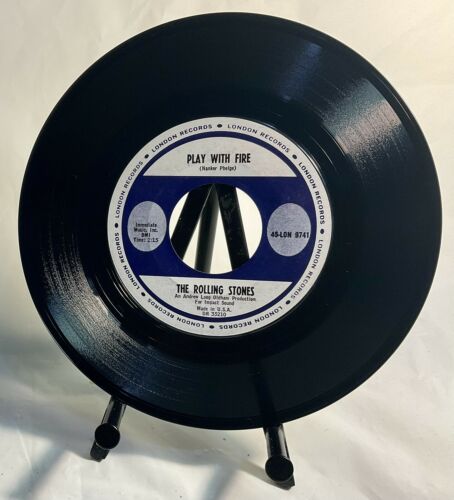
45 Rolling Stones * Play With Fire / The Last Time 1965 Super Clean
$
31
Favourite Auctions
To save auctions to your favourites, please login
If you don't have an account, please register
Description
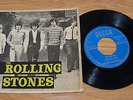
**************** PLEASE NOTE THAT THE TWO PHOTOS OF THE BAND ARE NOT PART OF THE AUCTION WIN! *******************
Artist: The Rolling Stones
Label: London
Country: USA
Catalogue: 45-9741?
Date: 13 Mar 1965
Format: 7"
A The Rolling Stones The Last Time Jagger, Richard
B The Rolling Stones Play With Fire Nanker Phelge
Condition: Looks unplayed. (See pics).
Combine wins will get you cheaper shipping.
Questions are good.
Shipped with USPS media mail.
eBay member since 1997 - Shackwax
It comes with a brand new paper sleeve, plastic sleeve and a brand new mailing box.
**************** PLEASE NOTE THAT THE TWO PHOTOS OF THE BAND ARE NOT PART OF THE AUCTION WIN! *******************
—————————————————————————-
Song Review by Richie Unterberger
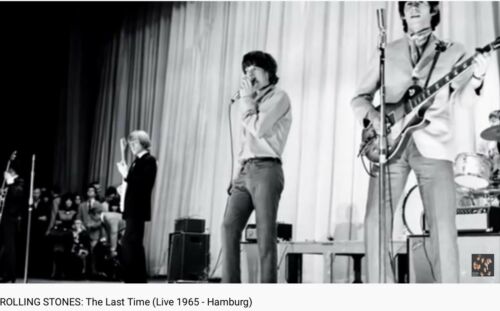
"The Last Time" was the first original Rolling Stones composition to become a big international hit single; indeed, it was the first Rolling Stones composition to even be used as an A-side in their native Britain. Its success no doubt gave the group confidence that they could compete and endure at the top level of rock at a time when it was starting to become expected that top groups would write their own material. It was also an important step forward for the band in that while it was clearly influenced by the roots blues and soul music that formed most of their early repertoire, it was also a convincing reformulation of those influences into a rock format that did not sound unduly derivative. "The Last Time" was built around a hypnotic, repetitive guitar riff; it and the sung melody were actually close in construction to country music. Before the verses became too repetitive, they were interrupted by a catchy chorus that was the most pop-oriented aspect of the tune. The lyrics, and Mick Jagger's vocals, adopt a stance more adolescent than those in many of the blues songs they covered, while projecting a sullen menace. The crashing, ringing guitar solo epitomizes the ragged-but-right ethos that the Stones would tap into over the course of their entire career. "The Last Time" did have some clear antecedents in black American music, in particular the 1964 James Brown single "Maybe the Last Time," which was itself based on ideas found in a gospel song that had been recorded by the Staple Singers. Some have thus accused the Stones of literally stealing from their black heroes, but "The Last Time" is clearly different from and more rock-oriented than the tracks recorded by James Brown and the Staple Singers, although there are some similarities in approach and the use of the title lyric. It's an easy call as to what's the most noteworthy cover of "The Last Time." In mid-1967, when Mick Jagger and Keith Richards were briefly sent to jail on trumped-up drug charges, the Who rushed into the studio to record a couple of Jagger/Richards covers as a show of solidarity. "The Last Time" and "Under My Thumb" were quickly issued as a Who single in the U.K. (though not in the U.S.), and the Who's version of "The Last Time" is actually quite respectable on its own merits, adding an appropriate more power chord-based feel with a buzzing guitar solo. The Who also introduced a key change leading into the very last verse -- a feature not found in the Stones' version, and also very characteristic of the Who's arrangements of the period, which often changed into a higher key for the last part of a song.
———————————————————
Song Review by Richie Unterberger
"Play With Fire," the B-side of the 1965 Rolling Stones single "The Last Time," was one of their most effective moody ballads. The word "sullen" is often used to describe 1960s Rolling Stones compositions, but it's hard to avoid when talking about "Play With Fire," perhaps most sullen Stones tune of all. For perhaps the first time, with "Play With Fire" the group was writing about their experience as young men in mid-'60s London rather than aping what they thought a blues song or pop hit was supposed to be. Certainly it is the best of the early Stones numbers credited to the group pseudonym of Nanker-Phelge, though one suspects that it is primarily the work of Mick Jagger and Keith Richards, so similar does it sound to songs in the same vein that the pair would write in 1965 and 1966. A bittersweet (leaning more toward the bitter) acoustic guitar riff sets the song's restrained mood, hitching a ride with Mick Jagger's nicely restrained, subdued vocals, which nonetheless contain a seed of submerged anger and resentment. The anger and resentment almost boil over on the chorus, with its seething title warning not to play with the narrator. There is a folk-rock feel to the track, with its acoustic guitars (one played by Phil Spector) and doleful tambourine bashes. There is also, for the first time on a Stones record, a distinctly British ambience, with the references to the London district of Knightsbridge and the addition of harpsichord. Lyrically the song is a diatribe -- and a pretty subtle and understated one, especially as Stones songs go -- against rich bitches, to be blunt, out to impose their neuroses on louts from lower classes, such as the Stones, one presumes. The resentment against people who strut their diamonds and chauffeur-driven cars is palpable, although in actual fact the Stones reached an income level in the mid-'60s which allowed them to flaunt such accoutrements themselves. The song ends with a brief but memorable percussive shake that sounds like a death rattle. "Play With Fire" has an under-produced, demo-ish feel that indicates that the group did not spend as much time on it as they could have or wanted to. Indeed, a friend of the Stones wrote in a book that it was actually an outtake from a session that had produced a fuller, more soul-oriented cut called "Mess With Fire," with a vengeful Brian Jones substituting the less polished "Play With Fire" version on the single to embarrass other members of the group. That story seems dubious; even given that quality control was less stringent in the mid-'60s than it became later among major labels, that seems like a pretty major trick to slip pass bandmembers, management, and record label executives. Anyway, "Play With Fire" if anything benefits from the under-production, as the spare arrangement and hushed atmosphere suit the tune very well. Although it was used as a B-side, "Play With Fire" became almost as popular as its A-side ("The Last Time"); the Stones, perhaps realizing that they had undervalued its commercial potential, made it a regular feature of their mid-'60s concerts.
**************** PLEASE NOTE THAT THE TWO PHOTOS OF THE BAND ARE NOT PART OF THE AUCTION WIN! *******************
price rating

![BBC Session 2011 Anno Domini [VINYL] Wolves in the Throne Room Vinyl](https://www.popsike.com/php/thumbnail.php?url=https://www.popsike.pics/pix/20160421/391439556503.jpg)

![ROMAX/NOW I KNOW (OLD TIME PEOPLE,GOOD YOU DO)- S.COLE & G.ANDERSON [REGGAE] 7](https://www.popsike.com/php/thumbnail.php?url=https://www.popsike.pics/pix/20190717/293155088022.jpg)










![Deceptive Bends [VINYL], 10cc, Vinyl, New, FREE & Fast Delivery](https://www.popsike.com/php/thumbnail.php?url=https://www.popsike.pics/pix/20190219/382796980451.jpg)