2X33T, 2XLP, PIERRE MARIETAN, ROSE DES VENTS ACTION MUSICALE, GERM, GERARD FREMY
€
60
$
70


Favourite Auctions
To save auctions to your favourites, please login
If you don't have an account, please register
Description
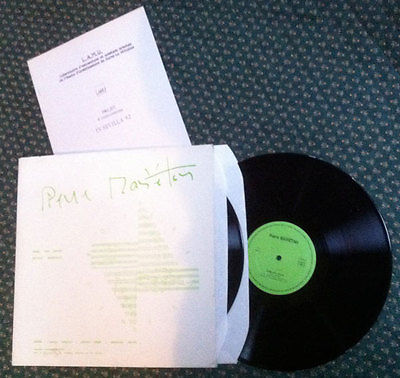
Double LP, 33T, Pierre Marietan, rose des vents action musicale
Pochette: VG++ (quelques petites taches, légèrement usée par le temps mais globalement en bon état, livret impécable)
Disque: EX/NM
Pierre Mariétan – Rose des Vents | Continuo's weblog
Composer, sound artist, sound ecologist and theorician Pierre Mariétan was born in Switzerland in 1935. He studied music in Basel’s Musikakademie with P. Boulez and K. Stockhausen (1961-1963) and in Cologne with B.A. Zimmermann (1960-1962) and H. Pousseur (1964-1965) – see Wikipedia article. He relocated to France in 1966 and founded the Groupe d’Etude et Réalisation Musicales (GERM), a group of musicians and composers (including Gérard Frémy and Martine Joste, piano, Philippe Blachette, violin, Philippe Drogoz, double bass, Louis Roquin, trumpet, Chantal Lemaire, cello, Jean-Yves Bosseur, rebab and flute and Bernadette Val, voice) exploring new music tendencies at the intersection of composition and improvisation. In 1970, the BYG Actuel label released an LP of Terry Riley and Mariétan’s music played by GERM members. In 1969, Mariétan became the sound producer of the legendary Atelier de Création Radiophonique founded by Alain Trutat on French national radio France Culture, a program commissioning new, original radio plays or sound documentaries by musicians, writers or composers – in a word, the closest thing France ever came to Hörspiel. In 1979, Mariétan founded the Laboratoire Acoustique et Musique Urbaine (LAMU), a think tank dedicated to the interaction of urban sound environment and architecture. It’s not clear whether he was influenced by Murray Schafer or followed a parallel track, but, like Murray Schafer, Mariétan was interested in sound ecology and soundscape and worked for UNESCO on which sounds need to be preserved in our sound environment and which ones could be reduced. Mariétan published several books on the subject, including L’Environement Sonore, published 2005, pictured right.
? Rose Des Vents, or compass rose, was commissioned by the French government in 1981 and would take 6 years to complete through various stages. A preliminary version was premiered during a live performance in 1982 with 8 saxophonists and tape. During the following years, Mariétan gave more and more importance to field recordings and the work became an aural travelogue, “a seven-day musical happening in an urban environment” (PM). In its final version, self released in 1987 with help from GERM members, Rose Des Vents included urban and field recordings, music workshops for children, interviews, animal sounds as well as music recorded in the studio – saxophone and keyboards, mostly. The outdoor recordings come from various small cities around Paris (Cergy-Pontoise, Meaux).
During the 1980s, Pierre Mariétan worked on several projects with children as an educator, materializing in his book “L’enfant à l’écoute de son environnement” (The child’s sound environment). This experience is well reflected in the first part of Rose Des Vents (IA) with lovely, tentative music by children (see listening guide below). But it’s actually the low rumble of a barge’s engine which forms the backbone of IA and IIB. This specific sound functions as a metaphor of power, travel and home living on water, and can brings memories of childhood or tourism. Generally speaking, the sounds chosen by Mariétan for Rose Des Vents have deep psychological roots and the whole sound work is a major achievement in the field of psychoacoustics, comparable only with similar works by Annea Lockwood and Herbert Distel. If you’ve ever wondered what psychoacoustics means, listen to track #4 at around 05:00, a French horn and neighing horse duet. The juxtaposition of these 2 sounds, the proximity with the horse contrasted with the horn in the distance, combine for an overwhelming experience where the smell of the horse is almost tangible (on a good stereo).
01 Rose Des Vents – IA (25:06)
02 Rose Des Vents – IB (23:55)
03 Rose Des Vents – IIA (25:23)
04 Rose Des Vents – IIB (27:25)
with:
Pierre Mariétan, field recordings, montage
Bernard Geyer & Gérard Frémy, piano and synthesizer
Daniel Kientzy, saxophones
Gilles Laujol, sound engineer
GERM, producer
Total time 1h 41mn 49s
2xLP in gatefold, white cover, private release, France, 1987
Info label: SACEM, MADE IN FRANCE
code traduction cover grading record grading S Sealed The record is still packed. The record is still packed. M Mint Cover and extra documents like lyric sheet, booklet or poster are in perfect condition. The record is in brand new condition, absolutely perfect. NM Near mint The cover should look close to perfect with only minor signs of wear and or age. Minor impressions to the cover (due to the outer edge of the record resting inside) may be acceptable, however the artwork should be as close to perfect as can be. Describes an almost mint record, this grade is used for records that appear virtually flawless but not perfect. A very minor scuff can appear on the record. Yet, the record must play without any noise over the flaw and the latter must be very hard to detect. Any blemish affecting sound quality will prevent records from being graded NM or M. EX Excellent The cover and packaging might have slight wear but excellent aspect overall. The record shows some signs of having been played, but there is very little lessening in sound quality. VG++ Excellent The cover and packaging might have slight wear but excellent aspect overall. The record shows some signs of having been played, but there is very little lessening in sound quality. VG+ Very good + Cover shows some handling imperfection like normal wear and tear, price tag, creasing... Cover can also be in mint condition but there is a DJ or promo copy stamp or cut in the corner. Most common condition for records. The record has been played a few times but displays no major deterioration in sound quality, no wear, despite occasional light marks.The average person would not notice anything wrong. VG Very good Cover suffers from folding, scuffing of edges, spine splits, discoloration ... Now the signs of age and handling are starting to show. You can notice some clear wear on the surface, there is some noise (pops and crackles). There may be minor warps and skips (better to ask for confirmation to the seller especially if your turntable is sensitive). VG- Very good - Cover suffers from folding, scuffing of edges, spine splits, discoloration ... Now the signs of age and handling are starting to show. You can notice some clear wear on the surface, there is some noise (pops and crackles). There may be minor warps and skips (better to ask for confirmation to the seller especially if your turntable is sensitive). G Good The cover and contents can be torn, stained and/or defaced, there also can be some writing on it. The record has been played so much that the sound quality has been noticeably deteriorated, perhaps with some distortion and mild scratches. B Bad The cover and contents are badly damaged or partly missing. Cover can also be missing. The record does not play properly due to scratches, bad surface noise, etc ... Unless it is something very rare it is not worth listing in this condition. NA Not applicable The cover is missing or this code is not applicable for that kind of item (Plain white or black sleeve, books, merchandising ...). The record is missing or this code is not applicable for that kind of item (books, merchandising ...). code traduction état pochette état disque S Neuf (emballé) Le disque est encore sous son emballage d'origine. Le disque est encore sous son emballage d'origine. M Comme neuf La pochette est comme neuve, elle n'est juste plus sous son emballage d'origine. Le disque est absolument parfait, comme neuf. Il n'est juste plus sous son emballage d'origine. NM Comme neuf- La pochette est presque parfaite, pouvant comporter de très minimes signes d’usure. Par contre le dessin artistique ou la photo de la pochette doit être aussi impeccable que possible. Le disque est presque parfait. De très légères marques lumineuses peuvent être constatées sur la surface du disque, mais cela doit être vraiment minime. Il ne doit y avoir aucun effet sur la qualité sonore du disque. Si c’est le cas, même minime, il ne pourra plus être considéré comme NM ou M- . EX Excellent La pochette peut avoir quelques très discrètes rayures et/ou des petits plis. Le disque montre des signes d'avoir été joué (sensibles marques lumineuses), mais la perte de qualité sonore est pratiquement inaudible. VG++ Excellent La pochette peut avoir quelques très discrètes rayures et/ou des petits plis. Le disque montre des signes d'avoir été joué (sensibles marques lumineuses), mais la perte de qualité sonore est pratiquement inaudible. VG+ Très bon + La pochette présente des signes de manipulations évidents : extrémité légèrement cornée, étiquette du prix, plis. Mais aucun défaut majeur. Il se peut aussi qu'elle soit en parfaite état mais présente un poinson ou une extrémité biseautée. C'est l'état le plus courant des disques de deuxième main. Les disques ont quelques rayures qui n'affectent pas la qualité sonore. Certains crépitements peuvent être audibles sur des platines très sensibles. VG Très bon La pochette est usée avec des plis, des marques, des décollements, une usure des bords, des décolorations, un début de marque circulaire du disque sur la pochette. Les signes de l'âge sont présents. Le disque a des rayures et marques qui affectent la qualité sonore. Il peut y avoir des craquements et également des petits sauts si le disque est légèrement gondolé (préférable de demander confirmation au vendeur en particulier si votre platine est sensible). VG- Très bon - La pochette est usée avec des plis, des marques, des décollements, une usure des bords, des décolorations, un début de marque circulaire du disque sur la pochette. Les signes de l'âge sont présents. Le disque a des rayures et marques qui affectent la qualité sonore. Il peut y avoir des craquements et également des petits sauts si le disque est légèrement gondolé (préférable de demander confirmation au vendeur en particulier si votre platine est sensible). G Pauvre L'état de la pochette est proche de celui de VG- avec en plus des écritures, un papier gondolé à cause de l'humidité, des déchirures sur les bords ... La qualité du son est détériorée par les nombreuses lectures, il y a un souffle et il peut y avoir des sautements et craquements. On ne distingue pratiquement plus les sillons du disque. B Mauvais La pochette est très abîmée avec des déchirures, des traces et marques d'usure un peu partout. Des éléments de la pochette peuvent être également manquants. Le vinyle n'est plus jouable correctement à cause des trop nombreuses rayures et défauts de surface. Le disque peut être cassé, dans ce cas il mérite sa place dans un listing uniquement s'il est très rare. NA Non applicable La pochette est manquante ou ce code n'est pas applicable à ce type d'articles (Pochette neutre blanche ou noire, livres, merchandising, ...). Le disque est manquant ou ce code n'est pas applicable à ce type d'articles (livres, merchandising, ...).
price rating