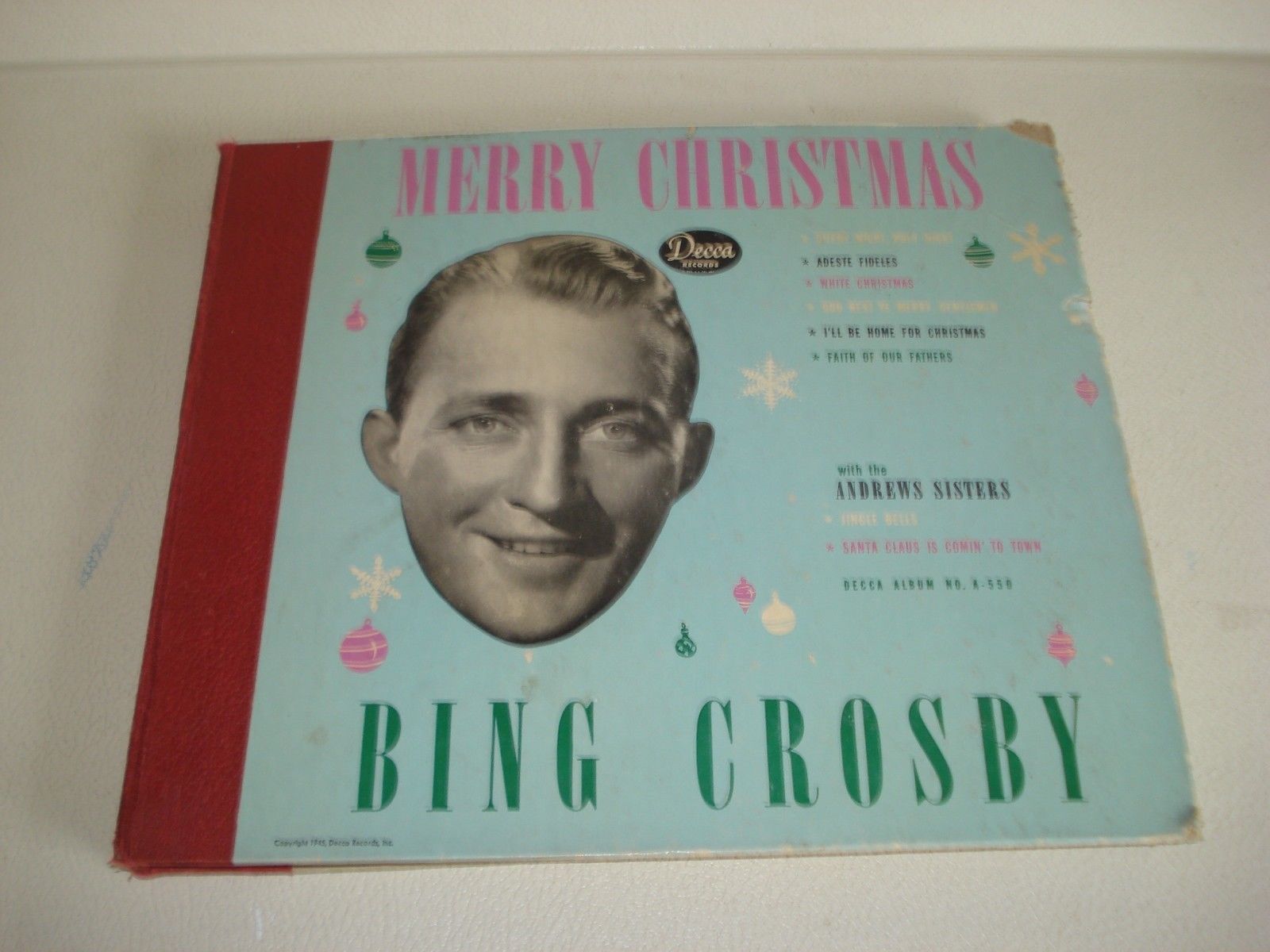
1940's BING CROSBY MERRY CHRISTMAS Decca Record Album A550 ANDREW SISTERS 78RPM
$
32


Favourite Auctions
To save auctions to your favourites, please login
If you don't have an account, please register
Description
Check out my other items! Be sure to add me to your favorites list! Don't miss out on our Great Sales!! (we will be posting many rare collectible books over the next several weeks, so please keep coming back and checking out our other items)
Four Record Set in Album Binder / or / Box Set BING CROSBY MERRY CHRISTMAS
Silent Night, Holy Night 23777 A L3026AA
Adeste Fideles Oh Come, All Ye Faithful 23777B L3025AA
White Christmas 23778A WL4374T4A
God Rest Ye Merry Gentlemen 23778B DLA3028-A
I'll Be Home For Christmas If Only In My Dreams 237793 A L3203A
Faith of Our Fathers 23779B L3027A
BING CROSBY with the ANDREW SISTERS
Jingle Bells 23281A L3199A
Santa Claus is Coming To Town 23281B WL3200T2A
Copyright says 1945 on front cover but inside it says 5-47 and in the write up by Budd Fielding White mentions things up to 1947
Vintage Records
Published by : Decca Records Personality Series
Condition: We do not know how to grade records so we will describe them. These records have not been tested. They are 10" 78 RPM, we believe they are shellac. The album cover / binder has a red spine, it has rubbing, scuffing, peeling at corners, two inch tear at edge, fraying, stains/dirtiness, binding is a bit loose. The inside cover has 3.94 written in corner and 1st sleeve is inscribed to previous owner with a date of 1949. The records themselves all seem in decent shape (including labels) look like they could use a light cleaning as they seem a bit smudged .
Please look at all of the pictures as sometimes it is possible we may have missed something.
Album will be carefully wrapped and shipped in a box.
A little Info from Wikipedia
Harry Lillis "Bing" Crosby Jr. ( May 3, 1903 – October 14, 1977) was an American singer and actor. Crosby's trademark warm bass-baritone voice made him one of the best-selling recording artists of all time, having sold over one billion analog records and tapes, and digital compact discs and downloads around the world.
The first multimedia star, from 1931 to 1954 Crosby was a leader in record sales, radio ratings, and motion picture grosses. His early career coincided with technical recording innovations such as the microphone. This allowed him to develop a laid-back, intimate singing style that influenced many of the popular male singers who followed him, including Perry Como, Frank Sinatra, Dick Haymes, and Dean Martin. Yank magazine said that he was the person who had done the most for American soldiers' morale during World War II. In 1948, American polls declared him the "most admired man alive", ahead of Jackie Robinson and Pope Pius XII. Also in 1948, Music Digest estimated that his recordings filled more than half of the 80,000 weekly hours allocated to recorded radio music.
Crosby won an Academy Award for Best Actor for his role as Father Chuck O'Malley in the 1944 motion picture Going My Way and was nominated for his reprise of the role in The Bells of St. Mary's opposite Ingrid Bergman the next year, becoming the first of six actors to be nominated twice for playing the same character. In 1963, Crosby received the first Grammy Global Achievement Award. He is one of 33 people to have three stars on the Hollywood Walk of Fame, in the categories of motion pictures, radio, and audio recording.
Crosby influenced the development of the postwar recording industry. After seeing a demonstration of an early Ampex reel-to-reel tape recorder he placed a large order for their equipment and convinced ABC to allow him to tape his shows. He became the first performer to pre-record his radio shows and master his commercial recordings onto magnetic tape. Through the medium of recording, he constructed his radio programs with the same directorial tools and craftsmanship (editing, retaking, rehearsal, time shifting) used in motion picture production, a practice that became an industry standard. In addition to his work with early audio tape recording, he helped to finance the development of videotape, bought television stations, bred racehorses, and co-owned the Pittsburgh Pirates baseball team.
Crosby was born on May 3, 1903 in Tacoma, Washington, in a house his father built at 1112 North J Street. In 1906, his family moved to Spokane, and in 1913, his father built a house at 508 E. Sharp Avenue. The house sits on the campus of Gonzaga University, his alma mater.
He was the fourth of seven children: brothers Larry (1895–1975), Edward (1896–1966), Ted (1900–1973), and Bob (1913–1993); and two sisters, Catherine (1904–1974) and Mary Rose (1906–1990). His parents were Harry Lillis Crosby Sr. (1870–1950), a bookkeeper, and Catherine Helen "Kate" (née Harrigan; 1873–1964). His mother was a second generation Irish-American.[18] His father was of English descent; an ancestor, Simon Crosby, emigrated to America in the 17th century, and one of his descendants married a descendant of Mayflower passenger William Brewster (c. 1567 – April 10, 1644).
In 1910, seven-year-old Harry Crosby, Jr. was forever renamed. The Sunday edition of the Spokesman-Review published a feature called "The Bingville Bugle". Written by humorist Newton Newkirk, The Bingville Bugle was a parody of a hillbilly newsletter, filled with gossip, minstrel quips, creative spelling, and mock ads. A Crosby neighbor, 15-year-old Valentine Hobart, enjoyed reading "The Bugle", and noting Harry's laugh, took a liking to him and called him "Bingo from Bingville". Eventually, the last vowel was dropped and the nickname stuck.
In 1917, Crosby took a summer job as property boy at Spokane's "Auditorium," where he witnessed some of the finest acts of the day, including Al Jolson, who held him spellbound with ad libbing and parodies of Hawaiian songs. He later described Jolson's delivery as "electric."
Crosby graduated from Gonzaga High School (today's Gonzaga Prep) in 1920 and enrolled at Gonzaga University. He attended Gonzaga for three years but did not earn a degree. As a freshman, he played on the university's baseball team. The university granted him an honorary doctorate in 1937.
On September 2, 1931, Crosby made his solo radio debut. Before the end of the year, he signed with both Brunswick Records and CBS Radio. Doing a weekly 15-minute radio broadcast, Crosby quickly became a huge hit. His songs "Out of Nowhere", "Just One More Chance", "At Your Command" and "I Found a Million Dollar Baby (in a Five and Ten Cent Store)" were all among the best selling songs of 1931.
As the 1930s unfolded, Crosby became the leading singer in America. Ten of the top 50 songs for 1931 featured Crosby, either solo or with others. A so-called "Battle of the Baritones" with singing star Russ Columbo proved short-lived, replaced with the slogan "Bing Was King". Crosby played the lead in a series of sound-era musical comedy short films for Mack Sennett, signed with Paramount and starred in his first full-length feature, 1932's The Big Broadcast, the first of 55 films in which he received top billing. He would appear in 79 pictures, and signed a long-term deal with Jack Kapp's new record company Decca in late 1934.
His first commercial sponsor on radio was Cremo Cigars and increasingly his fame spread nationwide. After a long run in New York, Bing went back to Hollywood to film The Big Broadcast and his personal appearances, his records, and his radio work substantially increased his impact. The success of his first full-length film brought him a contract with Paramount and he began a regular pattern of making three films a year. On radio, he fronted his own show for Woodbury Soap for two seasons and gradually his live appearances dwindled. His records produced hit after hit at a time when record sales generally were in decline because of the Depression. Critically acclaimed audio engineer Steve Hoffman once stated: "By the way, Bing actually saved the record business in 1934 when he agreed to support Decca founder Jack Kapp's crazy idea of lowering the price of singles from a dollar to 35 cents and getting a royalty for records sold instead of a flat fee. Bing's name and his artistry saved the recording industry. All the other artists signed to Decca after Bing did. Without him, Jack Kapp wouldn't have had a chance in hell of making Decca work and the Great Depression would have wiped out phonograph records for good."[36] His social life was hectic, his first son Gary was born in 1933 with twin boys following in 1934. By 1936, he'd replaced his former boss, Paul Whiteman, as host of the prestigious NBC radio program Kraft Music Hall, the weekly radio program where he remained for the next ten years. Where the Blue of the Night (Meets the Gold of the Day), which showcased one of his then-trademark whistling interludes, became his theme song and signature tune.
Also in 1936, Crosby exercised an option from Paramount to make a film out-of-house. Quickly signed to a one-picture agreement with Columbia, Crosby dreamt of having his icon and friend Louis Armstrong, an African-American, who largely influenced his singing style, in a screen adaptation of The Peacock Feather called Pennies from Heaven. Crosby talked to Harry Cohn about the matter, but he disagreed saying: "... no reason to entail the expense of flying him in and having no desire to negotiate with Armstrong's crude, mob-linked but devoted manager, Joe Glaser." Bing threatened to walk out on the film and refused to discuss it with Cohn. Armstrong's musical scenes, along with some comical dialogue as well, heightened his career. Bing also had it that Armstrong made high billing alongside his white co-stars, one of the first times ever for a black performer in a wide-audience film. He starred as himself in many more films to come and had a large appreciation for Bing's unracist views, often thanking him in his later years.
Crosby's much-imitated style helped take popular singing beyond the kind of "belting" associated with boisterous performers like Al Jolson and Billy Murray, who had been obliged to reach the back seats in New York theaters without the aid of the microphone. As Henry Pleasants noted in The Great American Popular Singers, something new had entered American music, a style that might be called "singing in American" with conversational ease. This new sound led to the popular epithet "crooner".
During the Second World War, Crosby made numerous live appearances before American troops fighting in the European Theater. He also learned how to pronounce German from written scripts and would read propaganda broadcasts intended for the German forces. The nickname "Der Bingle" was common among Crosby's German listeners and came to be used by his English-speaking fans. In a poll of U.S. troops at the close of World War II, Crosby topped the list as the person who had done the most for G.I. morale, ahead of President Franklin Delano Roosevelt, General Dwight Eisenhower, and Bob Hope.
The June 18, 1945, issue of Life magazine stated: "America's number one star, Bing Crosby, has won more fans, made more money than any entertainer in history. Today he is a kind of national institution." They also state: "In all, 60,000,000 Crosby disks have been marketed since he made his first record in 1931. His biggest best seller is White Christmas, 2,000,000 impressions of which have been sold in the U.S. and 250,000 in Great Britain." They go on to say: "Nine out of ten singers and bandleaders listen to Crosby's broadcasts each Thursday night and follow his lead. The day after he sings a song over the air – any song – some 50,000 copies of it are sold throughout the U.S. Time and again Crosby has taken some new or unknown ballad, has given it what is known in trade circles as the "big goose" and made it a hit single-handed and overnight." and "Precisely what the future holds for Crosby neither his family nor his friends can conjecture. He has achieved greater popularity, made more money, attracted vaster audiences than any other entertainer in history. And his star is still in the ascendant. His contract with Decca runs until 1955. His contract with Paramount runs until 1954. Records which he made ten years ago are selling better than ever before. The nation's appetite for Crosby's voice and personality appears insatiable. To soldiers overseas and to foreigners he has become a kind of symbol of America, of the amiable, humorous citizen of a free land. Crosby, however, seldom bothers to contemplate his future. For one thing, he enjoys hearing himself sing, and if ever a day should dawn when the public wearies of him, he will complacently go right on singing – to himself
The biggest hit song of Crosby's career was his recording of Irving Berlin's "White Christmas", which he introduced on a Christmas Day radio broadcast in 1941. (A copy of the recording from the radio program is owned by the estate of Bing Crosby and was loaned to CBS Sunday Morning for their December 25, 2011, program.) The song then appeared in his 1942 movie Holiday Inn. His record hit the charts on October 3, 1942, and rose to No. 1 on October 31, where it stayed for 11 weeks. A holiday perennial, the song was repeatedly re-released by Decca, charting another 16 times. It topped the charts again in 1945 and for a third time in January 1947. The song remains the bestselling single of all time. According to Guinness World Records, his recording of "White Christmas" has sold over 100 million copies around the world, with at least 50 million sales as singles. His recording was so popular that he was obliged to re-record it in 1947 using the same musicians and backup singers; the original 1942 master had become damaged due to its frequent use in pressing additional singles. Though the two versions are similar, the 1947 recording is more familiar today. After his death in 1977, the song was re-released and reached the No. 5 position in the UK Singles Chart in December 1977. Crosby was dismissive of his role in the song's success, saying "a jackdaw with a cleft palate could have sung it successfully."
Decca Records is a British record label established in 1929 by Edward Lewis. Its U.S. label was established in late 1934 by Lewis, along with American Decca's first president Jack Kapp and later American Decca president Milton Rackmil. In 1937, as a result of anticipating Nazi aggression leading to World War II, Lewis sold American Decca and the link between the U.K. and U.S. Decca labels was broken for several decades. The British label was renowned for its development of recording methods, while the American company developed the concept of cast albums in the musical genre. Both wings are now part of the Universal Music Group, which is owned by Vivendi, a media conglomerate headquartered in Paris, France. The US Decca label was the foundation company that evolved into UMG.
In 1942, American Decca released the first recording of "White Christmas" by Bing Crosby. He recorded another version of the song in 1947 for Decca; to this day, Crosby's recording of "White Christmas" for Decca remains the best-selling single worldwide of all time.In 1943, American Decca ushered in the age of the original cast album in the United States, when they released an album set of nearly all the songs from Rodgers and Hammerstein's Oklahoma!, performed by the same cast who appeared in the show on Broadway, and using the show's orchestra, conductor, chorus, and musical and vocal arrangements. The enormous success of this album was followed by original cast recordings of Carousel and Irving Berlin's Annie Get Your Gun, both featuring members of the original casts of the shows and utilizing those shows' vocal and choral arrangements. Because of the technical restrictions of recording on 78 rpm records, none of these scores were recorded totally complete; they were shorter than cast albums made after LPs were introduced. But Decca had made history by recording Broadway musicals, and the influence of these releases in the recording of theatrical shows in the U.S. continues to this day - in Decca's home country, the UK original cast albums had been a fixture for years. Columbia Records followed with musical theatre albums, starting with the 1946 revival of Show Boat. In 1947, RCA Victor released the original cast album of Brigadoon. By the 1950s, many recording companies were releasing Broadway show albums recorded by their original casts, and the recording of original cast albums had become standard practice whenever a new show opened.
The Andrews Sisters were an American close harmony singing group of the swing and boogie-woogie eras. The group consisted of three sisters: contralto LaVerne Sophia (July 6, 1911 – May 8, 1967), soprano Maxene Angelyn (January 3, 1916 – October 21, 1995), and mezzo-soprano Patricia Marie "Patty" (February 16, 1918 – January 30, 2013). Throughout their long career, the sisters sold well over 75 million records (the last official count released by MCA Records in the mid-1970s). Their 1941 hit "Boogie Woogie Bugle Boy" can be considered an early example of rhythm and blues or jump blues.
The Andrews Sisters' harmonies and songs are still influential today, and have been copied and recorded by entertainers such as Bette Midler, Christina Aguilera, Pentatonix, and others. The group was inducted into the Vocal Group Hall of Fame in 1998. Writing for Bloomberg, Mark Schoifet said the sisters became the most popular female vocal group of the first half of the 20th century. They are still widely acclaimed today for their famous close harmonies.
They recorded 47 songs with crooner Bing Crosby, 23 of which charted on Billboard, thus making the team one of the most successful pairings of acts in a recording studio in show business history. Their million-sellers with Crosby included "Pistol Packin' Mama", "Don't Fence Me In", "South America, Take It Away", and "Jingle Bells".
Edward Habib in the CD program notes for "Songs That Won the War Vol. 2 The Hollywood Canteen" states that the Andrews Sisters' radio transcription of Elmer's Tune was "so popular it even played on German radio," noting that "the opposition embraced the Andrews Sisters and their songs in the same way the Allied Forces adopted Lili Marlene."
Along with Bing Crosby, separately and jointly, The Andrews Sisters were among the performers who incorporated ethnic music styles into America's Hit Parade, popularizing or enhancing the popularity of songs with melodies originating in Brazil, Czechoslovakia, France, Ireland, Israel, Italy, Mexico, Russia, Spain, Sweden and Trinidad, many of which their manager chose for them.
FREE SHIPPING to the USA!International Shipping will be via USPS International 1st Class Package or USPS Priority Mail depending on the weight. USA Shipping is via USPS Media mail and will be properly professionally packed & boxed. New Jersey Residents must pay NJ sales tax.
Have fun Bidding, we have GREAT FEEDBACK so you can trust us.
Hey, Thanks for Looking! :)
price rating