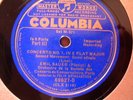
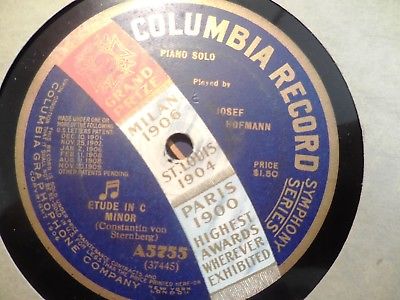
1915 JOSEF HOFMANN Piano Constantin v STERNBERG Etude/ Rachmaninoff Prel G Min78
$
40


Favourite Auctions
To save auctions to your favourites, please login
If you don't have an account, please register
Description
Please wait for me to send you an invoice. DO NOT USE EBAY CHECKOUT if you want the lowest possible postage.
Welcome to my auctions of great records
This is my FINAL WEEK of 2 weeks of great auctions – I WILL PACK AND BILL YOUR RECORDS after the close on NOV 11.
PLEASE DO NOT PAY before I send you an invoice. It will take me up to 48 hours to pack your records, but this is the ONLY WAY to get you the LOWEST POSTAGE. If you pay before I sent you an invoice, the EBAY system will charge you a HIGHER POSTAGE for shipping.
International shipping: approx postage 1x10"=$25: 1x12"=$35: 10"Album 4 Rec=50$: 12" Album 2 Rec=50$
HOWEVER in most cases I can get you SIGNIFICANT savings by using other services. Pls contact me for a quote.
About 30% less to Canada. Pls ignore international postage displayed in Ebay, rates are too high
Please wait for me to send you an invoice. DO NOT USE EBAY CHECKOUT if you want the lowest possible postage.
A series of great classical orchestral and instrumental performances by major conductors, composers and instrumentalists.
The two greatest pianists of the 20th century:
Josef Hofmann and Leopold Godowsky only left a paltry and scarce output on recorded music. Much a pity, since it does not enable us to always understand the superlative reviews of the period
Here in his early COLUMBIA recordings:
This is the first recording of Hofmann's friend and eminent piano teacher in the US, the russian born Constantin v STERNBERG: Etude in C Minor/ his other great friend and colleague: Rachmaninoff Prel G Minor
12" Columbia 78 rpm records
Condition: EXCELLENT minus, scuffs, plays quiet, w some crackle rare buzzing
"Perfect sincerity plus perfect simplicity equals perfect achievement." Thus wrote Josef Hofmann, that classicist among the Romantic pianists. In a day when many of the internationally famous keyboard virtuosos paralyzed the public with overwhelmingly sensational derring-do, Hofmann was chaste, controlled and simple, using relatively little pedal, letting his marvelous fingers do the work with clarity and the most pellucid of sounds. It was not that he was incapable of great bursts of sound when they were needed. But he represented aristocracy at all times, a musician blessed with an unerring ear, taste, and the ability to float lines that seemed to spin into infinity. His impact is hard to describe. But to those who heard him, including this writer, the finish and transparency of his playing, and the sheer perfection of his technique, somehow made all other pianists sound thick.
From the beginning, he was recognized as one of the greatest pianists in history. He was, of course, a prodigy. What great pianist has not been? But even here the young Hofmann was unique. Born in Poland in 1876, he studied with his father Casimir. At the age of 10, he came to New York and made his debut at the Metropolitan Opera House on November 29, 1887. He set the city and its music critics on their ears.
The consensus was unanimous. Such well-informed critics as Henry Krehbiel (1854 -1923, New York Tribune) and W.J. Henderson (1855 - 1937, New York Sun) could not believe what they had heard. This is no child, they wrote. This is piano playing equal to anything the world has to offer. Such was the excitement that within the space of about two months, little Josef gave fifty-two concerts. He had in his repertoire concerted works by Beethoven, Mendelssohn, Weber, and Liszt, plus of course a large repertoire of solo pieces.
After a while, people began to worry. What would this crazy schedule do to the health of a delicate-looking 10-year-old boy? A great fuss was made, and a philanthropist named Alfred Corning Clark offered Casimir the incredible sum of $50,000 to take the child away from the stage and not return until the age of 18. To give an idea of what $50,000 was worth in those days, a working man with a family of three was happy to be earning $500 a year.
Casimir grabbed the money and ran. The family settled in Berlin, where Josef studied first with Moritz Moszkowski (1854-1925) and then with the great Anton Rubinstein (1829-1894), the Russian Giant who was considered the greatest pianist after Franz Liszt (1811-1886). At age 18, Josef made his re-entry in a concert conducted by Rubinstein. He played his teacher's D minor concerto, a work that remained in his repertoire all his life. Then Hofmann started the concert life. He was not a trained monkey getting along on a limited repertoire. He worked and worked, building an immense backlog. He was especially popular in Russia. When he played in St. Petersburg in 1912, he gave twenty-one consecutive sold-out concerts. He did not repeat a piece, playing 255 different works. His memory was infallible, all the more amazing in that he seldom practiced. Once a work was in his fingers, it was there for good. As a matter of fact, he really did not need the music. He could hear a piece and immediately duplicate it on the keyboard, note for note.
No wonder Rubinstein called him a phenomenon such as the world of music had never before seen. Rosina Lhevinne (1880-1976) loved to tell the story of Hofmann's visit to Tbilisi, where her husband Josef (another all-time great pianist, 1874-1944) was teaching before World War I. They spent the afternoon together. At one point, Lhevinne played a piece that Hofmann did not know. Lhevinne told him it was the Liszt "Lorelei". "Play it again," said Hofmann. They then had dinner and escorted Hofmann to the concert hall. "He played wonderfully," recollected Rosina. "For his first encore he came out, winked at us, and played 'Lorelei' exactly as my Josef had done."
Hofmann lived in Berlin up to World War I. He moved to the United States, concertized, and also was a founding member of the Curtis Institute of Music, where he was head of the piano faculty in 1924 and then the school's director. He resigned in 1938. In 1937, he gave a Golden Jubilee Anniversary concert celebrating the fiftieth year of his American debut. At the Metropolitan Opera, with the Curtis Orchestra under the direction of Fritz Reiner (1888-1963), he played the Rubinstein fourth concerto, his own Chromaticon for piano and orchestra, and a large group of solo pieces. In Philadelphia the following April, he played a similar concert.
By that time, age was taking its toll. In addition, he had personal problems and started drinking heavily. By the middle of the 1940s he was an alcoholic, and that of course affected his playing. In 1946, he gave his last New York concert, and those who were there remember glorious moments and also several catastrophes. The formerly infallible Hofmann, that most perfect of pianists, was in sad decline. He died in Los Angeles in 1957.
His recording career was unusual. Hofmann was the first famous pianist ever to make a recording. In 1887, Edison, who had invented sound recording only ten years previously, invited the 10-year-old prodigy to his studio, where Josef made a few cylinders. Hofmann said that he had them until World War I, when his home in Berlin was destroyed by fire. An inventor as well as a pianist, the teen-age Hofmann was in constant communication with Edison, offering suggestions about improving the drive mechanism. In 1904, Hofmann made five records for The Gramophone Company in Berlin. From 1912 to 1923, he recorded a series for Columbia in America, and then, in 1924, he made some for Brunswick. All of these were acoustic (i.e., pre-electric) recordings. Hofmann never again made a commercial recording.
But he did make test recordings for RCA in America and for HMV in London in 1935 when he was still in his best form. There is also a brief 1940 American Columbia test. These are released here. Music lovers recorded on acetates some of his New York Philharmonic and other radio broadcasts and a concert he gave at Curtis in 1938 was also recorded. Thus there is available a rather sizable Hofmann discography. Too bad we do not have the equivalent from Rachmaninoff, who would never appear on a radio broadcast. Rachmaninoff and Hofmann were, incidentally, very close friends. Henry Pleasants, then a music critic at the Philadelphia Bulletin, once interviewed Rachmaninoff in the early 1930s. During the course of the meeting, he asked Rachmaninoff who he thought were the greatest pianists alive. Rachmaninoff thought for a while. "Well," he said, "there's Hofmann." He thought a bit more. "And there's me," he said. Then, according to Mr. Pleasants, "He closed his mouth and would not say another word."
In the last thirty or so years of his life, Hofmann's repertoire shrank. When he played on the radio, the general format was a movement of a concerto and then a solo group, all of a popular nature. Hofmann would select short pieces by Chopin, Schumann, or whomever, but never a complete sonata or any extended work. The feeling in those days was that a radio audience subjected to, say, Beethoven's Op. 111 (which Hofmann played inimitably) would develop brain fever and perish.
Thus on this release we get those short broadcast pieces - the Chopin nocturnes and waltzes, the Liszt "Liebestraum," and so on. Even a touch of Debussy with "Clair de Lune" - and how sweetly, unsentimentally, and colorfully Hofmann plays it! He plays two of his own pieces. Of special interest is the Hofmann "Berceuse," played once as a piano solo, and then with the violinist Efrem Zimbalist (1889-1985).
The best idea here of Hofmann in his prime comes from the 1935 test recordings and the 1938 Jubilee program in Philadelphia. Hofmann was still in his prime in all of these, and a good idea can be obtained of his sound and dynamics. The most interesting item from the RCA tests is the first movement of the Chopin B minor sonata. It unfolds easily and naturally, with the typical equilibrium between right and left hand (how he despised what he derisively called "right-handed pianists!"). The architecture is clearly defined, there is a transcendent lyricism, and the piece moves with an inevitable-sounding metrical steadiness relieved by delicate rhythmic adjustments. Hofmann, the great Romantic pianist, always had a classical streak in him. He was the coolest of the great Romantic pianists, even more so than Rachmaninoff. Those who equate Romantic style with egoism and "insane liberties" (as one uninformed American pianist put it) should be forced to listen to this aristocratic, elegant performance.
Equally fascinating is the performance of Chopin's "Andante Spianato e Grande Polonaise." Hofmann takes the "Andante" at a much faster tempo than is heard today, when tempos in general have slowed alarmingly. The prevalent feeling in recent years seems to be that slowness equals profundity. But Hofmann's tempos represent the faster, nineteenth-century tempos, as played by a pianist who was born only 27 years after Chopin's death. As Hofmann plays it, the music has ever so much more flow and charm and life and sparkle than in today's more sluggish tempos. And in the "Polonaise," he is coruscatingly brilliant. Every note is clear in this difficult virtuoso piece, textures never blur, and there is a grand sweep. Pianists who heard this performance must have come away from the concert asking themselves how he did it.
Tempos are also fast in the Beethoven E-flat sonata movement on the HMV disc. Here again we have nineteenth-century tempos. And here again we have Hofmann's classic precision, unflagging rhythm, and sheer joy of playing. Modern listeners, accustomed to much slower tempos, may be startled. In the Chopin F-sharp nocturne on the HMV recordings, Hofmann fits the fioritura into the bar, rather than lengthening the bar to fit the fioritura. Also on HMV are the two popular Chopin-Liszt transcriptions, which represent Hofmann at his very best. Again, it is appropriate to quote Hoffman: "Perfect sincerity plus perfect simplicity equals perfect achievement."
By the mid 1930s Josef Hofmann was regularly receiving inquiries from the world's leading record companies - would he be interested to make some records for their label? In most cases he didn't even bother to respond directly but had his manager, Richard Copley, send a one or two-sentence response to the effect that, thank you very much, Hofmann wasn't interested. If there is some piece of documentary evidence which conclusively explains why the pianist didn't want to make records, we haven't located it, and we can only speculate. Certainly in 1935 he was thinking about recording and releasing records, as the two groups of test recordings he actually made for HMV and RCA confirm. In fact, Hofmann later cited the HMV tests as particularly worthwhile examples of his playing. Many years later, EMI Ltd., parent company to His Master's Voice, thought about including these Hofmann discs in a volume of its LP series, "Great Recordings of the Century." Transfers were made from the original metal masters, but the proposed disc was never issued. As was that company's custom then, the masters were destroyed; the transfers here were taken from Hofmann's own carefully-preserved set of test pressings.
During the next few years his personal and professional life, then at the pinnacle of achievement, quickly and amazingly disintegrated. His wife's deteriorating condition and the sabotage he suffered at Philadelphia's Curtis Institute of Music were the main events which led him to a series of nervous and other breakdowns from which he never recovered. Through all this, paradoxically, his mind never wandered far from the idea of recording, and he made one test recording each for many different commercial record companies, always the same "selection," the test-pattern which contained several different kinds of piano writing in a short space. The piano sound captured on each of these test records is often exemplary, as on the Columbia example we issue here, but that didn't serve to seduce Hofmann into the recording studio. It was almost as if the pianist were more interested in the scientific problems of capturing piano tone, the most ephemeral of musical sounds, than in preserving his own playing. In his final years Hofmann experimented obsessively with differing and imaginative schemes for improving the sound of piano recording, making hundreds of amateur acetate recordings in his Los Angeles home, invariably of the same "test-pattern" - except for the one instance of the disc of the Gluck "MTlodie" from Orfeo ed Euridice.
By its uniqueness we can assume that the pianist/experimenter felt he had arrived at some point in his research worth preserving, and the unusual acoustic in which the performance is captured does seem particularly suited to the kind of super-legato, ethereal tone-spinning Hofmann gives the "MTlodie." Nor does the acetate disc bear, like many of the other home-made Hofmann acetates, any information about the details of the experimentation - perhaps the microphone was bolted to the sound board as in some of the other experiments Hofmann tried. The disc is not dated, but due to the physical appearance of the disc and to our ears, we believe it was most probably recorded in the late 1940s or even the early 1950s, disproving the canard often encountered that Hofmann lost his abilities and could never really play well again after the mid 1930s. He certainly could, if he was in the mood and sober.
Unfortunately for posterity, he was in particular distress on several of the later occasions when he broadcast for the Bell Telephone Hour. There were eight Hofmann Telephone Hour appearances between March 1, 1943 and the last on January 13, 1947, the bitter end of the pianist's career. Also, there was a promotional Bell Telephone/Hofmann film made in 1945 with some of the same selections but different performances from the broadcasts. On most of the later Telephone Hour broadcasts he should not have appeared. Adding to the unsatisfactory nature of the mostly prosaic, unmagical and even sometimes shockingly slipshod playing is the devastation wrought by the close microphone placement and excessive limiting which rob Hofmann in these recordings of his dynamic range, perhaps the most remarkable feature of his playing. Here everything sounds mezzo-forte, and no subsequent engineering can replace what has been lost. In this volume we have included seven selections from these Telephone Hour appearances.
We end this note on a dream: Just before his final problems began Hofmann was regularly broadcasting for other sponsors and perhaps some of these broadcasts were recorded - we hope someone someday locates such acetates - for instance, it would be important to find discs of the January 24, 1937 Ford Sunday Evening broadcast on which he played Liszt's Polonaise in E Major and the 12th Hungarian Rhapsody. Each year that passes dims these dreams, and there has been no "find" of Hofmann off-the-air recordings for more than ten years. Perhaps one could sponsor a project to search out such recordings of Hofmann and several other great artists of the time, and who knows, the discs thus uncovered might pass into the hands of enlightened guardians of history's musical heritage and see wide distribution, actually serving to illuminate and perhaps delight the public and posterity!
More Great Records on sale right now:
http://shop.ebay.com/carsten_sf/m.html
http://shop.ebay.com/carsten_sf/m.html
====
A Quick NOTE ON GRADING AND SHIPPING:
As you can see from my feedback, I try hard to earn your POSITIVE FEEDBACK and FIVE STAR RATINGS.
If for any reason your transaction was NOT SATISFACTORY, pls contact me and I will work something out with you. YOU WILL NEVER HAVE A REASON TO GIVE ME A NEGATIVE RATING or a LOW STAR RATING.
Quick note on grading:
The Grade (Excellent to Poor, I don't give Mint) refers to the WEAR of the record. Any other defects are stated separately
When I listen to a record, I may also give it an aural grade (again E to P), and make a SUBJECTIVE judgment of the pressing quality for hiss and surface noise.
"SUPERQUIET" is basically noiseless, like a vinyl pressing.
"VERY QUIET" is an exceptionally quiet record for a given pressing.
"Quiet" is a record that is a great example without undue noise for a give pressing.
These judgments are SUBJECTIVE and will depend one the styli, phonograph etc. you use on your own equipment.
Pls check my other auctions for more great records and phonograph items:
Multiple item shipping: I am happy to combine items for shipment in one parcel.
If you win multiple items, pls send me an INVOICE REQUEST to calculate the correct postage. Ebay check out will not give you the multiple item discount!
Records will be packed safely between corrugated cardboard in a sturdy box with plenty of padding for safe shipment.
Shipment is usually Media Mail, unless you request another service. Shipping is at your risk, I will be happy to insure items at your cost.
I charge actual postage plus a small fee for packing materials
As always, I guarantee your satisfaction. If you don't like the item, just return it, and I will refund the full purchase price.
If you are in the San Francisco area, I encourage pick-up in person.
US Domestic Shipping:
Here is a guideline for US Media Mail Shipping:
Prices below are for regular 78 rpm records. Up to about 5 records, I will ship Edison Discs for the same rates. Albums from Album Sets count as 1 record. Above that and for international shipments, it will be actual weight plus a small packing charge (1-3$ depending on size of shipment)
1 record: 4.75 – 5.00$
2 records: 6.00$
5 records: 7.50$
10 records: 10.00$
MANY MORE RECORDS: Don't worry. I safely ship 40 - 50 pounds of records double boxed in moving boxes, and even then Media Mail will probably not exceed 35$.
Please send me a message if you would like to lower your shipping rates!
I am very happy to ship records worldwide.
Please use the EBAY shipping cost only as a guideline. My actual charges are usually lower
One record usually ships for 25 – 28$ for 10" 35$ for most 12" records (Less for Canada).
I can get SIGNIFICANTLY LOWER rates from FedEx and the US Postal service for any kind of parcel weight, and will make use of all the cost-saving shipment methods
Pls contact me for a shipping estimate, or send me an invoice request after close of auction.
AND AGAIN -THANK YOU FOR YOUR INTEREST
As you can see from my feedback, I take great care in presenting, grading and shipping your items. I really want you to be happy with the purchase. If you feel that anything is wrong with the item or the shipping, contact me and we will work it out !!!
As always, I would appreciate any suggestions and corrections from you, pls contact me with any question.
Thank you very much, and good luck bidding !!!
price rating