ROLING STONES 'LET IT BLEED' BLOOD RED VINYL RARE LIMITED 1977 DUTCH PRESSING
$
47
Favourite Auctions
To save auctions to your favourites, please login
If you don't have an account, please register
Description
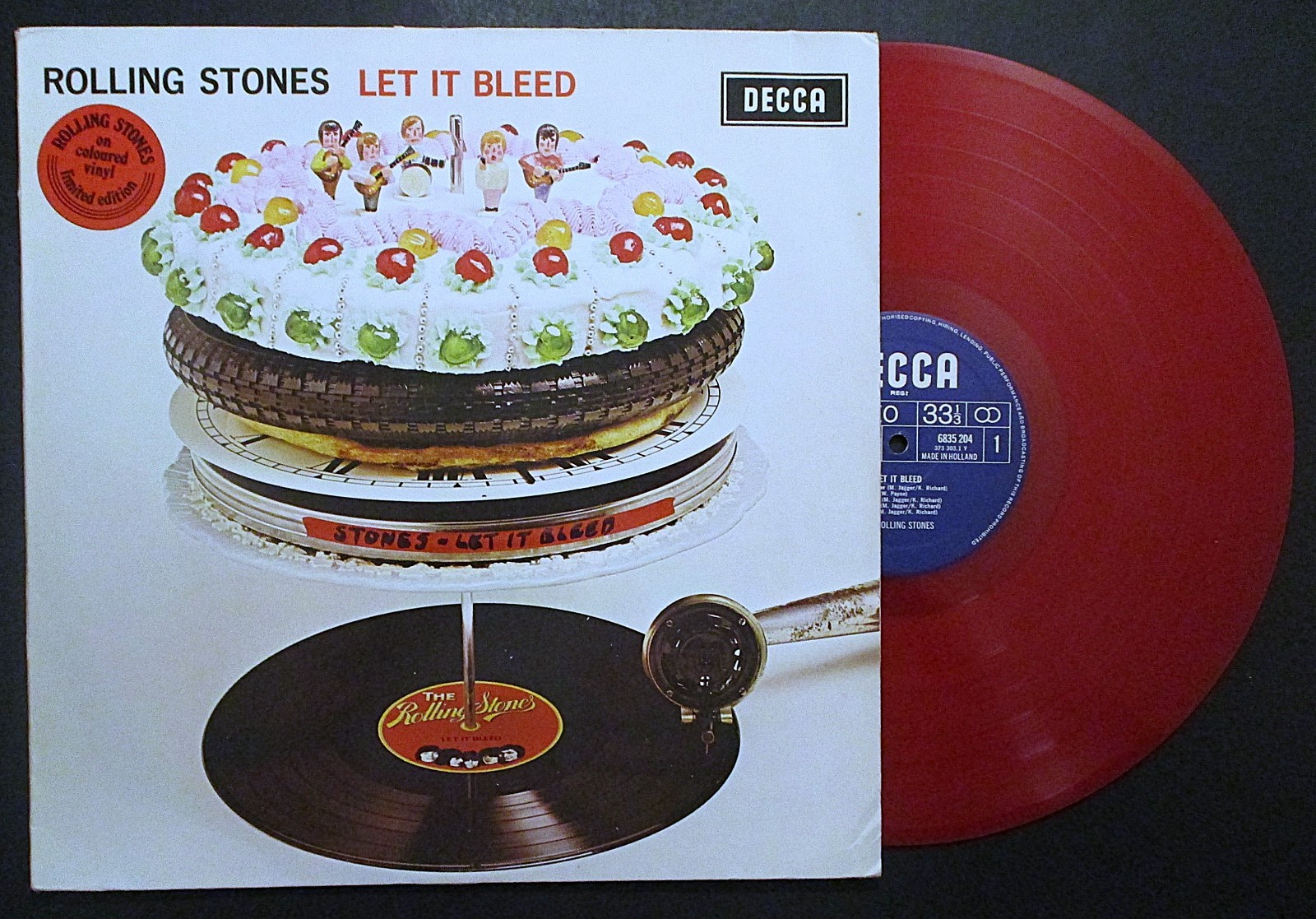
THE ROLLING STONES "LET IT BLEED" RARE LIMITED EDITION DUTCH PRESSING ON BLOOD RED VINYL LABEL: DECCA 6835 204 COUNTRY: HOLLAND ~ THE NETHERLANDS RELEASED: NOVEMBER 29th, 1969 (US) DECEMBER 5th, 1969 (UK) THIS PRESSING RELEASED: SUMMER OF 1977 PRESSED ON BEAUTIFUL BLOOD RED VINYL RECORDED: OLYMPIC SOUND STUDIOS ~ LONDON MASTERING & MIXING: SUNSET SOUND/ ELEKTRA STUDIOS ~ LOS ANGELES RECORDING ENGINEER: GLYN JOHNS PRODUCER: JIMMY MILLER LACQUERS/MASTERS CUT AT PHONODISC B.V. ~ BAARN, HOLLAND ( 'Y' & '670' IN MATRIX) PRESSING: PHONOGRAM PHONODISC B.V. ~ BAARN, HOLLAND LABEL CATALOG NUMBER: 6835 204 ~ 373 303.1/.2 Y ALBUM COVER ART & LINER DESIGN: ROBERT BROWNJOHN POSTER DESIGN: VICTOR KAHN MATRIX (SIDE A): (Stamped) AA 373 303 1Y3 ℗1969 670 1 2 06 MATRIX (SIDE B): (Stamped) AAA 373 303 2Y2 ℗1969 670 1 2 06
CONDITION: VINYL: VG++ JACKET: VG+ POSTER/INNERS: VG++ ~~~~~~~~~~~~~~~~~~~~~~~~~~~~~~~~~~~~~~~~~~~~~
I've been going thru my large vinyl record collection over the past few weeks and pulling out some LPs that I thought that someone else would want for their collection. I've been collecting records for nearly 50 years and it's time to pass some of them on to the next generation of collectors.
After all, we are just temporary 'caretakers' of these musical gems until the next owner and next collection takes them in.
This week on EBay I am offering up this rare 1977 Dutch, Limited Edition Pressing of the classic 1969 Rolling Stones album 'Let it Bleed', pressed on Blood Red vinyl and complete with the original Poster and pink inner sleeve.
This is my personal, original, copy that I purchased 'new' back in early 1978, shortly after its release, and has remained in my record collection ever since.
I've taken great care of this record for nearly 50 years now. It's been poly-line sleeved, inside and out, since I purchased it, stored properly in my collection, and it's still in great, very clean, original condition.
Please read the full description of this album's content, recording history, fantastic album cover, and details on the record's condition below. ~~~~~~~~~~~~~~~~~~~~~~~~~~~~
This is a nice, clean, fantastic sounding Dutch pressing, basically an 'Audiophile' pressing at the time, newly mastered by Phonodisc B.V. and pressed by Phonogram/Phonodisc in Baarn, Holland.
This was basically a new, high-quality repressing at the time, but designed to look like the original UK first pressings, right down to the thin European style jacket. It included the original fold-out poster, and the pink inner sleeve with the 'errors' on it.
Early pressings had 'Love in Vain' by Robert Johnson falsely credited to Woody Payne. Keith had heard this song on a bøøtleg of unreleased blues songs at the time, and initially thought it was by Woody Payne, the name on the bøøtleg, and used that for the credits. The proper credits were soon corrected, but this Dutch pressing uses the older original version of the sleeve.
The song 'Gimme Shelter' was originally listed as 'Gimmie Shelter' on the back cover and on the labels. This was also corrected early on, but this pressing still uses the 'Gimmie' title.
The original pink inner sleeve credited 'Mary Clayton', not 'Merry Clayton' for her vocals on Gimme Shelter. Backing Vocalist Nanette Workman was also wrongly listed as 'Nanette Newman' on early pressings. This Dutch pressing uses those early names.
The address for London Records at the bottom of the back cover is also the early 9 Albert Embankment, London location.
Odd that this 1977 Dutch re-issue would use the old style, but they were trying to replicate the UK original as close as they could, just update it with improved sound and blood red vinyl. It's actually very cool, and a fantastic looking and sounding record. ~~~~~~~~~~~~~~~~~~~~~~~~~~~~~~~~~
THE SOUND ON THESE 70's DUTCH PRESSINGS
Although the Rolling Stones aren't known for their audiophile sound, especially on their late 60's albums when their music could be heavy, dense, muddy and murky at times, these Dutch pressings sound stellar.
This album was newly mastered, freshly re-cut, re-plated, and pressed by Phonogram/Phonodisc B.V. in Baarn, Holland, one of the better pressing plants in Europe at the time.
It sounds amazing and was the best sounding pressing of 'Let it Bleed' available at the time, one of the reasons I purchased the whole series of 6 or 7 albums that they did back then.
The original master recording of "Midnight Rambler' always sounded a bit 'muddy'; always has, always will, but the rest of this album sounds clear, bold and punchy, with great separation, and plenty of depth and bite.
This fantastic sounding Dutch pressing reveals just how deeply layered, dynamic and intense the Rolling Stones music was. The soundstage is nicely balanced, deep, and 3D wide, typical of Stones mixes, with lots of hard panning of guitars and separation of the instruments.
It has great presence and sounds like a live studio recording!
'Let it Bleed' sounds fantastic, exactly how you would want it to sound, and expect it to sound; heavy, powerful, vibrant and very dynamic, with lots of punch.
The drums & guitars sound great; loud, bold & punchy - perfect. Merry Clayton's powerful voice on 'Gimme Shelter' sounds amazing. But the album also sounds warm, intimate, and sensitive where it should, on the mellower tracks, like Keith's 'You got the Silver' and on that amazing chorus on 'You Can't always get...'
This is an amazing sounding pressing; well mastered, sounds great, and all pure analog, not even a thought of anything digitally sourced.
Follow Jimmy Miller's suggestion on the inner sleeve and PLAY LOUD! ~~~~~~~~~~~~~~~~~~~~~~
This album has been repressed, re-released, and remastered over the years, but as a Rolling Stones fan and Stones vinyl collector, this is one of the copies you want; a very well made Dutch pressing of one of the band's classic albums, on beautiful, appropriate, 'Blood red' vinyl, and in great, wide, punchy, all analog sound, complete with the original clean poster and unique pink inner sleeve.
This is a fantastic record to add to any Rolling Stones classic Rock collection. ~~~~~~~~~~~~~~~~~~~~~~~~~~~
In terms of both performance and recording quality, the music here represents the full ferocious sound of the Stones in their early prime, recorded and released as the turbulent sixties came to a close.
For years, the Stones had been called the World's Greatest Rock'n'Roll Band, but if that designation ever applied, it was here on 1969's 'Let it Bleed'.
'Let it Bleed' is one of the very best, greatest, rock ’n’ roll albums of the late 60's. Nothing else in the Rolling Stones catalog comes close to touching it for it's musicianship, attitude, and classic dark heavy powerful sound. ~~~~~~~~~~~~~~~~~~~~~~~~~~~~~~~
THE RECORDING OF LET IT BLEED
'Let it Bleed', the 8th American studio album by the Rolling Stones, was recorded mostly in the Summer and Fall of 1969 at Olympic Sound Studios in London.
Some early recording sessions took place at Olympic in November 1968, before 'Beggars Banquet' had even been released, where the Stones laid down the basic track for 'You Can't Always Get What You Want', but the main recording sessions for 'Let It Bleed' began in earnest at Olympic in February 1969 and continued sporadically thru the summer.
'Let it Bleed' was originally scheduled to be released in July 1969, to coincide with the upcoming American tour, but there were numerous delays, mainly due to the sudden death of Brian Jones that month on July 2, 1969.
After various unexpected delays, the final mixing and overdubs for the album were done in October 1969 at Sunset Sound Studios and Elektra Sound Recorders Studios in Los Angeles, while the band were preparing and rehearsing for the upcoming infamous 1969 American tour.
Final work done on the album in L.A. included some fantastic overdubs by guest musicians including Merry Clayton (on "Gimme Shelter"), Byron Berline (on "Country Honk"), and Bobby Keys and Leon Russell (on "Live with Me"). The Doors recording engineer Bruce Botnick was involved with some of the final mixing and sound at Elektra Studios. ~~~
The recording was produced and overseen by Jimmy Miller, whose keen ears, excellent 'feel' for the Stones' music, and wise production suggestions gave the album a powerful, sharpened sonic focus.
As with most all Stones records, Mick and Keith were completely in charge and really produced the record themselves, but Jimmy Miller still made significant contributions and even plays percussion on a song or two, famously replacing Charlie Watts on drums on 'You Can't Always Get...'.
Once again, The Rolling Stones chose recording engineer Glyn Johns, who had worked on every Stones album since 1965, to capture what they were creating and get it all down on tape.
Glyn noted that 'Let it Bleed' contained "a significant leap in sound quality" compared to the generally muddy sound of their previous album 'Beggar's Banquet'. ~~~~~~~~
'Let it Bleed' was finally released in the States on November 29th, 1969 near the very end of the Stones' iconic 1969 American Tour and just a few days before the infamous Altamont Concert.
'Let It Bleed' was a popular record and sold well. It reached #1 on the UK Charts, kicking the Beatles' 'Abbey Road' out of that spot, and hit #3 on the US charts. ~~~~~~~~~~~~~~~~~~~~~~~~~
BRIAN JONES ON 'LET IT BLEED'
'Let it Bleed' was the last Rolling Stones album to include any contributions from the band's multi-talented original guitarist and founder Brian Jones.
A talented multi-instrumentalist, Jones had previously contributed extensively on guitar, forming an integral part of the Stones' dual-guitar sound that was central to the band's chemistry, but by the early summer of 1969, that relationship wasn’t working anymore, and Brian Jones' flame was quickly fading out.
Brian had become increasingly unreliable in the studio due to his heavy substance abuse and significant mental health issues.
During most recording sessions he was either absent physically, a no-show, or, if he was present in the studio, he was frequently too mentally distracted and incapacitated, or too stoned and intoxicated to contribute anything musically or meaningfully.
Brian was becoming a problem, a liability, and getting in the way of the band's music and creative process.
On June 8, 1969, in the midst of recording sessions for this album, Mick, Keith and Charlie met with Brian Jones at his home in Cotchford Farm and informed him he had to leave the group. They then issued a press statement that Brian Jones was leaving the Rolling Stones.
Less than a month later, on July 2, 1969, the once talented Brian was found dead, floating in his swimming pool at Cotchford Farm. "Death by misadventure".
Brian Jones barely appears on 'Let it Bleed', just playing backing instruments on two tracks; the autoharp on 'You Got the Silver', and Congas & percussion on 'Midnight Rambler'. Neither contribution is particularly significant.
Even as founder Brian Jones was slowly exiting the band, Mick Jagger and Keith Richards were hard at work reshaping the Stones’ sound, sensibility and direction. Most Rolling Stones fans would agree that Brian was an unreliable distraction and that his departure significantly improved the band's group dynamics.
ENTER MICK TAYLOR ON GUITAR
Keith Richards was the band's sole guitarist during most of the 'Let it Bleed' recording sessions, being responsible for nearly all of the rhythm and lead parts, so the first thing the band did was seek out a new guitar player to take some work load off of Keith.
On May 14th, 1969, Mick Taylor, who was fed up with John Mayall & the Bluesbreakers, auditioned for the Rolling Stones at Olympic Studios. He was instantly hired and joined the Rolling Stones' recording sessions.
Since Mick Taylor was hired after principal recording was completed on many of the tracks, Mick only plays guitar on two tracks on 'Let it Bleed'. He contributed some overdubs to 'Country Honk' and played slide on 'Live with Me' during those May 1969 London Olympic Studios recording sessions.
Taylor also played some great guitar on 'Honky Tonk Women', the non-album single, recorded during the 'Let It Bleed' sessions and released as a stand alone 7" 45 in July 1969.
Although he is only featured on 2 songs, Taylor is in top form with his inventive guitar work. His playing is amazing and he faithfully captures the attitude, style, and sound of the Stones, but also adds his own distinctive sounds and flavors. His technically proficient playing gave the band a harder rock sound during the late 1960s and early 1970s.
'Let it Bleed' marked the Stones vinyl debut of Mick Taylor and the incarnation of the new 'Mick Taylor era', which is considered by many to be the band's prime recording and performing period.
The three year period lasting from 1969 through 1971 represents the band at their absolute finest form. This is when they really earned the title “The Greatest Rock and Roll Band on Earth.”
This album is an essential part of the Rolling Stones' amazing string of 4 great albums in a row, from 1968's 'Beggars Banquet' the following year's 'Let It Bleed', on through 1971's 'Sticky Fingers' and 1972's 'Exile on Main Street'. One of the greatest four-album runs in the history of rock music. ~~~~~~~~~~~~~~~~~~~~~~~~~~~~~~~~~~~
'LET IT BLEED''S DARK ASSOCIATION WITH ALTAMONT
In many ways, 'Let it Bleed' is linked to many changes for the Rolling Stones. It will forever be associated with the death of Brian Jones, the addition of new guitarist Mick Taylor, the end of the tumultuous 1969 American tour, the dark tragedy of Altamont, and the end of the sixties in general.
More than anything else, this album, and it's dark, heavy music, will always be closely associated with the violence and tragedy of Altamont.
'Let it Bleed' was released on November 29th, 1969 near the end of the Stones' 1969 American tour and just a few days before the infamous Altamont Concert.
At the end of the official '69 Tour in Palm Beach Florida, instead of returning home to England, the newly restructured band, with Brian Jones out and Mick Taylor in, was already thinking ahead about their next step and immediately got to work on their new album, what would become "Sticky Fingers".
From Florida, they decided to drive up to Muscle Shoals Sound Studios in nearby Florence, Alabama, where over three days, December 2-4, 1969, the tight, energized and revitalized band managed to record Mick's new song 'Brown Sugar', Keith's new 'Wild Horses' and a rough version of 'You Gotta Move', three terrific songs that sounded nothing like the songs on 'Let it Bleed' and would form the heart and core of their new album.
While at the studio, pleased with their progress, the band decided to give a final 'free concert' for American fans and decided on performing it in San Francisco. The band then flew from Muscle Shoals to San Francisco, on December 5th.
The Stones intended to offer fans a fun, light-hearted, final 'free concert' in San Francisco to celebrate the end of the tour and the spirit of Haight Ashbury, but things didn't work out that way.
After some last minute changes, on December 6, 1969, The Rolling Stones headlined the infamous free concert at the Altamont Speedway in Livermore, California, playing in front of 300,000 fans.
What was intended to be a fun free concert turned out to be a disaster. The Hell's Angels, unwisely hired by someone as 'security', and paid with large amounts of alcohol, disrupted various opening group's performances, clashed with the audience and fans, and a concertgoer ended up being stabbed to death and murdered right in front of the Stones while performing on stage.
The real-life violent murder of concert attendee Meredith Hunter left Mick Jagger and the band badly shaken.
The murder, bad vibes, and turmoil of Altamont was all over the media, and a lot of unhappy fans and the press unfairly blamed the Stones for how Altamont turned out, making them scapegoats.
The media and many conservative Americans associated the Rolling Stones' dark, heavy music and songs like 'Sympathy for the Devil' with the murder and mayhem of Altamont, the socio-political problems facing the country, and all that was 'wrong' with America, it's youth, and the music they listened to.
The new album, 'Let it Bleed', released just days earlier, didn't help. Songs like 'Midnight Rambler' and 'Gimme Shelter' just added fuel to the controversy.
The public opinion of the Rolling Stones and their music at the end of 1969 created a dark image and bad reputation that they had a hard time shaking off.
The band was in dire need of a reset, and a new direction in order to downplay their evil, 'Bad Boy' image and shake off the bad press that had come in the wake of the turbulent 1969 U.S. tour and it's tragic ending at Altamont.
The Stones set out making their next album, completely changing their sound and style, and never looked back, never wrote any more songs that were as dark, heavy and political as what was on 'Let it Bleed'.
For the Stones, 'Let it Bleed' was truly the end of an Era, the end of their dark, heavy sound, and the end of the sixties.
The Rolling Stones next album, the iconic 'Sticky Fingers' still contained powerful rock songs like 'Bitch', 'Brown Sugar' and 'Sway', as well as American Blues & Country songs like 'Dead Flowers', 'You Gotta Move', and 'Moonlight Mile' but they forever abandoned their heavy political songwriting.
The release of 'Sticky Fingers' in the Spring of 1971 put the Stones back on track and they rose like a phoenix from their past troubles. ~~~~~~~~~~~~~~~~
THE STONES IN THE LATE 60's AND THE ROAD TO 'LET IT BLEED'
In 1966 The Stones released 'Aftermath', their first album of all original material. It was a strong album full of Stones swagger, musical mojo and urban blues.
The band were heading in a powerful new direction, but then followed up 'Aftermath' with their two weakest studio albums of the 1960's; 'Between The Buttons' and 'Their Satanic Majesties Request'.
In the wake of the 1967 drug busts that ensnared Jagger, Jones and Richards, they became linked to the emerging hippie counterculture and decided to record a psychedelic album, the odd 'Satanic Majesties Request', which alienated many of the loyal fans they had gathered during the British invasion.
Most fans and critics frowned upon the Stones' detour into psychedelic rock and the flower power scene of 1967.
Their next album, 1968's 'Beggars Banquet' was a huge step in the right direction for the Rolling Stones. It reclaimed the sound and style they had lost with 'Satanic Majesties' and put them back into a favorable spotlight with rock fans, critics and the music press.
'Banquet' steered away from psychedelia and mod pop-rock, renewing their original focus on rock based blues music, all while retaining their dark, counter-culture, bad boy image. 'Banquet' also added some lighter country and acoustic blues accents. It put the Rolling Stones back in the forefront of rock n roll, and all eyes were upon them for a worthy follow-up.
'Let It Bleed' was a worthy successor to the groundbreaking 'Beggars Banquet' and found Richards and Jagger expanding and extending the rock and blues feel of 'Banquet' into slightly darker, harder-rocking, and more demonically sexual territory.
'Let it Bleed' was a dark, heavy rock album, a stark contrast to the preceding 'Pop' and 'flower power' movement of just a few years earlier.
Before 'Let it Bleed', the Stones seemed perfectly content to write catchy rock songs that smirked about the establishment, middle class hypocrisy, sexual frustrations, and traditional boy/girl romances.
Inspired by a new sense of outrage and political awakening in the band, the songs on 'Let it Bleed' were new powerful statements and anthems about the sociopolitical turmoil and unrest that was going on in the late 60's; The Viet Nam war, Civil rights unrest, assassinations of Robert F. Kennedy and Dr. Martin Luther King, student campus uprisings, urban riots, and other happenings. ~~~~
The Rolling Stones' Let It Bleed' was a highly acclaimed, dark masterpiece that mirrored the violent ’60s milieu in which it was created.
The album's turbulent, but potent sound reflects the tumultuous and violent times, as well as the general socio-cultural collapse that was happening in the late 1960s.
Stones biographer Stephen Davis said of the album "No rock record, before or since, has ever so completely captured the sense of palpable dread that hung over its era."
The music on 1969's 'Let it Bleed' focuses on the powerful, timeless theme of human struggle, and offers insight into the human experiences of betrayal, compromise, acceptance of imperfection, and the constant struggle to get what one wants. Ideas that continue to resonate with listeners today and are still as relevant as they were in the late 60s.
This album is about the realities of life, the acceptance of flaws and bad situations, and especially the need to make do with what you have.
The Stones have always been more realistic about the world as it is, and some of their best songs often contained insightful social commentary on real life situations. The real world isn’t as pretty as you’d like it to be. ~~
'Let it Bleed's bold violent and sexual themes also have a much larger presence than they did on earlier albums. It's a raw and dark record, containing songs about rape, murder, serial killers, dive bars, sex and drugs.
Despite a new heavier sound, the personalities and essence of the band that fans came to know and love in the mid-60's is still present; They are still thrill-seeking, swaggering young studs, rebellious counter-culture hoodlums, hard-partying socialites, unashamed womanizers and harem keepers, and travelers in the fast lane of life, but the album explores these bad-boy roles with darker, heavier, more aggressive, more challenging music.
The album is still considered one of the Stones' best. Many critics and fans view 'Let It Bleed' as the Stones' creative zenith, a definitive album full of great songs that represents their most creative, complex, and sophisticated work.
For over 55 years now, this has been many Rolling Stones fan's favorite album and a definitive work that solidified their importance in the music history of the late 60's. ~~~~~~~~~~~~~~~~~~~~~~~~~~~~~~~~~~~~
STYLES ON LET IT BLEED
'Let It Bleed' contains multiple different sounds of the late ‘60s, blended with outstanding vocals and instrumental work that make it a fantastic, rich, full listening experience.
Despite being made by a British rock band, the album includes distinct American influences and embraces a perfect mix of American musical styles, borrowing from delta & country blues, gospel, R&B, rock, soul and country. These styles are all deeply ingrained into the sound and feel of 'Let It Bleed'.
The Stones were creating their own unique sound, and enjoying themselves in the studio when they created this classic album, but it's also clear that they were aware of, and listening to, the current music going on around them at the time. On 'Let it Bleed' you can hear the rich psychedelic rock of 'Revolver', the country balladry of 'Highway 61 Revisited' and, in places, the Stones' music even shares a similar sense of brutality with that of The Velvet Underground.
While this is still a solid heavy rock'n'roll record, the key to its success is the deep, wide, mixing pot of influences which give each track a flavor of its own, and makes for a fantastic, free-flowing track list that has aged beautifully over the years.
'Let it Bleed' is a timeless album, essential listening, and a prime example of what made this group the "Greatest Rock and Roll Band in the World."
“Let It Bleed” is so good that it can easily be a stand alone ‘best of’ album. It’s a triumph of sound and sheer power, one of my all time favorite, top-5 Stones albums, and a true classic.
The Rolling Stones have rarely done anything better. ~~~~~~~~~~~~~~~~~~~~~~~~~~~~~~~~~~~~~~~
THE ALBUM COVER AND PACKAGING FOR "LET IT BLEED"
The original working title of 'Let it Bleed' was "Automatic Changer", a name chosen to reflect the quick, sudden, but relatively smooth change the band had gone thru with the firing of Brian Jones and the hiring of Mick Taylor.
For the album cover, Mick Jagger originally wanted use the popular artwork of graphic artist M.C. Escher, whose strange drawings often showed changes or 'transitions' from one form, or one point of view, to another.
It would have made a terrific, trippy, pop-art album cover, but Escher, not wanting to be associated with a violent, drug-taking, rock band, turned the Stones down.
Keith Richards then hired his friend, graphic artist Robert Brownjohn, to design the new album cover.
Keith told Brownjohn that the record title was "Automatic Changer" and that he wanted a 'cake' theme that represented an automatic record-changing turntable, a record player that could play a tall stack of records, one after another, without interruption.
Robert Brownjohn took Keith's suggestion and ran with it. The result is the bizarre musical "cake" seen on the album cover.
Brownjohn hired, then unknown, London home economist Delia Smith to create the actual cake part of his surreal sculpture. She went on to become a popular British TV chef and food writer.
Although the title of the album had changed to 'Let it Bleed', the band loved Brownjohn's 'Automatic Changer' theme and sculpture and went with it.
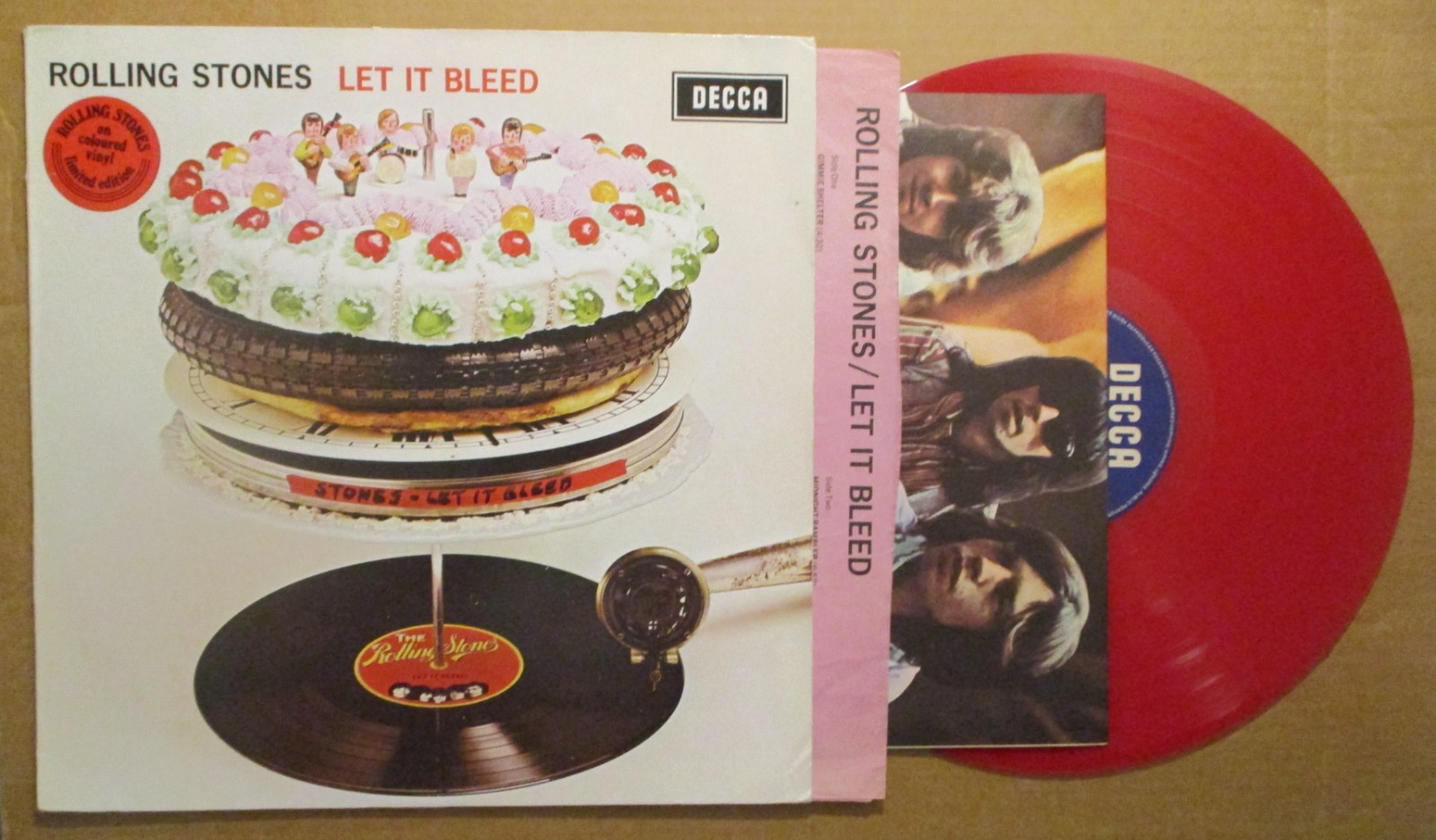
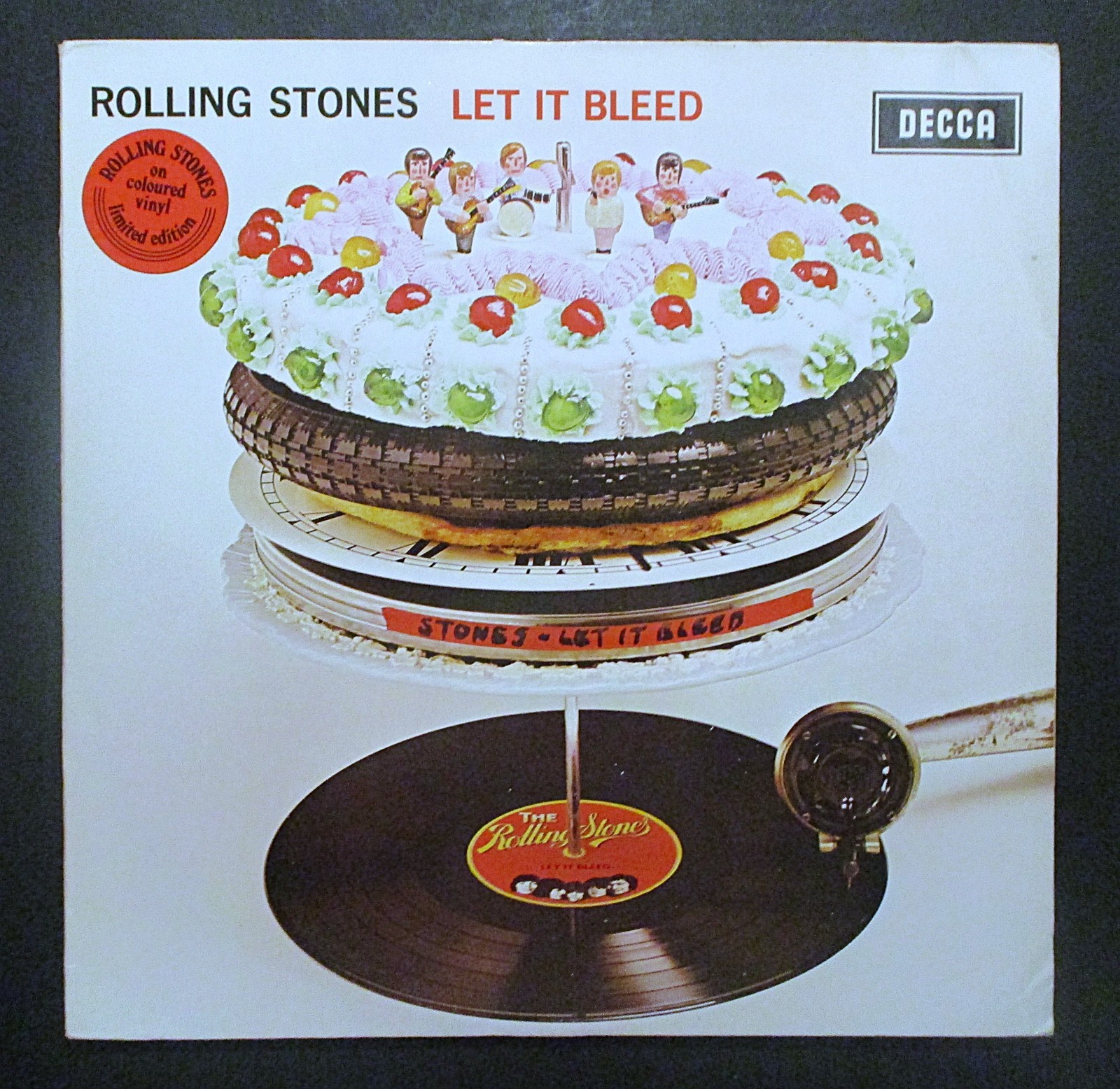
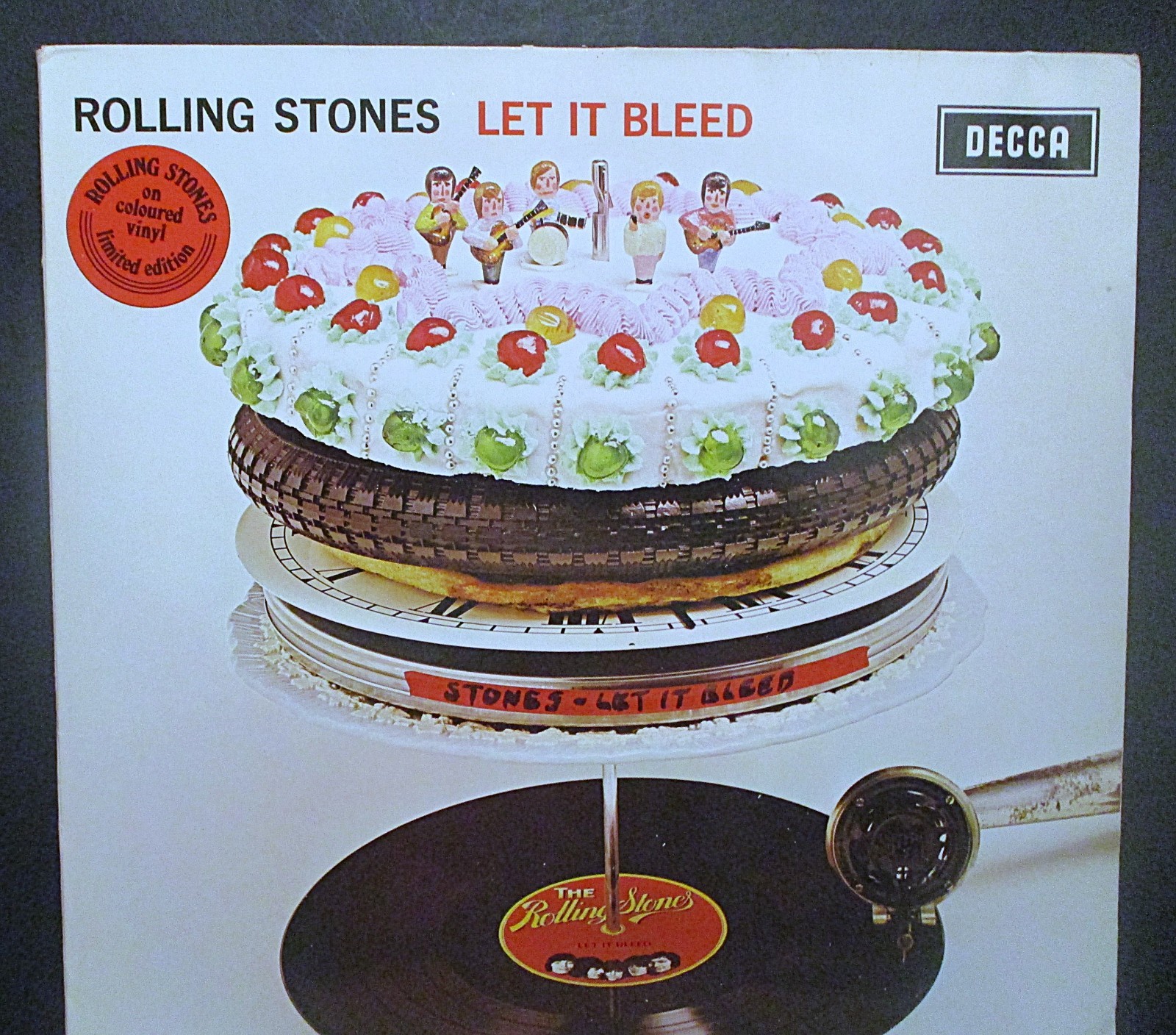
The iconic cover shows a crazy wacky 'cake' with multiple layers made up of a motorcycle tire, a clock-face dial, a metal recording tape canister marked 'Stones - Let it Bleed' and a pizza, all covered in white frosting with pink details, and decorated with candied fruit.
Five cute tiny Rolling Stones figurines top the cake, which is situated on a record player spindle, with a red-labeled copy of 'Rolling Stones -Let it Bleed' being played by a vintage 78-rpm steel-needle tonearm below.
Totally bizarre.
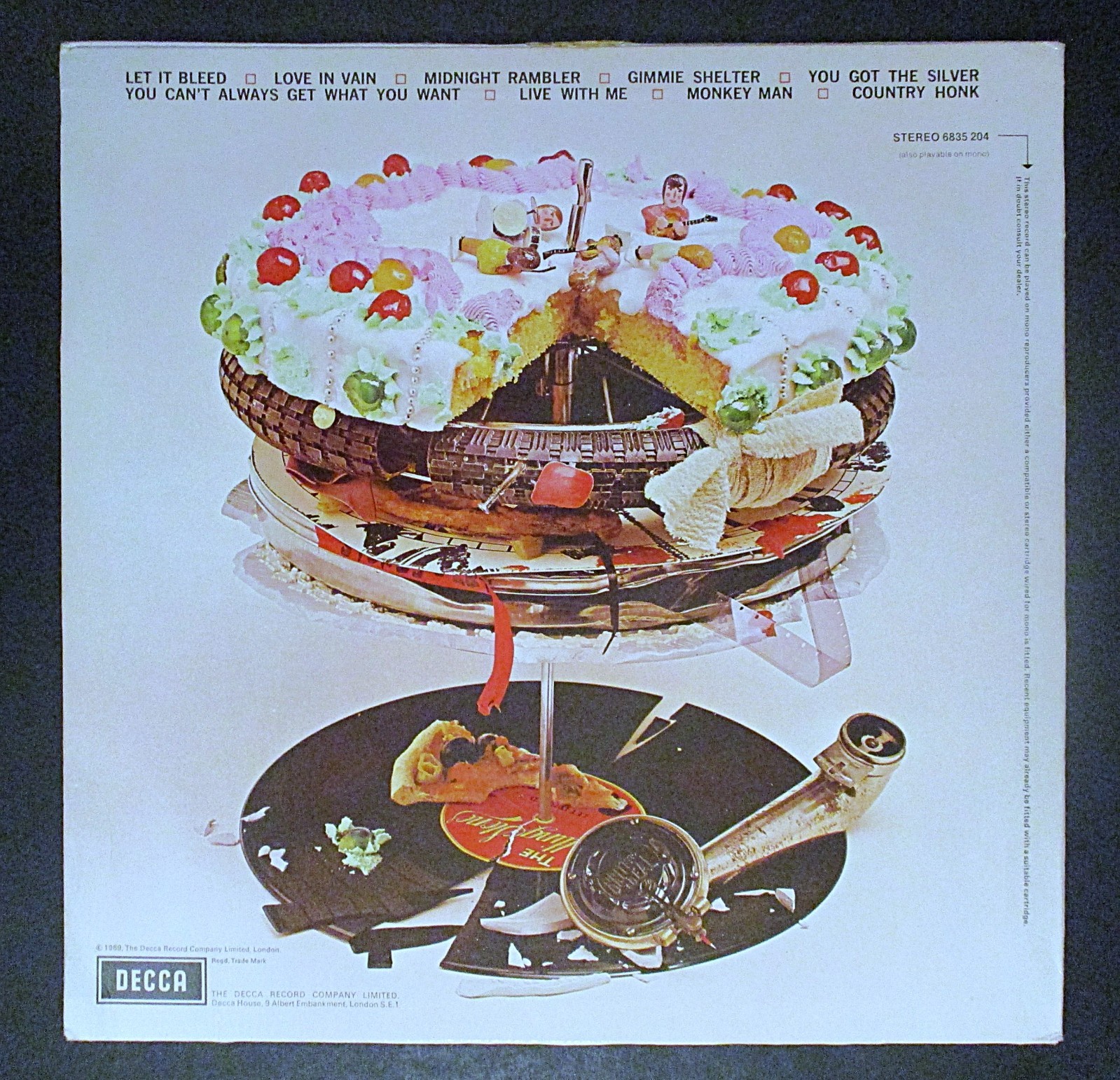
The back cover shows the 'Aftermath': A big piece of cake missing, The deflated tire full of nails and patches, the clock re-numbered and defaced, the recording tape canister open, broken and dented, and the pizza mostly eaten, except for the last slice, sitting on the cracked and shattered record below. The tone-arm has been ripped out of the phonograph and up-ended. The Rolling Stones figurines on the top are all toppled over and passed out, except for Keith, waist deep in frosting, and, as usual, the last man standing.
Totally strange and totally iconic.
Robert Brownjohn also designed the album's inner sleeve, complete with it's pink icing color. The sleeve was blank on one side and inserted into the record so that when you pulled it out, you only saw the blank side at first, like pink frosting in a layer cake. Flipping it over, you saw the text. The credits and production notes are printed in a simple plain font with no real graphics or 'style'. Just the facts. Rock critic Greil Marcus famously said it looked like it was "designed by a government printing office."
Also, the track listing at the top of the back of the album jacket did not follow the one on the album itself. According to Brownjohn, he altered it purely for visual reasons; the correct order was shown on the record's labels.
Additionally, he mistakenly listed 'Gimme Shelter' as 'Gimmie Shelter', which was later corrected.
Original pressings of 'Let it Bleed' also included a large, 4-square Poster, designed by graphic artist Victor Kahn, showing Mick and a great group photo of the new 'changed' band, with Mick Taylor replacing Brian Jones.
That 'automatic change' turned the Rolling Stones into the greatest rock n roll band in the world, a crown they wore for most of the next decade. ~~~~~~~
This 1977 Dutch pressing copies Brownjohn's original UK first pressing jacket design, down to the mis-spelled 'Gimmie Shelter' and the inner sleeve still has the 'Mary' Clayton name and 'Love in Vain' credited to Woody Payne. The only difference is that the inner sleeve does not say 'Printed in USA' or 'Printed in the UK', like American and UK copies. ~~~~~~~~~~~~~~~~~~~~~~~~~~~~~~~~~~~~~~~
THE SONGS ON 'LET IT BLEED'
The songs on this legendary album include:Follow Jimmy Miller's suggestion on the inner sleeve and PLAY LOUD!
Gimme Shelter Love in Vain Country Honk Live with Me Let It Bleed Midnight Rambler You Got the Silver Monkey Man You Can't Always Get What You Want ~~
While 'Let it Bleed' did not contain any #1 singles, many of its songs are among the band's very best. Many became fan favorites, regular staples of the band's live shows for decades, and timeless classics on FM rock radio stations.
'Let It Bleed' is bookended by two great songs that both became musical landmarks of their era; the iconic 'Gimme Shelter' and the beloved 'You Can't Always Get What You Want', both of which frequently appear on lists of the greatest Rolling Stones songs ever.
Personally, it's really hard not to love an album that opens and closes with those classic songs, but it's the non-hit songs in-between that make this album timeless. ~~
GIMME SHELTER
When you drop the needle onto side one, the album hits you like a runaway locomotive, with the best opening track of any Stones album ever, the brooding, ominous 'Gimme Shelter', a fantastic blues rock anthem about the Viet Nam war.
The song starts out quietly, almost imperceptibly, as Keith's ominous, quiet guitar notes call up distinct eerie mental images of a gathering storm.
The music then quickly crashes all around you, like some monstrous tidal wave, as Charlie Watts’ snare hits strike like cracks of rifle fire, and Jagger's vocals lead us into a raging storm of war, rape and murder.
Jagger’s great vocals and Keith's stabbing shimmering guitars create an ominous mood and make 'Gimme Shelter' a brutally effective rocker. The band build on one of the best melodies the Stones ever found, slowly adding instruments and heavier sounds until the song just explodes into howls from Jagger and Merry Clayton.
Keith continues to blaze and riff away in his signature 'Open E' tuning as the violent maelstrom of 'Gimme Shelter' builds and builds.
After repeatedly mentioning the apocalyptic lyrics of war, rape, and murder, and suggesting “It’s just a shot away”, the song shifts from a metaphor of war to a metaphor of trying to find shelter from the threatening storm.
The song then takes a sudden drastic change of tone, as it replaces the dark lyrics with love: “It’s just a shot away" becomes “It’s just a kiss away".
The lyrics are still quite violent, but Jagger presents the listener with a stark choice: we can live in a world where rape, murder and war are just a shot away, or choose a world where love is just a kiss away.
'Gimme Shelter', an iconic, heavy, blues-rock anthem, is one of the strongest Rolling Stones tracks from the 60's, painting a gruesome depiction of the war in Viet Nam. ~~~
'Gimme Shelter' reflects the Stones' new style of using female vocals as part of their sound and sonic palette. The Stones first experimented with female vocals, and a mixed gospel choir, on the previous album’s 'Salt of the Earth' but take it to whole other level on 'Let it Bleed'.
Producer Jimmy Miller’s insistence that 'Gimme Shelter' called for female vocal support resulted in the brilliant decision to bring in Merry Clayton, a gospel-trained singer.
Stones legend tells the tale that she was brought in at the last minute, late in the session, pregnant, and in the middle of the night, to lay down her iconic backing vocals, which, through their amazing power and intensity, became the song's lead co-shared vocals.
Her powerful, scorching, perfect vocals add even more fire and brimstone to the already hellish nightmare and throbbing rhythms that drive the track.
Many fans feel that 'Gimme Shelter' is the very best Rolling Stones composition of all time....that everything is perfect on this masterpiece, and that the Stones have never done anything better.
It's a great album opener, a clear highlight on 'Let it Bleed', and has lost none of its relevance over the years. ~~~~
LOVE IN VAIN
After that classic opening song, 'Let it Bleed' then opens up and reveals it's true, enigmatic power and charms.
The Stones cushion the fury of 'Gimme Shelter' with the subdued 'Love in Vain'; an acoustic, down-home country blues, written by the master, Robert Johnson, who was revered by Keith.
The lyrics, sung perfectly by Jagger, tell of leaving a lover at the train station, and as the train departs, all that are left behind are two lights on the train's last car; a blue light representing the lover, and a red light representing the singer’s mind. In the end, both of these lights, and his lover, fade from his sight and life.
Keith heard this classic song on an obscure bøøtleg compilation back at the time, before it was officially released, loved it, but didn't realize who actually wrote it.
Early pressings of 'Let it Bleed', as well as this 1977 Dutch pressing, wrongly credit the song to Woody Payne, the name on the bøøtleg, and a pseudonym used by the music publisher of Robert Johnson's songs.
It’s an example of Mick and Keith's love and respect for Robert Johnson. A great song, wonderfully performed, and as authentically close to the roots of the blues as the Stones ever got.
A beautiful, mournful and serene ballad, hidden between the much heavier tracks on 'Let it Bleed'. The only cover tune on this great album, and the Stones really give it justice.
The arrangement is simple and supportive of the lyrics. Some amazing acoustic guitar licks and melody by Keith, a simple Bass and snare drum background, a few jabs of electric guitar, and some fantastic mandolin by Californian guitar virtuoso Ry Cooder.
"During the sessions, Jack Nitzsche dropped by and brought Ry Cooder along with him. We said, 'Do you want to come along and play'? The first thing Mick wanted was to re-cut 'Sister Morphine'... which is what we got together....He played beautifully, man." - Keith Richards, 1971
Ry Cooder also introduced Keith to several new guitar techniques, including 'open G' tuning, crucial to so many signature 'Keef' guitar riffs like “Honky Tonk Women”, “Brown Sugar”, “Start Me Up”, and so many others. ~~
COUNTRY HONK
The country blues vein on 'Love in Vain' segues nicely into 'Country Honk', which recasts 'Honky Tonk Women' as a country cousin of the band's recent smash-hit.
Keith has said in interviews that the sound and style of 'Country Honk' is truer to how the song 'Honky Tonk Women' was actually first written.
The song sounds spontaneous and live. It starts out with Mick Jagger's brief spoken intro over Keith's acoustic strumming. You then hear two car horn 'honks' as Byron Berline’s fiddle kicks in.
'Country Honk' has the same lyrics and melody as 'Honky Tonk Women' in places, just more of a loose, good timey, country hillbilly feel as it skips along, and some great, slurred, ragged harmonies. The song ends just like it started, with 2 car horn honks.
The most country-sounding piece on the album, the lyrics speak of an obsessive love for a divorced “honky tonk woman” and the song creates a vivid image in your mind of the Stones just drinking the night away while loosely jamming in some run-down Jackson Mississippi dive bar.
Keith's acoustic guitar drives the melody along over Mick Jagger's southern drawl, Charlie's snare drums, and some other slaps, hollers and percussion in the background. Mick Taylor adds some smooth slide guitar, one of his first appearances on a Stones record.
Mick Taylor also played some excellent slide and electric guitar on the non-album single 'Honky Tonk Women', released a few months earlier.
This track provides a nice contrast to the songs that follow it on the rest of this album. From this point on, 'Let it Bleed' gets much heavier and darker.
The loose, carefree fun of 'Country Honk' ends as the album transitions into the heavy, intense, 'Live with Me'.
LIVE WITH ME
'Live With Me', an upbeat, sexy, carnal, R&B romp, begins with a fantastic, funky, soulful, solo bass line, oddly played by Keith, not Bill, who is not on this track.
Keith then plays sharp, stabbing electric guitar riffs over Charlie's hard driving rhythm, Leon Russell’s loud, pulsating, barrelhouse piano, and Mick Jagger's powerful lyrics. Jagger's vocals are at their very finest -- raw, bluesy, and totally in command.
Mick Taylor, in his Rolling Stones vinyl debut, lays down some slinky, overdubbed, slide guitar fills, perfectly complementing Keith's jabbing chords. Taylor's terrific, unique 'sound' is already clear and obvious.
Tenor sax player, Bobby Keys, also in his Rolling Stones vinyl debut, lays down some soulful R&B sax lines and a terrific solo. His gritty, thick tenor sax works so well on this song, laying down some soulful powerful horns, just like he will on the next album's 'Brown Sugar' and other classics.
The song's bold lyrics are an invitation to a woman, the French maid, from a man who is totally explicit and upfront about his 'nasty habits' and his urge to get her "in-between the sheets".
The end of the song has Charlie banging out the song's rocking groove simultaneously on snare and crashing cymbals, and Bobby Keys blowing out the tune's melody on his sax, as the song fades.
A fantastic upbeat, powerful song about Sex, Drugs and Rock'n'Roll that sounds so typical 'Stones', and hints at the type of music like 'Brown Sugar' and 'Bitch' that would be found on their next album 'Sticky Fingers'.
LET IT BLEED
Side One of 'Let it Bleed' finishes out with the druggy party ambience of the album's title track, 'Let it Bleed'.
This fun, boozy tune is a celebration of companionship, sex, drugs and rock ’n’ roll. The song is about being mutually supportive for one another, even if you're involved in socially questionable activity. The lyrics of the song include multiple sexually suggestive lines and clear drug references.
Jagger's vocal delivery is outstanding; light, campy, and playful as he sings the explicit, honest, over the top lyrics:
"She said, "My breasts, they will always be open Baby, you can rest your weary head right on me And there will always be a space in my parking lot When you need a little coke and sympathy"
The music and pace of the song is softer, with a slow guitar melody, wonderful blues rock piano by Ian Stewart, and a soft drum sound. Keith's electric guitar does come in with a few riffs throughout the song.
A terrific song that has a great groove and is now recognized as a Stones classic.
MIDNIGHT RAMBLER
Side two of 'Let it Bleed' opens with the harmonica-driven, 'Midnight Rambler'.
This song has a much more catchy rock rhythm and a terrific bluesy vamp, what we would expect from the Stones, but 'Midnight Rambler' is also about as dark and creepy as the Stones' music ever got.
The song's darkness descends as Mick Jagger first warns of, and then becomes, a murderous serial killer.
The lyrics are pretty dark; full of sex, violence and terror. Jagger's deep, dramatic vocals and singing style portray him as a dark, mysterious, and terrifying villain, stalking his victims.
In-between singing the verses, Mick plays some excellent, wild and ferocious harmonica as the band builds the pace, and increases the intensity, of the music behind him.
A fantastic, deep, dark, powerful song. This is the Rolling Stones music that your parents worried about you listening to back then.
This classic song would be extended, expanded, and take on a life of it's own when performed live in concert. There's an excellent, scorching live version from the 1969 tour captured on 'Get Yer Ya-Ya’s Out'. ~~~~
YOU GOT THE SILVER
After the heavy 'Midnight Rambler', the album's pace again slows down for 'You Got the Silver', a gentle, country rock ballad that wouldn’t have sounded out of place on a late 60's Bob Dylan record.
A 'happy accident' with this track led to Keith having his first solo lead vocal on a Rolling Stones album.
'Let it Bleed's producer Jimmy Miller wanted to put 'reverse echo' on Keith's lead guitar part at the beginning of the song, an effect that required turning the tape upside down to be run backwards thru the recording console to add the 'inverted' echo.
By doing so, recording engineer Glyn Johns accidently erased Mick Jagger’s original vocal track on the tape. Johns thought that Mick could just simply record another lead vocal, but by this time, late in the recording process, Jagger was a hemisphere away, filming 'Ned Kelly' in Australia.
Keith had to step up and record the new lead vocal, his first solo lead vocal on a Rolling Stones recording.
Keith had previously sung harmony and background vocals with Mick on 'Connection' and shared alternating lead vocals with Jagger on parts of 'Salt of the Earth' and 'Something Happened to Me Yesterday', but had never sung a Stones song alone.
Keith does a decent, respectable job with his first solo lead vocal. Many fans feel it's his best lead vocal of any Stones tune he ever sang.
He starts the song off singing softly, but quickly builds confidence, and belts out the last two verses. The song has a lovely soft melody and Keith's sweet, tender, warm and vulnerable vocals sound great, blending nicely with the acoustic-dominated mix.
The music has a layered arrangement decorated with Keith's open “E” tuned guitar, Nicky Hopkins' celestial organ, drums, piano and Brian Jones’ final contribution as a Rolling Stone on autoharp. ~~~~
MONKEY MAN
'Monkey Man', a powerful rocker about co-dependence and drug addiction starts off with a powerful, startling piano solo, sharp guitar riffs, and a moody slinky vibe that quickly expands into to a terrific, solid, jamming rocker with heavy drums and electric guitar. This song has a full powerful sound and is a real rocker.
"Monkey Man" contains some outstanding keyboard work by Nicky Hopkins and some beautiful-sounding vibes, played by Bill Wyman. Even Jimmy Miller joins in, keeping rhythm on tambourine. Monkey Man rocks.
The strange lyrics are ramblings about being “just a monkey man.” 'Monkey' was a 60's slang word for addiction, especially Heroin addiction, and Jagger's lyrics confirm the image they’ve carried for almost the whole of the decade: “All my friends are junkies! (That’s not really true…).”
His “I hope we’re not too Messianic or a trifle too satanic…’ line suggests that Jagger realized that the Stones were possibly pushing the boundaries a little too far on 'Let it Bleed', but he seems to blame it all on just being a 'monkey man' with primal urges of sex, drugs and rock ’n’ roll.
It's a terrific, powerful track that creates a nice balance between Keith's softer song that precedes it, and the majestic album closer that follows it. ~~~~
YOU CANT ALWAYS GET WHAT YOU WANT
The selection for songs to include on Rolling Stones albums were always a constant battle between discipline and overindulgence. 'Let It Bleed' provides excellent examples of both tendencies: 'Love in Vain' is an example of the band's simple, pure discipline and love of the blues, while 'You Can’t Always Get What You Want' is an example of their shameless over-the-top overindulgence.
Early sessions for 'Let it Bleed' in November 1968, before 'Beggars Banquet' was even released, resulted in 'Let it Bleed''s first completed song, and the most majestic moment on the album, 'You Can’t Always Get What You Want'. It was first released as the edited B-Side to the 'Honky Tonk Women' single in July 1969.
It's a master class in crisp, wide, deep, cinematic record production.
The song begins with the London Bach Choir setting the scene with a beautiful sound and rich harmonies that suggest a cathedral more than the song’s actual mean London backstreets.
Quiet acoustic guitar and a delicate French horn lead us to Jagger’s opening vocals: "I saw her today at the reception, a glass of wine in her hand".
The arrangement swells in scale and momentum, and the lyrics are phenomenal, including some of the darkest lines, yet also some of the most inspiring lines, on the entire album.
“You Can’t Always Get What You Want” starts out sounding quintessentially British, with the London Bach Choir, but after Mick sings “But if you try some time, you just might find/You’ll get what you need', the track opens up and takes flight, exploding into a rocking, gospel-infused classic lifted by Al Kooper’s organ and piano lines and Jimmy Miller’s swinging, syncopated drumming.
It's a really long song, shamelessly overindulgent, with excessive pomposity and over-the-top layering of vocals and instrumentation, but it's majestic greatness is simply unmatched in the Rolling Stones catalog when it comes to sheer grandeur and power.
The song defined its era and has become an enduring classic.
Drummer Charlie Watts struggled to find just the right groove and rhythm for the song, so producer Jimmy Miller filled in for him on drums instead.
That delicate opening French horn solo is played by Al Kooper, who didn’t really know how to play the instrument. In his book, Kooper claims that it required approximately 100 takes to practice it and get it right.
This beloved, albeit dark song has a fantastic chorus, great rhythm, philosophical lyrics, fantastic melody, and soaring, crescendo-like ending that brings this terrific album to a perfect close.
The song works perfectly as the closing track and as an answer to the violence and menace of “Gimme Shelter” and “Midnight Rambler". ~~~~~~~~~~~~~~~~~~~~~~~~~~
THE SONGS LEFT OFF OF 'LET IT BLEED'
'Let it Bleed' contains some of the Rolling Stones' best songs and is so solid that it can easily be a stand alone ‘best of’ album, but looking back, it could have been an even stronger album.
In the late 60's, it was common in England for bands to release their best songs as stand-alone singles. Those songs would then typically not be included on the band's current LP release.
The Rolling Stones, The Beatles, and other bands did this regularly.
'Jumpin' Jack Flash', one of the Rolling Stones most iconic hits, was released in May 1968, during the 'Let it Bleed' sessions, as an independent, non-album single, backed with the fantastic B-side 'Child of the Moon'.
The song was seen as the band's return to their rocking blues roots and called "supernatural Delta blues by way of Swinging London" by Rolling Stone magazine.
'Honky Tonk Women' is also one of the Rolling Stones' top five classics from the 1960s. Recorded during the 'Let it Bleed' sessions, the song contained great guitar work from new band member Mick Taylor and was also released as an independent, non-album single on July 4th 1969.
Both of these are classic Rolling Stones songs, and neither was included on 'Let it Bleed', or any other regular Stones studio album, only showing up on later compilations.
The 'Let it Bleed' sessions also produced the classic, iconic, 'Sister Morphine', recorded at Olympic Studios in March 1969. It was later dusted off and used for 1971's great 'Sticky Fingers'.
'Let it Bleed' was, and still is, a fantastic album, but imagine how much better it would have been with 'Honky Tonk Women'. 'Jumpin' Jack Flash', and 'Sister Morphine' added onto it, replacing the odd 'Country Honk'.
The 'Let it Bleed' sessions resulted in several other great songs such as 'Jiving Sister Fanny', 'Downtown Suzie', 'Loving Cup', 'I Don't Know Why', and several other terrific instrumental songs that are easily found on Rolling Stones 'collector' records like the great 'Trident Mixes'.
They also recorded an early version of 'Shine a Light', entitled 'Get a Line on You' which is not on 'Let it Bleed' but shows up later on 'Exile'.
Also, most Stones collectors don't realize that the fantastic 'Jamming with Edward' album is essentially a 'Let it Bleed' recording session.
During one session at Olympic Sound Studios on April 23rd, 1969, Keith didn't show up, so Mick Jagger, Charlie Watts, Bill Wyman, Brian Jones, Nicky Hopkins and Ry Cooder record a prolonged jam session instead, which was released as 'Jamming with Edward'.
Nicky Hopkins has said that the album's title came from some banter between him and Brian Jones. Brian was fooling around on bass for some reason and I was at the other end of the studio playing piano. He called over, "Give me an E, Nicky", but Hopkins couldn't hear him so he shouted, "Give me an E for Edward". It all developed out of that.
Nicky Hopkins drew the iconic front cover to look like a page from a Beano comic. A terrific album that is closely related to 'Let it Bleed'.
There were many great Rolling Stones songs that came out of the 'Let it Bleed' sessions, many more than appear on that iconic album. ~~~~~~~~~~~~~~~~~~~~~~~~~~~~~~~~~~
THE MUSICIANS ON 'LET IT BLEED'
This album was the last time the original core members of the band would appear together on a Rolling Stones album.
The overall musicianship on this album is outstanding and many excellent musical contributions are made by long-time Stones collaborators and other friends of the band.
By 1969 Jagger’s trademark mix of swagger and abandon had already made him rock's definitive frontman, but on this album, his songwriting, lyrics and vocal performances reach incredible new heights. Mick Jagger's voice is amazing; powerful, emotional, and all about feeling, and style. It’s not just what he’s singing, but how he’s singing it.
Gifted musician and studio session player Ry Cooder adds his beautiful slide guitar and mandolin to 'Love in Vain'.
This album was also the debut of both Bobby Keys and Mick Taylor, who would strongly shape and flavor the Stones' music going forward.
The musicians on this album include:
MICK JAGGER: Vocals and Harmonica KEITH RICHARDS: Electric, Acoustic & Slide Guitars, Vocals, Bass on 'Live With Me' BRIAN JONES: Autoharp & Congas CHARLIE WATTS: Drums (Except on 'You Can't Always Get...') BILL WYMAN: Bass, Autoharp, Vibraphone MICK TAYLOR: Slide and Electric Guitar IAN STEWART: Piano NICKY HOPKINS: Piano and Organ BOBBY KEYS: Tenor Saxophone RY COODER: Guitar & Mandolin BYRON BERLINE: Fiddle LEON RUSSELL: Piano & Horn arrangements on 'Live With Me' MERRY CLAYTON: Lead and backing vocals on 'Gimme Shelter' DORIS TROY, MADELINE BELL & NANETTE WORKMAN: Backing vocals JIMMY MILLER: Percussion, Tambourine, Maracas, Drums on 'You Can't Always Get...) AL KOOPER: Piano, Organ, French Horn on 'You Can't Always Get...' JACK NITZSCHE: Choral arrangements on 'You Can't Always Get...' ROCKY DIJON: Percussion on 'You Can't Always Get...' THE LONNDON PHILHARMONIC BACH CHOIR: Vocals on 'You Can't Always Get...' ~~~~~~~~~~~~~~~~~~~~~~~~~~~~~~~~~~~~
'Let it Bleed' is many people's favorite 60's Rolling Stones album and it's long been considered one of their masterpieces. When people talk about the signature Stones “Sound” of the late 60's, this is the album and the time period they are referring to.
Los Angeles Times, music critic Robert Hilburn said that 'Let it Bleed' was “one of the best rock albums we’ll hear this year”.
NME wrote that it "captures the Stones bluesy swagger" in a "dark-land where few dare to tread." 'Let it Bleed' consistently ranks high on Rolling Stone magazine's "The 500 Greatest Albums of All Time" ~~~~~~~~~~~~~~~
'Let it Bleed' is a terrific record. The Stones at their peak; great music, great musicianship, fantastic songs, and an iconic album cover.
While no singular Rolling Stones album can encapsulate their long, diverse and multifaceted career, 'Let it Bleed' is a great place to start.
It's one of their best, well balanced, and all-encompassing records and a remarkably pure distillation of their musical genius.
Overall, a great vintage Rolling Stones record and one that belongs in your collection. ~~~~~~~~~~~~~~~~~~~~~~~
CONDITION: I tried to show good hi-resolution photos of the jacket, labels, inner sleeve, and vinyl in my pictures.
This is my original Dutch, red vinyl copy of 'Let it Bleed' that I purchased nearly 50 years ago, back when it was a 'new' release.
It was purchased in the record shops of Greenwich Village, which were my regular vinyl digging grounds in those early New York years of collecting.
I've taken great care of it since. This record has been sleeved and stored properly for decades, and is still 'complete' and in quite nice condition.
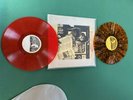
VINYL: The vinyl is still fantastic. An iconic blood red color, so fitting to 'Let it Bleed'. Clean and bright, with a nice glossy sheen. No obvious flaws, scratches, dings or damage.
The deep red vinyl makes it hard to see details, but I can only see one very light superficial hairline, over 'Live with Me', otherwise it still looks terrific, and I'm sure you'll be happy with it.
This record is beautifully pressed on thick, heavy, high quality vinyl and has fantastic sound to match. I'll call the vinyl a very conservative VG+, to keep everyone happy, but you can see from my photos how terrific it still looks.
LABELS. This pressing has dark blue, early UK style, unboxed London labels.
The label has the overlapping circles ('Stereo') and "Made in Holland" on the right side, and the boxed 'Sterma' Rights Society logo on the left.
The labels are clean and bright; no dings, scuffs, writing or damage, and the spindle holes are clean and sharp, suggesting infrequent playing and my careful handling over the years.
I haven't messed with this disc or cleaned it, other than my trusty 'DiscWasher' brush, in almost 50 years, so it has a few dust specks, and would likely benefit from a good deep cleaning to make it even better looking and better sounding than it already is. I'll leave that up to the winning bidder.
JACKET: As you can see from my pictures, this still looks very nice for a nearly 50 year old import copy. I purchased this record new back in early 1978.
It has some very mild corner bumping and corner creasing from being stored, moved, and shifted around in my collection over the years, but still looks great. Note that there is a 'scuff' in the center of the top edge, only noticeable from the back. I showed a detail in my pictures. Not a big deal, but should be noted. As they say, you don't play the jacket, it's all about the fantastic music inside.
That being said, as you can see from my pictures, it still looks quite decent and very acceptable. I tried to show many details in my photos.
No names, marks or writing. The spine is straight, and the great cover art is clear, bold and sharp.
This Dutch pressing has the record company listed as:
"© 1969, The Decca Record Company Limited, London." "The Decca Record Company Limited ~ Decca house, 9 Albert Embankment, London S.E.1"
"This stereo record can also be played on mono reproducers provided either a compatible or stereo cartridge wired for mono is fitted. Recent equipment may already be fitted with a suitable cartridge. If in doubt consult your dealer."
The round red circle at the top left of the front jacket is actually printed on the jacket, not a hype-sticker.
The whole album, except for the red circle, resembles a UK first pressing copy, right down to the thinner European style of cardboard jacket and the 'errors' on the inner sleeve. ~~~
This album comes with it's original cool fold-out Poster and the original pink inner sleeve listing all the production credits and musicians, plus producer Jimmy Miller's iconic bold "This Record Should be Played Loud" statement and his "Hard Knox and Dirty Sox" comment.
This copy also has a 'spare' "211 Reasons" fold-out insert added. I believe this insert started showing up inside 1971's 'Hot Rocks' and other very early 70's Stones repressings for a short while.
This insert was stuck in by ex-manager Alan Klein to help sell records that he still 'owned', when the Stones dumped him to form their own label in 1971. Although it didn't come with original copies of 'Let it Bleed', I stuck an extra copy inside this record decades ago, so I'll include it. A cool, and somewhat rare, little 'extra'. ~~
These original 1977 Dutch red vinyl pressings are getting very difficult to find and you just don't see them turn up for sale that often, especially in great condition. Since this fantastic Stones album got played, and played hard, usually not under optimal conditions, and on 'average' equipment, even if you find a copy, it's usually trashed.
This copy of 'Let it Bleed' is a beautiful, relatively clean, original 1977 red vinyl, limited edition, Dutch pressing, with a clean, un-hung Poster and an original clean pink inner sleeve. An amazing rare survivor and a real gem. In my opinion, and in my experience, it's about as good of a 'used' copy of this classic album as you're ever likely to find these days.
I've owned this record since 1978, and it has been sleeved, inside and out, stored properly, and kept in great condition for nearly 50 years now.
Very nice, all original, and a real gem. I'm sure you'll be very happy to add it to your collection. It would make a great addition to any Classic Rock or Stones vinyl record collection. ~~~~~~~~~~~~~~~~~~~ Follow Jimmy Miller's suggestion on the inner sleeve and PLAY LOUD! ** NOTE: I'm selling this rare 'Collector' record "AS IS" and "NO RETURN". It's rare, still quite nice and as described, and I'm sure you'll be very happy with it. A great, rare, original, excellent sounding copy. ~~~~~~~~~~~~~~~
I’m recently retired and downsizing and letting go some gems and rarities from nearly 50 years of vinyl record collecting.
Over the next few months I'll be offering an assortment of these rare and collectable LP’s. Many of these records have been in my personal collection for decades. Some of them are quite rare and seldom come up for sale.
Keep an eye on my Ebay page, 'jjrbyrne' for more of these great rare collectible albums, EPs and 45 singles.
All records have been carefully evaluated and graded by me. I visually inspect all records under bright light, personally gently clean them with a soft cloth and then, if unsure, play them on a modern high-end turntable and system to get a true picture of condition.
Please look at all the high-resolution pictures I added. They are all my own and are of the actual record being sold. The pictures are part of the description and can show small details, label variations, and condition better than I can put into words.
My grading is fair and honest. I have had over 3,600 happy and satisfied EBay customers over the years, with 100% positive feedback, and I have been buying/selling on EBay for nearly 30 years, so please bid with confidence!
I'm a One-man operation, this is a hobby, not my job. I do this for fun. I do this because I love music, love collecting vinyl and want others to share in that same experience. I take my time listening, researching, grading, listing and packaging. I will NOT sell any record that I personally would not want in my collection.
As you well know, packing and shipping rare records requires special care and attention, therefore, shipping cost within the lower 48 states is $5.00 on this item. If you would like insurance, or anything faster than Media/Economy Mail, please let me know and I can arrange it for you. I’ll work with you to make sure you’re happy!
I will gladly combine multiple records, or other items on my page, and make the shipping much less for you. I don’t inflate the shipping costs; they are what they are. I strive to keep them as low as possible. See my feedback for comments on my quality packing and shipping.
All items are packaged with sturdy cardboard mailers and appropriate padding. I take pride in my packaging and shipping and package all my records as if I were sending them to myself. I treat the records you win as if they were my own, and mail them the same way.
All orders are processed and shipped within 2 business days of receipt. We package and ship our vinyl records with the greatest care, using proper packaging to ensure that your rare and collectible vinyl records arrive in pristine condition.
Payments can be made by any of the multiple options that Ebay offers.
I will be happy to exchange feedback with anyone I complete a transaction with.
THANK YOU for looking and reading if you got this far. I know I rambled on a bit, but can't help it. I have a passion for records, especially the Rolling Stones. I hope this listing was entertaining and informative. -- JOHN
price rating




![LIFELOVER - Konkurs [2-LP - BLUE] (DLP)](https://www.popsike.com/php/thumbnail.php?url=https://www.popsike.pics/pix/20150804/351472338514.jpg)